

What if your conservatory was no longer a seasonal luxury defined by the whims of unpredictable weather, but a permanent, thermal masterpiece that anchored your home’s comfort throughout the year? For many homeowners, the dream of a light-filled retreat often fades when faced with the harsh reality of bitter winters and stifling summer glare, leaving a beautiful space feeling like an expensive afterthought. You likely recognise the frustration of watching heat escape through a dated roof whilst energy bills continue to climb, yet the path to improving conservatory energy efficiency often feels clouded by technical jargon and quick-fix promises that fail to address the soul of the building.
At Madison May Consulting Ltd, we believe that your home is a deeply personal sanctuary, and any enhancement should reflect that same sense of quiet elegance and meticulous craftsmanship. This guide promises to show you how a professional, whole-house retrofit approach can transform your glasshouse into a year-round sanctuary of thermal poise. We’ll explore the intersection of high-performance materials and heritage aesthetics, providing a clear roadmap from professional building assessments to a beautifully integrated, energy-efficient living space that truly belongs to your home’s unique story.
Key Takeaways
- Reclaim your living space by understanding how traditional polycarbonate and thin-plate glass contribute to thermal disharmony and seasonal discomfort.
- Compare sophisticated solutions for improving conservatory energy efficiency in Halifax, including the distinct benefits of solar control glass and lightweight tiled systems.
- Discover the importance of a ‘whole-house’ approach, ensuring that increased insulation is perfectly balanced with professional ventilation assessments to protect your home’s fabric.
- Learn how to interpret U-values and EPC ratings to measure the true thermal performance and long-term value of your conservatory’s transformation.
- Understand the role of expert coordination in navigating the complexities of building regulations and crafting a sanctuary that complements your home’s heritage.
The Evolution of the Conservatory: Reclaiming Your Year-Round Sanctuary
The historical narrative of The Evolution of the Conservatory reveals a transition from grand botanical houses to the domestic extensions we recognise today. Whilst these structures were originally designed to nurture exotic flora, their modern role as a bridge between the home and the garden often falls short of the comfort we expect from our living spaces. When considering improving conservatory energy efficiency Halifax residents frequently encounter the same dilemma: a room that is either a sun-drenched kiln in August or a glacial vault in January. This thermal instability does more than just inflate energy bills; it disrupts the rhythmic flow of your home, rendering a significant portion of your property unusable for half the year.
Shifting your perspective from a simple repair to a transformative artistic journey allows you to reclaim this wasted square footage. It isn’t merely about fixing a draught; it’s about curating a serene, temperate refuge where you can watch the Pennine mist roll in without feeling the chill. By addressing the fundamental fabric of the building, you transform a fragile glass box into a permanent sanctuary of thermal elegance.
Understanding the Thermal Behaviour of Glass Extensions
Traditional polycarbonate and thin-plate glass are notoriously poor insulators. During the summer, solar gain creates a relentless greenhouse effect, whilst in winter, the lack of a thermal barrier allows heat to radiate directly through the roof. Beyond temperature, the acoustic profile of these materials is often jarring. The percussive drumming of West Yorkshire rain on a hollow polycarbonate sheet can shatter the quietude of a Sunday morning; this makes the room feel more like a temporary shelter than a refined living space. A professional retrofit addresses these sensory disruptions, returning a sense of calm to the environment.
The Cost of Inefficiency: Energy Bills and Carbon Footprints
The financial implications of an inefficient conservatory are often hidden within your monthly energy statements. An uninsulated glazed space acts as a heat sink, requiring your boiler to work significantly harder to maintain a baseline of comfort. This inefficiency directly impacts your property’s Energy Performance Certificate (EPC) rating, which is becoming an increasingly vital metric for discerning buyers and homeowners alike. By improving conservatory energy efficiency Halifax homeowners can lower their carbon footprint and ensure their property reflects a commitment to modern sustainability and long-term value. Investing in the thermal integrity of this space is an investment in the overall health and heritage of your home.
Comparing Modern Solutions for Improving Conservatory Energy Efficiency
Selecting the right materials for improving conservatory energy efficiency in Halifax means balancing the desire for panoramic views with the absolute necessity of thermal control. It’s a delicate equilibrium. Every home in West Yorkshire tells a different story, whether it’s a Victorian terrace or a more contemporary dwelling, and the solution must resonate with that unique architectural heritage. Industry guidance, such as the standards explored in Comparing Modern Solutions for Improving Conservatory Energy Efficiency, highlights that the path to a year-round sanctuary lies in selecting components that treat the conservatory as a permanent part of the home’s thermal envelope.
High-Performance Glazing: The Art of Light and Warmth
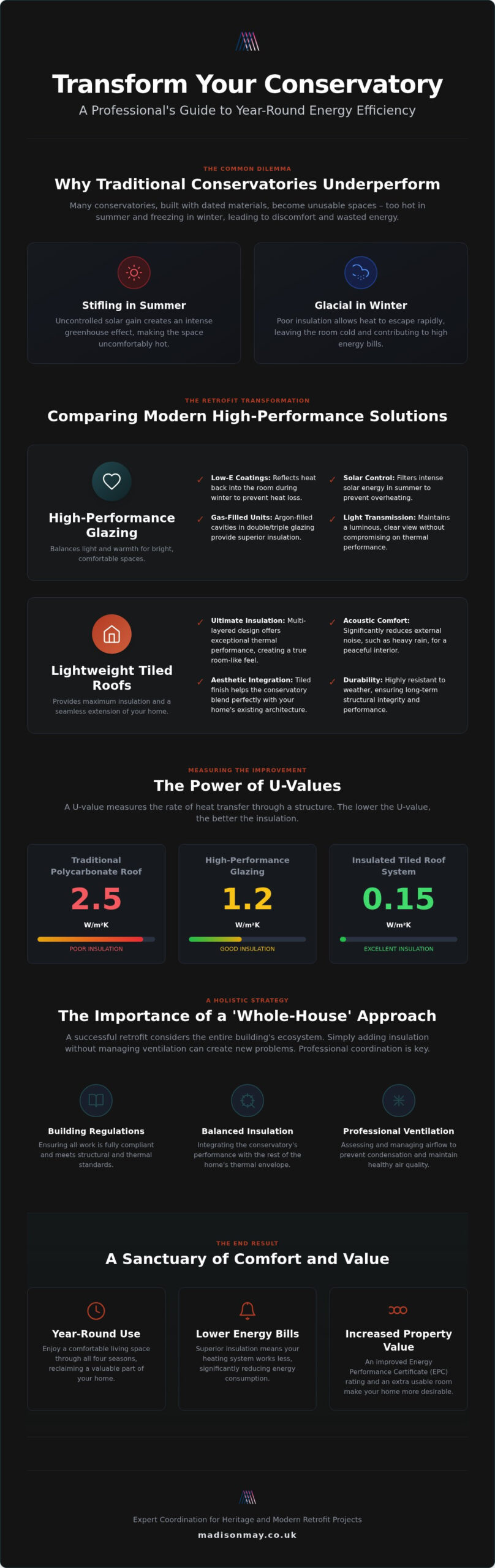
Low-emissivity (Low-E) coatings have revolutionised how we think about glass. These microscopic, transparent layers are designed to reflect radiant heat back into the room during the winter whilst filtering out the intense solar energy that leads to overheating in the summer. When paired with argon-filled cavities in double or triple glazed units, the thermal performance is significantly enhanced. It’s vital to consider the G-value, which measures solar heat gain, alongside the U-value. Achieving a window U-value of 1.6 W/m²K or lower ensures your space retains its luminous clarity without sacrificing its thermal poise. This technical precision allows you to enjoy the changing seasons from a position of total comfort.
Solid and Tiled Roofs: The Ultimate Thermal Barrier
Hybrid solutions also offer a sophisticated middle ground, blending solid insulated panels with high-performance glazing to create a bespoke environment. This allows for targeted temperature management in specific areas of the room. Exploring these refined options with a professional retrofit assessment ensures that your chosen materials align perfectly with your property’s needs, transforming a seasonal room into a permanent sanctuary of elegance and efficiency.
The Whole-House Approach: Why Professional Retrofit Strategy Matters
When embarking on the journey of improving conservatory energy efficiency Halifax homeowners often view the project through a narrow lens, focusing solely on the roof as an isolated component. However, a conservatory is not an island; it is a vital part of your home’s broader thermal ecosystem. Approaching an upgrade as a standalone product installation rather than a strategic retrofit can inadvertently disrupt the delicate balance of your property. A meticulous, whole-house strategy ensures that any thermal enhancement in one area doesn’t create unforeseen complications elsewhere, such as thermal bridging or moisture imbalances in the connecting rooms.
By treating the conservatory as an integral element of the building fabric, we can ensure that the transition between your main living areas and your glazed sanctuary is seamless. This professional coordination prevents common pitfalls where a newly insulated space causes the rest of the house to feel cooler by comparison, or where the lack of a holistic view leads to technical failures. It’s about crafting a sanctuary that works in perfect harmony with the heritage and performance of your entire home.
Avoiding the Ventilation Gap
As we enhance the insulation and airtightness of a conservatory to retain warmth, we must also be mindful of how the building breathes. Sealing a room too tightly without a dedicated ventilation strategy is a recipe for damp and mould. When warm, moist air from the home meets a surface that hasn’t been correctly treated, it can lead to interstitial condensation, a hidden issue that occurs within the layers of the building fabric itself. Adhering to the official UK Building Regulations regarding both heat loss and air quality is essential. Integrating sophisticated trickle vents or subtle mechanical ventilation ensures a healthy indoor climate, protecting both the structural integrity of your home and the well-being of those within it.
PAS 2035: The Gold Standard for Home Energy Upgrades
For the discerning homeowner, aligning a conservatory upgrade with PAS 2035 standards provides an unparalleled level of security. This professional framework is designed to oversee the quality of domestic retrofits, ensuring that every measure is appropriate for the specific building. A qualified Retrofit Coordinator acts as your sophisticated guide, managing the technical complexities and ensuring that all works are compliant and effective. This meticulous oversight protects your investment, moving beyond simple home improvement into a realm of verified performance and enduring quality. It’s a commitment to excellence that ensures your improving conservatory energy efficiency Halifax project delivers the serene, high-performance environment you deserve.
Measuring Performance: U-Values, EPC Ratings, and ROI
Quantifying the impact of improving conservatory energy efficiency Halifax requires a shift from purely aesthetic appreciation to a more analytical understanding of thermal performance. Whilst the visual transformation of a space is immediate, its true value lies in the data that governs its comfort and longevity. By demystifying the technical metrics, we can appreciate how meticulous design choices translate into tangible benefits for both your lifestyle and your property’s standing. An energy-efficient conservatory is no longer a seasonal luxury; it’s a high-performing asset that contributes to the overall thermal harmony of your home.
The financial logic of a professional retrofit extends beyond immediate comfort. By balancing the initial investment against long-term energy savings, homeowners can justify the transition from a glasshouse to a true year-round living area. This permanent addition of usable square footage often yields a significant return on investment, particularly as energy prices and sustainability standards continue to evolve. It’s about creating a space that is as light on your conscience as it is on your heating bills.
U-Value Comparisons by Material
The U-value is the definitive measure of heat transfer; quite simply, the lower the number, the more effectively your sanctuary retains its warmth. Traditional polycarbonate roofs, often found in older Halifax extensions, possess a U-value of approximately 2.4 W/m²K, which explains why they feel so susceptible to the external elements. In contrast, a modern lightweight tiled roof achieves a vastly superior rating of between 0.15 and 0.18 W/m²K. To comply with current Building Regulations, a replacement solid conservatory roof must achieve a limiting U-value of 0.15 W/m²K. This leap in performance is mirrored in glazing, where high-specification solar control glass significantly outperforms standard double glazing by managing both heat loss and solar gain with effortless poise.
The EPC Improvement Roadmap
For the discerning homeowner or landlord, a conservatory upgrade is a vital chapter in a meticulous EPC improvement plan. Enhancing the thermal integrity of this space contributes to a better overall Energy Performance Certificate rating, which is increasingly essential for meeting Minimum Energy Efficiency Standards (MEES) in the rental sector. The cumulative effect of insulating the roof, upgrading to high-quality doors, and considering floor insulation creates a robust thermal envelope that elevates the entire property’s efficiency profile. This strategic approach ensures that your investment not only reduces monthly energy consumption but also secures the home’s future value as a high-performing asset. To begin your journey, we invite you to book a professional retrofit assessment with Madison May Consulting Ltd to identify the most impactful upgrades for your unique space.
Crafting Your Sanctuary: The Madison May Consulting Ltd Process
The transition from a seasonal glass room to a permanent living space requires a shift in perspective, moving away from transactional home improvements toward a structured, consultative partnership. Madison May Consulting Ltd serves as a sophisticated guide through this complex landscape, ensuring that your vision for a temperate refuge is grounded in technical reality. When the objective is improving conservatory energy efficiency Halifax, the process begins with an initial conservatory upgrade consultation. This stage isn’t a sales pitch; it’s a deep dive into the thermal behaviour of your property, where we move beyond surface aesthetics to develop an evidence-based strategy tailored to your home’s unique heritage.
We believe that every material and measure should be chosen with meticulous intentionality. This involves an attentive listening process where your personal story and the home’s requirements are prioritised above all else. By shifting the focus from a quick fix to a long-term investment in thermal elegance, Madison May Consulting Ltd ensures that your conservatory becomes a seamless, high-performing extension of your property’s story. Once this transformation is complete, the space serves as an ideal setting for gatherings; for those looking to host, Melt Productions offers specialist event design to make any celebration truly exceptional.
Fixed-Fee Retrofit Assessments
A professional building fabric survey is the essential first step in any successful home transformation. Madison May Consulting Ltd provides detailed retrofit assessments that replace generic builder advice with data-driven insights. During this survey, we examine the intersection of insulation, air quality, and structural integrity, identifying exactly how heat moves through your current extension. Our reports provide a clear, logical sequence of works, ensuring that every material and measure is chosen with care and intentionality. This rigorous approach removes the uncertainty often associated with improving conservatory energy efficiency Halifax, providing a transparent roadmap for the work ahead.
Professional Retrofit Coordination
The true value of a professional partnership lies in the peace of mind provided by expert oversight. Madison May Consulting Ltd offers comprehensive retrofit coordination, acting as the bridge between design intent and physical execution. We manage the technical complexities of project management, ensuring that every element of the build meets the highest standards for future-proofing and compliance. This journey takes you from a draughty, underutilised space to a refined, evocative sanctuary that feels like a natural part of your home. By prioritising the client’s personal story and the building’s health, we create meaningful environments that resonate on a personal level for years to come.
Reclaiming Your Home’s Thermal Harmony
Your conservatory shouldn’t be a space lost to the seasons, but a vibrant expression of your home’s identity that remains inviting from the first frost of winter to the height of a Yorkshire summer. By embracing a whole-house retrofit strategy, you ensure that every thermal upgrade is balanced with meticulous ventilation, protecting your property’s fabric whilst enhancing your daily life. We’ve explored how technical precision, from U-value compliance to PAS 2035 aligned consultancy, transforms a simple renovation into a meaningful investment in your property’s heritage.
The path to improving conservatory energy efficiency Halifax is paved with intentionality and expert EPC improvement planning. It’s about moving beyond transactional fixes to create a sanctuary that resonates with your personal story. When you prioritise professional coordination and data-driven insights, you secure a living space that is as sustainable as it is beautiful. This journey of transformation ensures your home remains a place of calm and enduring quality for years to come.
Begin your property’s transformation with a professional Retrofit Assessment today. We look forward to guiding you toward a home that offers lasting peace, warmth, and thermal elegance.
Frequently Asked Questions
Do I need planning permission for an energy efficient conservatory roof?
Most energy-efficient roof replacements in Halifax fall under permitted development, yet changing to a solid roof legally re-classifies the structure as an extension. This means the project must comply with Part L of the Building Regulations to ensure thermal safety. It’s always wise to consult with Calderdale Council to ensure your specific project meets local requirements before beginning your transformation.
How much natural light will I lose if I choose a tiled roof?
Whilst a solid roof replaces transparent panels, the loss of light is often negligible when balanced with a white internal vaulted ceiling that reflects luminosity back into the room. Strategic placement of high-performance roof lights can actually improve the quality of light by reducing harsh summer glare. This creates a more balanced, serene atmosphere than traditional polycarbonate or thin glass ever could.
What is a PAS 2035 assessment and why is it recommended for my conservatory?
A PAS 2035 assessment is a professional framework that ensures home improvements are appropriate for the building’s specific fabric and history. For those improving conservatory energy efficiency Halifax, this assessment prevents the common mistake of treating the roof as an isolated element. It guarantees that insulation and ventilation work in harmony to protect your home from damp whilst securing long-term comfort.
Will an energy efficient roof stop condensation on my conservatory windows?
An energy-efficient roof significantly reduces the temperature difference between internal surfaces and the air, which is the primary cause of surface condensation. However, thermal upgrades must be paired with a dedicated ventilation strategy to be fully effective. Without correct airflow, moisture from daily living can still linger, making a professional building survey vital for maintaining a healthy indoor climate.
How long does a conservatory roof replacement typically take to complete?
The physical installation of a replacement conservatory roof typically takes between three and five days to complete once the materials are on-site. This efficiency ensures minimal disruption to your daily rhythm and home life. The preceding consultancy and assessment phase is equally important, as it allows for the meticulous planning required to ensure every detail of the retrofit is intentional and precise.
Can a new roof really improve my property’s EPC rating significantly?
A high-performance roof can positively impact your Energy Performance Certificate (EPC) rating by reducing the overall heat demand and carbon footprint of the property. This is particularly true if the conservatory is treated as a permanent, integrated part of your living space. Improving conservatory energy efficiency Halifax projects are a strategic move for homeowners looking to enhance their property’s standing in an increasingly eco-conscious market.
What is the difference between a U-value and a G-value in glazing?
A U-value measures the rate of heat loss through a material, whilst a G-value quantifies the amount of solar heat gain that passes through the glass. For a refined sanctuary, you want a low U-value to keep warmth in during winter and a controlled G-value to prevent the room from overheating in summer. Balancing these two metrics is the key to achieving year-round thermal poise and elegance.
Is it better to replace the whole conservatory or just the roof for efficiency?
If your existing frames and foundations are structurally sound, a professional roof retrofit is often the most elegant and sustainable choice for your home. However, if the frames are dated or lack modern thermal breaks, a more comprehensive refurbishment might be necessary to achieve your goals. A building survey will provide the data-driven insights needed to make an informed, confident decision about your property’s future.