


Could adding more loft insulation be the wrong next step for your home? If you’re searching for a loft insulation top-up, it’s natural to wonder whether the existing layer is too thin. But its condition, how it has been installed and how the rest of the home manages moisture and airflow all matter too.
A thicker layer can help improve comfort and energy performance, yet insulation shouldn’t be considered in isolation. Ventilation needs to be considered alongside changes to the building fabric, so the decision reflects the home as a whole. The right next step depends on what’s already there, not just a depth target.
This guide explains signs that your loft insulation may need reviewing, what a top-up can involve and why ventilation belongs in the conversation. It also explores how a property-specific retrofit assessment can help distinguish a focused insulation improvement from a wider plan. Madison May Consulting Ltd’s assessments consider insulation alongside ventilation, building fabric, heating and overall energy performance, helping you make a measured decision for your home.
Key Takeaways
- Gaps, uneven coverage or compressed insulation are reasons to arrange a review, not proof that a top-up is the right solution.
- A loft insulation top-up should take account of the existing material and how the home manages ventilation, heat and moisture.
- Compare topping up, reviewing or replacing existing insulation, and planning wider improvements in light of your property’s condition and needs.
- Gather details of previous insulation work, loft access and comfort concerns to make an assessment more useful.
- A retrofit assessment can bring insulation, ventilation, building fabric and heating into a PAS 2035-compliant improvement plan.
Loft insulation top-up: what it means and when to review what you have
A loft insulation top-up means adding new insulation over or alongside material already in place. The aim is to address what the existing installation lacks, but the right approach depends on the loft and the wider home. Put simply, a loft insulation top-up adds to existing insulation where a property review shows that doing so is suitable. It isn’t a universal prescription based on one measurement.
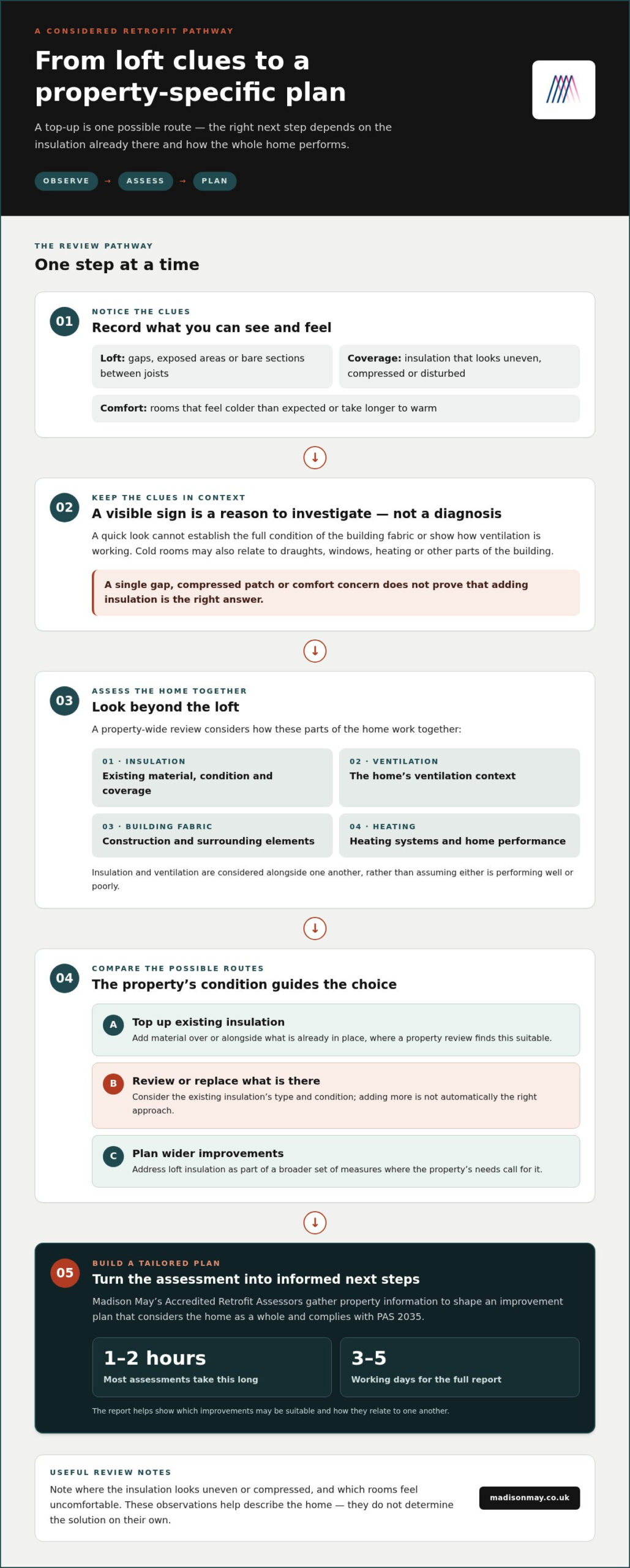
Start by noting what you can observe and what needs a closer assessment. A photograph or quick look may reveal unevenness, but it can’t show the full condition of the building fabric or establish how ventilation is working.
What signs suggest existing loft insulation needs attention?
Visible gaps, exposed areas and patches where insulation looks thinner than elsewhere are sensible reasons to investigate. You might notice bare sections between joists, material that appears to have been moved, or compressed insulation beneath stored belongings. These clues can help describe the loft’s condition, but none proves by itself that more insulation is the right answer.
Comfort can provide useful context, too. Rooms that feel colder than expected or take longer to warm may prompt a review, but household comfort alone can’t identify the exact source of heat loss. Draughts, windows, heating and other parts of the building may also be relevant. An assessment puts your observations alongside the condition and coverage of the insulation.
- Note where gaps or exposed areas appear, rather than assuming the whole loft has the same issue.
- Record whether insulation looks uneven, compressed or disturbed.
- Keep track of comfort concerns, including which rooms are affected and when you notice them.
Why is a top-up not automatically the right answer?
An older installation may be incomplete, uneven or no longer suited to the property’s needs. In some cases, adding material could be appropriate; in others, the existing insulation may need a closer review or a different approach. Its type and condition matter, as do the roof and ceiling construction, how the loft is used and the home’s ventilation.
Insulation is one part of how a building manages heat and moisture. General building insulation principles explain why material, placement and surrounding construction matter. A single visual clue cannot determine the solution. Ventilation deserves attention alongside insulation, since changes to one part of a home can affect how the whole building performs.
This guide can help you recognise when to seek a review, but it can’t provide a property-specific recommendation. A retrofit assessment considers existing insulation alongside ventilation, building fabric and heating systems, helping shape a suitable improvement plan rather than defaulting to a top-up. That review can distinguish between adding to what’s there and considering a different or broader set of improvements.
How loft insulation top-ups fit into a property-wide assessment
A loft can’t be understood in isolation from the rooms below or the systems that keep the home comfortable. Insulation, ventilation, building fabric and heating each contribute to overall energy performance, so a top-up decision should reflect how these elements work together. One visible gap may be worth investigating, but it doesn’t tell the whole story or establish what work is suitable.
For someone considering a loft insulation top up West Yorkshire, a property-wide assessment offers a way to move from a single observation towards a considered plan. It brings together information about the home’s existing measures and performance, helping show whether loft insulation should be addressed on its own or alongside other improvements. UK home efficiency specialists like Extract Energy similarly emphasise that loft insulation delivers the best results when considered as part of a property’s overall energy performance.
How do insulation and ventilation considerations connect?
Insulation and ventilation are considered together because both influence how a home manages heat and air. An assessment reviews the insulation present and the ventilation context, rather than assuming either is performing well or poorly. For example, the arrangement of insulation can be considered alongside the home’s ventilation provision, so recommendations take account of both. A concern is a reason to investigate, not proof of a defect or a prediction that additional insulation will cause a problem.
The Energy Saving Trust guidance on loft insulation provides general information about roof and loft insulation. It can help explain the topic, but it cannot account for the particular construction, existing measures or heating arrangements in an individual home. Those details shape the assessment.
What does a retrofit assessment examine?
A Madison May Retrofit Assessment reviews a property’s insulation, ventilation, building fabric, heating systems and overall energy performance. Looking across these elements helps place the loft within the home’s wider condition, rather than treating a chilly room or uneven insulation as a complete diagnosis. Madison May’s Accredited Retrofit Assessors gather property information to inform a tailored improvement plan that complies with PAS 2035.
Most assessments take 1-2 hours, and a full report is delivered within 3-5 working days. The report provides a basis for understanding which improvements may be suitable and how they relate to one another. This can help distinguish a focused loft insulation measure from a broader programme, without assuming that every property needs the same work.
A PAS 2035-compliant approach is especially useful where several measures may interact. If insulation, ventilation or heating are all under consideration, coordinating the recommendations can help ensure the plan reflects the home as a whole. The assessment doesn’t make a top-up the default; it gives the decision a property-specific foundation. Learn about a Madison May Retrofit Assessment.
Loft insulation top-up, replacement or wider improvements: how to compare the options
Choosing between adding insulation, reviewing what is already there or planning several improvements depends on the evidence from the property. A top-up may suit a sound existing base, whilst damaged, displaced or unsuitable material may call for a different response. If ventilation, the building fabric or heating also needs consideration, a wider plan can help bring those decisions together.
Option
Existing insulation and coverage
Ventilation context and project scope
Top-up
An assessment finds existing material that may provide a suitable base, with coverage or performance needing improvement.
Ventilation is considered alongside the proposed addition. The work may remain focused on the loft if wider findings support that scope.
Review existing insulation
The type, condition or distribution of the current material needs closer investigation before deciding what to do.
The review considers the loft’s ventilation context and whether the existing installation should be retained, adjusted or replaced.
Wider improvement plan
Loft findings form part of a broader picture of the home’s insulation and building fabric.
Ventilation and heating can be considered alongside insulation, with measures organised as a coordinated project where appropriate.
When might adding to existing insulation be considered?
A top-up may be considered when an assessment identifies existing material that is suitable to build on, but the final recommendation depends on the property-specific findings. Its condition, coverage and relationship to the surrounding construction all matter. An apparently intact layer isn’t automatically suitable, just as an uneven section doesn’t automatically mean it must be removed. An assessment helps distinguish these circumstances before work is planned.
When might a broader improvement plan be more useful?
A broader plan can be useful when loft insulation is only one part of the home’s improvement needs. For example, assessment findings may point to ventilation, building fabric or heating considerations that should be coordinated with insulation work. A considered sequence can help organise measures around the property rather than treating each one as a separate decision. The EPC improvement plan guide explains how recommendations can be arranged into a roadmap.
There’s no universal trigger based on a particular material condition or insulation level, and this comparison can’t replace an assessment. A property-specific review can establish whether a focused top-up, further investigation or wider work is the most appropriate next step. For broader context on coordinated upgrades, explore energy-efficient home improvements. This is especially relevant when considering a loft insulation top up West Yorkshire as part of the home’s overall performance.
Preparing for a loft insulation review and understanding the next steps
A little preparation can make a loft insulation review more useful, even if you don’t have technical measurements or detailed records. Your observations and any information about earlier work can help build a clearer picture of the home. The assessment considers the property before recommending whether a top-up, further investigation or another improvement may be appropriate.
A straightforward sequence can help you understand what to expect:
- Gather what you know. Collect any available details about existing insulation and previous improvements, such as when work was carried out or which areas were addressed.
- Arrange an assessment. Share the concerns that prompted you to seek a review, along with any practical access considerations.
- Review the findings. Consider what the assessment says about the loft and the home’s wider condition before deciding on a course of action.
- Plan suitable work. Use the recommendations to shape an improvement plan that reflects the property, rather than assuming installation is automatic.
What information can help make the review useful?
Note any insulation changes you know about, including whether material has been added, moved or disturbed during other work. Describe which rooms feel less comfortable, when you notice it and whether the concern is consistent or seasonal. These details are useful context, not proof that the loft is the cause. You don’t need to take specialist measurements or enter an area that feels unsafe.
It can also help to mention access limitations or features that may affect the review, such as stored belongings or a loft hatch that is difficult to reach. You don’t need to clear or rearrange anything unless it’s safe and practical to do so. Where the concern relates to the building more broadly, comprehensive building surveys can provide wider context about a property’s condition.
How do assessment findings lead to a practical plan?
Findings inform tailored recommendations; they don’t automatically prescribe a loft insulation installation. Madison May’s Retrofit Assessors review insulation alongside ventilation, building fabric, heating systems and overall energy performance, then use this property information to shape a PAS 2035-compliant improvement plan. Most assessments take 1-2 hours, and a full report is delivered within 3-5 working days.
If the recommendations involve multiple retrofit measures, Retrofit Coordination provides end-to-end project management for work meeting PAS 2035 requirements. This helps keep proposed measures aligned, with the sequence shaped around the home rather than a single concern. For anyone considering a loft insulation top up West Yorkshire, an assessment helps establish what the property needs before settling on the next step. You can explore Madison May’s retrofit assessment support as you prepare for a review.
How Madison May can guide your loft insulation top-up decision
A loft insulation decision is more useful when it follows an understanding of the home, rather than an assumption that adding more material must be the answer. Madison May supports homeowners, landlords and housing providers across the UK with Retrofit Assessments, Loft & Roof Insulation and Retrofit Coordination. These services connect a possible loft improvement with the property’s wider needs.
Madison May’s Loft & Roof Insulation installation is intended to reduce heat loss and improve EPC ratings. A Retrofit Assessment can help establish whether a top-up is suitable by reviewing existing insulation alongside ventilation, building fabric, heating systems and overall energy performance. Its findings inform tailored recommendations that comply with PAS 2035, giving you a considered basis for deciding what to do next.
What support can homeowners, landlords and housing providers expect?
Support can begin with understanding your priorities, whether you’re looking to review an existing home, plan improvements as a landlord or consider work across housing provision. An assessment brings together details that help clarify the options; where insulation work is appropriate, Loft & Roof Insulation can form part of the recommendations. Retrofit Coordination offers end-to-end project management for retrofit work meeting PAS 2035 requirements.
Madison May reports that 75 % of installations are carried out by qualified professionals, alongside a 90 % installation quality rating and a 99 % ongoing support and after-care rating. These figures describe the company’s stated installation and support measures, while the assessment remains focused on the individual property and the work its findings indicate.
Where funding may be relevant, Madison May supports clients with identifying available funding and meeting the technical requirements needed to apply. This is practical assistance with the application process, not a promise that funding will be awarded. Recommendations depend on the property assessment and the options identified for your home.
How can you take the next step?
If you’re weighing up a loft insulation top up West Yorkshire, start with the question you want answered: is the existing insulation suitable to build on, or do the property’s wider needs call for a different approach? You can request a quote for insulation work or book an assessment to review the home and inform tailored recommendations. Sharing what you know about earlier insulation work, access and comfort concerns can make the conversation more focused.
A property-specific review gives you a measured route from concern to informed action, without committing you to a particular solution before the findings are understood. Request a quote or book a retrofit assessment with Madison May, or call 01422 652316 or email info@madisonmay.co.uk to discuss the next step.
Take the next step towards a more considered home
The most useful outcome isn’t necessarily an immediate installation. It’s knowing what your home needs, why a particular measure may be suitable and how it fits with the way you want the property to work for you. That perspective can make decisions about comfort and future improvements clearer, whether you’re responsible for your own home or managing a property for others.
If you’re weighing up a loft insulation top up West Yorkshire, let the property’s individual circumstances guide the decision rather than relying on a one-size-fits-all answer. Keep a note of the concerns you want addressed and use them to shape a practical conversation about possible next steps.
Madison May can help you move from uncertainty towards a plan informed by your property. Explore your assessment and quotation options with Madison May and take the next step for your home.
Frequently Asked Questions
What is a retrofit assessment?
A retrofit assessment is a full property survey that reviews insulation, ventilation, building fabric, heating systems and overall energy performance. Its purpose is to create a PAS 2035-compliant improvement plan based on the home’s actual features, rather than assumptions. For example, if you’re considering changes to insulation, the assessment can help place that idea alongside other property considerations and provide a more informed starting point for deciding which improvements to explore.
Do I need to upgrade my EPC rating?
Not every homeowner needs to upgrade an EPC rating, although homeowners and landlords may choose to improve one to support energy performance, reduce bills, future-proof a property or meet applicable targets. If you’ve searched for “loft insulation top up West Yorkshire”, consider whether your priority is an EPC improvement or resolving a particular concern in the home. An assessment can help clarify which improvements may suit your property.
How long does an assessment take?
Most homes take 1-2 hours to assess, with a full report delivered within 3-5 working days. The time on site allows the assessor to gather information about the property, so it can help to have any relevant records to hand, such as details of previous improvement work. You don’t need specialist measurements; simply sharing what you know can provide useful context for the review.
Do you help with grant funding applications?
Yes. Madison May supports clients with identifying available funding and meeting the technical requirements needed to apply. This can help you understand what application information is relevant to the proposed work and how the property assessment may inform it. Funding is not guaranteed, and support with identifying options should not be taken as confirmation that a particular grant will be available or that an application will be successful.