

The lowest-carbon insulation isn’t automatically the best fit for every home. Wood fibre, straw, cork, hemp and paper wool each have a manufacturing-stage global warming potential below 10 kg CO2e per functional unit; the comparison uses enough material for a 1 m² wall to achieve a U-value of 0.12 W/m²K. These low-carbon insulation materials in the UK still need to be judged against the building, its exposure to moisture and the way each material will be installed.
It’s understandable to want a clear answer when insulation options differ in cost, performance and feel, as well as embodied carbon. This guide compares five lower-carbon materials and explains where each may suit walls, roofs or floors, how moisture management affects the choice, and what to consider when balancing upfront cost with long-term comfort. It also shows why a whole-home view matters: the right material works with the property’s construction and climate, not simply the one with the lowest carbon figure.
Key Takeaways
- Choose insulation thickness by considering the wall, roof or floor and the thermal performance the whole building needs.
- Compare embodied carbon alongside the material’s intended use, rather than treating one carbon figure as the only measure of suitability.
- Match moisture behaviour to the home: breathable materials can support humidity management, while details of the building fabric matter too.
- Use an assessment of the building fabric, services and ventilation to shape practical insulation upgrades for your home.
What are the five best types of eco-friendly insulation?
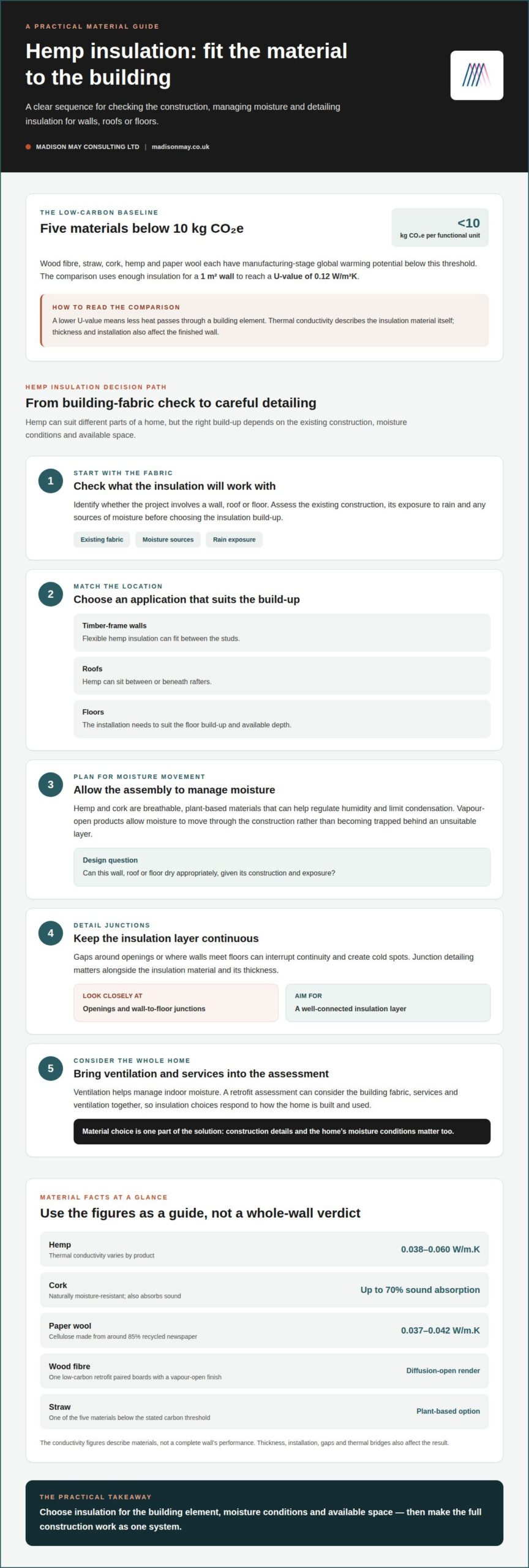
Wood fibre, straw, cork, hemp and paper wool are five low-carbon options for UK homes. Each has a manufacturing-stage global warming potential below 10 kg CO2e per functional unit. That comparison makes them a useful starting point, but material choice also depends on the wall, roof or floor, available thickness and moisture conditions.
The functional unit compares enough insulation for a 1 m² wall to reach a U-value of 0.12 W/m²K. U-value measures heat transfer through a building element; a lower value means less heat passes through it. Thermal conductivity, measured in W/m.K, describes the material itself. Thickness and installation affect the finished wall’s resistance to heat flow.
- Wood fibre: a plant-based option for considering wall insulation alongside embodied emissions and the building fabric.
- Straw: plant-based insulation that sits among the five options below the stated carbon threshold.
- Cork: naturally moisture-resistant, with sound absorption of up to 70%.
- Hemp: thermal conductivity ranges from 0.038 to 0.060 W/m.K, depending on the product.
- Paper wool: cellulose is made from around 85% recycled newspaper; its conductivity is 0.037-0.042 W/m.K.
For comparison, cork’s conductivity is 0.037-0.043 W/m.K, while sheep’s wool insulation measures 0.038 to 0.054 W/m.K. Recycled plastic rolls have a measured thermal performance of 0.040 W/m K. These figures help compare materials, but they don’t describe a whole wall’s performance.
Insulation layers in new buildings and many renovations are commonly 10-30 cm thick. The suitable thickness depends on the building element and project decisions. Gaps, joins and thermal bridges can also affect how well the installed layer limits heat transfer, so thickness alone cannot determine performance.
For comfort, consider sound as well as heat: cork can absorb up to 70% of sound. Compare this acoustic quality with the required thermal performance, the available space and the material’s moisture behaviour before choosing.
What is Embodied Carbon?
Embodied carbon is the greenhouse gas emissions associated with making, transporting and disposing of building materials. For insulation, compare its environmental impact across the life cycle, rather than judging it by performance in use alone. A materials analysis drawing on around 2,200 environmental product declarations (EPDs) compared 17 types of thermal insulation. It reported global warming potential above 30 kg CO2e per functional unit for PUR, XPS and foam glass.
An EPD sets out environmental information about a product, helping designers compare embodied emissions consistently. It is a declaration, not a product certification. Life-cycle assessment considers stages such as raw material extraction, manufacturing and end of life, and the stages included can affect comparisons. For a project, compare like with like: the same functional unit, scope and insulation performance.
Building design can reduce embodied carbon before material selection. In a study of 503 Canadian homes, insulation accounted for 26.1% of material carbon emissions across foundations, walls and roofs; concrete, insulation and exterior cladding together accounted for 73%. The practical lesson is to consider the whole building: retain usable fabric where suitable, avoid unnecessary material, and design each layer to meet the building’s needs.
For UK building work, insulation must meet the building regulations that apply to the project, and its fire suitability must match its position and construction. Requirements vary across the UK, so the relevant rules depend on the nation and the work involved. Lower-carbon options are available from insulation merchants and manufacturers. Review product EPDs alongside documentation on fire performance and intended use: an EPD describes environmental impact, not fire certification.
Durability and end-of-life options depend on material and installation. Sheep’s wool panels can last up to 100 years in walls and under floors; reuse or recycling depends on the material’s condition and available recovery route. A retrofit assessment can consider the building fabric, services and ventilation together, helping align insulation choices with the home.
Hemp insulation applications and moisture management
Hemp insulation can suit walls, roofs and floors, depending on the construction detail. In timber-frame walls, flexible hemp insulation can fit between studs; in roofs, it can sit between or beneath rafters. Floor installations need to suit the floor build-up and available depth. Hemp is one option for sustainable construction, not a universal specification.
Moisture management matters as much as heat retention. Hemp and cork are breathable, plant-based materials that can help regulate humidity and limit condensation. Many insulation products are vapour open, allowing moisture to move through the construction rather than becoming trapped behind an unsuitable layer. A sound design considers the existing wall, roof or floor, its exposure to rain and how the assembly can dry.
For a home with timber walls, start by assessing the existing fabric and identifying moisture sources. Then design compatible insulation and finishes. Hemp panels or batts can form part of the build-up, while ventilation helps manage indoor moisture. Junction detailing matters too: gaps around openings or where walls meet floors can interrupt continuity and create cold spots.
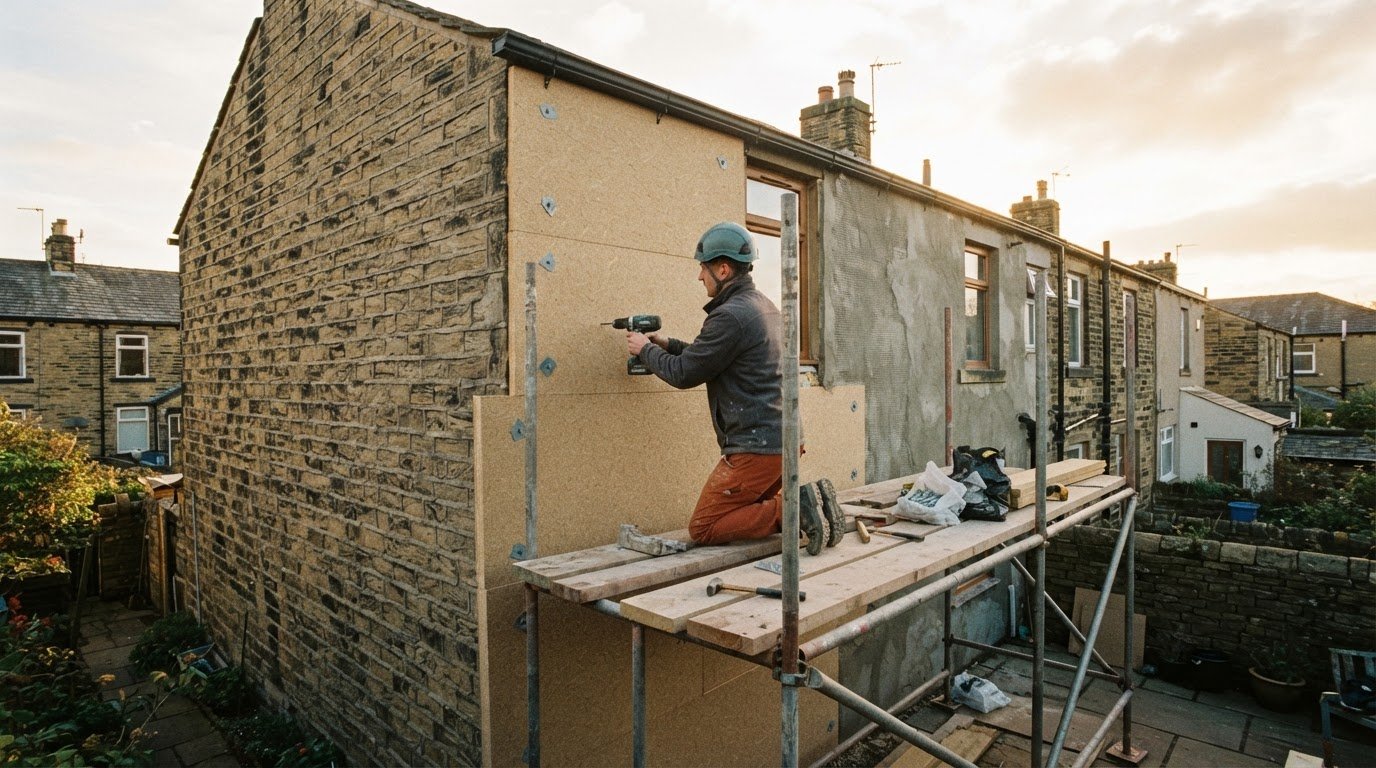
Wood fibre boards offer another option for walls and external insulation. In one low-carbon retrofit of a semi-detached home, wood fibre insulation was paired with diffusion-open EWI Pro render. This example shows how board insulation and a vapour-open finish can work together in a wall, but it is not a design for every property.
Across these applications, match the material to the building’s structure and moisture conditions. In a roof, the build-up and ventilation strategy affect drying; in a floor, the existing construction and available space shape the detail. For walls, breathable hemp or wood fibre can support humidity management when designed as part of a compatible assembly. This joined-up approach helps balance thermal efficiency, moisture movement and the character of the home.
Choosing insulation for home, budget and climate
Start with the property, not a favourite material. Suitable low-carbon insulation materials in the UK depend on the wall, roof or floor construction, moisture conditions, available space and local climate. A solid-wall home, for example, needs a different insulation design from a timber-frame property. Consider how the complete assembly will manage heat and moisture instead of comparing materials in isolation.
Then weigh thermal performance against embodied carbon, durability and installation requirements. Recycled cellulose can suit cavities and lofts, while plant-based boards or batts may suit other wall and roof assemblies. Mineral wool is another thermal insulation option. Product format, access, preparation and detailing all affect installation complexity and overall project cost.
Grant support may be available through relevant insulation schemes, but eligibility and supported measures depend on the programme and household or property criteria. There is no single grant rule for every UK home, so assess the scheme’s terms alongside the proposed work.
Installation typically starts with an assessment of the existing building fabric and any damp, ventilation or repair issues. The design then matches insulation to the building element and its construction. Installers prepare the surface, fit the material and complete compatible finishes. Finally, check continuity around junctions, openings and services. These details help limit gaps that can reduce thermal performance.
Costs depend on the material, area, access, preparation and finish, so a material price alone does not represent the installed project. A draughty roof with clear access, for example, differs from a solid wall needing repairs and external finishing. A whole-property assessment can identify the upgrade that best addresses heat loss, rather than relying solely on the material’s purchase cost.
For low-carbon insulation materials across the UK, plan upgrades around the home’s construction, climate and moisture needs. This keeps material choice, installation detail and energy efficiency connected to the way the property is built. Plan insulation upgrades as a considered next step.
Madison May Consulting: Insulation upgrades
Madison May Consulting Ltd helps homeowners plan insulation upgrades as part of energy efficient home improvements. It’s a natural next step when you’re weighing materials but need to understand how they fit your property’s construction, moisture conditions and wider energy needs.
A considered plan looks beyond one wall or roof, connecting insulation choices with the home’s fabric and other relevant improvements. Depending on the property, windows and doors or conservatory upgrades may also be part of the plan. The aim is to identify practical measures that work together, rather than choosing insulation by material alone.
If you’re ready to discuss insulation for your home, contact Madison May Consulting Ltd.
Make the next improvement fit your home
The next step is to turn material preferences into a considered plan for the property. Start with the change you want at home: a warmer room, a more comfortable loft or a steadier indoor environment. Then connect that goal with the building’s construction, moisture behaviour and planned improvements. This keeps the decision personal while giving practical performance and environmental impact equal weight.
Choosing low-carbon insulation materials for UK homes is not simply a matter of selecting a product. It means creating a coherent approach that respects the building’s character and supports the way you want to live in it. When insulation is part of wider home improvements, a joined-up plan can make each decision more purposeful.
For help shaping the next step around your property, contact Madison May Consulting Ltd. A thoughtful plan can bring greater comfort and a calmer, more efficient home within reach.
Frequently Asked Questions
Wood fibre insulation: Is it suitable for mainstream housebuilding?
Yes, wood fibre can be used in mainstream housebuilding when its format and detailing suit the construction. Boards can form part of wall insulation or an external wall system, and the design must account for junctions, openings and moisture movement. For a new timber-frame home, the key is to integrate the insulation with the wall build-up and chosen finish, rather than treat the board as a standalone solution.
What are the lowest-carbon insulation materials available in the UK?
Wood fibre, straw, cork, hemp and paper wool are among the lowest-carbon options in the comparisons discussed here. Their manufacturing-stage global warming potential is below 10 kg CO2e per functional unit. These materials differ in format and application, so the lowest figure alone won’t determine the best fit. Consider the building element, installation detail and moisture conditions alongside embodied carbon.
How do embodied carbon emissions compare for insulation materials such as cellulose, wood fibre, sheep’s wool, hemp, and mineral wool?
Cellulose, wood fibre, hemp and sheep’s wool fall within the low-carbon material group reported below 10 kg CO2e per functional unit. Cellulose is recycled-paper insulation; wool and hemp have different sourcing and processing routes. Mineral wool should be compared using product-specific environmental declarations, not assumed to match plant-based materials. Check that figures use the same functional unit and life-cycle scope before drawing a ranking.
What are the typical UK prices per square metre for low-carbon insulation materials?
Typical UK material costs generally range from £15 to £35 per square metre for blown cellulose and standard hemp batts, whilst premium rigid wood fibre boards and specialist sheep’s wool products often cost between £30 and £70 per square metre depending on thickness and density. These ranges vary by material and don’t establish an installed project cost, which also depends on preparation, access and finishing.
How well do low-carbon insulation materials perform for thermal conductivity and U-values?
Thermal conductivity describes heat flow through a material: lower conductivity means greater resistance at the same thickness. A U-value describes heat transfer through the complete building element, so it also depends on thickness, layers and construction details. A material’s conductivity figure therefore cannot predict a wall’s final U-value on its own. Compare product data in the context of the intended wall, roof or floor assembly.
How do moisture, condensation, and mould risks vary between natural insulation materials?
Moisture behaviour differs by material and assembly. Sheep’s wool can absorb and release moisture without affecting its insulation, while cellulose can compact over time, reducing its insulation capability. Hemp and cork are breathable materials that can help regulate humidity, but no insulation layer removes the need for suitable moisture management. Condensation risk depends on how the full construction handles moisture, including ventilation and compatible finishes.