

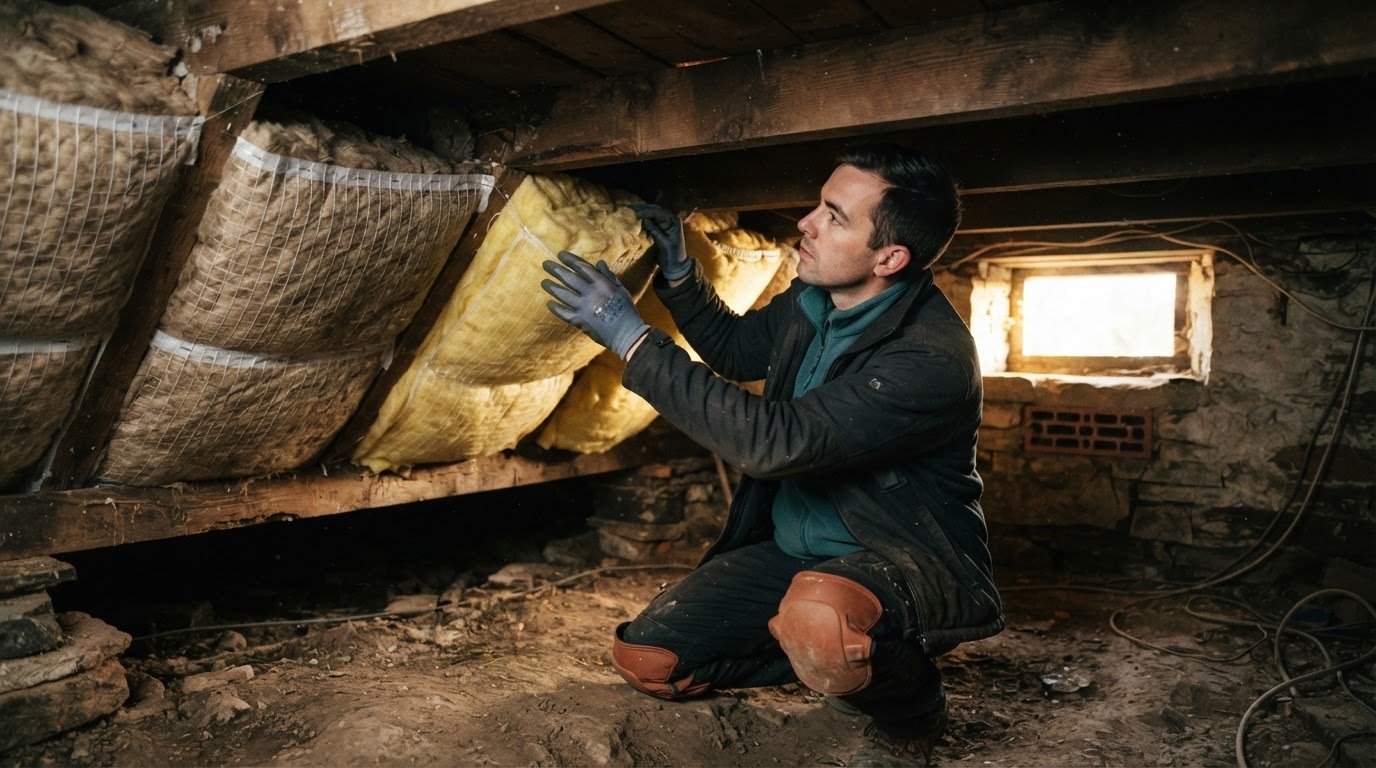
Natural insulation isn’t automatically the best fit for an older home, and synthetic insulation isn’t always the simplest answer. When comparing natural vs synthetic insulation, the right choice depends on where it will be fitted, how the building manages moisture and the demands of its construction. For a UK loft, the recommended insulation depth is 270 mm.
It makes sense to weigh warmth, durability and environmental impact together, but no single insulation material performs the same way in every part of a home. Natural fibres can absorb and release moisture, helping buffer indoor humidity, but the material and installation must suit the building.
This guide compares the options for lofts, roofs and floors, including what to consider in historic buildings. It also covers lifespan, pests and fire safety, helping you identify the factors to weigh before planning an insulation upgrade.
Key Takeaways
- Match insulation to the part of the home and its construction, especially where historic fabric needs careful consideration.
- Compare materials by more than initial warmth: lifespan, moisture behaviour and pest and fire resistance also shape the decision.
- Explore how sheep’s wool, wood fibre, hemp and flax differ before settling on a natural option.
- For a tailored upgrade plan, Madison May Consulting Ltd can assess the home and identify practical insulation improvements.
How to choose between natural and synthetic insulation for lofts?
Start by assessing the roof structure, ventilation and moisture conditions, then compare the insulation materials. Natural fibres such as sheep’s wool and wood fibre can absorb and release moisture, helping regulate indoor humidity. This moisture buffering depends on the construction allowing the material to dry.
Breathability means moisture vapour can move through materials and disperse when conditions allow. It does not make a roof waterproof or remove the need to manage condensation. In a historic roof, changes to the existing fabric or ventilation can affect how moisture moves. Choose an approach that respects the building’s construction.
In lofts, installation details matter as much as the material. Gaps between insulation and adjoining components allow air passage and can reduce performance. A considered design accounts for ventilation paths, the roof build-up and where warm indoor air could meet colder surfaces. These details help limit condensation and damp risks.
| Option | Moisture response | Thermal consideration |
|---|---|---|
| Sheep’s wool | Absorbs and releases moisture | Natural fibre that buffers humidity |
| Wood fibre | Absorbs and releases moisture | Natural option for breathable assemblies |
| Mineral wool | Choose with the full roof build-up in mind | Thermal storage capacity is 20-40% of natural insulation |
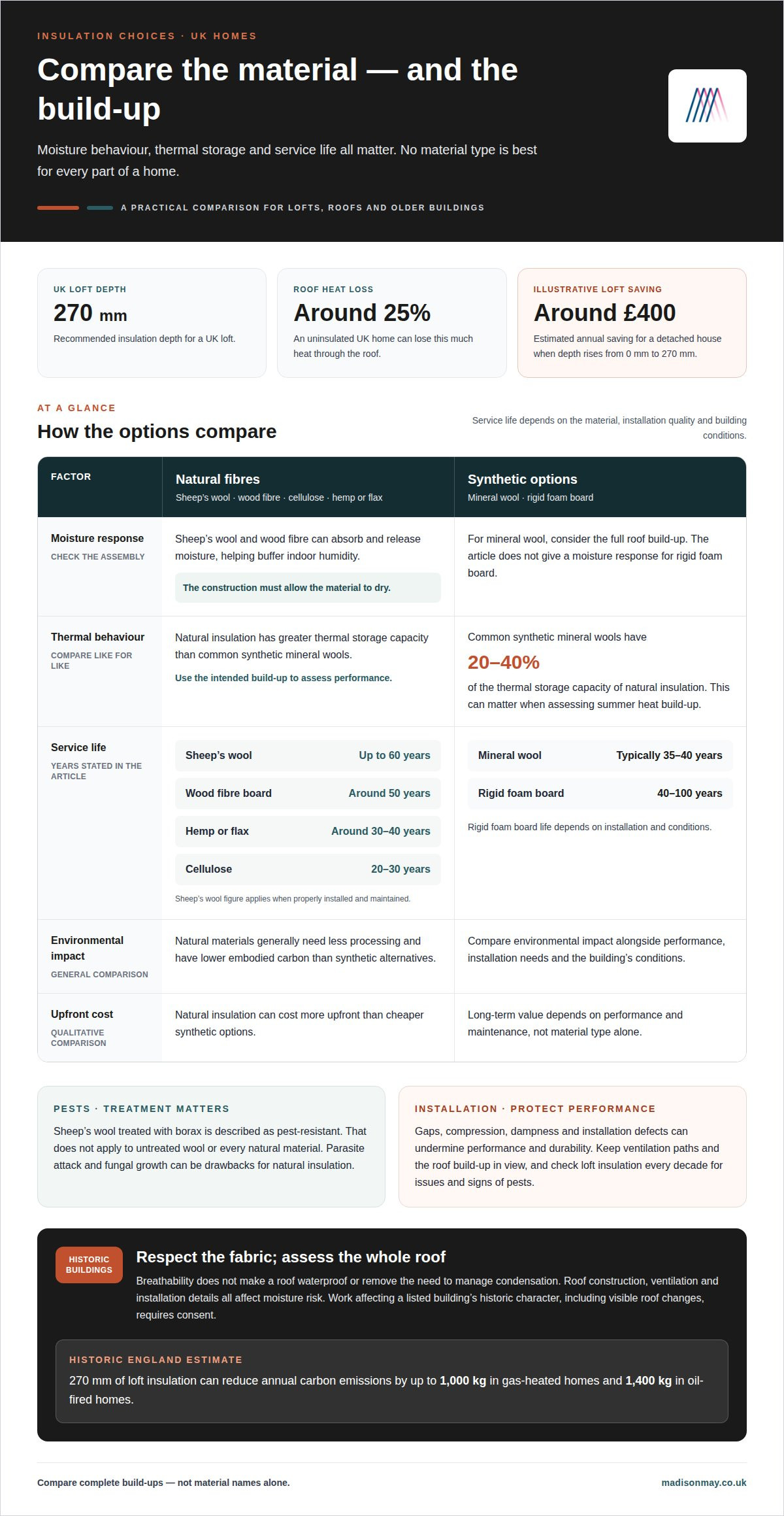
Thermal storage capacity describes how much heat a material can hold and release. Common synthetic mineral wools have 20-40% of the thermal storage capacity of natural insulation, which can matter when considering summer heat build-up. Thermal mass and night-time ventilation are relevant parts of that assessment.
When comparing natural vs synthetic insulation, weigh moisture behaviour, thermal performance, available depth and installation requirements together. Choose a system that suits the loft’s construction rather than making the decision on material type alone.
Applications in roofs, floors and historic buildings
Thermal conductivity describes how readily heat passes through a material. Lower conductivity means better insulation at the same thickness. An R-value expresses resistance to heat flow, so it depends on both conductivity and installed thickness. Compare complete build-ups, not just material names.
The Energy Saving Trust estimates that raising loft insulation depth from 0mm to 270mm can save a detached house around £400 per year. Flexible insulation can fit between wall studs; pairing it with rigid wood-fibre board externally can reduce thermal bridging. Floors need an option suited to their structure, available depth and moisture conditions.
Roofs require a design that preserves warmth while managing humidity and ventilation. An uninsulated UK home can lose around 25% of its heat through the roof.
Historic buildings need an approach that respects their fabric. Natural materials such as wood fibre may suit assemblies designed to manage moisture, while synthetic options may suit structures with the appropriate construction and available space. Material choice alone cannot resolve moisture risk: roof construction, ventilation and installation details all matter.
For listed buildings, work affecting historic character, including visible roof changes, requires consent. Internal insulation may also be subject to regulation if it alters historic fabric or ventilation. Historic England notes that 270 mm of loft insulation can reduce annual carbon emissions by up to 1,000 kg in gas-heated homes and 1,400 kg in oil-fired homes.
Insulation reduces heat demand, but the right application depends on the building’s structure and condition. In older roofs, prioritise moisture behaviour and heritage impact. In accessible lofts, compare suitable materials against the required depth and thermal performance. For floors and walls, consider how insulation integrates with adjoining elements, maintaining continuous coverage and the building’s intended ventilation.
Natural and synthetic materials cannot be ranked by type alone. Lower thermal conductivity provides better insulation at the same thickness. Compare R-values in the intended build-up, as R-value depends on both conductivity and installed thickness.
Durability, pest resistance and fire safety
Service life varies with insulation type, installation quality and building conditions. Pest and fire performance also depend on the material and any treatment it receives.
Durability and Longevity
Mineral wool typically lasts 35-40 years, while rigid foam board can last 40-100 years, depending on installation and conditions. Natural options also vary: sheep’s wool can last up to 60 years when properly installed and maintained, wood fibre board around 50 years, cellulose 20-30 years, and hemp or flax around 30-40 years. These figures describe different materials, not a universal natural-versus-synthetic rule.
In practice, dampness, compression and installation defects can affect thermal performance and durability. Check loft insulation every decade for these issues and signs of pests. Natural materials generally need less processing and have lower embodied carbon than synthetic alternatives, while natural insulation can cost more upfront than cheaper synthetic options. The long-term value depends on performance and maintenance.
Pest Resistance
Pest resistance varies across natural fibres. Sheep’s wool treated with borax is described as pest-resistant, but that claim does not apply to untreated wool or every natural material. Parasite attack and fungal growth are also potential drawbacks for natural insulation. Chemical treatments can address these vulnerabilities, so treatment and installation matter to the finished construction.
For any insulation, a dry, well-fitted assembly helps avoid conditions that can undermine performance. An inspection should look for pest activity, damp patches and compressed sections, rather than judging resistance by material category alone.
Fire Safety
Borax-treated sheep’s wool is described as fire-safe, but this does not mean every wool product has the same fire properties. Natural fibres can be flammable, and chemical treatment may address this drawback. Compare the specific insulation’s stated fire performance with the complete building assembly, rather than assuming natural or synthetic materials share one fire rating.
Material choice is only part of the picture: how insulation fits within the construction matters too. A sound assessment considers the product, its treatment and the surrounding building materials together.
Natural insulation materials: sheep’s wool, wood fibre, hemp and flax
Natural insulation includes animal and plant fibres, cork and cellulose, each available in forms suited to different parts of a home. Compare the material’s composition and intended application with the building fabric.
Sheep’s Wool Insulation
Sheep’s wool is a natural fibre used in building insulation and can also provide acoustic insulation. Some products are blends rather than pure wool: wool insulation used in one study included 5-15% recycled polyester. That example shows why checking the source and composition matters when choosing a product. Its fibre makeup and any treatment distinguish it from wood fibre, hemp and flax.
Wood-Fibre Insulation
Wood-fibre insulation comes in flexible and rigid forms that can serve different roles in a building envelope. One project can use both forms together, showing how products may be combined within the same construction. Natural insulation can also be used in a Passivhaus-level design when moisture and breathability are considered. Wood fibre’s suitability depends on the assembly, not simply the material name.
Hemp and Flax Insulation
Hemp and flax are plant-based insulation materials made from renewable resources. They offer alternatives to animal fibres and wood products, and can be considered for loft insulation. Their product format and position in the building fabric shape how they fit a project. Compare the available material information and intended use, then consider how each option integrates with adjoining parts of the structure.
Cork and Cellulose Insulation
Cork and cellulose add further options to the natural-material palette. Cork is available as boards, while cellulose is another building insulation option. Straw is also made from renewable resources. These materials differ in form and source, so their suitability depends on the application and design. Environmental Product Declarations can help compare environmental factors at the design stage.
For a considered insulation upgrade, match the material to your home’s fabric and project requirements.
Madison May Consulting Ltd: Insulation upgrades
Madison May offers insulation upgrades and energy-efficient home improvements for properties where heat loss, comfort or the building’s construction informs the next step. If you’re comparing natural and synthetic materials, base the decision on the property’s fabric, moisture conditions and intended location, not material preference alone.
An insulation upgrade can be considered alongside related improvements, such as windows and doors or conservatory upgrades, when they form part of the home’s wider energy-efficiency needs. This joined-up perspective puts insulation choices in context, particularly when a roof, wall or floor has distinct requirements.
For guidance on an insulation upgrade suited to your home, contact Madison May Consulting Ltd.
Make your next insulation decision with confidence
Rather than treating insulation as an isolated choice, consider how the planned improvement fits the way you want your home to feel and function. Comparing natural vs synthetic insulation is a useful starting point; the next step is relating that choice to the property and your wider priorities for its future.
A considered plan can help you decide what to address first and how an insulation upgrade relates to other improvements. This perspective is particularly valuable when you want a more comfortable home without losing sight of its character. The right approach should make sense for both the building and the people who live in it.
If you’re ready to explore your options, take the next step with Madison May Consulting. A thoughtful conversation can help turn your priorities into a clear direction for your home.
Frequently Asked Questions
Does down stop insulating when it gets wet?
No. When down gets wet, it loses loft, so it traps less insulating air and provides less warmth. It can take longer to dry than synthetic filling, making prolonged dampness a concern. Down is generally used in clothing and bedding rather than as insulation in a home’s roof or walls. For building projects, compare materials designed for the specific construction and moisture conditions.
How do modern natural blends compare?
Modern natural blends combine fibres or include other components, so the label “natural” does not describe every ingredient. For example, insulation made mainly from wool may contain recycled polyester. If recycled content, renewable sourcing or moisture behaviour matters to your decision, review the product’s composition and environmental product information. Compare the full product rather than assuming all natural blends perform alike.
What about hybrid insulation?
Hybrid insulation usually means using different materials in one building assembly rather than relying on a single insulation type throughout. A roof, for example, may have flexible insulation between structural members and a separate board layer. The materials need to work together as a designed system, with attention to moisture movement, continuity and junctions. Simply combining products does not guarantee better performance.
What are the pros and cons of natural insulation?
Natural insulation can use renewable raw materials and may help buffer humidity, making it an option for projects where moisture behaviour matters. Some products also need less processing than synthetic alternatives. However, natural materials differ in composition, treatment, format and lifespan, and can cost more upfront. Consider the product’s environmental information alongside its suitability for the building’s structure and intended use.
What are the main types of natural insulation available in the UK, such as sheep’s wool, wood fibre, hemp and cellulose?
Common natural options include sheep’s wool, wood fibre, hemp, flax, cork, straw and cellulose. They come in different forms, such as flexible fibre products, boards or loose-fill material, so their possible uses vary. For instance, a board may suit a different part of a building from flexible material between structural members. The right choice depends on the application and complete construction.
What are the main types of synthetic insulation used in UK homes, such as mineral wool, EPS, XPS and PIR?
Common synthetic or manufactured options include mineral wool, expanded polystyrene (EPS), extruded polystyrene (XPS) and polyisocyanurate (PIR) boards. These materials differ in form and properties, so they are not interchangeable in every roof, wall or floor. Compare the intended application, available space and stated product performance. The surrounding construction and installation details also shape how the finished insulation system works.