

The material with the strongest sustainability credentials on paper may not be the right choice for your home. When comparing sustainable building materials for renovation, look beyond how a product is made: consider whether it suits the existing building, how it will perform in its intended role and how long it is expected to last.
There is no single label that answers all of these questions. A useful comparison weighs whole-life impact alongside durability, comfort and the property’s construction. It also considers how each proposed upgrade relates to the rest of the home, rather than treating it as an isolated swap.
This guide explains how to compare materials across their lifecycle, assess their suitability for different renovation needs and plan improvements as a coherent whole. It also covers why insulation, ventilation and heating need to be considered together, and how a Retrofit Assessment can help you understand your home before deciding what to change.
Key Takeaways
- Assess sustainable building materials for renovation across sourcing, production, use and end of life, rather than relying on a broad sustainability label.
- Compare products designed for the same purpose, using product-specific evidence about service life and end-of-life options.
- Match material choices to the renovation task and the property, weighing relevant evidence alongside practical trade-offs.
- Plan upgrades around your home’s condition and goals. Insulation choices should work with ventilation and the wider building fabric.
- A Retrofit Assessment can help you understand your property’s insulation, ventilation, heating and energy performance before choosing measures.
What makes building materials sustainable for renovation?
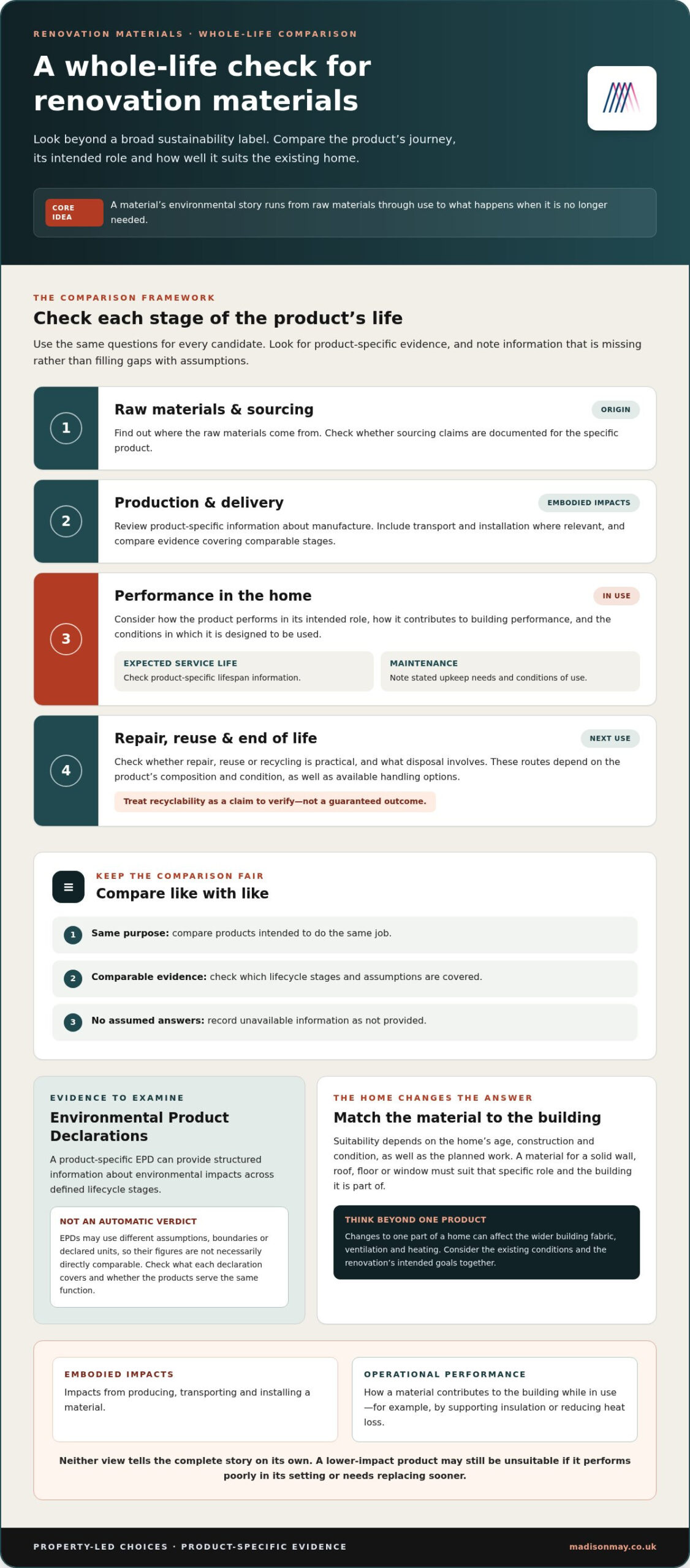
For renovation, judge a material across its whole life: where its raw materials come from, how it is manufactured and transported, how it performs in the home, and what can happen to it when it is no longer needed. This gives a more useful picture than a broad green label, which cannot by itself show whether a product suits a particular building.
The idea sits within the broader principles of sustainable architecture and materials, but renovation calls for a property-led approach. The aim is to improve an existing home with care, not to remove sound materials simply because a newer option is described as greener.
It also helps to distinguish embodied impacts from operational performance. Embodied impacts arise from producing, transporting and installing a material. Operational performance concerns how it contributes to the building while in use, for example by supporting insulation or reducing heat loss. Neither tells the complete story alone. A product with lower manufacturing impacts may still be unsuitable if it performs poorly in its intended setting or needs replacing sooner.
How does whole-life impact apply to a renovation?
Start with the product, not just the material category. Information about sourcing and production can show how a particular product is made and what its environmental claims are based on. For a fair comparison, choose products intended for the same purpose and check that the evidence covers comparable stages, including transport and installation where relevant.
Next, consider how long the product is expected to remain in use. Service life, maintenance needs and contribution to building performance all affect the overall picture. A product that lasts in the conditions it is designed for may avoid replacement, but lifespan claims should be supported by product-specific information rather than assumed from a material’s name. In exterior applications like roofline drainage, durable metal fixtures from specialists such as Copper Gutter Supply Company illustrate how extended service life and lower maintenance can reduce the need for repeated replacements.
Finally, look at end of life. Reuse, recycling, repair and disposal are possible routes, but they depend on the product’s composition and condition, as well as available handling options. Treat recyclability as a claim to verify, not a guaranteed outcome.
Why does the existing home change the answer?
A suitable choice depends on the home’s age, construction, condition and planned work. A material selected for a solid wall, for instance, needs to be considered in relation to that wall’s construction and condition, not chosen solely because its environmental credentials look attractive. The same applies to a roof, floor or window: the material has to suit its specific role.
Changes to one part of a home can affect the wider building fabric, ventilation and heating. Before choosing an option, understand what is already there and what the renovation is intended to achieve. A product’s sustainability claim cannot replace that assessment, and no single material guarantees lower energy use, improved comfort or a particular saving in every property.
In practice, sustainable building materials for renovation are supported by credible, product-specific evidence and suited to the home’s needs over time. This whole-life, property-first approach helps protect what is working, identify what needs improvement and make each material choice part of a considered renovation.
How to compare sustainable renovation materials across their lifecycle
A consistent comparison makes sustainability claims easier to assess without reducing them to a single score. Choose products designed for the same job, then note what the available evidence says about sourcing, production, expected service life and end-of-life options. A broad claim about a material category is less useful than information about the specific product you are considering.
A product’s environmental story extends from its raw materials to its eventual reuse, recycling or disposal, not just the moment it is bought.
Use this framework for each candidate. Add a note or source reference in every cell, and mark information that is not provided rather than filling gaps with assumptions.
| Candidate | Source | Production evidence | Expected service life | End-of-life options |
|---|---|---|---|---|
| Product A | What are the raw materials, and are sourcing claims documented? | Is product-specific information available on manufacture and impacts? | What is stated about lifespan, maintenance and conditions of use? | Can it be repaired, reused or recycled, and how is this supported? |
| Product B | Record the equivalent sourcing details for a fair comparison. | Look for evidence covering comparable production stages. | Note stated lifespan and maintenance on the same basis. | Record the practical route for reuse, recycling or disposal. |
What evidence can support a material’s sustainability claims?
A product-specific Environmental Product Declaration (EPD) can provide structured information about a product’s environmental impacts across defined lifecycle stages. It is evidence to examine, not an automatic verdict. EPDs may use different assumptions, boundaries or declared units, so their figures are not necessarily directly comparable. Check what the declaration covers and whether the products serve the same function. The UK Green Building Council (UKGBC) also provides wider context on lower-carbon and circular approaches in the built environment.
For timber, look for independent documentation supporting any responsible-sourcing claim, such as relevant timber certification. Give more weight to verifiable product information than to general marketing terms such as “natural” or “eco-friendly”, which do not explain how a claim has been assessed.
How should durability and end-of-life options affect the comparison?
Compare stated service-life information and maintenance requirements where they are documented, and consider whether the product suits the conditions in which it will be used. Renewable raw materials or recycled content may be valuable, but neither proves a lower whole-life impact on its own. The answer also depends on processing, transport, product performance and how long the material remains in service.
Check the practical end-of-life route, too. Repair may extend a product’s use; reuse depends on it being recoverable and suitable for another purpose; recycling depends on the material and available processes. If the evidence only says “recyclable”, do not assume it will be collected or recycled in practice. This comparison can inform a property-focused Retrofit Assessment, helping relate material choices to the home and planned improvements.
Which sustainable building materials suit different renovation needs?
The right material depends on the part of the home being improved and what the work needs to achieve. A roof insulation choice, for example, must suit the roof construction. A material that looks favourable in isolation may not fit the building or planned work. Use the comparison below to focus on relevant evidence and trade-offs rather than looking for one winner across every application.
| Renovation application | Evidence to seek | Principal trade-off |
|---|---|---|
| Loft or roof insulation | Product-specific performance information, sourcing, service life and end-of-life options | Suitability depends on roof type, condition and how the wider fabric performs |
| Internal wall insulation | Evidence for the insulation product and its intended use, alongside installation requirements | Must be considered in relation to wall construction, available space and ventilation |
| Timber in refurbishment | Documented sourcing, durability, maintenance needs and potential for reuse | Performance and environmental credentials vary by product and application |
| Recycled-content or mineral-based products | Declared recycled content, production information, lifespan and end-of-life route | Recycled content or mineral origin alone does not establish whole-life impact |
Material suitability depends on the building element and project objective, not on a universal ranking of “green” options.
How do insulation materials differ in existing homes?
Cellulose, sheep’s wool and cork are examples of insulation categories available in the wider market. For each product, compare evidence on sourcing, performance for its intended application, service life and end-of-life options. The detail matters: products within one category can differ, and broad claims about renewability do not show how a particular product performs.
In an existing home, insulation decisions also need to account for ventilation and the condition of the building fabric. Madison May provides Loft & Roof Insulation and Internal Wall Insulation as part of its energy-efficient home improvements. A property-led assessment helps place these measures in the context of the home, rather than treating insulation as a standalone material swap.
When might timber, recycled or mineral-based materials be considered?
Timber may suit some refurbishment work where its documented sourcing, durability and potential for reuse align with the project. When focusing on interior joinery and fitted spaces, specialists such as Reality Kitchens can help homeowners choose durable materials and bespoke designs that stand the test of time. Recycled-content products can make use of recovered resources, but check the stated content and production evidence. Mineral-based materials may also suit particular building elements; their suitability depends on the product information and the role they need to perform. None is automatically the more sustainable choice in every situation.
For wider UK energy and net-zero policy context, the UK Department for Energy Security and Net Zero provides government information, though policy material does not determine whether a specific product suits an individual home. Compare the evidence for the product and application, then weigh it against the property’s needs and the intended improvement. This is more dependable than choosing sustainable building materials for renovation by category name alone.
How to choose materials for your renovation without overlooking the building
A good material choice starts with a clear picture of the home, not a product catalogue. Before comparing options, consider the renovation goal alongside the condition of the building fabric, existing insulation, ventilation and heating. This keeps individual decisions in context and reduces the risk of choosing a material that looks suitable on paper but does not fit the property or wider plan.
A property-first process for choosing materials
- Define the renovation goal. Be specific about what you want the work to address, whether that is improving comfort, upgrading insulation or working towards an EPC improvement. Keep your priorities separate from product claims so you can judge options against the needs of your home.
- Understand the property. Record the building’s construction and condition, existing insulation, ventilation arrangements, heating systems and current energy performance. Note areas of concern, such as damp, and include the parts of the home affected by the proposed work.
- Compare relevant evidence. For products intended for the same application, compare documented sourcing, production information, expected service life, maintenance and end-of-life options. Set aside broad claims that do not relate to the product or the job it needs to do.
- Plan the measures together. Consider how each proposed change relates to the existing fabric and other planned work. Decide on a sensible sequence for the project rather than buying materials as isolated upgrades.
What should a property-first material checklist include?
Bring together the facts that will shape the decision: the condition and construction of walls, roof and other relevant elements; insulation already in place; ventilation; heating systems; and energy performance. Then write down your priorities, such as comfort or an EPC improvement. This helps distinguish a project requirement from a marketing message. Assessment findings can inform which measures may be appropriate, but they do not guarantee a particular result.
Insulation needs particular care. Changing how heat moves through a wall or roof can affect how that part of the building performs, so consider ventilation and the wider fabric at the same time. Choosing insulation by material category alone overlooks how the home is built and its condition.
How can the renovation plan keep measures coherent?
Think of the project as a connected set of improvements. Consider a proposed insulation measure alongside ventilation and the condition of the area being upgraded, then plan how it fits with any heating work. A property-first sequence helps identify dependencies and make material decisions more purposeful. An EPC Improvement Plan can also set out a roadmap of potential upgrades.
Madison May’s Retrofit Assessments review insulation, ventilation, building fabric, heating systems and overall energy performance. Each assessment takes 1-2 hours, with a full report delivered within 3-5 working days. If you want to understand your property before selecting measures, arrange a Retrofit Assessment to inform your renovation planning.
How Madison May supports informed renovation material decisions
Comparing material claims is only part of a considered renovation. Before choosing what to install, understand how a proposed measure relates to the home’s construction, condition and energy performance. Madison May supports this property-first approach through Retrofit Assessments, EPC Improvement Plans and Retrofit Coordination, helping homeowners, landlords and housing providers consider individual decisions in the context of the whole property.
What does a Madison May Retrofit Assessment consider?
A Retrofit Assessment reviews the building fabric, existing insulation, ventilation, heating systems and overall energy performance. These details build a picture of the property before measures are considered, so recommendations can respond to the home rather than rely on a generic material choice. Your priorities and the building’s condition can inform a tailored improvement plan without assuming that one product or intervention suits every property.
An assessment takes 1-2 hours, and the full report is delivered within 3-5 working days. This gives you a basis for weighing renovation options, including sustainable building materials for renovation, against the needs of your home. Madison May also provides EPC Improvement Plans, with improvement plans that are PAS 2035 compliant.
How does Madison May support the next stage?
Once the property and potential measures have been considered, planning can connect material decisions with the work required. Madison May’s insulation services include Loft & Roof Insulation and Internal Wall Insulation. The right measure depends on the property and improvement plan, so material choices should sit within the wider assessment of the fabric, ventilation and heating rather than being treated as standalone purchases.
For projects involving multiple measures, Retrofit Coordination oversees works to meet PAS 2035 requirements. This helps keep the process aligned with the improvement plan as work progresses. Madison May supports clients with identifying available funding and meeting the technical requirements needed to apply.
The value of this approach is in connecting evidence about materials with the practical realities of the home: what needs improvement, how proposed measures relate to each other and how the work can be planned coherently. An assessment provides informed direction, not a guaranteed result, leaving room for decisions that reflect the property and your renovation goals.
If you’re ready to discuss your home and its potential improvements, Book your assessment or request a quote from Madison May.
Make your next renovation decision with confidence
Your next step need not be choosing a product straight away. Start by turning your priorities, from comfort to the character of your home, into clear goals for the work ahead. This gives material choices a purpose: consider them as part of a home you want to improve and care for over time, rather than as isolated purchases.
Madison May’s Accredited Retrofit Assessors & Coordinators can help you move from those priorities towards a plan informed by your property. Its PAS 2035-compliant improvement plans are shaped by property data, giving you a framework for the decisions ahead. That makes it easier to approach sustainable building materials for renovation with your home’s needs in view and choose measures that reflect how you want it to feel and function.
Start with a clearer understanding of the property, then take the next step for your project. Book your assessment and move towards a more thoughtfully planned renovation.
Frequently Asked Questions
What is a retrofit assessment?
A full property survey reviewing insulation, ventilation, fabric, heating systems and energy performance to create a PAS-compliant improvement plan.
Do I need to upgrade my EPC rating?
Many landlords and homeowners are choosing to improve their EPC rating to reduce bills, future-proof properties and meet upcoming regulatory targets.
How long does an assessment take?
Most homes take 1-2 hours, with a full report delivered within 3-5 working days.
Do you help with grant funding applications?
Yes – the company supports clients with identifying available funding and meeting the technical requirements needed to apply.