

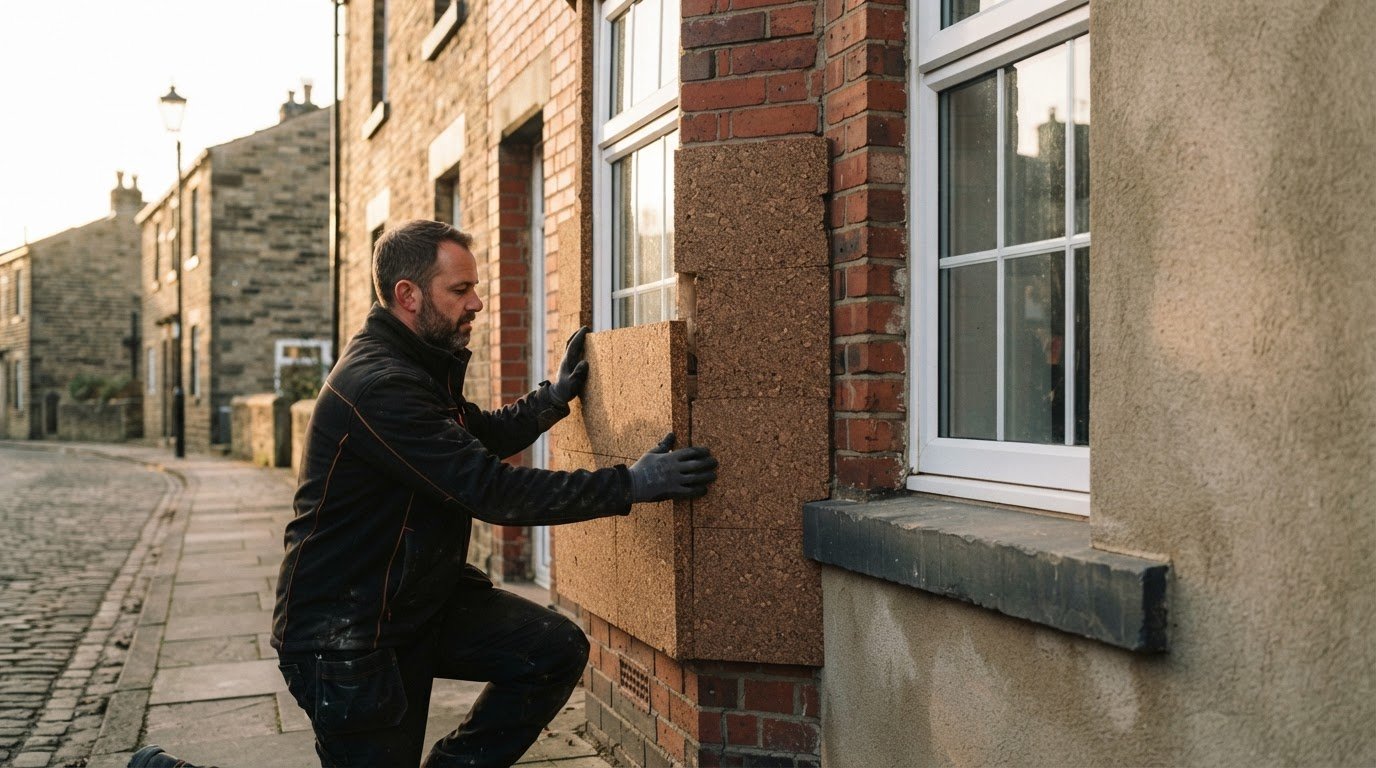
The cost of cork insulation for external walls depends on the wall area, its condition, the application method and the finish. To understand the full project cost, look beyond the cork itself: preparation and access can also affect the work involved.
It’s natural to want a clear budget before choosing an upgrade. Cork boards create a thicker insulating layer, while a granule coating is applied directly to the existing surface; each approach brings different considerations for thermal and acoustic performance.
This guide explains the factors that shape project costs and compares board and granule applications. You’ll learn how the wall, insulation build-up and finish affect the choice, so you can assess which approach may suit your home.
Key Takeaways
- Estimate the scope of the work by considering the wall area, access, preparation and finish, not just the insulation material.
- Compare cork boards with granule coatings by how they are applied and the space available for a thicker wall build-up.
- Assess thermal performance alongside acoustic comfort, since the right choice depends on the building and the outcome you want.
- A retrofit assessment can help identify how external wall insulation fits with other improvements to the home.
How Much Does External Wall Insulation Cost in the UK?
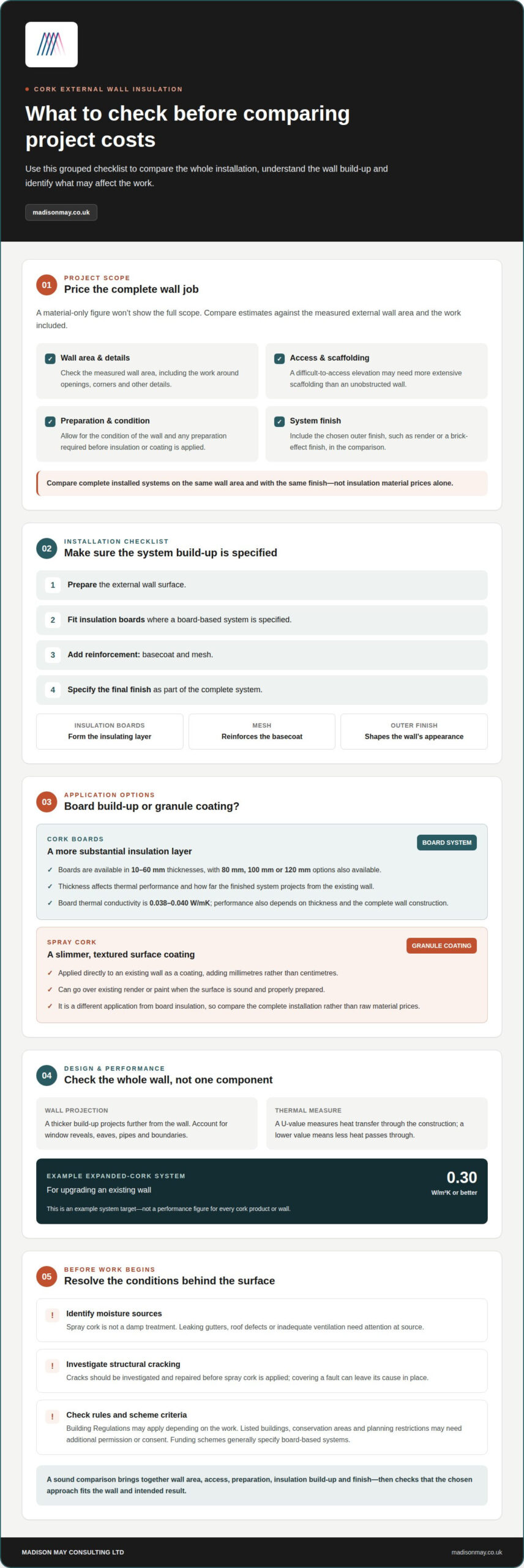
The cost depends on wall area, the insulation system, access and the finish. For a solid-wall home, compare the complete installed system rather than focusing on the insulation material alone.
Cost per Square Metre
A per-square-metre estimate shows the cost across each square metre of external wall being insulated. It can help you compare estimates, but the total also depends on the measured wall area and the work required around openings, corners and other details.
For example, two homes with similar floor areas can have different external wall areas and access requirements. Scaffolding, wall preparation and decorative finishes can all affect the project cost, so a material-only figure won’t show the full scope.
Insulation Thickness and Thermal Performance
Board thickness is the depth of insulation added to the wall, and it influences the thermal performance of the finished construction. Cork boards are available in thicknesses from 10 to 60 mm, with 80, 100 or 120 mm options also available.
A thicker insulation build-up can improve thermal performance, but it also projects further from the existing wall. The design needs to account for window reveals, eaves, pipes and boundaries. External wall insulation can improve energy efficiency in solid-wall properties by reducing heat loss through the walls.
External wall insulation is often considered for a solid wall, where insulation cannot be fitted within a cavity. Installation involves preparing the outside surface, fixing boards, then applying reinforcement and a finish. Installation time can vary with the property, and scaffolding may affect access around the home.
Planning permission and Building Regulations are separate considerations. Building Regulations may apply depending on the nature and extent of the work. Listed buildings, conservation areas and properties with planning restrictions may also need additional permission or consent.
Funding schemes generally specify board-based external wall insulation systems. This matters when considering support for cork insulation: a cork board system differs from a spray or granule coating, and scheme criteria may influence which approach is suitable.
Factors affecting installation costs
The final cost reflects more than the insulation itself. Access and wall condition can affect preparation, installation and finishing work. For example, a difficult-to-access elevation may need more extensive scaffolding than an unobstructed wall.
Installation typically involves preparing the external wall, fitting insulation boards, then adding a reinforced basecoat, mesh and final finish. Traditional systems may use render or a brick-effect finish, and the choice affects both cost and appearance. Consider the system’s components together rather than treating the boards as the whole installation.
Moisture and existing damage also affect the work required. Spray cork is not a damp treatment, so it won’t resolve underlying problems such as leaking gutters, roof defects or inadequate ventilation. Structural cracking should be investigated and repaired before spray cork is applied. Covering a crack or source of damp without addressing it can leave the cause of heat loss or moisture in place.
A common mistake is choosing an exterior coating to address damp without first identifying its source. Another is applying spray cork over a surface that hasn’t been properly prepared. It can go over existing render or paint when the surface is sound. With board systems, overlooking the basecoat, mesh or final finish can leave the project specification incomplete.
Each element has a distinct role: insulation boards form the insulating layer, mesh reinforces the basecoat, and the outer finish shapes the wall’s appearance. If you’re planning insulation upgrades, considering the wall condition, moisture source and full system build-up helps define the work before installation begins.
Cork insulation board and granule applications
Cork can be installed as solid boards or applied as a spray coating containing cork granules. These methods create different wall build-ups and finishes, so compare complete installation costs rather than material prices alone.
They form a thicker insulating layer and can be combined with a reinforced basecoat, mesh and render finish. Cork board thermal conductivity is 0.038-0.040 W/mK, a measure of how readily heat passes through the material. Board performance also depends on the thickness and complete wall construction.
Spray cork is applied directly to an existing wall as a coating, adding millimetres rather than centimetres. Its cost shouldn’t be compared directly with the price of cork board material, because it covers a different application method.
Cork boards can provide the main insulation layer, with spray cork used as a separate surface coating where the design calls for it. Combining them doesn’t automatically improve the wall: consider the full build-up, including the substrate, moisture movement and external finish. Spray cork can go over existing render or paint when the surface is sound and properly prepared.
Those figures cover installed systems, unlike the price of cork board material alone. Compare wood fibre as a complete installed system too, using the same wall area and including the same finish, rather than comparing it with a raw board price.
Choose the application to suit the wall and intended result. Boards create a more substantial build-up; granule coatings preserve a slimmer profile and provide a textured finish. Junctions around openings and edges affect how cohesive the finished wall looks and feels.
Thermal and acoustic performance
Cork’s thermal performance depends on thickness and the complete insulation system, not material alone. An example expanded-cork system for upgrading an existing wall aims for a U-value of 0.30 W/m²K or better. A U-value measures heat transfer through the construction; lower values indicate less heat passing through.
Spray cork works differently from a thick board build-up. A reported 6-millimetre spray-cork application can reduce heat loss through walls by up to 30 per cent. That figure describes a particular reported application, not every wall or system. Because spray cork adds millimetres rather than centimetres, it generally achieves higher U-values than thicker external wall insulation.
Thickness matters. A board system creates a deeper insulating layer, while a thin coating changes the existing wall’s surface with little added depth. Cork’s thermal conductivity is 0.038-0.040 W/mK, describing how readily heat travels through the material. The final wall performance also reflects the original construction, installation details and condition of the substrate.
Acoustic comfort depends on the whole wall assembly, including the existing masonry, insulation layer and finish. Cork may contribute to sound absorption, but a coating and a thicker board system won’t create identical acoustic conditions. Gaps around windows or poorly treated junctions can also affect how sound travels through the finished construction.
Moisture and weather exposure matter alongside thermal performance. Spray cork is described as breathable and vapour open, allowing moisture in solid walls to escape. That doesn’t make it a damp treatment: leaking gutters, roof defects and inadequate ventilation still need their underlying causes addressed. The substrate must be sound and prepared before the coating is applied.
For a clearer view of how wall construction affects warmth and sound, arrange a retrofit assessment to consider the existing building fabric and suitable insulation approach.
Madison May Consulting: Insulation upgrades
Madison May helps homeowners consider insulation upgrades as part of a wider approach to energy-efficient home improvements. This can be useful when weighing cork boards against a thinner coating, or considering how external wall insulation might fit alongside other changes to your home.
The right choice depends on the property’s construction, wall condition and desired finish. Considering insulation in context can help you understand how it relates to windows and doors or conservatory upgrades, rather than treating each improvement in isolation.
For a considered discussion of your property and possible improvements, contact Madison May Consulting Ltd.
Shape the next step around your home
The cost of cork insulation for external walls can be considered as part of a wider plan for how your home should perform and feel. Think about the property’s character, exterior details you want to preserve, and how the finished wall will sit alongside windows, entrances and other features. This helps give the material choice a clear purpose, beyond appearance alone.
Madison May can consider insulation alongside energy-efficient home improvements, including windows and doors and conservatory upgrades. Discussing these elements together can help you understand how each change relates to the home as a whole, while keeping your priorities at the centre.
For a considered discussion of your property and possible improvements, contact Madison May Consulting Ltd. A thoughtful next step can make the route ahead feel clearer and help your home better reflect the comfort and character you value.
Frequently Asked Questions
Is there a reduction in energy bills after external insulation?
External wall insulation can reduce energy bills by up to 35%, depending on the home’s original energy consumption. A household that previously used more energy for heating may see a different effect from one that already used less. The improvement also depends on how the insulation fits the building as a whole, including how heat escapes through other parts of the property.
How long does the work take?
External wall insulation installation typically takes 5-10 days, depending on the property’s size and condition. The schedule can include preparing the wall, fitting the insulation, applying reinforcement and completing the external finish. Weather can affect the timing of work involving external coatings, while complex wall details may influence the sequence. The home remains occupied during many projects, but access around the exterior changes during installation.
How long will the insulation last?
External wall insulation can last 25 to 30 years when high-quality materials and experienced professionals are used. Its working life depends on the system being installed correctly and maintained, with the render or other finish helping protect the insulation from weather exposure. Damage to the outer layer should be addressed as part of upkeep, since the finish is the system’s exposed protective surface.
What is the average cost per m² of external wall insulation using cork in the UK?
These figures describe different cork applications, not like-for-like installed prices: boards form an insulation layer, while spray cork is applied as a coating. Compare the same method, wall area and work scope when assessing costs.
How much does cork external wall insulation cost for a typical UK house?
There isn’t one whole-house figure that applies to every cork system. The market range for external wall insulation across systems is typically £9,000 to £17,000, with a median of about £12,000. This is a general market comparison, not a cork-specific quote. The total for a particular home depends on its wall area and the chosen application and finish.
What factors affect the price of cork external wall insulation, including thickness and finish?
Wall area, cork application, board thickness and finish all shape the project scope. Thicker boards use more material and project further from the existing wall, which can affect details around windows, pipes and eaves. The wall’s condition matters too: repairs or preparation may be needed before insulation is applied. Access and the chosen outer finish also influence the work involved.