

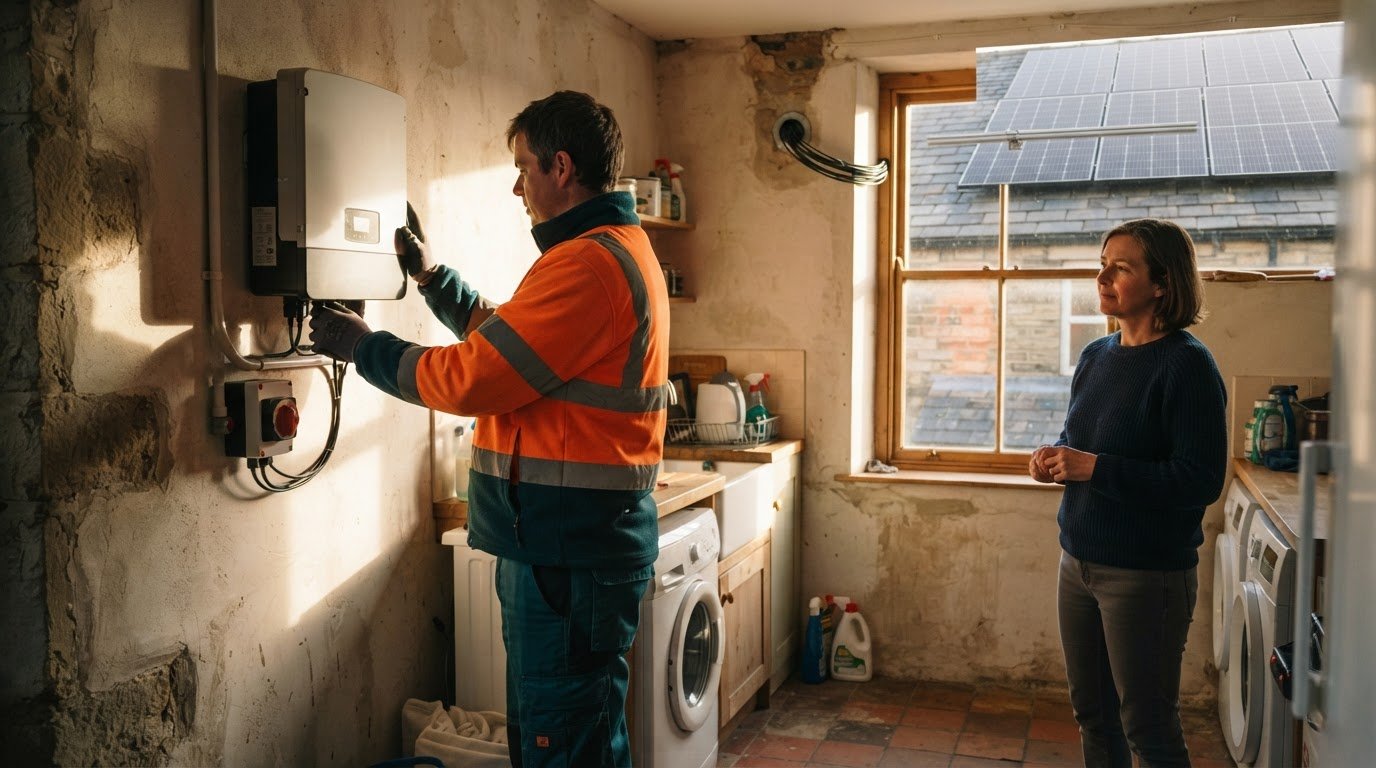
Solar panels can improve an EPC score by up to 15 points, but installing them won’t automatically update an existing certificate. Improving an EPC rating with solar panels starts with understanding the scale: according to the UK Government, homes are rated from A, the most efficient band, to G, the least efficient.
It’s natural to ask whether solar panels could move your home into a better EPC band. The effect depends on how the system is recorded in the assessment and on the property’s overall performance, so the same change in points will not produce the same band improvement in every home.
This guide explains what an EPC rating means, how assessors calculate it and what solar documentation they need. You’ll also learn how to have panels included in a new assessment, which other improvements can contribute, and how to understand the potential effect on your home’s EPC band.
Key Takeaways
- Keep records that describe your solar system, so the assessor has information to include it in the assessment.
- Understand which household energy uses shape the EPC score, and why the property’s overall performance matters.
- Consider system size and how much of its electricity your home uses on site when assessing solar’s potential contribution.
- Look at solar alongside other energy-efficiency improvements to identify a considered route towards a stronger EPC rating.
Does the EPC assessor need documentation of the solar system?
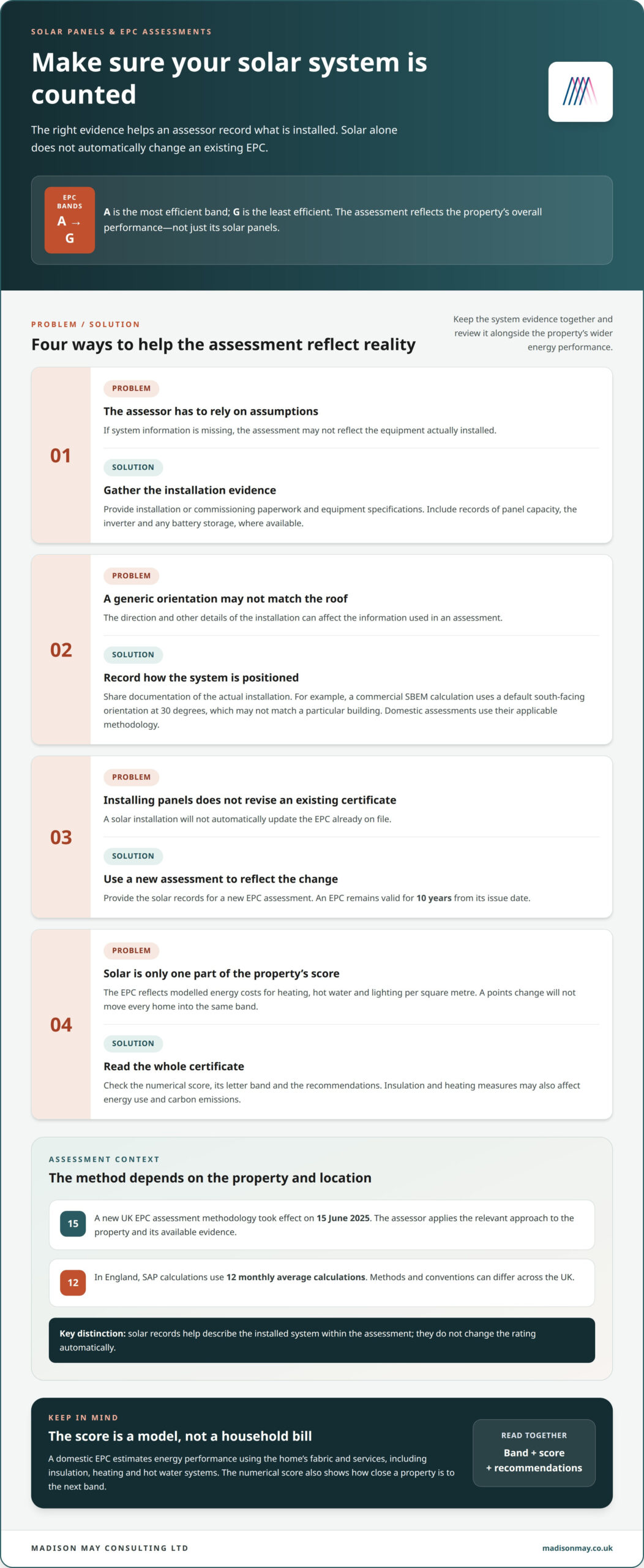
- Gather evidence of the installation. Give the assessor documents that describe the solar PV system, such as its installation or commissioning paperwork and equipment specifications. These details help distinguish the system’s actual features from assumptions used when information is unavailable. Include records showing the panel capacity, inverter and any battery storage, where available, so the assessment reflects the installed equipment.
- Explain how the system is positioned. Panel orientation and other system details can affect the information used in an assessment. Provide documentation that records the installation rather than relying on a generic assumption. For example, a commercial SBEM calculation uses a default south-facing orientation at 30 degrees, which may not match a particular building’s roof. Domestic assessments use their applicable methodology.
- Use the current assessment method. A new UK EPC assessment methodology took effect on 15 June 2025. In England, SAP calculations use 12 monthly average calculations. Since methods and conventions can differ across the UK, the assessor applies the relevant approach to the property and its available evidence. Solar records help describe the system within that assessment, rather than changing the rating automatically.
- Review the existing certificate and recommendations. An EPC rates a property from A, the most efficient band, to G, the least efficient, according to the UK Government. Read its recommendations alongside the solar documentation: insulation or heating measures may also be relevant to energy use and carbon emissions. Installing panels doesn’t update an existing certificate; a new assessment is needed to reflect them. An EPC remains valid for 10 years from its issue date.
- Keep the rating in context if you’re a landlord. In England and Wales, covered domestic private rented properties must meet the minimum EPC rating of E, according to the Ministry of Housing, Communities and Local Government. Landlords who fail to meet the applicable minimum energy-efficiency standard can face compliance notices and fines of up to £5,000, according to the Ministry of Housing, Communities and Local Government. Solar evidence supports assessment, but the rating depends on the whole property.
How EPC ratings are calculated
- Start with the right rating scale. The UK Government rates homes from A, the most efficient band, to G, the least efficient. The score reflects modelled energy costs for heating, hot water and lighting per square metre. It is an estimate of a building’s energy performance, not a record of every household’s actual energy bills.
- Understand what the domestic assessment models. In England, SAP calculations use 12 monthly average calculations. The assessment considers the home’s fabric and services, including insulation, heating and hot water systems. These inputs shape the estimated energy efficiency and running costs. Installing heat pumps or improving insulation can alter the modelled performance, because each measure affects how the home uses energy.
- Read the certificate as a whole. The letter band gives a useful summary, while the numerical score shows how close the property sits to the next band. For example, a home near a band boundary may need fewer score points to move up than one further away. The recommendation section identifies measures that could improve its calculated performance.
- Distinguish domestic and commercial calculations. Commercial assessments use the Simplified Building Energy Model, or SBEM, to model a building’s energy use and carbon emissions. Its output includes the Building Emission Rate (BER), which expresses modelled emissions for the building. SBEM calculations for new buildings and certain existing commercial buildings are carried out to Level 4 or Level 5, depending on building-services complexity.
- Interpret commercial results in context. The commercial scale runs from zero to 150 or more, with zero representing net-zero carbon performance. A BER is part of the calculation, not a direct measure of household energy bills. The property’s services, fabric and energy systems shape its result. A considered package of energy-efficient home improvements can address several influences together.
How do I improve the EPC rating of my home?
Use these steps to judge whether solar suits your roof, electricity use and wider home-improvement plans.
-
Assess factors limiting solar improvements
First, assess your roof’s direction and shading, as both affect how much electricity the panels can generate. Trees, nearby buildings and roof features can cast shade over the array and reduce its output. Factor these constraints into your expectations for the system’s contribution to your EPC. A suitable, unshaded roof can support generation; a shaded or poorly oriented roof may limit it.
-
Match system size to on-site electricity use
Choose a system size that reflects household electricity demand and the amount likely to be used at home. Most UK residential installations range from 3kW to 5kW; a typical system generates 3,200-4,000 kWh annually. A battery can store surplus electricity for later use, increasing self-consumption from 30-40% to 60-80% with a 5-10kWh system. This balance is central to improving EPC rating with solar panels, as system output and household demand shape the assessed contribution.
-
Choose and install a solar PV system
Compare the proposed system’s capacity and expected generation with your household’s use, roof conditions and future plans. A 4kW system is a common reference point, but the right design depends on the home. Consider solar alongside heating system improvements: an efficient boiler can reduce energy demand, while suitable heating controls help manage how heat is used. A whole-home approach to improving EPC rating with solar panels considers these measures together, rather than relying on generation alone.
-
Review installation costs and incentives
The Energy Company Obligation (ECO4) scheme is identified as the only active government grant for solar panels. Eligibility and support depend on scheme criteria. Assess the investment alongside on-site electricity use, system size and any battery, rather than assuming a grant or a particular EPC change.
Solar’s potential effect on EPC bands
A 4 kW solar PV system can earn up to 15 EPC points, and solar panels may improve a property’s rating by up to two bands. The effect depends on the home’s starting score and how its energy use is modelled. A considered approach to improving EPC rating with solar panels starts by understanding what those points mean for the property.
- Interpret the potential change in points and bands. EPC scores determine whether a property sits within band A, B, C, D, E, F or G. Gaining points may improve the score without crossing into a higher band. Compare the current score with the next band threshold, then consider how solar generation could alter the assessment’s calculation of energy costs and carbon emissions. This makes the likely band outcome clearer than looking at panel capacity alone.
- Consider solar alongside other measures. A joined-up set of improvements can influence more than one part of a home’s energy performance. Combining solar PV with measures such as a heat pump, better insulation or improved lighting may support a larger change than panels alone. A coordinated package could move a property from E to B or even A, though the route depends on its existing condition.
- Assess battery storage for its actual role. An EPC currently doesn’t assess how energy is stored in a home, so adding a battery does not directly raise the certificate’s rating. It may help a household use more renewable electricity, but improving EPC rating with solar panels relies on the assessment’s treatment of generation, not storage alone.
- Relate the rating to your property’s purpose. For a rented home, an improved EPC band may help meet the applicable minimum standard in England and Wales. For any home, use the score alongside expected running costs and the property’s wider improvement priorities. Solar’s contribution is best understood as one part of the overall energy picture.
For a considered view of which measures may support your home’s EPC performance, explore an EPC improvement plan.
Madison May Consulting Ltd
Madison May can help you understand how solar fits into a wider home-improvement plan. Its retrofit assessments review the building fabric, services and ventilation to identify practical ways to reduce heat loss and improve energy efficiency. An EPC improvement plan can consider solar alongside relevant measures such as insulation, heating upgrades, windows and doors, or conservatory upgrades, so decisions account for the property as a whole.
Consider this support when weighing solar’s likely effect, reviewing EPC recommendations or deciding which improvements to prioritise. The aim is a clear, considered plan shaped around your home’s existing performance, rather than a single upgrade in isolation.
Contact Madison May Consulting Ltd to discuss your home’s energy-efficiency priorities.
Shape your next home improvement decision
Treat solar as part of your home-improvement plan, not an isolated addition. A well-considered upgrade can contribute to a more comfortable, efficient home while respecting your property’s character and practical needs. Start by deciding what matters most: reducing energy use, addressing heat loss or planning upgrades in a sensible order.
Improving your EPC rating with solar panels is therefore part of a wider conversation about how your home performs and how each change contributes. Madison May can help you consider the whole picture, including energy-efficient improvements, windows and doors, and conservatory upgrades, in light of your home’s needs.
Contact Madison May Consulting to discuss a thoughtful way forward for your home. Each considered decision can bring you closer to a home that feels more comfortable, works more efficiently and reflects the way you want to live.
Frequently Asked Questions
What do EPC ratings mean?
An EPC rating places a property in a band from A, the most efficient, to G, the least efficient, according to the UK Government. The band summarises assessed energy performance, while the underlying score shows how close the property is to a band boundary. It’s a modelled assessment, not a prediction of exact household bills, which also depend on how occupants use energy.
Can solar alone get my commercial building to EPC B?
Solar alone can’t establish that a commercial building will reach EPC B. A well-specified commercial solar installation typically improves a rating by 1 to 3 bands, but the starting rating and wider building performance shape the result. SBEM assesses the building as a whole, so heating, lighting, insulation and other services matter alongside on-site generation.
How are EPCs calculated?
Domestic EPCs use a model of the property’s energy performance, based on features such as its fabric, heating and hot water systems. In England, SAP calculations use 12 monthly average calculations. Commercial assessments use SBEM, which models the building’s energy use and emissions. The relevant method depends on the property type and assessment context, so domestic and commercial scores aren’t directly interchangeable.
How does solar impact EPC ratings?
Solar PV generation is included when an EPC assessment calculates energy costs and carbon emissions. A 4 kW system can earn up to 15 EPC points, and solar may improve a property’s rating by up to two bands. Points don’t always mean a higher band: the starting score and distance to the next band boundary affect whether the rating changes.
How is the EPC methodology changing, and does that affect solar’s value?
A new UK EPC assessment methodology took effect on 15 June 2025. The government has also confirmed a further reform adding four headline metrics alongside the carbon rating. For solar, its assessed contribution remains connected to energy costs and carbon emissions. When comparing certificates, consider the assessment date and methodology as well as the band, since the framework can change how performance is presented.
How do solar panels affect EPC calculations and energy costs?
The EPC accounts for solar PV generation when modelling energy costs and carbon emissions. Electricity used at home can offset some imported power, while surplus electricity exported to the grid may earn income through Smart Export Guarantee tariffs. An EPC models performance; it does not record a household’s actual bills. Generation, when you use electricity and how much you export all affect the difference between the assessment and real-world costs.