


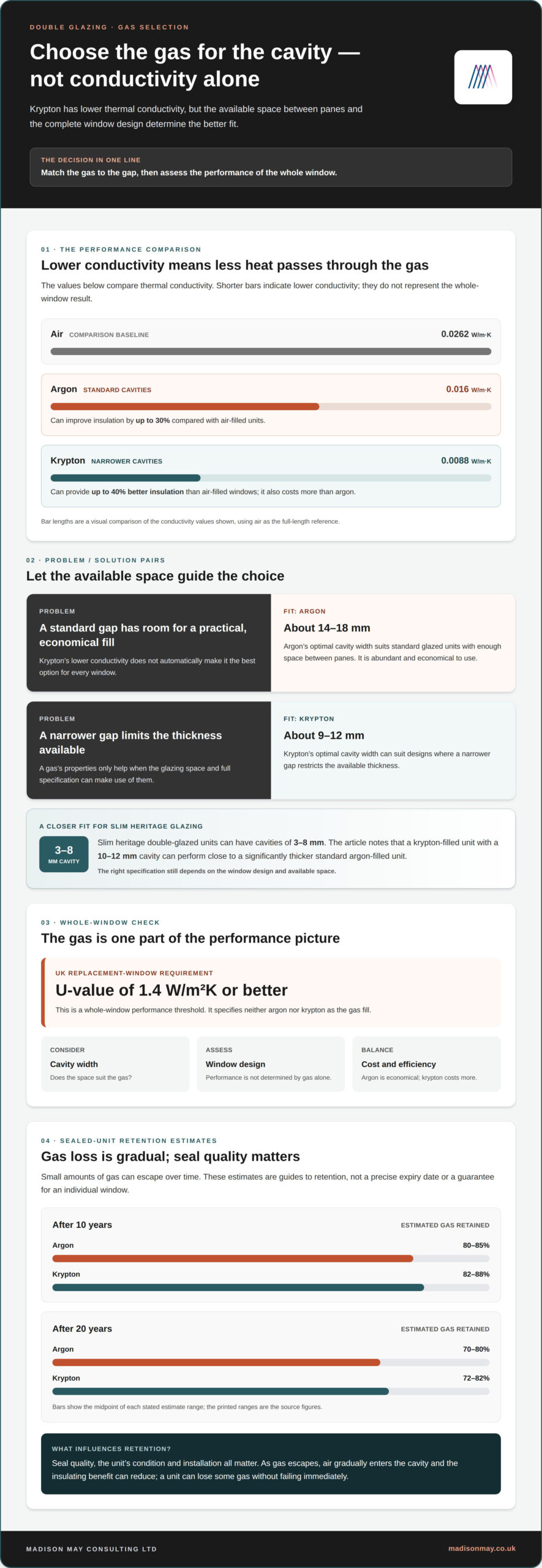
Krypton isn’t automatically the better choice: the size of the gap between the panes matters. In argon vs krypton filled double glazing, argon has a thermal conductivity of 0.016 W/m·K, compared with 0.0088 W/m·K for krypton; both are less conductive than air at 0.0262 W/m·K. Argon-filled windows can improve insulation by up to 30% compared with air-filled units, while krypton can provide up to 40% better insulation than air.
It’s natural to assume the gas with lower thermal conductivity will provide the warmest result, but the best choice depends on how it performs in the space available. This guide compares argon and krypton with air, explains whether gas can escape from a sealed unit, and shows how cavity width and window design influence the choice. You’ll see when argon is a practical fit and when krypton’s performance in a narrower cavity may make it worth considering.
Key Takeaways
- Match the gas to the cavity width: krypton can suit slimmer spaces, while argon is a practical option for standard gaps.
- Assess insulation as a whole-window result, not by gas alone; glazing design and the space between panes also matter.
- Understand how seals affect gas retention and what gradual leakage may mean for a unit’s long-term performance.
- Use a retrofit assessment and improvement plan to identify where reducing heat loss could make the greatest difference in your home.
Is krypton always better than argon?
No. Krypton has lower thermal conductivity, but cavity width and the design of the complete window determine which gas is the better fit. For homeowners comparing argon vs krypton filled double glazing, the gas is only one part of the performance picture.
Argon thermal performance and suitability
Argon has a thermal conductivity of 0.016 W/m·K, compared with air at 0.0262 W/m·K. It can improve insulation by up to 30% compared with air-filled units, and is abundant and economical to use. Its optimal cavity width is about 14 to 18 mm, making it suitable for standard glazed units with enough space between panes.
UK Government states that UK replacement windows must meet a whole-window U-value of 1.4 W/m2K or better. This requirement sets a performance threshold, rather than specifying argon or krypton as the gas fill.
Krypton thermal performance and suitability
Krypton’s thermal conductivity is 0.0088 W/m·K, and it can provide up to 40% better insulation than air-filled windows. Its optimal cavity width is about 9 to 12 mm, so it can suit designs where a narrower gap limits the available thickness. The drawback is its higher cost compared with argon; lower conductivity alone doesn’t make it the right choice for every window.
Krypton-filled units don’t pose a special chemical risk if a seal breaks: both gases are noble gases. A failed seal can still reduce the unit’s performance.
Thermal conductivity and energy bills
Lower thermal conductivity means less heat passes through the gas between the panes. With argon vs krypton filled double glazing, cavity width helps determine how much the gas’s properties benefit the finished unit. Improved thermal efficiency may help lower energy bills, but results depend on the complete window, not the gas alone.
| Option | Thermal conductivity | Typical fit | Consideration |
|---|---|---|---|
| Air | 0.0262 W/m·K | Comparison baseline | Higher conductivity |
| Argon | 0.016 W/m·K | Standard cavities | Economical fill |
| Krypton | 0.0088 W/m·K | Narrower cavities | Higher cost |
Choose a gas to suit the available cavity and the complete window’s U-value and design.
Does argon gas leak out of double glazing?
Yes, small amounts can escape from a sealed unit over time. The rate depends on the seal and installation. Gradual gas loss doesn’t mean the window suddenly stops working.
Gas retention and sealed-unit lifespan
Sealed units are commonly made with gas between the panes. Estimates suggest argon-filled units retain 80-85% after 10 years, whilst krypton-filled units retain 82-88%. After 20 years, estimates place argon retention at 70-80% and krypton at 72-82%.
These figures describe gradual loss, not a precise expiry date. High-quality sealed glass units can retain either inert gas for decades, with minimal leakage. The gas stays in the cavity between the panes, so the sealed unit’s integrity matters more than whether the glazing is double or triple.
Gas loss and expected performance
Argon-filled windows typically maintain their performance for 15-20 years. Estimated argon loss is less than 1% per year; well-made units with dual seals and warm-edge spacer bars are also estimated to lose approximately 1% per year. These are broad estimates, rather than a timetable for every installation.
As gas escapes, air gradually enters the cavity, reducing the insulating benefit. A sealed unit can lose some gas without failing immediately. Performance depends on seal quality, the unit’s condition and the care taken during installation.
Krypton follows a similar pattern of gradual retention loss, with estimates of 72-82% remaining after 20 years. The differences between gases don’t remove the importance of the seal: either can escape if the sealed unit deteriorates. For both gases, the figures offer a guide to retention, not a guarantee for an individual window.
Gas retention is only one aspect of a window’s durability. A sound sealed unit keeps gas in the cavity and limits air exchange; a compromised seal allows the balance to change over time. That’s why installation and unit quality are central to long-term performance.
Why choose a gas-filled window?
A sealed gas layer slows heat transfer between the panes, helping the glazing insulate more effectively. The right specification depends on the gap and the window’s intended use.
Argon-filled window insulation
Argon is about 1.4 times as dense as air, and its properties help reduce heat transfer within a glazed unit. It offers an effective insulation upgrade in standard cavities, where the available space suits its performance. Compared with krypton, argon is generally the more economical choice, making it a practical option for many replacement-window specifications.
Argon’s value lies in balancing improved efficiency with a widely used gas fill, rather than offering the lowest possible thermal conductivity.
Krypton insulation and narrow glazing gaps
Krypton is about 2.8 times as dense as air, and is particularly useful where glazing gaps are narrow. Slim heritage double-glazed units can have cavities of 3 to 8 mm; a krypton-filled unit with a 10 to 12 mm cavity can perform close to a significantly thicker standard argon-filled unit.
This makes krypton a strong candidate when thickness is restricted. Its superior insulating properties matter most when the gap and overall specification make use of them.
Xenon has a thermal conductivity of 0.0051 W/m·K, lower than either argon or krypton. That property makes it relevant to specialist, high-performance applications, rather than an automatic choice for ordinary double glazing. Gas selection still needs to reflect the glazing design, available cavity and performance aim.
For a narrow gap, consider whether krypton can improve insulation without changing the window’s profile. In a standard cavity, argon may offer a more balanced way to reduce heat loss. The gas is only one part of the build: pane specification and the complete window’s thermal performance also shape the result.
Argon and krypton in double glazing
Both gases sit between the panes in a sealed glazing unit, reducing heat transfer through the cavity. The choice of argon vs krypton filled double glazing depends on the space available and the performance you want.
Argon-filled double glazing
Argon is abundant and economical, making it a practical gas fill for typical double-glazed units. A standard 24 mm unit has a 16 mm cavity, which sits within argon’s optimal range. With low-emissivity glass, an argon-filled unit with a 16 mm cavity has an estimated centre-pane U-value of approximately 1.1-1.2 W/m²K.
That value describes the centre pane, not the whole window, so read it in context.
Krypton-filled double glazing
Krypton has lower thermal conductivity than argon and can suit a narrower cavity. Its insulating benefit is estimated to improve U-value by 22-28% compared with air. In argon vs krypton filled double glazing, this makes krypton especially relevant where the design restricts the space between panes, rather than an automatic upgrade for every unit.
Performance still depends on the cavity, glass and wider unit specification.
Unit dimensions help clarify the distinction: a standard 24 mm double-glazed unit has a 16 mm cavity, while a 28 mm unit has a 20 mm cavity. The extra space can affect the gas selection, but a thicker unit is not always suitable for an existing frame. Triple glazing adds another pane and cavity, so its overall design must also be considered.
Argon and krypton are noble gases, formerly known as inert gases. If a window seal breaks, they pose no risk of a dangerous chemical reaction or explosion. A failed seal can still reduce glazing performance, so gas choice doesn’t replace sound unit construction.
For a typical cavity, argon offers a practical option; krypton is worth considering when the available gap is narrower. Compare the unit’s dimensions and whole-window performance before choosing the gas fill.
Madison May Consulting
Madison May Consulting Ltd helps homeowners and landlords consider glazing choices as part of their property’s overall energy performance. If you’re weighing argon against krypton or considering replacement windows to reduce heat loss, a Retrofit Assessment can identify practical improvements in context.
Its PAS 2035-aligned retrofit assessments gather information on the building fabric, services and ventilation, then inform a detailed EPC Improvement Plan and PAS 2035-compliant report. This whole-home perspective helps show how windows and doors relate to other energy efficient home improvements, rather than treating the gas fill as the only factor.
For practical guidance on improving your property’s energy performance, contact Madison May Consulting Ltd to discuss a Retrofit Assessment.
Make the choice part of a wider plan
Choosing between argon- and krypton-filled double glazing is most useful when the decision reflects the needs of the whole property, not just one item on a window quote. Consider which rooms feel least comfortable, the building’s character and how each proposed change fits your longer-term plans for the home. This keeps a technical choice connected to the comfort you want to create.
If you’re unsure how glazing fits among other possible improvements, a Retrofit Assessment can bring the options into focus. It provides a clearer foundation for deciding what to prioritise, rather than treating each upgrade in isolation.
Contact Madison May Consulting to discuss your property and the next steps you’re considering. A well-considered decision can move your home towards a more comfortable future.
Frequently Asked Questions
How much better is argon than air in a window?
Argon-filled double glazing can improve the unit’s U-value by 12-15% compared with air. The improvement describes heat passing through the glazing, not a guaranteed reduction in household bills. Glass coatings and cavity design also influence the result, so compare the full window specification. For example, argon with soft-coat low-E glass and a 16 mm cavity is estimated to achieve a whole-window U-value of 1.2-1.4 W/m²K.
Can I replace the gas fill later?
Replacing the gas itself is not usually a simple alteration to an installed sealed unit. The panes and edge seals form a closed assembly, so changing its contents would mean disturbing the seal. If you’re planning a window upgrade, consider the gas fill as part of the replacement unit’s specification, alongside the glass, cavity and frame. Resources from replacement specialists such as windowgalaxy.com can help homeowners understand how different glass packages and frame styles work together. This keeps the decision focused on the complete window’s performance.
Can I tell what gas is in my existing double glazing?
You generally can’t identify argon or krypton just by looking through the glass: both are colourless. The original window documents or product specification may record the gas fill and cavity details. Without those records, appearance alone won’t reliably distinguish a gas-filled unit from one filled with air. The unit’s overall condition and performance are more useful clues when considering an upgrade.
Can existing windows be refilled with gas?
Gas is held inside the sealed glazing unit, so refilling it is not normally a straightforward way to restore the original specification. If the seal has failed, replacing the sealed glass unit is the usual way to address the problem. Depending on its condition, the existing frame may stay in place. The replacement unit’s gas and cavity can then be specified together.
Gas retention rates: how long does the gas stay in?
Sealed glazing units are made with at least 90% gas fill, and retention gradually changes as small amounts escape. The rate depends on the unit and its seals, so estimates aren’t a precise service-life forecast for an individual window. A unit’s insulating performance can also change gradually rather than stopping suddenly. Seal failure is a different issue from the slow loss expected over time.
Is krypton gas worth paying for in double glazing?
Krypton is most compelling when the design has a narrow cavity that makes use of its insulating properties. In a standard-width gap, argon may offer a more balanced specification. Consider the available space, the complete window’s performance and how the glazing suits the building. Krypton isn’t automatically the better investment simply because it has lower thermal conductivity than argon.