


If your property portfolio is the sanctuary you have carefully curated over years, could a single letter from a local authority dismantle its value overnight? With Westminster City Council alone issuing over 200 breach notices since 2023, the reality of enforcement is no longer a distant whisper but a pressing concern for the discerning landlord. It’s natural to feel a sense of unease as the regulatory landscape shifts, especially when you find yourself wondering what happens if I don’t meet MEES whilst facing the looming 2027 and 2030 targets. The fear of substantial financial penalties, which can reach up to £150,000 for commercial assets, often weighs heavily against the desire to maintain the financial health of your investment.
This guide serves as a sophisticated roadmap to help you understand the legal and financial consequences of failing to meet Minimum Energy Efficiency Standards. You will gain a clear perspective on the penalty structures for domestic and non-domestic spaces, the nuances of the proposed EPC ‘B’ and ‘C’ mandates, and how to achieve a graceful balance between high-performance energy standards and the enduring quality of your properties.
Key Takeaways
- Understand the current legal baseline of an EPC rating of ‘E’ and why maintaining this standard is essential for the lawful management of your existing tenancies.
- Discover what happens if I don’t meet MEES, including the structure of financial penalties for domestic properties and the weight of public non-compliance registers.
- Explore the rigorous requirements for the PRS Exemptions Register, ensuring your property is protected through meticulously documented evidence rather than simple assumptions.
- Learn to implement a “fabric first” strategy that prioritises insulation and draught-proofing, creating a more efficient environment whilst protecting your investment’s future value.
- Recognise how professional Retrofit Coordination provides a sophisticated layer of oversight, harmonising technical compliance with the enduring quality of your property portfolio.
The Essence of MEES: Understanding the Minimum Energy Efficiency Standards
MEES represents a profound commitment to the UK’s Net Zero strategy, serving as the regulatory framework that ensures our built environment evolves into a collection of efficient, sustainable sanctuaries. At its core, the Minimum Energy Efficiency Standards (MEES) dictate that any property falling into the “sub-standard” categories of EPC ratings F or G cannot be legally let. This isn’t merely a matter of carbon reduction; it’s about the dignity of the living space and the preservation of a building’s long-term heritage. By setting a floor for energy performance, the government seeks to eliminate the most inefficient properties from the rental market, encouraging a transition toward more thoughtful, meticulous property management.
If you are currently managing a portfolio, you may be feeling a sense of urgency regarding what happens if I don’t meet MEES. Since April 2023, the regulations have undergone a significant shift. It’s now unlawful to continue letting any domestic or commercial property with a rating below E, even if the tenancy was granted years ago. This change transformed MEES from a requirement triggered by new leases into a continuous, mandatory obligation for all existing agreements. A property that fails to meet this threshold is officially deemed sub-standard, leaving the landlord vulnerable to legal action and financial loss.
The Evolution of EPC Requirements
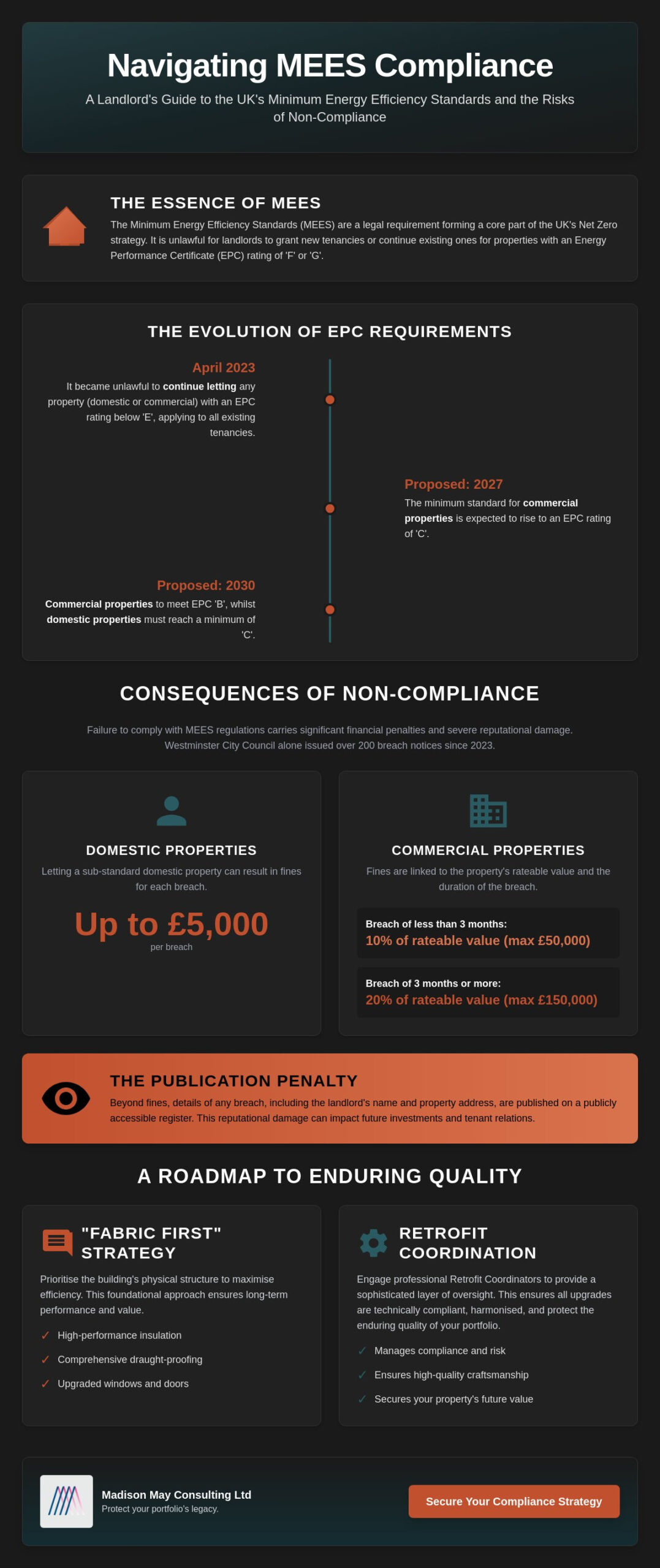
The journey began in 2018 with modest targets, but the 2026 landscape reflects a much more ambitious trajectory. Whilst the current legal floor remains at ‘E’, the government has consulted on raising the bar to ‘C’ by 2027 and ‘B’ by 2030 for commercial assets. Domestic properties are expected to reach a minimum of ‘C’ by October 2030. Understanding what happens if I don’t meet MEES now is vital, as delaying these upgrades often invites inflated costs and the stress of rushed craftsmanship. Proactive landlords recognise that early investment protects their ROI and their reputation as a trusted curator of quality homes.
Domestic vs. Commercial MEES Nuances
Residential and commercial properties face distinct paths to compliance. For domestic landlords, a “whole-house approach” is often the most elegant solution, focusing on how different elements, from insulation to heating, harmonise to create a warm, dry refuge. Commercial properties, however, often rely on complex building fabric assessments and rateable values to determine their penalty risks. In both scenarios, the goal remains the same: transforming a functional structure into a high-performing asset that resonates with the values of a discerning clientele. For commercial owners, integrating renewable energy and modern systems through Renewapower can be an essential step in this transformation.
The Consequences of Non-Compliance: Fines and Reputational Risks
The weight of non-compliance extends far beyond a simple administrative oversight, manifesting as a significant threat to both your capital and your standing as a property owner. For domestic landlords, the financial penalties for letting a sub-standard property can reach up to £5,000 per breach. Whilst this figure is substantial, it pales in comparison to the stakes for commercial property owners. When considering what happens if I don’t meet MEES in the non-domestic sector, the fines are intricately linked to the rateable value of the premises. A breach lasting less than three months can incur a fine of 10% of the rateable value, capped at £50,000; however, should the non-compliance persist for three months or more, that penalty doubles to 20%, with a staggering cap of £150,000.
Parallel to energy standards, maintaining comprehensive safety protocols through UK Fire Risk Assessments is a critical responsibility for any landlord wishing to protect their portfolio from broader legal and financial risks.
Perhaps more damaging than the immediate fiscal loss is the “Publication Penalty.” Details of the breach, including the landlord’s name and the property address, are entered into a publicly accessible database. This level of transparency ensures that any interested party, from prospective investors to local authorities, can scrutinise your compliance history. This public record is often housed alongside the PRS Exemptions Register, making it nearly impossible to obscure a history of neglect. Understanding what happens if I don’t meet MEES is particularly vital when you realise that these records remain visible to the public, potentially tarnishing the heritage of your brand for years to come.
Financial Implications Beyond the Fine
The true cost of a sub-standard EPC rating is often found in the silent erosion of a property’s utility. Legally, you are prohibited from granting a new lease or renewing an existing tenancy if the property falls below the required threshold. This creates a forced vacancy, where rental income ceases whilst the fixed costs of ownership remain. Additionally, sub-standard ratings can severely limit your mortgage eligibility and diminish the property’s market valuation, as lenders and buyers alike increasingly view energy inefficiency as a significant liability. The cost of inaction is a compound risk of punitive fines coupled with the total loss of revenue.
The Risk to Professional Reputation
A property is an outward expression of a landlord’s identity and values. In a market where discerning tenants increasingly favour high-performing, sustainable sanctuaries, a poor energy rating serves as a mark of diminished quality. Maintaining a portfolio that reflects excellence requires more than just meeting a minimum; it involves a commitment to the enduring health of the building. If you are concerned about the specific technical requirements for your properties, a professional Retrofit Assessment and building survey can provide the clarity needed to secure your legacy and restore peace of mind.
Navigating Exemptions and the PRS Exemptions Register
Whilst the penalties for non-compliance are designed to be robust, the regulatory framework acknowledges that not every property can reach the required threshold through standard means. However, it’s a common misconception that these reprieves are granted automatically. To secure your property’s status, you must meticulously evidence and register your circumstances on the PRS Exemptions Register. Without this formal registration, a property remains legally sub-standard, leaving you vulnerable to the question of what happens if I don’t meet MEES despite your best intentions. The official government guidance on MEES provides a detailed breakdown of these requirements, yet the burden of proof rests entirely with the landlord.
Several pathways exist for the discerning landlord to remain compliant when an ‘E’ rating is out of reach. For domestic properties, the “High Cost” exemption applies if the cheapest recommended improvements exceed £3,500, including VAT. In other instances, you may find that you’ve already implemented every feasible measure, yet the EPC remains stubbornly low; this “All Improvements Made” status provides a five-year window of compliance. Technical exemptions also cover specific scenarios such as wall insulation, where a professional expert might advise that the measure would negatively impact the building’s fabric, or the “Consent” exemption, which applies if a tenant or planning authority refuses the necessary works.
The Temporary “New Landlord” Exemption
Acquiring a new asset is a moment of visionary potential, yet it can bring immediate regulatory pressure if the property is sub-standard. A six-month grace period is afforded to new owners, providing a strategic window to align the property with modern standards. This time is best spent commissioning a PAS 2035 assessment, which serves as the gold standard for home retrofitting. It ensures that any transition from a sub-standard rating to a high-performing sanctuary is handled with the care and technical precision your investment deserves.
The Burden of Proof for Registering Exemptions
Local authorities require more than just a cursory explanation to approve an exemption. They demand professional reports that offer a deep, analytical look at the property’s condition. A generic EPC is rarely sufficient for this purpose. Instead, a comprehensive building survey provides the detailed evidence needed to justify why certain works cannot be undertaken. Most exemptions expire after five years and are linked to the landlord rather than the property itself. This means that understanding what happens if I don’t meet MEES is a recurring responsibility, requiring a long-term strategy for property evolution rather than a one-time fix.
Strategic EPC Improvement: A Roadmap to Enduring Quality
The transition from compliance to craftsmanship begins with a fundamental shift in perspective. Rather than viewing energy standards as a bureaucratic hurdle, the most successful landlords treat them as an opportunity for refinement and long-term preservation. A bespoke EPC improvement plan serves as a visionary document, guiding the evolution of your property from a sub-standard asset into a high-performing sanctuary. This strategic roadmap ensures that you never have to worry about what happens if I don’t meet MEES, as every intervention is designed to enhance both the thermal efficiency and the aesthetic heritage of the building.
A “fabric first” philosophy is essential to this process. By prioritising high-quality insulation and meticulous draught-proofing, you address the fundamental energy loss of the structure before considering complex heating upgrades. This approach often involves choosing bespoke windows and doors that honour the property’s original character whilst providing modern thermal performance. However, there is a distinct danger in “piecemeal” upgrades. Implementing measures in isolation, without a cohesive strategy, can disrupt the delicate balance of the building, often leading to unintended consequences like poor air quality or structural moisture issues. A property is a single, integrated system; every change to the fabric must be balanced with a corresponding update to its ventilation.
The Whole-House Approach to Retrofit
A truly sophisticated retrofit considers the home as a living environment where the interplay of heat, air, and moisture is balanced with grace. When we improve the thermal envelope, ventilation must be considered alongside insulation to prevent the silent accumulation of damp and mould. A coordinated strategy ensures that each measure complements the next in a logical sequence, maintaining a healthy, serene environment for your tenants. Professional thermal imaging plays a vital role here, identifying hidden heat loss through the building fabric and ensuring that interventions are targeted with surgical precision before you commit to more expensive works.
Sequencing for Maximum ROI
Achieving a higher EPC rating requires a thoughtful sequence of works that maximises your return on investment whilst protecting the building’s integrity. Identifying the most cost-effective upgrades, such as loft insulation or professional draught-proofing, can provide the significant jump in points needed to secure compliance quickly and efficiently. Whilst temporary, “quick-fix” solutions may seem enticing, they rarely offer the enduring quality or the peace of mind that a discerning clientele expects. The most expensive measure is the one that must be installed twice because the initial attempt was poorly planned or executed. To ensure your property reaches its full potential, commissioning a professional Retrofit Assessment is the most reliable way to secure your investment’s future.
Securing Your Legacy with Professional Retrofit Coordination
For the property owner who views their portfolio as a collection of carefully managed sanctuaries, the complexities of energy regulation can feel like a disruption to the sense of calm they have worked so hard to establish. Professional Retrofit Coordination acts as the ultimate safeguard, transforming the technical demands of legislation into a seamless, managed experience. By providing a single point of oversight, a Retrofit Coordinator ensures that every energy efficient home improvement is executed to the highest technical standards. This professional stewardship is the most effective way to address the lingering anxiety regarding what happens if I don’t meet MEES, as it replaces uncertainty with a PAS 2035 compliant framework designed to mitigate risk at every stage.
Rather than viewing compliance as a burdensome necessity, we invite you to see it as the beginning of a journey toward a more refined, future-proofed portfolio. A coordinated approach prevents the technical failures that often arise from unmonitored works, protecting the heritage of your buildings whilst elevating their performance. When you have a professional overseeing the sequence of upgrades, the question of what happens if I don’t meet MEES becomes irrelevant, as you are already on a documented path to success. It’s about more than just avoiding a fine; it’s about ensuring your properties remain desirable, comfortable, and legally sound for the next generation of residents.
The Role of the Retrofit Assessor
The journey toward excellence begins with the meticulous data collection of a professional Retrofit Assessor. Unlike a standard EPC, which provides a relatively surface-level snapshot, a deep-dive retrofit survey involves a detailed analysis of the building’s fabric, its occupancy patterns, and its unique architectural nuances. This data forms the foundation of a bespoke, individualised improvement strategy that respects the identity of the home. By identifying the specific needs of each room, the assessor ensures that the subsequent roadmap is both practical and visionary, providing a level of detail that is essential for long-term future-proofing and capital preservation.
Partnering with Madison May Consulting Ltd
At Madison May Consulting Ltd, we approach property evolution with quiet confidence and a commitment to visionary design. We understand that your portfolio is a deeply personal expression of your values, and our role is to act as a sophisticated guide through the complexities of the retrofit process. By partnering with us, you can transform regulatory anxiety into a clear, rhythmic plan for property excellence. We take the time to listen to your story, ensuring that every upgrade honours the craftsmanship of the past whilst embracing the efficiency of the future. Discover how Madison May Consulting Ltd can secure your property’s future.
Elevating Your Portfolio Beyond Compliance
The transition from regulatory anxiety to property excellence is a journey defined by clarity and intention. By synthesising the nuances of penalty structures with a proactive approach to the exemptions register, you move from a position of vulnerability to one of quiet confidence. You no longer need to fear what happens if I don’t meet MEES; instead, you can focus on the rhythmic evolution of your properties into high-performing, sustainable sanctuaries. A strategic roadmap, prioritising building fabric and coordinated ventilation, ensures your investment remains a testament to quality and heritage for decades to come.
As a Yorkshire-based consultancy with a national reach, Madison May Consulting Ltd provides the professional stewardship required to navigate this complex landscape. Our PAS 2035 aligned assessments and expert EPC improvement roadmaps offer the ultimate safeguard for your legacy. Book a Professional Retrofit Assessment with Madison May Consulting Ltd to Ensure Your Portfolio is Compliant and transform this bureaucratic challenge into a curated experience of property refinement. We invite you to step into a world where functionality and beauty coexist in effortless union, securing a serene future for every space you curate.
Frequently Asked Questions
Is it illegal to rent a house with an EPC rating of F?
Yes, it is currently unlawful to grant a new lease or continue an existing tenancy for a property with an EPC rating of F or G. These are classified as sub-standard properties under the Energy Efficiency (Private Rented Property) Regulations 2015. To remain compliant, you must either improve the property to at least an E rating or register a valid exemption on the PRS register with meticulous evidence.
How much are the fines for MEES non-compliance in 2026?
Financial penalties vary significantly between domestic and commercial sectors. Domestic landlords face fines of up to £5,000 per property. For commercial assets, the penalty is linked to the property’s rateable value. A breach lasting more than three months can result in a fine of 20% of the rateable value, with a maximum cap of £150,000, alongside a public notification of the breach.
Can I be fined if I have already applied for a MEES exemption?
You may still be at risk if the exemption has not been formally approved and registered. Simply intending to apply or having a pending application doesn’t provide automatic immunity from enforcement. It’s essential to ensure your evidence is comprehensive and that the registration is confirmed on the PRS Exemptions Register to protect your portfolio from potential legal action.
What happens if a tenant refuses access for energy efficiency improvements?
If a tenant or a third party refuses the necessary consent for upgrades, you can register a “Consent” exemption. This requires documented proof of the refusal to satisfy local authorities. This exemption acknowledges that the landlord has made a reasonable attempt to comply but was prevented by factors beyond their control, providing a temporary reprieve from standard requirements.
How long does a MEES exemption last on the PRS register?
Most exemptions remain valid for five years. Once this period expires, the exemption is removed, and you must either meet the minimum EPC rating or register a new exemption based on the current circumstances of the property. It’s important to remember that exemptions are personal to the landlord and don’t transfer to a new owner if the property is sold.
Do MEES regulations apply to listed buildings or heritage properties?
Yes, the regulatory landscape has shifted to include heritage assets within the scope of EPC requirements. If you are worried about what happens if I don’t meet MEES for a listed building, a specialist assessment is the most graceful way to proceed. This ensures that energy improvements don’t compromise the meticulous craftsmanship or the historic integrity of the structure.
What is the “High Cost” cap for domestic energy improvements?
The current spending cap for domestic landlords is £3,500, including VAT. If the cheapest recommended measures to reach an ‘E’ rating exceed this amount, you can register a “High Cost” exemption. You must first spend up to this limit on feasible improvements before the exemption can be granted, ensuring that at least some progress is made toward efficiency.
Will the minimum EPC rating change from E to C soon?
The government has proposed raising the minimum standard to EPC ‘C’ for all domestic tenancies by October 2030. Commercial properties are expected to meet even more ambitious targets, with a move to ‘C’ by 2027 and ‘B’ by 2030. Understanding what happens if I don’t meet MEES now is a vital step in preparing your portfolio for these future shifts with quiet confidence.