


What if a momentary pause in your property’s energy journey was the very thing that allowed you to preserve its unique heritage and your financial peace of mind? Many landlords feel a natural trepidation when faced with the dense, clinical language of energy regulations and the looming shadow of a £5,000 penalty for non-compliance. It’s entirely understandable to feel anxious about the mounting costs of upgrades or the intricate evidence needed to secure exemptions for minimum energy efficiency standards for a property that isn’t yet ready to meet the current EPC ‘E’ rating. You deserve to manage your portfolio with a sense of calm and visionary clarity rather than constant worry over shifting mandates.
By reading this guide, you’ll discover how to handle these complexities whilst maintaining the integrity and comfort of your property portfolio. We’ll provide a clear understanding of the legal exemption categories and the rigorous registration process demanded by the latest June 2026 standards. This exploration will offer you a strategic view of property improvements that goes beyond simple compliance, treating your buildings as the cherished sanctuaries they’re meant to be.
Key Takeaways
- Understand the current legal baseline for domestic energy performance and the specific criteria that define your ongoing obligations as a landlord in England and Wales.
- Learn how to navigate the specific categories for exemptions for minimum energy efficiency standards, including the ‘High Cost’ threshold and the ‘All Improvements Made’ criteria.
- Discover why a meticulous approach to evidence collection is vital for the PRS Exemptions Register to ensure your property remains legally compliant and protected from significant penalties.
- Explore how to view an exemption as a strategic, measured pause that allows for a more thoughtful, whole-house approach to retrofitting and long-term property care.
- Gain the confidence to transform your portfolio into a collection of high-performing sanctuaries through the guidance of expert retrofit assessments and tailored improvement plans.
Navigating the Minimum Energy Efficiency Standards (MEES) Framework
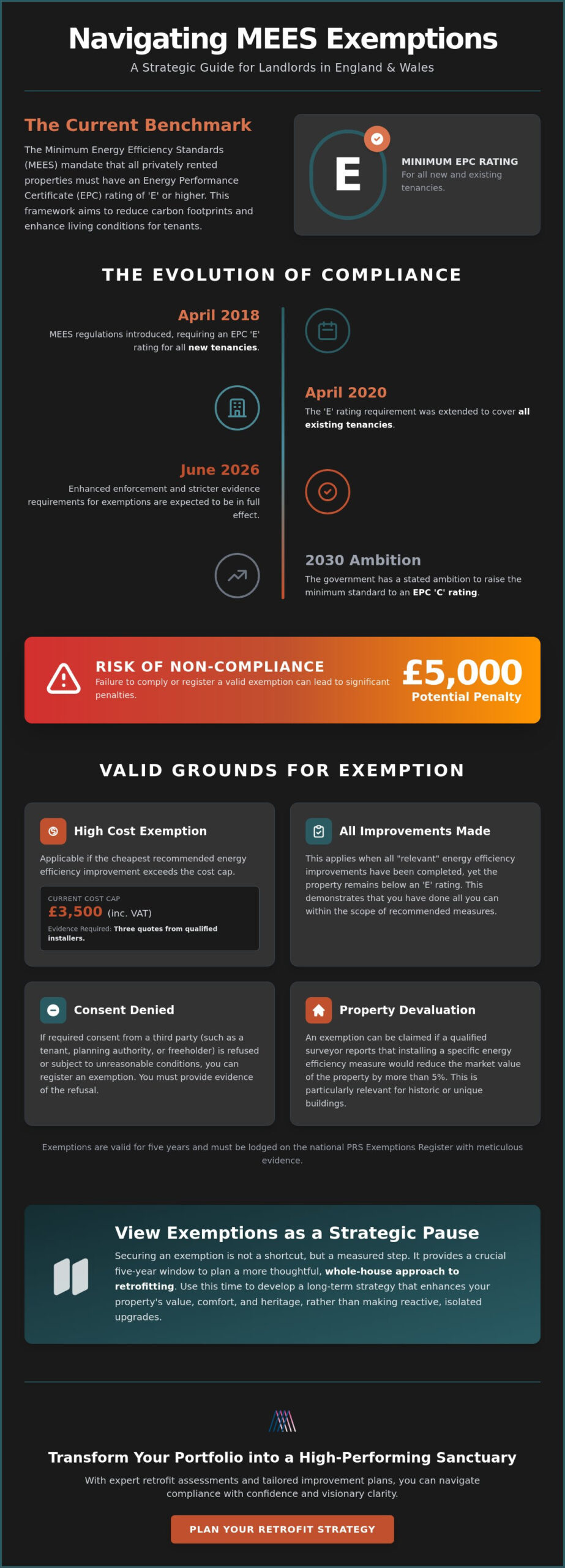
The Minimum Energy Efficiency Standards (MEES) represent the essential regulatory baseline for domestic property performance across England and Wales. This framework ensures that every home provided to a tenant meets a fundamental level of warmth and efficiency, currently defined by an Energy Performance Certificate (EPC) rating of ‘E’ or higher. Whilst some view these mandates as mere administrative hurdles, they are rooted in a global movement toward a more robust Minimum Energy Performance Standard, aiming to reduce carbon footprints and elevate the living experience. For the discerning landlord, these regulations offer an opportunity to reflect on the enduring quality of their assets. However, for properties with unique architectural nuances or significant financial constraints, the law provides a pathway through exemptions for minimum energy efficiency standards. These are not shortcuts, but rather a recognition that the journey to a sustainable sanctuary is rarely a straight line.
The Evolution of Domestic Energy Compliance
The journey of domestic compliance has unfolded with steady deliberation since its inception in 2018. What began as a requirement for new tenancies expanded in April 2020 to encompass all existing let properties. As we stand in 2026, the landscape has matured, with local authorities exercising more rigorous oversight. Planning for the future is now a necessity rather than a choice, especially with the government’s stated ambition to raise the minimum standard to an EPC ‘C’ by 2030. This evolution mirrors a shift in how we value our homes; a high energy rating is increasingly seen as a hallmark of a well-maintained property that respects its own heritage whilst embracing modern comfort.
Current compliance involves several key milestones:
- April 2018: New tenancies required a minimum EPC ‘E’.
- April 2020: The ‘E’ rating became mandatory for all existing tenancies.
- June 2026: Enhanced enforcement and stricter evidence requirements for exemptions.
Why Exemptions are Essential for Discerning Landlords
Exemptions play a vital role for landlords who oversee properties with distinct character or historical significance. In many instances, standard energy-saving measures might clash with the aesthetic integrity of a period building or prove prohibitively expensive beyond the current £3,500 cost cap. Securing exemptions for minimum energy efficiency standards allows a landlord to protect the financial health of their portfolio without being forced into hasty, unsuitable renovations. It acknowledges that every home has its own story. For some, the path to efficiency requires a more tailored, patient approach. By viewing these regulations through the lens of stewardship, you can ensure your property remains a cherished refuge for years to come.
A Meticulous Overview of MEES Exemption Categories
Understanding the specific pathways for exemptions for minimum energy efficiency standards requires an eye for detail and a commitment to the long-term health of your property asset. These categories aren’t designed as simple loopholes; they’re a recognition that every building has its own structural story and financial reality. For some, the path to an EPC ‘E’ rating is blocked by third-party refusals or technical risks that could compromise the very fabric of the home. Consulting the official government guidance on MEES exemptions is an essential step for any landlord seeking to formalise these claims with the necessary professional rigour.
The Financial Thresholds: High Cost and Payback
The ‘High Cost’ exemption is perhaps the most frequent refuge for landlords managing older stock. In the current 2026 regulatory environment, the self-funding cap remains at £3,500 including VAT. If the cheapest recommended improvement exceeds this amount, you’re eligible to register an exemption. This requires at least three separate quotes from qualified installers to prove that the expenditure is disproportionate. Whilst non-domestic properties often look toward the ‘7-Year Payback Rule’ as a benchmark for investment, domestic landlords must focus on this specific monetary ceiling. Every quote must be gathered with care, ensuring the scope of work is identical across all three to provide a transparent and undeniable record of the financial burden. Choosing to partner with a dedicated retrofit consultant can help you gather this evidence with the grace and precision your portfolio deserves.
Structural and Aesthetic Constraints: Wall Insulation and Devaluation
Sensitive properties often face unique challenges when standard measures like wall insulation are proposed. The ‘Wall Insulation’ exemption is specifically tailored for instances where such works would negatively impact the building’s breathability or structural integrity, potentially leading to damp and rot. This requires a written opinion from a relevant expert, such as a chartered surveyor, confirming the risk. Similarly, the ‘Devaluation’ exemption applies if an improvement would reduce the market value of the property by more than 5%. This is a high bar to clear, requiring a meticulous report from an independent RICS surveyor. These protections ensure that the drive for efficiency doesn’t inadvertently strip away the character or the ‘soul’ of a historic home. Protecting the heritage of your sanctuary is just as vital as improving its thermal performance, and these exemptions provide the necessary space for a more measured, thoughtful approach.
The Significance of Evidence in the Registration Process
Securing exemptions for minimum energy efficiency standards is as much about the quality of your evidence as it is about the physical state of your property. It isn’t enough to simply have a valid reason for non-compliance; that reason must be meticulously documented and officially lodged. Without a formal entry on the PRS Exemptions Register, any claim to an exemption remains legally invisible to local authorities. This registry serves as a public testament to your property’s unique circumstances, ensuring that your status as a responsible landlord is transparently maintained. At the heart of every application lies the Energy Performance Certificate (EPC). It acts as the foundational narrative of your home’s energy story, providing the baseline data from which all subsequent claims are measured. You should also remember that most exemptions are a temporary grace period, typically valid for five years, after which a fresh, thoughtful re-evaluation of the property’s potential is required.
Required Documentation for a Seamless Application
The Consequences of Non-Compliance and Invalid Registration
The risks of failing to register are significant and can disrupt the sense of calm you’ve cultivated within your portfolio. An unregistered exemption is viewed by enforcement authorities as having no exemption at all, leaving you vulnerable to financial penalties. In 2026, the maximum fine for a breach of MEES regulations stands at £5,000 per property. Beyond the immediate monetary loss, there’s the emotional weight of legal scrutiny and the potential impact on your reputation as a curator of high-quality living spaces. Professional guidance ensures that your sanctuary remains protected, allowing you to focus on the long-term vision for your properties rather than the anxiety of regulatory gaps. Ensuring your registration is valid and current is the only way to truly safeguard your investment against the evolving demands of domestic energy legislation.
Strategic Retrofitting: Viewing Exemptions as a Temporary Measured Step
An exemption shouldn’t be viewed as a final destination; instead, it’s a sophisticated, measured pause in your property’s evolution. Whilst exemptions for minimum energy efficiency standards provide immediate legal relief, they also offer the precious gift of time. This interval allows you to step back and view your portfolio with visionary creativity, developing a meticulous EPC improvement plan that respects the building’s unique architectural voice. Rushing into piecemeal upgrades often leads to the ‘Ventilation Gap’, where new insulation traps moisture without adequate airflow, potentially causing long-term damage to the structure you’ve worked so hard to maintain.
Securing exemptions for minimum energy efficiency standards allows you to move away from reactive fixes toward a more rhythmic and intentional strategy. A professional assessment during this ‘pause’ identifies the most elegant sequence for future improvements, ensuring that every intervention is both functional and beautiful. This period of planning is the perfect time to consider deeper, more enduring property refurbishments that will eventually transform your assets into high-performing sanctuaries. By adopting a whole-house approach, you ensure that the integrity of the building fabric remains uncompromised as you move toward a more sustainable future.
The Role of PAS 2035 in High-End Property Management
Adopting the PAS 2035 retrofit standards elevates property management from simple maintenance to a visionary art form. This framework moves beyond the ‘quick-fix’ mentality that often leads to unintended consequences like damp or poor indoor air quality. By engaging a qualified Retrofit Assessor, you gain a partner who understands the intricate interplay between heating, insulation, and ventilation. They help you navigate the complexities of modern compliance with the grace of a seasoned curator, ensuring that each material is chosen with care and every detail is intentional. This coordinated effort transforms a regulatory requirement into a journey of craftsmanship, protecting the heritage of your home whilst enhancing its performance.
Enhancing Indoor Comfort and Sanctuary Status
Energy efficiency is ultimately about the identity and feeling of a home. A house that is difficult to heat or prone to draughts can never truly serve as a sanctuary for its residents. Future upgrades should be framed as a way to craft a deeply personal and healthy refuge, where the prevention of damp and mould is a natural result of superior design rather than an afterthought. High-quality insulation and draught proofing don’t just lower bills; they create a sense of calm, permanence, and restorative comfort. By using your exemption period to plan these deeper refurbishments, you’re investing in the home’s status as a place of genuine well-being. To begin this transformative journey, schedule a consultation with Madison May Consulting Ltd to explore how a tailored retrofit assessment can elevate your portfolio.
Cultivating a Sanctuary with Madison May Consulting Ltd
Madison May Consulting Ltd acts as a sophisticated guide through the often clinical landscape of energy performance, offering a bridge between complex regulation and refined property management. We understand that your portfolio is more than a collection of assets; it’s a curated selection of spaces that reflect your commitment to quality and heritage. Our fixed-fee retrofit assessment serves as a rhythmic, stress-free entry point, providing the clarity you need without the rushed aggression often found in standard compliance services. By positioning ourselves as the curator of your property’s transition, we ensure the journey from ‘compliant’ to ‘exceptional’ is handled with the quiet confidence and visionary creativity your investment deserves.
Our Attentive Approach to EPC Improvement
We begin every partnership by listening to the unique story of your property. Rather than applying a generic template, we develop a bespoke improvement roadmap that respects the building’s identity whilst addressing modern efficiency needs. Our expertise allows us to identify precisely where exemptions for minimum energy efficiency standards represent the most graceful path forward, particularly for homes where standard interventions might compromise architectural integrity. We take a highly organised approach to project management, ensuring that every detail is intentional and every material is chosen with care. This meticulous oversight allows you to maintain a sense of calm, knowing that your property’s transition is being guided by thoughtful experts who prioritise your personal story above all else.
Partnering for an Enduring Legacy
Viewing energy efficiency as a transformative artistic journey allows you to transcend the fear of financial penalties and embrace the potential of your portfolio. We encourage a long-term perspective that values the natural and effortless union of functionality and beauty, ensuring that your properties remain desirable as both homes and investments. As the regulatory trajectory moves toward an EPC ‘C’ rating by 2030, having a reliable and serene partner becomes essential for maintaining the sanctuary status of your buildings. We invite you to move beyond the anxiety of compliance and toward a future where your properties stand as outward expressions of individual identity and enduring quality. Begin your property’s transformation with a Madison May Consulting Ltd consultation and discover how we can help you craft a meaningful environment that resonates on a personal level.
The Art of Sustainable Stewardship
The path to a high-performing property portfolio is rarely found in hasty fixes or reactive compliance. By understanding the legitimate exemptions for minimum energy efficiency standards, you gain the necessary space to plan with visionary creativity and care. These legal provisions act as a temporary pause, allowing you to gather the meticulous evidence required for the PRS register whilst protecting the unique soul of your buildings. Whether you’re navigating financial thresholds or managing the structural sensitivities of a historic façade, your focus should remain on long-term value and resident comfort. Precision is the hallmark of quality.
True transformation begins with an expert perspective that balances functionality and beauty. Our PAS 2035 Compliant Assessments and Specialist Retrofit Coordination ensure that every intervention is intentional, whilst our Expert EPC Improvement Roadmaps provide a rhythmic sequence for future upgrades. Secure your property’s future with a meticulous Retrofit Assessment from Madison May Consulting Ltd. Embrace this journey as an opportunity to curate a legacy of enduring quality and sanctuary. Your properties aren’t just buildings; they’re personal stories that deserve the thoughtful guidance of Madison May Consulting Ltd.
Frequently Asked Questions
What is the maximum I have to spend on MEES improvements before I can claim an exemption?
You are required to spend a maximum of £3,500, including VAT, on energy efficiency measures for a domestic property. If the cheapest recommended improvements exceed this threshold, you may register a ‘High Cost’ exemption. This ensures that the financial burden of upgrading a sanctuary remains proportionate to its value and your resources as a landlord.
How long does a MEES exemption last on the register?
Most exemptions for minimum energy efficiency standards are valid for five years from the date of registration. Once this period concludes, the exemption expires and you must either meet the current standards or provide fresh evidence to register a new one. This rhythmic cycle encourages a periodic re-evaluation of the home’s potential as technology and techniques evolve.
Can I register an exemption if my property is a listed building?
Listed buildings are eligible for an exemption if the required energy improvements would unacceptably alter their character or appearance. You’ll need to demonstrate that you’ve sought advice from the local planning authority or a heritage expert. Protecting the unique history and soul of a building is a legitimate priority within the regulatory framework, ensuring that modern performance doesn’t compromise heritage.
What happens to an exemption if I sell the property to a new landlord?
Exemptions are personal to the landlord and don’t transfer to a new owner upon the sale of a property. A new landlord is granted a temporary six-month grace period to either bring the home up to an EPC ‘E’ rating or register their own exemption. This ensures that every new steward of the property takes personal responsibility for its energy journey from the moment they take ownership.
Is tenant consent a valid reason for a MEES exemption?
Tenant refusal is a valid grounds for an exemption if you can prove that the current residents withheld consent despite your reasonable efforts to proceed. This protection acknowledges that a home is a personal refuge, and improvements cannot be forced upon those living within it. You must document all correspondence to demonstrate that you’ve acted with grace and persistence in your attempts to upgrade the property.
Do I need a professional survey to claim a devaluation exemption?
You must provide a report from an independent RICS chartered surveyor to successfully claim a devaluation exemption. The report must verify that the required energy measures would reduce the property’s market value by more than 5%. This meticulous level of proof ensures that the pursuit of efficiency doesn’t inadvertently damage the financial integrity of your asset or the quality of the living space.
What is the ‘7-year payback’ rule and does it apply to domestic properties?
The ‘7-year payback’ rule is a financial test used exclusively for non-domestic properties and doesn’t apply to the domestic sector. For residential homes, the primary financial benchmark remains the £3,500 cost cap. Understanding this distinction is vital for landlords managing mixed portfolios, as it ensures each property type is treated with the appropriate regulatory logic and financial planning.
Can I apply for an exemption if I have already made all ‘relevant’ improvements?
You can register an ‘All Improvements Made’ exemption if the property remains below an EPC ‘E’ after every feasible and cost-effective measure has been installed. This category is essential for properties that have reached a temporary plateau in their efficiency journey. It allows you to maintain legal compliance whilst you consider more transformative, long-term refurbishments that might eventually elevate the property’s performance.