


Could the very improvements intended to safeguard your property actually be the catalyst for its structural decline? It’s a question that weighs heavily on property owners as the 1 October 2030 deadline to achieve an EPC rating of C draws closer. You probably feel the mounting pressure of evolving regulations and the valid concern that unskilled installers might leave you with a legacy of damp rather than a sophisticated, energy efficient home. Mastering the current retrofit standards for landlords West Yorkshire is no longer merely a matter of compliance; it’s about protecting the heritage and future value of your investment through a curated, whole-house philosophy.
We promise to demystify the intricacies of PAS 2035:2023, providing a clear roadmap to navigate these technical requirements with quiet confidence. This guide explores why a professional Retrofit Assessment is a necessary evolution from a standard EPC, ensuring your portfolio remains a sanctuary of comfort for tenants whilst maintaining its structural integrity. We’ll examine the transition to the Home Energy Model and how a fabric-first approach creates a seamless union between modern efficiency and the enduring quality of your properties.
Key Takeaways
- Understand the shifting regulatory landscape and the 2030 deadline for EPC Band C to protect your property portfolio from the risks of non-compliance.
- Learn how the current retrofit standards for landlords West Yorkshire advocate for a holistic, whole-house philosophy that ensures every energy improvement is intentional.
- Discover the profound difference between a standard EPC and a meticulous Retrofit Assessment, providing the clarity needed to avoid inappropriate or damaging installations that could compromise your building’s fabric.
- Explore how to balance enhanced insulation with sophisticated ventilation strategies to prevent damp and maintain a refined, healthy living environment for your tenants.
- Identify the role of a Retrofit Coordinator as a visionary guardian of your project, offering the technical expertise required for a seamless and successful energy transition.
The Shifting Landscape of Retrofit Standards for Landlords in West Yorkshire
The rental market is undergoing a profound transformation, moving away from the era of superficial updates towards a period of meticulous, high-quality refurbishment. For many property owners, the introduction of more stringent retrofit standards for landlords West Yorkshire represents a significant shift in how they must curate their portfolios. The days when a simple boiler replacement or a layer of loft insulation sufficed to meet Minimum Energy Efficiency Standards (MEES) are fading. Today, the focus is on the whole-house approach, a philosophy that views a building as a single, harmonious system where every element, from the windows to the ventilation, works in concert to preserve the property’s soul and structural integrity.
The Regulatory Horizon: From MEES to Future Homes
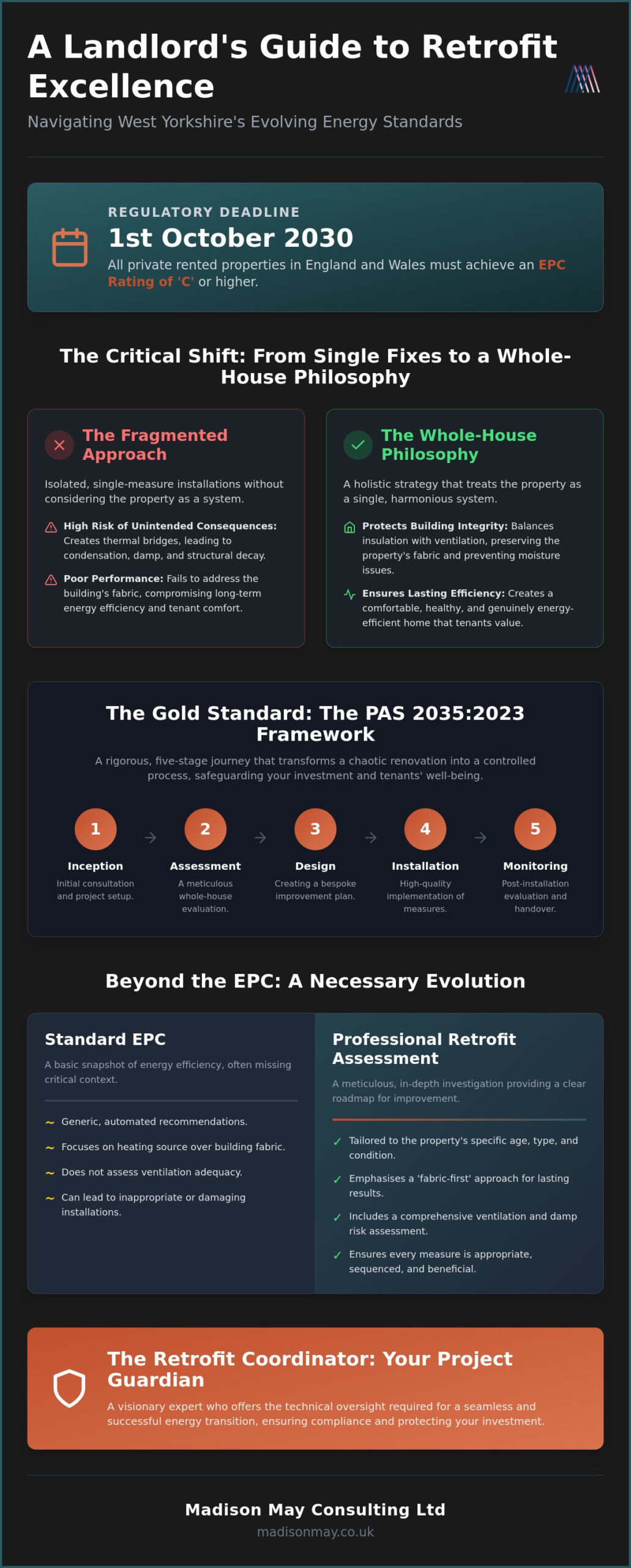
Looking ahead, the trajectory is clear and uncompromising. By 1 October 2030, all private rented properties in England and Wales must achieve an Energy Performance Certificate (EPC) rating of C. This isn’t just a distant compliance target; it’s a call to action for those who value the enduring quality of their investments. The Home Energy Model (HEM), set to replace the current assessment methodology in the second half of 2027, will place a much greater emphasis on the building’s thermal fabric rather than just its heating source. To navigate these complexities, landlords must familiarise themselves with the overarching framework; a comprehensive PAS 2035 overview reveals how this standard acts as a guardian of quality, ensuring every intervention is designed with care and precision. By embracing these changes early and planning around the £10,000 cost cap, you avoid the rush of last-minute, high-cost upgrades whilst creating a more desirable home that naturally reduces the risk of voids.
The Regional Context of Yorkshire Housing Stock
Understanding PAS 2035: The Gold Standard for Landlord Retrofits
PAS 2035 is often misunderstood as a mere hurdle for government funding, but for those seeking to uphold the highest retrofit standards for landlords West Yorkshire, it is actually a sophisticated framework for excellence. It ensures that energy efficient home improvements are not just installed, but are meticulously integrated into the building’s unique story. This standard, which entered its latest iteration on 31 March 2025 following a transition period, provides a rigorous five-stage journey: inception, assessment, design, installation, and monitoring. By following this path, you transform a potentially chaotic renovation into a calm, controlled process of property refinement that protects both your capital and your tenants’ well-being.
The Whole-House Approach: A Symphony of Measures
Traditional renovation often relies on “single-measure” thinking, such as installing a new boiler or adding loft insulation in isolation. This fragmented approach can be counterproductive. If you insulate a roof but ignore the cold spots where walls meet floors, you risk creating thermal bridges that invite condensation and decay. A whole-house philosophy treats the property as a single, breathing entity. It ensures that improvements are sequenced with care, mirroring the way a curator might assemble a collection where every piece must complement the next. This harmony is what ultimately delivers the promised energy savings and protects the building’s fabric from unintended consequences. When measures work in a symphony, the result is a home that feels fundamentally different; it is warmer, quieter, and more resilient.
Risk Assessment and Property Pathfinding
Every project begins with a bespoke risk assessment, categorising properties into Path A, B, or C based on their complexity and the scale of the intended works. This ensures that the level of professional oversight matches the inherent risks of the building. By identifying hidden vulnerabilities through a government-endorsed quality scheme, landlords can move beyond guesswork. Instead of a series of reactive “quick fixes” that might fail within a few years, you gain a comprehensive roadmap that prioritises the long-term health of your portfolio. This pathfinding process is essential for the technical nuances of older Yorkshire stone or brick properties. Understanding your property’s specific path is the first step towards a successful energy efficient home improvement, and commissioning a professional Retrofit Assessment provides the clarity needed to proceed with confidence. This meticulous planning ensures that every pound spent is an investment in the enduring beauty and functionality of your space.
Beyond the EPC: Why Retrofit Assessments are Vital for Compliance
Whilst the Energy Performance Certificate is a familiar sight in the property market, it is often a surface-level document that barely scratches the surface of a building’s true character. For those committed to the rigorous retrofit standards for landlords West Yorkshire, relying solely on an EPC is a risk that could lead to unintended consequences. An EPC is a snapshot in time; a Retrofit Assessment is a strategic roadmap. The latter involves a deep, sensory exploration of the building’s fabric, services, and ventilation, ensuring that every recommendation is rooted in reality rather than software assumptions.
The Limitations of Standard Energy Performance Certificates
Standard assessments frequently suffer from “cloned” data. When a surveyor spends only twenty minutes on-site, they often rely on default values within the software, particularly for non-standard construction common in our region. This can be particularly damaging for the gritstone and solid-walled properties of West Yorkshire, where incorrect assumptions about wall U-values can lead to the specification of inappropriate insulation. By contrast, adhering to the PAS 2035 standards requires a much more granular approach. It looks at how the house actually behaves, rather than how a computer model says it should. This level of detail is what separates a generic upgrade from a curated property transformation.
What to Expect During a Professional Retrofit Assessment
A professional assessment is a meticulous journey through the property. It moves beyond the visible to identify hidden vulnerabilities such as moisture ingress or compromised ventilation paths. During this process, we utilise tools like thermal imaging to reveal heat loss patterns that remain invisible to the naked eye. This data-rich approach allows for the creation of a meticulous EPC improvement plan, which serves as a sophisticated investment tool. This plan doesn’t just list upgrades; it sequences them to respect the property’s heritage, ensuring that every intervention enhances both beauty and functionality. The resulting report is a bespoke document that treats your property as a unique sanctuary, providing the clarity needed to protect your investment for the next generation of tenancies. It’s about moving from guesswork to a state of quiet confidence in your portfolio’s future.
Mitigating Risk: Ventilation, Damp, and the Whole-House Approach
Many landlords mistakenly believe that insulation is a universal cure for heat loss, yet without a corresponding ventilation strategy, these improvements can inadvertently trigger a “Ventilation Gap.” This is where the retrofit standards for landlords West Yorkshire become a vital safeguard for your investment. When we seal a building to retain warmth, we also trap the moisture generated by modern living. Understanding Part F of the Building Regulations is essential; it ensures that as we improve air-tightness, we maintain the necessary air exchange to protect the property’s fabric. A house must be allowed to breathe, even as it becomes more efficient, to prevent the silent accumulation of moisture that leads to structural decay.
The Science of Indoor Air Quality
Modern living habits, such as showering, cooking, and drying clothes indoors, clash significantly with the airtight nature of a retrofitted home. In a traditional Yorkshire property designed to breathe through draughty windows and porous stone, these habits were managed naturally, albeit inefficiently. Today’s high-performance retrofits require a more intentional, curated approach. We advocate for sophisticated “extract and supply” ventilation systems that work silently in the background, ensuring the air remains fresh and the environment healthy for your tenants. This isn’t just about comfort; it’s about creating a sanctuary where the air quality mirrors the refined aesthetics of the space, protecting both the occupant and the enduring quality of the building.
Identifying and Solving Mould Issues at the Source
True retrofit standards for landlords West Yorkshire require a scientific eye to distinguish between penetrating damp, rising damp, and the more insidious interstitial condensation. Often, traditional “damp-proofing” treatments fail because they address the symptom rather than the underlying thermal performance of the wall. Madison May approaches damp remediation by identifying cold spots through thermal imaging, ensuring that moisture is managed at its source. This intersection of air-tightness and breathability is where the structural integrity of your portfolio is either won or lost. By resolving these issues through meticulously planned energy improvements, you ensure that your property remains a dry, warm, and prestigious asset for years to come.
To safeguard your investment and ensure a healthy living environment for your tenants, we recommend you arrange a professional Ventilation Assessment with our expert team today. This direct step ensures your energy efficiency journey is built on a foundation of technical excellence and long-term security.
Securing Your Investment: The Role of a Retrofit Coordinator
Quality Assurance and Compliance Management
Compliance management is far more than a bureaucratic exercise; it’s the ultimate protection for your capital investment. Your Retrofit Coordinator acts as the final arbiter of quality, signing off on completed works only when they are certain that the required U-values and performance targets have been met. This meticulous approach is informed by professional building surveys, which provide the deep architectural understanding needed to coordinate a successful retrofit. By centralising this authority, you gain a single point of professional contact who manages the complex documentation required for future property sales or refinancing. This provides you with the quiet confidence that your portfolio is not only compliant but is also backed by a robust, professionally verified history of excellence.
The Madison May Philosophy: A Refined Journey to Efficiency
At Madison May, we believe that energy efficiency should never come at the expense of a property’s soul. Our consultancy approach is defined by an attentive, personal touch that prioritises your unique goals and the story of your building. We view each project as a curated journey where functionality and beauty coexist in effortless union. Whether we are advising on draught proofing or coordinating a full refurbishment, every detail is intentional and every material is chosen with care. We aren’t just meeting the retrofit standards for landlords West Yorkshire; we are crafting meaningful environments that resonate on a personal level. We invite you to begin your property’s transformation by booking a professional consultation with our team. Together, we can navigate the complexities of PAS 2035 to create a sanctuary that is as sustainable as it is sophisticated, ensuring your investment remains a source of pride for years to come.
Cultivating the Future of Your Property Portfolio
The journey toward enhanced efficiency is not merely a box-ticking exercise; it’s a commitment to the enduring quality and heritage of your investment. By embracing the retrofit standards for landlords West Yorkshire, you move beyond the limitations of generic assessments and into a world of meticulous, whole-house planning. You’ve seen how the strategic interplay of insulation and ventilation, guided by a dedicated Retrofit Coordinator, can safeguard your buildings against the risks of damp whilst ensuring long-term compliance with the 2030 EPC C deadline.
Madison May acts as your trusted curator, offering PAS 2035 Aligned Assessments and detailed EPC improvement roadmaps that respect the unique character of your home. As specialists in damp and ventilation remediation, we ensure every intervention is both functional and beautiful. Book your professional Retrofit Assessment with Madison May to begin your property’s transformation today. Your portfolio deserves a strategy that is as sophisticated as the spaces you provide, ensuring a legacy of comfort and value for years to come.
Frequently Asked Questions
What is the minimum EPC rating for landlords in 2026?
The current minimum Energy Performance Certificate (EPC) rating for all private rented properties in England and Wales remains at Band E for 2026. Whilst this is the legal baseline today, the regulatory horizon is shifting towards a unified requirement for Band C by 1 October 2030. Landlords who act early to improve their properties to this higher standard avoid the inevitable price surges and contractor shortages that are expected to precede the new deadline.
How does PAS 2035 differ from a standard building survey?
A standard building survey typically focuses on the structural condition and immediate repairs needed for a property transaction or valuation. In contrast, a PAS 2035 Retrofit Assessment is a meticulous, energy-focused evaluation that considers the property as a single, breathing system. It includes detailed occupancy assessments, ventilation checks, and fabric evaluations to create a long-term roadmap for energy efficient home improvements without causing structural harm.
Can I carry out retrofit works without a Retrofit Coordinator?
You can carry out basic home improvements independently, but you cannot achieve PAS 2035 compliance or access government-funded schemes without a qualified Retrofit Coordinator. This professional acts as a visionary guardian for your project, ensuring that every measure is designed and installed according to strict technical specifications. Their oversight is essential for maintaining the integrity of retrofit standards for landlords West Yorkshire and protecting your investment from unskilled work.
Why is ventilation so important when installing external wall insulation?
Ventilation is critical because external wall insulation significantly increases the air-tightness of a building, which can trap moisture generated by daily activities like cooking and bathing. Without a sophisticated ventilation strategy, this trapped humidity often leads to interstitial condensation and mould growth behind the new insulation or on internal surfaces. Aligning with Part F of the Building Regulations ensures that as we wrap the house in warmth, we also maintain a healthy, refined indoor climate.
How much does a professional PAS 2035 Retrofit Assessment cost?
The investment for a professional PAS 2035 Retrofit Assessment varies depending on the size, complexity, and specific risk path of the property. Rather than a generic flat rate, these assessments are typically tailored to the unique needs of your building fabric and your wider portfolio goals. We recommend contacting a specialist for a bespoke consultation to understand the professional fees associated with your particular project, ensuring you receive a meticulous and accurate evaluation.
Will retrofitting my property increase its market value?
Improving a property’s energy performance often enhances its market value by making it a more attractive, future-proofed asset for discerning buyers and tenants. A home that has undergone a high-quality retrofit is perceived as a sanctuary of comfort with lower running costs and reduced maintenance risks. By documenting these improvements through the PAS 2035 framework, you provide tangible evidence of the property’s enduring quality and structural health, which can be a persuasive factor during future financing or sales.
How long does a whole-house retrofit usually take to complete?
The timeline for a whole-house retrofit unfolds with the calm deliberation of a high-end consultation, typically taking several weeks to months from initial assessment to final sign-off. The assessment itself is usually completed within a few days, but the design and installation phases depend on the complexity of the measures chosen and the availability of accredited installers. Planning your energy journey well in advance of the 2030 deadline ensures a seamless, graceful process that respects your property’s heritage.
Are there any grants available for West Yorkshire landlords to help with retrofit costs?
Landlords in the region can currently access several initiatives, including the Boiler Upgrade Scheme (BUS) which provides grants for low-carbon heating systems like air source heat pumps. The West Yorkshire Combined Authority also offers support and advice to help identify suitable upgrades and potential financing options. Adhering to professional retrofit standards for landlords West Yorkshire is often a prerequisite for these schemes, ensuring that any public investment is matched by meticulous installation quality and long-term performance.