


Does an Energy Performance Certificate truly capture the soul of a sanctuary, or is it merely a reflection of a hurried survey and technical assumptions? It is deeply unsettling when high-quality insulation or bespoke glazing is seemingly ignored, leaving you with a rating that feels more like a clerical error than a true narrative of your home’s efficiency. You likely feel the weight of this discrepancy, especially with the 2030 requirement for a Grade C rating looming; there is a natural anxiety that an assessor’s oversight might compromise your property’s future and marketability.
Discovering how to challenge an EPC rating is the first step in reclaiming the integrity of your property’s performance and its true identity. By following a professional and meticulous pathway, you can ensure your home is represented with the grace and accuracy it deserves. We will guide you through the process of gathering evidence, engaging with accreditation schemes, and understanding the nuances of the current RdSAP 10 methodology. This guide provides a clear, sophisticated roadmap to correcting errors and securing a certificate that reflects the true, refined character of your living space.
Key Takeaways
- Learn to identify specific technical discrepancies where generic assumptions have failed to recognise your meticulous investments in high-quality insulation and heating systems.
- Understand the professional protocol for how to challenge an EPC rating by initiating a measured enquiry with the original assessor and providing documented proof of your property’s efficiency.
- Discover the importance of gathering clear, sensory evidence to ensure that every unique feature of your home is correctly captured within the official energy narrative.
- Explore the transition from basic compliance to true performance through a PAS 2035 Retrofit Assessment; this offers a more profound understanding of your property’s thermal character.
- Recognise how a corrected certificate serves as the essential foundation for a bespoke improvement plan, harmonising long-term comfort with your property’s aesthetic integrity.
Understanding the Energy Performance Certificate (EPC) Narrative
An Energy Performance Certificate (United Kingdom) is far more than a simple colour-coded chart; it’s a technical biography of your home’s thermal efficiency. This document captures a specific moment in the property’s life, telling a story of heat retention, carbon impact, and potential comfort. For many, this narrative is a cornerstone of property value and essential for regulatory compliance. With the UK government confirming that all privately rented homes must reach a Band C by October 2030, the accuracy of this record has never been more vital. Whilst a certificate remains valid for ten years, it often fails to reflect the meticulous refurbishments or high-performance insulation upgrades you’ve recently completed. If the report on your desk doesn’t mirror the reality of your sanctuary, learning how to challenge an EPC rating becomes a necessary step in reclaiming your home’s true efficiency profile.
Most homeowners are familiar with the domestic EPC, yet few realise it differs significantly from a full Standard Assessment Procedure (SAP). While a SAP assessment is a granular, data-heavy analysis typically used for new builds, the standard domestic certificate is often a swifter snapshot. This creates a potential gap between your lived experience of a warm, draught-free environment and the cold, digital assumptions made during a brief site visit. When these figures feel misaligned, it’s often because the underlying data hasn’t captured the nuances of your property’s unique building fabric.
For property owners seeking to maintain the highest standards of data integrity and regulatory adherence, you can visit Oxford Environmental Consultants (OEC) for multi-disciplinary compliance support across the United Kingdom.
The Role of RdSAP in Domestic Assessments
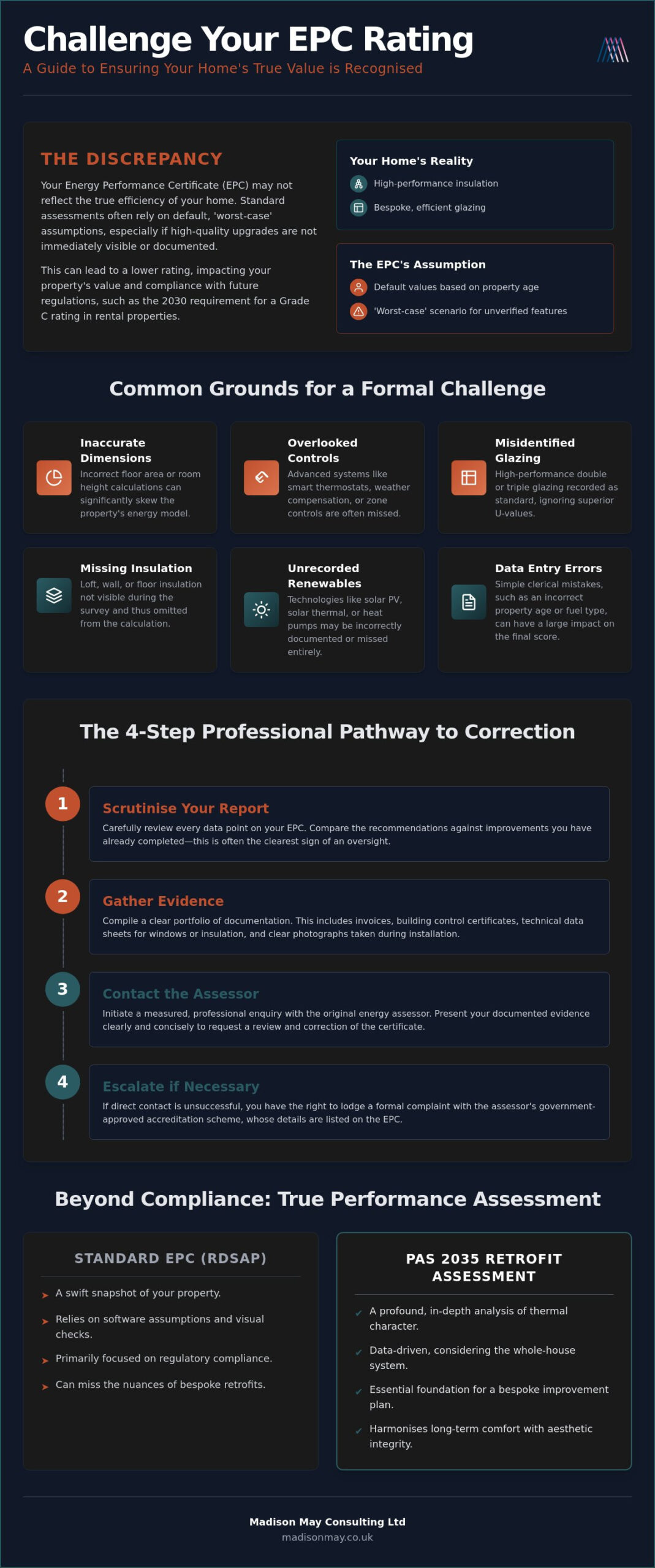
The vast majority of existing dwellings are assessed using the Reduced Data Standard Assessment Procedure (RdSAP). Since June 2025, assessors have utilised RdSAP 10, a methodology designed to be more precise than its predecessors. Even with these improvements, the system still relies on software-driven assumptions when physical evidence is absent. If an assessor cannot visually verify the depth of your loft insulation or the specific U-value of your glazing, the software defaults to ‘worst-case’ values based on the property’s age. For those who’ve invested in high-end, non-standard materials, these default assumptions can unfairly penalise a home that actually performs beautifully.
Why Ratings May Fluctuate Amongst Similar Properties
It’s common to find that two seemingly identical properties on the same street hold different ratings. This fluctuation often stems from the subjectivity of the data collection process or a lack of accessible evidence during the survey. If you’ve wondered how to challenge an EPC rating, the first place to look is the ‘recommendations’ section. If the report suggests improvements you’ve already meticulously installed, it’s a clear indication that the initial data entry was incomplete. Providing documented proof of your upgrades ensures the assessor doesn’t have to rely on generic software assumptions, allowing the true character of your home’s performance to shine through.
Identifying Grounds for a Formal EPC Challenge
A successful challenge begins with a discerning eye for detail. When you consider how to challenge an EPC rating, you must look beyond the final score and scrutinise the individual data points that constitute the report. Inaccuracies often hide in the mundane, such as incorrect floor area measurements or room heights that skew the property’s volume calculations. If an assessor underestimates the height of your ceilings, the software assumes a smaller volume of air to heat; this can paradoxically lead to misleading efficiency results that don’t reflect your home’s true performance.
Sophisticated heating and hot water controls are another area where errors frequently occur. Modern residences often feature weather compensation, smart thermostats, or advanced zone controls that the standard RdSAP software might default to ‘standard’ settings if they aren’t explicitly identified. Similarly, bespoke glazing with specific U-values is often overlooked. Without technical data sheets, an assessor might record your high-performance windows as standard double glazing, failing to capture the quiet, thermal excellence they provide. Understanding how to challenge an EPC rating effectively requires a portfolio of evidence that speaks to the quality of your home’s materials.
For property owners who wish to maintain a professional and thorough compliance file, including detailed inventory reports from AG Property Services, such documentation can be invaluable when presenting evidence for a rating appeal.
Missing Evidence of Energy Efficient Improvements
The most common ground for a challenge is the absence of physical or documentary proof. For upgrades like cavity wall insulation or underfloor heating, which are inherently concealed within the building’s fabric, the assessor requires clear evidence. Organising a ‘homeowner’s evidence pack’ containing building regulations completion certificates, invoices from specialist contractors, or photographic records of the installation process is essential. If your previous survey was conducted in haste, you may need to Find an accredited EPC assessor who is willing to review this documentation with the care it requires.
Assumptions vs Reality in Building Fabric
Software logic relies heavily on ‘age bands’ to estimate the thermal performance of walls and roofs. However, if your property has undergone a deep refurbishment, these defaults are likely obsolete. You might consider using thermal imaging to provide the missing evidence for heat loss claims, proving that your walls perform better than the software’s age-based assumptions. This intersection of technology and physical reality is where an EPC Improvement Plan can help bridge the gap, ensuring your home’s narrative is grounded in fact rather than generic estimates.
- Renewable Energy: Ensure solar PV arrays, battery storage, or heat pumps are recorded with their specific capacities and MCS certificates.
- Ventilation: Mechanical Ventilation with Heat Recovery (MVHR) systems are often misidentified, yet they play a critical role in both comfort and energy scores.
- Draught Proofing: Whilst small, professional draught-proofing measures across an entire heritage property can significantly alter the heat loss narrative.
The Step-by-Step Process to Challenge an EPC Rating
Correcting a flawed energy narrative requires a blend of technical precision and diplomatic poise. When you consider how to challenge an EPC rating, the journey begins not with a confrontation, but with a measured, written enquiry addressed to the original domestic energy assessor (DEA). This initial contact is an opportunity to present the sensory and physical evidence you’ve meticulously gathered, inviting the professional to revisit the data that defines your home’s thermal identity. It’s a process of refinement, ensuring that every layer of insulation and every sophisticated heating control is honoured within the final calculation.
If the original assessor’s response feels incomplete or fails to address the technical discrepancies you’ve identified, the pathway leads towards a formal escalation. As of July 2026, the process remains accessible to property owners, with accreditation schemes mandated to investigate disputes without charging a fee to the complainant. This ensures that the pursuit of accuracy is never hindered by financial barriers, allowing the true performance of your sanctuary to remain the primary focus.
Communicating with the Original Assessor
Frame your initial outreach as a ‘request for data verification’ rather than a standard complaint. This professional approach encourages a collaborative atmosphere where the assessor can review specific sections of the EPC that feel mismatched with your property’s reality. Perhaps the software defaulted to an ‘assumed’ age band for your solid walls, or maybe the presence of a high-efficiency cylinder was overlooked during the site visit. By referencing these specific data points and providing clear, documentary proof, you provide the assessor with the necessary tools to rectify the record. Maintain a polished, rhythmic record of all correspondence; this creates a steady trail of evidence should the matter require further review.
Escalating to Accreditation Schemes
Should the initial dialogue reach an impasse, you must identify the accreditation scheme the assessor belongs to, such as Elmhurst, Quidos, or Stroma. These details are always listed on the EPC itself. Lodging a technical dispute involves a formal review of the RdSAP inputs used during the survey. The scheme will typically conduct an audit of the original assessment, acting as an independent third party to ensure the software logic aligns with the physical building fabric. This level of scrutiny provides a final adjudication, often resulting in a corrected certificate that truly reflects the elegance and efficiency of your home. Understanding how to challenge an EPC rating through these formal channels ensures that your property’s story is told with absolute integrity.
- Review the assessor’s accreditation details on the existing certificate.
- Submit your evidence pack alongside a formal letter of dispute.
- Await the scheme’s audit, which may involve a second site visit for verification.
- Receive your updated EPC, issued at no cost if an error is confirmed.
Beyond the Appeal: Reimagining Property Performance
Challenging a rating is about more than just an administrative correction; it’s an act of reclaiming the narrative of your home. Whilst learning how to challenge an EPC rating is essential for rectifying immediate errors, the process often reveals a deeper truth. A standard certificate, restricted by the limitations of the RdSAP methodology, may never fully capture the technical soul of a high-end refurbishment. For a property that has been meticulously restored with heritage materials or advanced thermal solutions, the journey toward efficiency requires a more evocative and detailed picture than a simple colour-coded chart can provide.
This is where the transition from mere compliance to genuine performance begins. By moving beyond the baseline requirements of an EPC, you can explore the true thermal character of your living space. Tools such as thermal imaging cameras and detailed building surveys offer a sensory depth to data collection, identifying exactly where heat lingers and where it escapes. This level of scrutiny ensures that every detail of your property’s construction is both intentional and recorded with absolute integrity.
The EPC vs. the PAS 2035 Retrofit Assessment
A PAS 2035 Retrofit Assessment represents the gold standard in building data. Unlike a standard EPC, which relies heavily on software assumptions and age-band defaults, a Retrofit Assessment provides a deeper, more accurate layer of information tailored to the specific building fabric. It moves away from generic estimates to real-world performance metrics, creating a data-rich foundation for your home’s future. This transition ensures that the sanctuary you’ve built is recognised not just for its aesthetic grace, but for its measured ability to retain warmth and reduce carbon impact. Understanding how to challenge an EPC rating is often the catalyst that leads homeowners to seek this more profound level of technical clarity.
The Whole-House Approach to Energy Efficiency
True efficiency is found in the harmony between insulation, ventilation, and heating systems; they must interact as a single, breathing organism. There is a delicate balance to strike, particularly in period properties where adding high-performance insulation without a professional assessment of air flow can lead to unintended consequences like damp or poor indoor air quality. A Retrofit Coordinator acts as the sophisticated guide through this complexity, ensuring that every improvement is functional, beautiful, and safe. This whole-house philosophy ensures that your property’s journey toward a higher rating is a seamless experience, grounded in meticulous craftsmanship and visionary planning.
For those seeking a deeper level of accuracy and a strategic roadmap for their home’s future, commissioning a professional Retrofit Assessment is the most effective way to ensure your property’s true performance is captured with poise and precision.
Crafting Your Property’s Future with a Bespoke Improvement Plan
Securing an accurate certificate is a vital victory, yet it remains merely the prologue to your home’s enduring story. While the immediate goal of understanding how to challenge an EPC rating is often regulatory compliance or marketability, the ultimate reward is the clarity it provides for future enhancements. A corrected rating serves as a reliable baseline, allowing you to transform a technical document into a strategic roadmap for long-term comfort and character. It’s about moving beyond the digital verdict to create a living space that feels as efficient as the data suggests.
The philosophy at Madison May Consulting Ltd is rooted in the belief that functionality and the aesthetics of warmth are not mutually exclusive. We view each property as a unique sanctuary, where every technical upgrade should feel like a natural extension of its heritage. By creating a sequence of improvements that respect the property’s original fabric and your personal story, we ensure that the journey toward a more efficient home is both beautiful and intentional. This meticulously planned energy strategy provides a sense of peace, knowing that every material chosen and every system installed is working in harmony to preserve your refuge for generations to come.
The Meticulous EPC Improvement Plan
Once the initial data is corrected, the next logical step is to look forward. The Meticulous EPC Improvement Plan: A Roadmap for West Yorkshire Sanctuaries offers a sophisticated way to navigate the complexities of home refurbishment. A professional plan avoids the pitfalls of piecemeal improvements, which can often lead to conflicting systems or compromised air flow. Instead, we prioritise measures that offer the greatest emotional and financial return, ensuring that your investment enhances the lived experience of your home whilst steadily climbing the efficiency bands. This measured pace allows for a deeper focus on quality craftsmanship rather than hurried compliance.
Your Journey to a More Efficient Sanctuary
The path to a truly refined home begins with an attentive listener and a thoughtful expert. We invite you to engage a professional Retrofit Assessor to conduct a comprehensive building survey, providing the granular detail that a standard EPC simply cannot reach. This intersection of visionary energy design and meticulous building fabric analysis ensures that your home’s transformation is grounded in reality. Whether you are addressing damp remediation or planning a sophisticated loft conversion, every detail is managed with grace and poise. To begin your property’s transformation and reclaim your efficiency narrative, please Contact Madison May Consulting Ltd for a bespoke consultation.
- Strategic Sequencing: Ensuring insulation and ventilation are balanced to protect the building’s health.
- Heritage Respect: Using materials that honour the property’s history whilst meeting modern standards.
- Long-term Vision: Aligning your property’s performance with upcoming 2030 regulatory requirements.
Reclaiming the Integrity of Your Home’s Efficiency
Your home is a sanctuary, a deeply personal refuge where every detail has been chosen with care. Understanding how to challenge an EPC rating is the vital first step in ensuring this narrative is captured with absolute integrity and technical precision. By moving from generic assumptions to a data-driven reality, you protect both the marketability of your property and its long-term regulatory compliance. This journey doesn’t end with a corrected certificate; it’s the foundation for a visionary energy strategy that balances modern functionality with the timeless beauty of your living space.
The path toward a truly efficient home requires a sophisticated guide who prioritises your personal story. We invite you to begin your property’s energy transformation with a professional consultation at Madison May Consulting Ltd. Through our PAS 2035 Aligned Assessments and specialist retrofit consultancy, we provide a meticulous whole-house strategy that honours your property’s heritage. You don’t have to navigate these technical complexities alone. With the right expert support, your home can finally reflect the true performance and comfort it was always meant to provide.
Frequently Asked Questions
Can I challenge an EPC rating for free?
Yes, you can challenge an EPC rating for free by contacting the accreditation scheme listed on the certificate. These professional bodies are required to investigate technical disputes at no cost to the property owner. If an error is confirmed, a corrected certificate must be issued without charge, ensuring that the pursuit of accuracy remains accessible to everyone seeking to reflect their home’s true performance.
How long does it take to appeal an EPC rating?
The timeline for an appeal typically unfolds over several weeks, beginning with the initial enquiry to the assessor. Whilst some simple data corrections are resolved within days, a formal escalation to an accreditation scheme may take longer as it requires a technical audit of the original evidence. This measured pace ensures that every detail of your property’s energy narrative is reviewed with the necessary care and professional scrutiny.
What evidence do I need to provide to challenge an EPC?
To challenge an EPC effectively, you should provide clear documentary or physical proof of your property’s efficiency measures. This includes building regulations completion certificates, specialist contractor invoices, and photographic records of concealed upgrades like cavity wall insulation. Providing these technical details allows the assessor to move away from software assumptions and record the authentic thermal character of your sanctuary with absolute confidence.
Can an EPC rating be lowered after a challenge?
Yes, it is possible for a rating to be lowered if a formal audit reveals that the original assessment was overly optimistic. Whilst most homeowners seek to raise their score, the primary objective of any challenge is data integrity and absolute accuracy. A corrected certificate ensures that your property’s energy story is told truthfully, protecting you from future regulatory complications or compliance issues.
What happens if the assessor refuses to change the EPC?
If the original assessor declines to amend the certificate, you should escalate the matter to their professional accreditation scheme. Details for schemes such as Elmhurst or Quidos are found on the EPC itself. These bodies act as independent adjudicators, conducting a technical review of the data inputs to ensure the final rating aligns with the physical reality of your home’s building fabric.
Is a Retrofit Assessment the same as an EPC?
A Retrofit Assessment is significantly more detailed than a standard EPC, focusing on a whole-house approach aligned with PAS 2035 standards. Whilst an EPC provides a high-level snapshot for compliance, a Retrofit Assessment offers a granular analysis of how insulation, ventilation, and heating systems interact. This deeper layer of building data is essential for those planning a sophisticated and intentional journey toward long-term energy performance.
How often should I update my EPC if I am making improvements?
You should consider updating your EPC whenever you complete significant energy-efficient home improvements that could alter the property’s rating. Whilst a certificate is valid for ten years, an outdated report won’t reflect recent investments like high-performance glazing or heating upgrades. Refreshing the data ensures your home’s marketability and compliance status remain as sophisticated and accurate as the refurbishments you’ve meticulously undertaken.
What are the most common mistakes made by EPC assessors?
Assessors often make errors regarding wall construction types or the presence of concealed insulation when physical evidence isn’t immediately visible. Other frequent discrepancies include misidentifying advanced heating controls or recording inaccurate floor areas, which skew the property’s volume calculations. Learning how to challenge an EPC rating involves scrutinising these specific data points to ensure the software’s default assumptions haven’t unfairly penalised your home’s true efficiency.