


The final craftsman has departed, the dust has settled, and your home stands transformed, yet the quiet that follows can often feel more like uncertainty than peace. You might find yourself questioning whether those sophisticated new layers of insulation are truly protecting your walls or if the intricate pulse of your updated heating system is performing as it should. It’s a common anxiety, which is why professional post-installation support for retrofit is so essential; it provides the reassurance that your sanctuary is functioning exactly as intended rather than leaving you to guess at its performance.
We understand the desire for absolute verification after such a significant journey of improvement. This article will demonstrate how dedicated support ensures your energy upgrades deliver the lasting comfort, compliance, and cost savings you expect. We will explore the transition from a construction project to a high-performance lifestyle, detailing how to secure your documentation and master your home’s new rhythm whilst ensuring your investment remains a source of pride and security for decades to come.
Key Takeaways
- Understand why the formal handover process serves as a vital bridge between the completion of building works and your long-term comfort within the PAS 2035 framework.
- Discover how dedicated post-installation support for retrofit ensures you possess the complete documentation, including TrustMark and MCS certificates, necessary for future property sales.
- Learn to master the delicate balance of ventilation and heating, ensuring your new air source heat pump or insulation works in harmony with your home’s unique rhythm.
- Explore the sophisticated validation methods, such as thermal imaging, that offer tangible verification of your home’s enhanced energy performance and airtightness.
- Gain clarity on the role of a Retrofit Coordinator as a project guardian who oversees the critical first year of habitation and organises essential system maintenance.
Defining Post-Installation Support in the PAS 2035 Framework
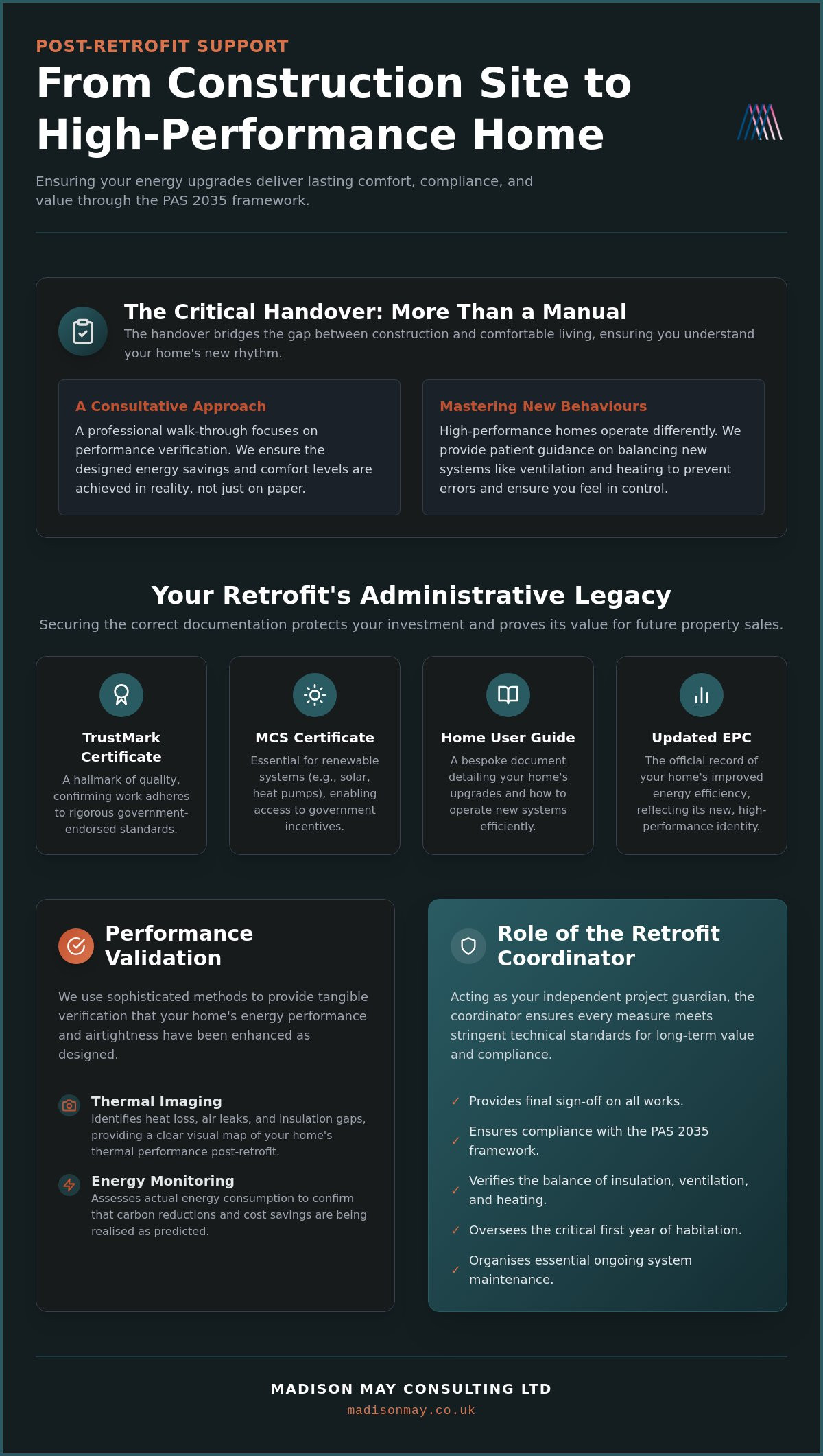
The moment the last van pulls away from your driveway marks a profound shift in the life of your home. The physical disruption has ceased, yet the journey towards true energy efficiency is only just beginning. Within the PAS 2035:2023 framework, which became the mandatory standard for government-funded projects on 30 March 2025, the handover is viewed as a critical bridge. It’s the point where a construction site returns to being a private refuge. Professional post-installation support for retrofit distinguishes itself from a standard contractor’s walkthrough by offering a deep, evaluative look at how these new systems interact with your specific environment.
While a traditional builder might simply hand over a stack of manuals, a professional approach treats this phase as an essential consultancy. The goal is to verify that the energy upgrades don’t just exist but actually perform. This involves a formal evaluation of the retrofit’s success, ensuring that the intended carbon reductions and comfort levels are being met in reality. Comprehensive post-installation support for retrofit ensures that the vision established during the design phase is actually realised in the lived experience of the occupants.
The Handover: More Than Just a Manual
Transitioning back to a sanctuary requires more than a cursory glance at a thermostat. It demands a rhythmic, measured explanation of the new technologies that now breathe within your walls. High-performance homes operate differently than traditional ones; they require a different set of building behaviours. A professional walk-through prevents future operational errors by teaching you how to live in harmony with your upgrades. This patient guidance ensures you feel in control of your environment rather than overwhelmed by its complexity.
Regulatory Compliance and the Project Guardian
In the complex landscape of UK building regulations, the Retrofit Coordinator acts as your project guardian. They provide the final sign-off, ensuring every measure meets the stringent technical standards required for long-term durability. Through a rigorous whole-building analysis, the coordinator ensures that insulation, ventilation, and heating systems are perfectly balanced. This oversight protects your interests, ensuring that the intersection of beauty and functionality is never compromised by technical shortcuts. By securing the necessary TrustMark and MCS certificates, the coordinator provides the documentation you’ll need for future property sales. It’s a sophisticated layer of protection that transforms a series of home improvements into a certified, high-value asset.
The Essential Retrofit Handover: Documentation and Certification
While the physical installation of energy measures defines the immediate comfort of your home, it is the invisible thread of documentation that secures its long-term value. A successful transformation is never truly complete until the technical achievements are translated into a robust administrative legacy. The true value of post-installation support for retrofit lies in the meticulous assembly of this evidence; it ensures that every heat pump, solar array, and layer of high-performance insulation is backed by the certifications required for both current peace of mind and future property transactions.
Securing your TrustMark and MCS certificates is a non-negotiable step for any project involving government grants or high-tech renewable systems. These documents serve as a hallmark of quality, confirming that the work adheres to the rigorous standards of the PAS 2035 framework. Without these specific validations, even the most expertly installed system remains an unverified asset. Beyond these certificates, your handover should include a bespoke Home User Guide. This narrative document tells the story of your property’s evolution, providing future owners with a clear understanding of how the building’s fabric has been enhanced and how the systems within it are designed to breathe.
Validating Your EPC Improvement Plan
The transition from a planned upgrade to a verified reality culminates in the post-installation Energy Performance Certificate (EPC). This document is the official record of your success, updating your property’s rating to reflect its new, efficient identity. By linking your EPC improvement plan to the final, documented results, you provide tangible proof of performance. This is particularly vital for measures that are no longer visible, such as cavity wall or floor insulation, where photographic evidence and technical data sheets are the only way to demonstrate the presence of high-value materials to surveyors or lenders.
The Administrative Sanctuary: Keeping Records Safe
Creating an administrative sanctuary for your home involves more than just filing papers; it is about building a digital and physical archive that protects your investment. Invoices, building regulation notifications, and transferable warranties should be organised with the same care as the design itself. Ensuring your guarantees are legally robust and easily accessible provides a sense of calm that lasts long after the contractors have left. If you feel overwhelmed by the complexity of these requirements, seeking professional coordination can ensure no detail is overlooked, allowing you to focus on the enjoyment of your refined space.
Living in Your Retrofitted Sanctuary: Adjusting to New Building Behaviours
Stepping into a newly retrofitted home is a sensory experience that transcends mere temperature. The air is often stiller, the acoustics are softened, and the pervasive chill of older properties is replaced by a steady, reliable warmth. This atmospheric shift is a testament to meticulous craftsmanship, yet it also signals a fundamental change in how your home breathes. Professional post-installation support for retrofit is essential during this phase, as it helps you bridge the gap between traditional living and the specific requirements of a high-performance envelope.
The latest PAS 2035/2030:2023 standards place a significant emphasis on the interaction between the building fabric and its occupants. It’s no longer enough to simply install measures; success is defined by how those measures perform over time under your stewardship. Understanding this relationship is the key to protecting your energy investment and ensuring your home remains a healthy, inviting refuge.
The Art of Ventilation and Damp Prevention
A common anxiety amongst homeowners is the fear of damp or mould following the addition of insulation. This often stems from the ‘Ventilation Gap’, where a home is made airtight without a corresponding strategy for fresh air exchange. Adding insulation without a professional ventilation assessment is a risk that can lead to moisture becoming trapped within the structure. Managing your home’s humidity requires a shift in behaviour, such as understanding how to use trickle vents or mechanical ventilation systems effectively. By monitoring indoor air quality, you can prevent the silent arrival of damp and maintain a serene indoor environment that remains healthy for both the building and your family.
Heating for Comfort, Not Just Temperature
Living with a low-temperature system, such as an air source heat pump, requires unlearning the habits formed by decades of using traditional gas boilers. We are often accustomed to a ‘frantic’ heating cycle: short, intense bursts of high heat followed by rapid cooling. In a retrofitted sanctuary, the approach is more rhythmic and measured. These systems rely on thermal mass and a steady, low-temperature flow to maintain a constant environment. It’s about educating the senses to appreciate a consistently tempered home rather than waiting for a radiator to become too hot to touch. This transition ensures your post-installation support for retrofit translates into genuine, long-term comfort and significant cost savings.
Performance Validation: Measuring the Success of Your Energy Upgrades
Verification is the final, essential act of a successful home transformation. It’s the moment when the abstract promises of a design plan are translated into empirical truth. While the previous stages of your journey focused on the physical installation and administrative compliance, this phase is about technical certainty. High-quality post-installation support for retrofit moves beyond simple visual inspections; it employs sophisticated technology to ensure your home’s new thermal envelope is performing exactly as intended. The data doesn’t lie. It provides a baseline for a new era of home performance, turning anxiety into quiet confidence.
There is a profound psychological reassurance in seeing the invisible made visible. Understanding that your investment has successfully eliminated cold spots or reduced heat loss by a specific margin provides a sense of peace that no manual can offer. By comparing your actual energy consumption against the predicted savings from your initial assessment, you can finally witness the tangible impact of your choices on both your bank balance and the environment. This validation is the cornerstone of protecting your energy investment for the decades to come.
The Insight of Thermal Imaging Surveys
Identifying gaps in insulation amongst complex architectural details requires more than a keen eye. A professional thermal imaging survey provides objective proof of quality, revealing the hidden thermal bridges that traditional inspections might miss. These surveys act as a final quality control measure, ensuring your contractor has delivered the promised performance. It allows you to see exactly where the heat is staying in and, more importantly, confirms that no critical areas were overlooked during the busy construction phase. It is a visual narrative of efficiency that confirms your home is now a true sanctuary.
Air Testing and Building Breathability
Quantifying draught reduction is a vital step in validating the whole-house approach. Professional air pressure testing measures the literal airtightness of your home’s new envelope, providing a numerical value for its performance. This isn’t about creating a sealed box, but rather ensuring the delicate balance between preventing heat loss and allowing for necessary air exchange. This empirical data confirms that your ventilation strategy and insulation are working in perfect harmony, protecting the building’s longevity whilst maintaining a fresh, healthy atmosphere. To ensure your home meets these exacting standards, you can arrange a professional retrofit assessment to validate your recent upgrades.
Professional Coordination: Ensuring Long-Term Value and Compliance
A home isn’t a static object; it’s a living, breathing entity that evolves with its inhabitants. Viewing a retrofit as a singular transaction is a common mistake that overlooks the subtle adjustments required during the first four seasons of habitation. Professional post-installation support for retrofit should ideally extend into this first year, providing a watchful eye as the building settles into its new thermal rhythm. This period of observation allows for the fine-tuning of heating schedules and ventilation patterns, ensuring that the theoretical efficiency of the design becomes a lived reality.
Scheduling annual maintenance for high-tech systems, such as air source heat pumps or mechanical ventilation units, is essential for preserving the longevity of your investment. This proactive care prevents minor inefficiencies from becoming costly repairs, maintaining the delicate balance of your home’s ecosystem. By adopting a consultant-led approach, you position your property to meet upcoming regulatory shifts, such as the Future Homes Standard coming into force on 24 March 2027. This foresight ensures your sanctuary remains at the vanguard of efficiency, effortlessly meeting the 75% carbon reduction targets set for the next generation of housing.
The Evolving EPC and Future Compliance
For landlords and commercial owners, staying ahead of MEES (Minimum Energy Efficiency Standards) regulations is a matter of both legal necessity and ethical stewardship. An EPC isn’t merely a certificate to be filed away; it’s a dynamic roadmap that requires periodic review as technology and standards advance. Integrating new elements, such as bespoke windows and doors, into an ongoing energy strategy allows for a phased approach to refinement. This methodical progression ensures that every addition enhances the property’s narrative of quality whilst steadily improving its official energy rating.
A Legacy of Craftsmanship and Efficiency
Treating your home as a living story of sustainable refinement requires a partnership that transcends the typical client-contractor relationship. By engaging in a long-term collaboration with a specialist consultancy, you benefit from a curated experience where every detail is intentional. This enduring harmony is the true hallmark of a well-coordinated retrofit. It transforms a series of technical upgrades into a legacy of craftsmanship, ensuring your home remains a personal refuge and a testament to visionary creativity for many years to come. Providing dedicated post-installation support for retrofit is the final, graceful note in this transformative journey, ensuring the peace of mind that only true expertise can provide.
Securing the Future of Your High-Performance Sanctuary
A successful retrofit is far more than a collection of technical upgrades; it’s a commitment to a refined and sustainable way of living. By embracing professional post-installation support for retrofit, you ensure that the intricate balance between insulation, ventilation, and heating remains in perfect harmony as the seasons change. We’ve explored how empirical validation through thermal imaging and the meticulous organisation of certifications protect your property’s value whilst providing the quiet reassurance that your investment is performing exactly as intended. This journey is about transforming a building into a resilient, healthy refuge that responds effortlessly to your lifestyle.
Expertise ensures that the transition from construction to comfort is both seamless and secure. With our PAS 2035 aligned assessments and specialist damp and ventilation expertise, we act as the dedicated guardian of your home’s long-term efficiency. Through independent retrofit coordination, we provide the steady, authoritative guidance needed to navigate complex regulatory landscapes and technical fine-tuning.
Discover how Madison May can guide your home’s energy transformation and help you craft a legacy of enduring comfort and craftsmanship. Your home is a living story; let’s ensure its next chapter is one of serenity, health, and sustainable excellence.
Frequently Asked Questions
What is the most important document to receive after a retrofit installation?
The most critical document is the comprehensive handover pack, which must include your TrustMark and MCS certificates. These provide the essential verification that your upgrades meet national standards and are often required for grant compliance. This pack should also contain a bespoke Home User Guide, detailing how your property’s specific systems interact to maintain a healthy, efficient environment for years to come.
How long does post-installation support typically last for a domestic property?
Professional post-installation support for retrofit typically extends through the first twelve months of habitation to cover a full cycle of seasons. This allows your Retrofit Coordinator to monitor how the building performs during both the depth of winter and the height of summer. It’s a measured period of fine-tuning that ensures your home’s new rhythm is perfectly balanced and performing as intended.
Why do I need a new EPC after completing energy efficiency works?
A post-installation Energy Performance Certificate (EPC) is vital because it provides the official, updated record of your home’s enhanced efficiency. This document translates your physical upgrades into a recognised rating, which is essential for future property sales or meeting rental regulations. It serves as the final, objective proof that your investment has delivered the promised carbon reductions and enhanced thermal performance.
Can a retrofit coordinator help if I discover damp after insulation is installed?
Your Retrofit Coordinator acts as a project guardian and is your first point of contact if moisture issues arise after the works are finished. They will conduct a thorough review of the ventilation strategy to identify any imbalances between the new insulation and air exchange. Their role is to ensure that the whole-house approach remains intact, protecting your home from the risks of interstitial condensation or mould.
What happens if my new heating system doesn’t seem to be saving money?
If your savings don’t match predictions, professional post-installation support for retrofit will include a performance evaluation to identify the cause. This often involves reviewing system settings or adjusting occupant behaviours, such as moving away from the frantic heating cycles of traditional boilers. Small, sophisticated refinements in how you interact with the technology can lead to significant improvements in long-term cost-effectiveness.
Is thermal imaging necessary for every post-installation support package?
While not strictly mandatory for every project, thermal imaging is a highly sophisticated tool for validating the quality of your insulation. It offers a visual narrative of your home’s thermal performance, revealing hidden gaps or cold bridges that a standard inspection might overlook. For many homeowners, this objective proof provides a profound sense of psychological reassurance and technical certainty that the work was completed correctly.
How does occupant behaviour need to change in a highly insulated home?
Living in a high-performance home requires a shift towards more rhythmic heating and active ventilation management. You’ll need to move away from intense, short bursts of heat in favour of steady, low-temperature warmth that utilises the building’s thermal mass. Additionally, understanding how to use trickle vents or mechanical systems effectively is crucial for maintaining air quality whilst preserving the integrity of the building’s fabric.
What is the role of TrustMark in post-installation support?
TrustMark provides the overarching quality framework and financial protection for your retrofit project. Their revised requirements, effective from 30 June 2026, ensure that homeowners have robust recourse and protection if works don’t meet the expected standards. It’s a mark of excellence that guarantees your post-installation support is backed by a reliable, government-endorsed scheme, providing a sense of calm and security.