


True property preservation is found not in the mere maintenance of the past, but in the meticulous preparation for a more efficient and refined future. However, the evolving landscape of mees regulations often creates a sense of profound unease, leaving many landlords to grapple with shifting deadlines and the shadow of financial penalties that can now reach £30,000 for domestic breaches. You likely feel the tension between the desire to maintain a beautiful, efficient home and the anxiety surrounding the true cost of these essential energy upgrades. It is a delicate balance to strike, especially when the regulatory requirements feel like a moving target rather than a clear destination.
This guide offers the clarity you seek, providing a professional roadmap to navigate the complexities of compliance whilst enhancing the inherent value of your investment. We will explore the definitive requirements for 2026 and beyond, including the mandatory move towards an EPC C rating by 2030 and the nuances of the £10,000 cost cap for domestic improvements. You will discover how to transform these regulatory obligations into a visionary journey of property improvement, ensuring your portfolio remains both legally robust and beautifully efficient for years to come.
Key Takeaways
- Understand the transition from current EPC E standards to the mandatory EPC C requirement for all domestic tenancies by October 2030.
- Navigate the financial landscape of mees compliance, including the £10,000 cost cap and the significantly increased penalties for non-compliance.
- Learn why a “fabric first” methodology is essential for reducing heat loss effectively before investing in complex heating upgrades.
- Discover how a PAS 2035 aligned retrofit assessment acts as a meticulous guardian for your property’s long-term health and tenant comfort.
- Gain a clear, professional roadmap through a bespoke EPC Improvement Plan that sequences upgrades for maximum cost-effectiveness.
Understanding MEES: The Evolving Landscape of Energy Efficiency Regulations
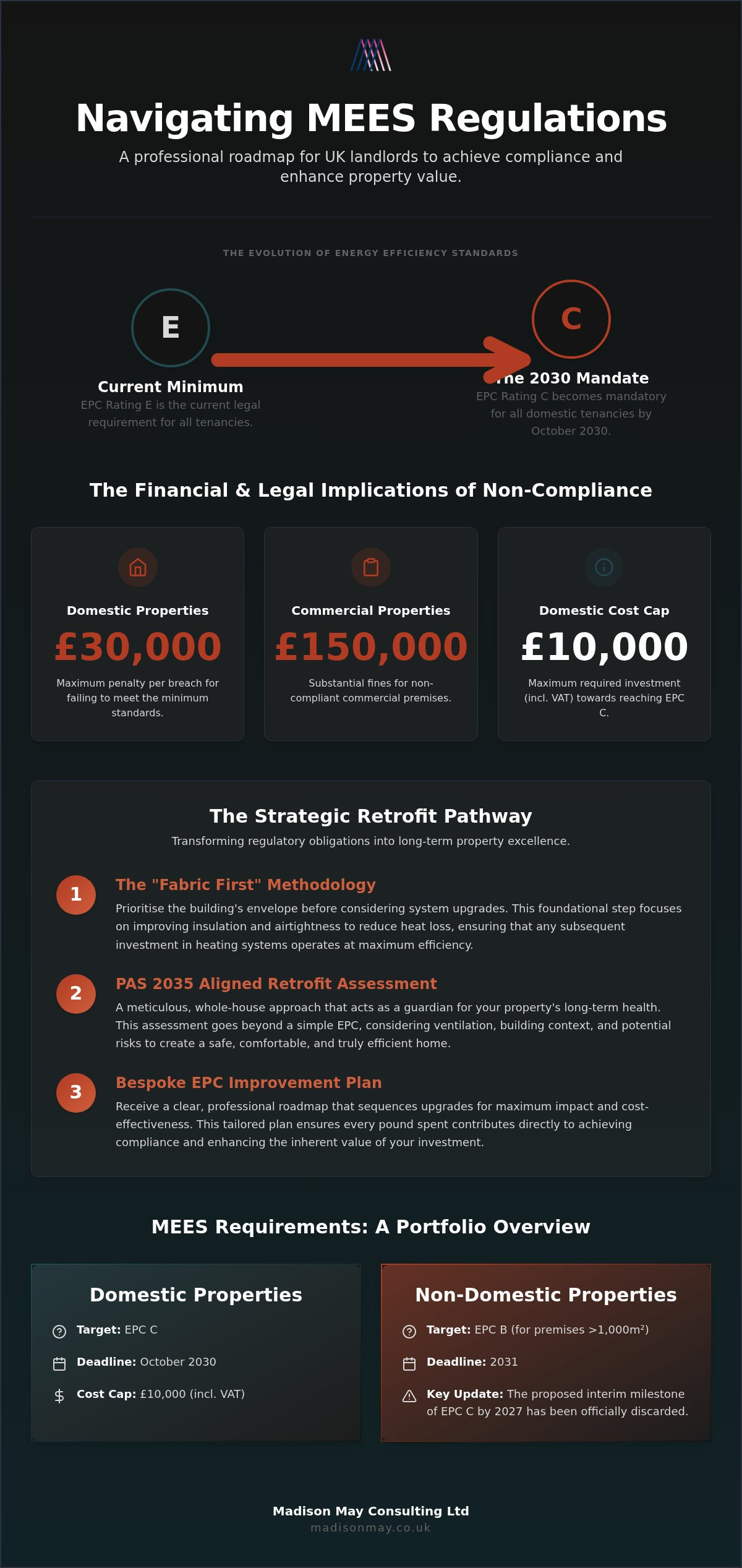
The Minimum Energy Efficiency Standards, commonly known as mees, represent a transformative shift in how we perceive and maintain our built environment. Rather than viewing these regulations as a mere checklist of compliance, they are better understood as a blueprint for the enduring quality of the Private Rented Sector. Currently, the legal minimum for domestic properties remains an EPC rating of E, yet the horizon is shifting toward a more ambitious standard of EPC C by October 2030. This trajectory is measured through the Energy Performance Certificate, a vital document that serves as the primary metric for a property’s thermal narrative, reflecting the invisible craftsmanship of its insulation and heating systems.
The Core Purpose of Energy Standards
The impetus behind these standards extends far beyond simple bureaucracy. At its heart, the movement focuses on a profound commitment to national decarbonisation, aligning individual property improvements with broader environmental stewardship. By ensuring homes are thermally efficient, we directly address the vulnerability of fuel poverty, allowing tenants to reside in spaces that are not only beautiful but also inherently supportive. Professional retrofitting, when executed with care, enhances the very life of the building, preserving the heritage of Energy efficiency in British housing as a legacy for future generations. It is an investment in the sanctuary of the home.
Domestic vs. Non-Domestic: Key Differences
Distinctions within the mees framework have become significantly clearer following the government’s interim response in June 2026. For those managing non-domestic portfolios, the focus has narrowed toward the largest premises. Properties exceeding 1,000 square metres are now expected to reach an EPC B rating by 2031, providing a generous window for strategic planning and meticulous execution. Crucially, the previously proposed interim milestone of EPC C by 2027 has been officially discarded. This change offers much-needed breathing room for smaller commercial landlords whose properties remain subject to the current EPC E minimum, with no new deadline for further improvements currently set.
In the residential sphere, the path is more direct and the expectations more immediate. Local authorities now possess the power to enforce compliance with increased vigour, backed by a maximum penalty for domestic properties that has risen to £30,000 per breach. For residential landlords, the focus remains on the October 2030 deadline for reaching an EPC C rating, supported by a £10,000 cost cap. This clarity allows for a more measured, graceful approach to refurbishment. It encourages a shift away from reactive fixes toward a philosophy of long-term property excellence where every upgrade is intentional.
The Financial and Legal Implications of MEES Compliance
Compliance is far from a voluntary aspiration; it is a rigid legal prerequisite for the granting of new leases or the renewal of existing ones. For domestic properties, the stakes have risen significantly. Local authorities now have the mandate to issue penalties of up to £30,000 per property for non-compliance, a sharp increase from previous years that reflects the government’s commitment to thermal efficiency. Commercial landlords face even more substantial risks, with fines reaching up to £150,000 for breaches. These figures are not merely deterrents; they represent a fundamental shift in the accountability of property ownership and the management of our built environment.
Beyond the immediate financial sting, the mees framework is woven into the very legality of your rental agreements. If a property falls below the required standard, you may find yourself legally unable to let the space, creating a void that impacts both cash flow and the long-term viability of your portfolio. Identifying potential issues early through a professional building survey allows you to address these risks before they manifest as legal barriers to your business operations.
Navigating the Spending Cap Thresholds
The transition toward EPC C by 2030 introduces a new financial landscape, most notably a £10,000 cost cap (inclusive of VAT) for domestic improvements. Whilst the previous £3,500 limit provided a baseline for the E rating, this expanded threshold ensures that more comprehensive measures, such as internal wall insulation or high-performance glazing, are brought into scope. For properties valued under £100,000, the cap is limited to 10% of the property’s value, offering a necessary safeguard for lower-value assets. It’s vital to meticulously document all expenditure, as any qualifying work carried out since October 1, 2025, can be counted toward this total. The spending cap acts as a protective threshold for landlords whilst ensuring steady progress toward a more efficient national housing stock. To ensure your financial records are as robust as your compliance strategy, you can learn more about Mazuma and their professional accountancy services for UK landlords.
Exemptions do exist, though they are not a permanent reprieve. You may register a “high cost” exemption if the cheapest measure exceeds the cap, or a “wall insulation” exemption if such measures would negatively impact the building’s structural integrity. These must be formally recorded on the PRS Exemptions Register and typically expire after five years. You can find detailed instructions on these processes in the Official UK Government MEES Guidance.
The Risks of Non-Compliance Beyond Fines
Financial penalties are only one facet of the risk profile. A property with a poor energy rating risks becoming an “un-lettable” asset in a market that increasingly values sustainability and tenant well-being. Reduced rental yields often follow low efficiency ratings, as tenants become wary of spiralling energy costs. Lenders are also tightening their criteria to avoid “stranded assets” within their own portfolios, making it increasingly difficult to secure buy-to-let mortgages or refinancing for low-rated properties. Investing in efficiency is no longer just about avoiding a fine; it’s about protecting the future liquidity and desirability of your property.
Beyond the Certificate: Why a Whole-House Approach Surpasses Simple EPC Improvements
The journey toward achieving mees compliance is often mistaken for a simple race to acquire a new certificate. However, true property excellence requires a more profound perspective. Instead of applying isolated, reactive fixes, we must view the improvement process as a sophisticated, integrated journey known as a ‘whole-house’ retrofit. This methodology ensures that every change, from draught proofing to heating upgrades, works in harmony with the building’s unique character. It’s about moving away from a tick-box mentality and toward a philosophy of property preservation that values the home as a sanctuary.
A PAS 2035 aligned approach is the gold standard for quality in this field. It moves beyond the surface-level checks of a standard EPC to provide a meticulous analysis of the building’s needs. Without this level of care, landlords risk ‘shallow retrofitting’. This occurs when measures like new windows or internal insulation are installed without considering the delicate balance of airflow. Such oversights can lead to unintended consequences, including damp and condensation, which compromise the very fabric of the building. The building’s fabric must always be the foundation of any successful energy strategy.
The Role of the Retrofit Assessor
Standard EPC surveys are often brief, lasting mere minutes and relying on high-level assumptions. In contrast, a professional retrofit assessment is a deep dive into the property’s individual story. It involves detailed data collection on the building’s fabric, occupancy patterns, and existing ventilation systems. For traditional buildings, this level of detail is essential. An assessor identifies practical upgrades that respect the property’s heritage whilst meeting modern efficiency standards. This thoughtful approach is supported by the official government MEES guidance for landlords, which emphasises the necessity of appropriate, well-considered measures for diverse housing types.
Retrofit Coordination: Your Project Guardian
The technical complexities of a whole-house upgrade require a steady, expert hand. A Retrofit Coordinator acts as your project guardian, providing the meticulous oversight needed to ensure every installation meets the highest technical standards. This role is vital for bridging the gap between the initial assessment and the final, finished environment. By managing the interaction between different measures, such as ensuring insulation doesn’t block vital ventilation paths, they ensure the property functions as a healthy, breathable space. They oversee the transition from a drafty, inefficient house to a refined home where heat loss is reduced effectively and every material is chosen with care. The result is a property that doesn’t just meet a legal requirement but resonates with a sense of enduring quality and calm.
Creating Your EPC Improvement Plan: A Strategic Roadmap to EPC C and Beyond
An EPC improvement plan serves as a meticulously curated roadmap, ensuring that your journey toward mees compliance is both efficient and aesthetically harmonious. Generic recommendations found on a standard certificate often lack the nuance required for a sophisticated refurbishment; they fail to consider how one measure might impact another. By establishing a bespoke sequence, you can organise works to minimise disruption for your tenants, perhaps aligning upgrades with scheduled maintenance or tenancy changes. This strategic foresight transforms a regulatory obligation into a seamless evolution of your property’s identity, protecting your investment whilst enhancing its allure.
Fabric First: Insulation and Draught Proofing
The foundation of any high-performing home lies in its fabric. Before considering complex heating systems, one must first address the building’s ability to retain warmth through high-quality loft, cavity wall, or external house insulation. Each layer of insulation acts as a protective cloak, preserving the internal climate and reducing the energy required to maintain comfort. This commitment to quality extends to the choice of windows and doors, where one should seek pieces that offer an effortless union of aesthetic elegance and exceptional U-values. Draught proofing creates an immediate sense of calm and warmth by sealing the subtle breaches where comfort escapes. These foundational steps ensure that subsequent heating upgrades can be smaller, more efficient, and more cost-effective.
The Ventilation Gap: Preventing Damp and Mould
A common pitfall in the pursuit of energy efficiency is the neglect of airflow. Adding significant insulation without a comprehensive ventilation assessment is often a recipe for disaster, as it can trap moisture and lead to damp issues. Understanding and implementing Part F of the building regulations is essential for maintaining a healthy home environment where air is refreshed without losing its precious warmth. Any existing damp or mould must be meticulously remediated as a vital precursor to energy-saving measures; covering these issues with insulation only invites future structural distress. By balancing airtightness with controlled ventilation whilst meeting mees standards, you protect both the building’s heritage and the well-being of those who reside within it.
To begin your journey with a clear and professional vision, you can commission a bespoke EPC improvement plan to identify the most impactful sequence for your property.
Madison May Consulting: Elevating Your Property Through Expert Retrofit Guidance
Madison May Consulting stands as a specialist retrofit consultancy, dedicated to the preservation and elevation of the Private Rented Sector through a lens of understated elegance. We believe that compliance with mees is more than a legal obligation; it’s a profound opportunity for a transformative journey that protects the heritage and value of your investment. Our fixed-fee retrofit assessment service serves as an essential gateway to informed decision-making, offering a moment of calm deliberation before any physical works begin. By championing a whole-house approach, we ensure that the intersection of functionality and beauty is never a compromise, but a natural union that enhances both the thermal performance and the sensory appeal of every room, positioning our brand as a trusted curator of your property’s lifestyle and sanctuary.
Our Meticulous Process
Our process is defined by its meticulous attention to detail, beginning with a deep building survey that listens to the property’s unique story. We prioritise your personal journey as a landlord, ensuring that the resulting roadmap for improvement respects the building’s identity whilst embracing modern efficiency standards. This narrative-driven approach is anchored in the technical rigour of PAS 2035 compliant reporting, providing the peace of mind that every measure is intentional and every material is chosen with care. It’s a structured yet imaginative path that moves logically from the initial spark of inspiration to the final, high-performing detail of the finished project.
A Trusted Guide Through Complexity
We position ourselves as a trusted guide through the technicalities of modern regulation, acting as attentive experts who simplify the design and retrofit process for our clients. Our team possesses a quiet confidence, born from a deep understanding of craftsmanship and a visionary approach to energy efficiency. With national coverage and a focus on enduring quality, we bring a sense of grace and poise to every project, ensuring that your property remains a deeply personal refuge for years to come. This flow creates a sense of ease and luxury, reassuring you that your portfolio is in capable, patient hands. We invite you to begin this property’s transformative journey with a professional consultation, allowing us to curate a space that is as efficient as it is exquisite.
Contact Madison May to secure your property’s future and ensure MEES compliance.
Securing the Legacy of Your Property Portfolio
The path toward mees compliance is not merely a navigation of legal hurdles; it is an invitation to refine the very essence of your rental assets. By embracing a fabric-first strategy and a whole-house philosophy, you ensure that your property remains a desirable, healthy sanctuary that stands the test of time. We’ve explored how a meticulous roadmap, grounded in professional assessment, replaces the anxiety of shifting deadlines with the quiet confidence of a well-executed vision. This transition allows you to protect your investment whilst providing a superior standard of living for your tenants.
Madison May Consulting is here to act as your project guardian, offering fixed-fee transparency and a PAS 2035 aligned methodology that guarantees technical excellence. Our expert Retrofit Coordination ensures that every improvement is sequenced perfectly, bridging the gap between current standards and the future requirements of 2030. Book your professional Retrofit Assessment with Madison May today to begin the elegant transformation of your portfolio. Your journey toward a more efficient, compliant, and beautiful property starts with a single, thoughtful step.
Frequently Asked Questions
What is the current minimum EPC rating for rental properties in 2026?
The current legal minimum for both domestic and non-domestic rented properties in 2026 is an EPC rating of E. Whilst this remains the baseline today, residential landlords must prepare for the mandatory transition to an EPC C rating by October 1, 2030. Non-domestic properties exceeding 1,000 square metres are on a separate trajectory, with a target of EPC B by 2031.
Is there a financial limit on how much I have to spend to meet MEES?
There is a cost cap of £10,000, inclusive of VAT, for landlords working to reach the EPC C target for domestic properties. Any qualifying expenditure on energy efficiency improvements made since October 1, 2025, can be counted towards this threshold. For properties valued under £100,000, the cap is further limited to 10% of the property’s value to protect the viability of smaller investments.
Can I let a property with an EPC rating of F or G if I apply for an exemption?
You can only let a property rated F or G if you’ve successfully registered a valid exemption on the PRS Exemptions Register. These exemptions aren’t automatic; they require formal documentation to prove that all relevant improvements have been made up to the cost cap or that specific structural limitations exist. Letting a sub-standard property without a registered exemption is a direct breach of mees regulations.
How long does a MEES exemption last once it is registered?
Most registered exemptions last for five years, offering a temporary window to plan for future enhancements. It’s important to remember that these exemptions are personal to the landlord rather than the building. If you sell the property, the new owner won’t be covered by your registration and must either achieve compliance or apply for their own exemption within six months of the transfer.
What happens if I fail to comply with MEES regulations?
Failure to comply can result in substantial financial penalties and the risk of your property becoming an “un-lettable” asset. For domestic properties, the maximum fine has increased to £30,000 per property, per breach, whilst non-domestic penalties can reach £150,000. Beyond the fines, local authorities may publish details of your non-compliance, which can impact your reputation and the marketability of your portfolio within the mees framework.
Does MEES apply to social housing and non-domestic properties?
Yes, the standards apply across the non-domestic sector, though the specific requirements and deadlines vary based on the size of the premises. Larger commercial buildings over 1,000 square metres are now the primary focus for the 2031 EPC B target. Whilst social housing often operates under different funding streams and specific performance metrics, the overarching drive for thermal efficiency remains a universal priority for all UK housing providers.
How can a Retrofit Assessor help me reach an EPC C rating?
A Retrofit Assessor provides the meticulous data needed to move beyond the generic recommendations found on a standard certificate. They conduct a deep dive into the property’s fabric, ventilation, and occupancy to create a bespoke roadmap for reaching the EPC C milestone. This professional guidance ensures every upgrade is intentional, protecting the building’s heritage whilst avoiding the risks of poorly planned improvements.
What is the ‘fabric first’ approach in the context of MEES?
The ‘fabric first’ approach prioritises the building’s envelope, such as its walls, roof, and floors, before considering upgrades to the heating system. By focusing on high-quality insulation and draught proofing first, you significantly reduce heat loss and lower the overall energy demand of the home. This methodology ensures that any subsequent heating technology can be smaller and more efficient, creating a refined and comfortable sanctuary for your tenants.