


What if the road to the October 2030 deadline wasn’t a series of stressful hurdles, but a curated journey toward achieving compliance as a landlord – a step by step guide to energy efficiency improvement that creates a more valuable, tranquil sanctuary for your tenants? It’s natural to feel a quiet anxiety when faced with the shifting landscape of RdSAP 10 updates and the £10,000 cost cap. You’ve likely questioned the delicate balance between investment and return, or perhaps you’ve felt the dread of potential damp and mould issues following poorly planned insulation.
This article provides the clarity you’ve been seeking, offering a sophisticated roadmap that protects both your asset and its inhabitants. We’ll explore how a whole-house approach, guided by the rigorous PAS 2035 standards and the watchful eye of a Retrofit Coordinator, turns regulatory pressure into an enduring investment in quality. By the end of this guide, you’ll understand how to navigate these changes with confidence, ensuring your property remains a high-performing, sought-after home for years to come.
Key Takeaways
- Understand the evolution of the 2026 regulatory landscape and why the transition to EPC Band C requires a thoughtful, whole-house philosophy.
- Discover the essential “Fabric First” methodology to ensure that insulation upgrades enhance the building’s thermal integrity without the risk of damp or poor ventilation.
- Follow our definitive roadmap for achieving compliance as a landlord – a step by step guide to energy efficiency improvement that transforms technical requirements into a strategic asset plan.
- Learn how a Retrofit Coordinator serves as a dedicated Project Guardian, meticulously overseeing the transition from design theory to exquisite on-site reality.
- Gain the professional insight needed to cultivate a high-performing rental property that offers a serene, energy-efficient sanctuary for every tenant.
Navigating the 2026 Regulatory Landscape for Private Rentals
The regulatory atmosphere for private rentals is undergoing a profound transformation. Whilst the current Minimum Energy Efficiency Standard (MEES) remains at Band E, the publication of the government’s Warm Homes Plan on 21 January 2026 has clarified the horizon. By 1 October 2030, every privately rented home in England and Wales must reach an EPC rating of C. This isn’t merely a bureaucratic shift; it’s a call to rethink the property as a sanctuary of efficiency and comfort. Achieving compliance as a landlord – a step by step guide to energy efficiency improvement starts with recognising that the 2030 deadline is a single, hard target for all tenancies, old and new alike.
Between 2.6 and 2.9 million properties currently sit below this threshold. For owners of these homes, the next few years represent a window of opportunity to transition from regulatory uncertainty to a position of quiet confidence. Alongside physical retrofitting, managing energy costs effectively is crucial; The Energy Desk provides specialist business energy procurement and management services that help landlords maintain financial control during this transition. The focus has moved from simple, isolated fixes to a more holistic, fabric-first philosophy that prioritises the building’s envelope before considering new heating systems. This measured approach ensures that every change is intentional, avoiding the pitfalls of poorly planned upgrades.
Understanding MEES and Future Targets
The journey toward 2030 is paved with strategic decisions. The government’s roadmap sets a maximum cost cap of £10,000 per property to reach Band C, with any investment made after 1 October 2025 counting towards this total. Aiming for the bare minimum of Band E is no longer a viable long-term strategy. Properties that fail to evolve risk becoming “stranded assets” that are difficult to mortgage or sell. A property’s energy efficiency in British housing is now a primary driver of its capital value, as lenders increasingly favour homes that meet modern environmental expectations. With the new Home Energy Model set to replace RdSAP by late 2027, landlords who prioritise achieving compliance as a landlord – a step by step guide to energy efficiency improvement gain a significant advantage by future-proofing their investments against shifting methodologies.
The Legal Risks of Non-Compliance
The penalties for falling behind are significant. Local authorities now have the power to issue fines of up to £30,000 per property for breaches of the 2030 EPC C standard. Beyond the financial sting, there’s the “unlettable” trap. If a property doesn’t meet the required standard, it simply cannot be legally let, halting rental income entirely whilst overheads remain. Relying on exemptions, such as the 10% value cap for properties worth under £100,000, is a delicate path. These exemptions are often temporary and require rigorous evidence. It’s far more prudent to view energy upgrades as a transformative artistic journey that secures the property’s future as a high-performing asset. A proactive approach ensures that your portfolio remains resilient, turning a potential liability into a sanctuary of enduring quality.
The Foundation of Compliance: Professional Retrofit Assessments
A standard Energy Performance Certificate is a useful snapshot, yet it often lacks the granular detail required for a truly transformative retrofit. A professional Retrofit Assessment, by contrast, is a comprehensive investigation into the property’s fabric, its mechanical services, and its unique ventilation needs. This process doesn’t merely count lightbulbs; it assesses the physical condition of the building to ensure that any future improvements are both safe and effective. It’s the essential first step in achieving compliance as a landlord – a step by step guide to energy efficiency improvement, providing a level of certainty that a generic survey cannot match.
This assessment acts as a bridge between high-level policy and the practical reality of your rental asset. By identifying exactly how a building breathes and loses heat, a surveyor can recommend improvements that work in harmony with the property’s original character. This level of detail is vital for avoiding the “ventilation gap,” a common issue where making a home more airtight without adequate ventilation leads to damp and mould. A professional survey ensures that every pound spent is an investment in quality rather than a temporary fix.
Why a Standard EPC Isn’t Enough
Standard EPC software often relies on default assumptions that don’t always reflect the reality of an older building’s performance. Relying solely on these figures can lead to unexpected costs or underwhelming energy savings. Instead, a meticulous EPC improvement plan serves as a more accurate roadmap, grounded in real-world data collection. By examining the specific thermal properties of the walls and the existing airflow patterns, you can create a strategy that is as unique as the property itself. This data-driven approach is the only way to ensure your property reaches the 2030 Band C target without the need for expensive remedial work later.
The PAS 2035 Standard Explained
PAS 2035 is the gold standard framework designed to bring rigour and accountability to domestic retrofitting. It was established to eliminate the inconsistent practices that have sometimes plagued the industry, ensuring that every measure is part of a coherent whole-house strategy. This framework protects your investment by requiring a professional hierarchy where the Retrofit Assessor collects data and the Retrofit Coordinator manages the risk. Following official government guidance, this structured approach ensures that every material is chosen with care and every detail is intentional. If you’re ready to begin this journey, a PAS 2035 aligned assessment is the most secure way to protect your property’s heritage whilst enhancing its future performance.
Strategic Improvements: Balancing Cost and Energy Performance
Achieving compliance as a landlord – a step by step guide to energy efficiency improvement requires a shift in perspective, moving away from isolated repairs toward a cohesive strategy of enhancement. The most sophisticated approach always begins with the “Fabric First” philosophy. This principle dictates that we must perfect the building’s envelope, its walls, floors, and roof, before considering the complexities of new heating systems. By reducing the demand for heat initially, you ensure that any subsequent mechanical upgrades operate with effortless efficiency, creating a home that is as sustainable as it is serene.
Whilst technical, this guide to energy efficiency upgrades highlights that the most effective improvements often begin with the building’s envelope. Balancing the initial investment against long term energy performance is an art form. It involves weighing the immediate impact on your EPC score against the enduring comfort of your tenants. A property that is cheaper to run and more pleasant to inhabit naturally becomes a more attractive asset, protecting your yield whilst fulfilling your regulatory obligations with grace.
Fabric First: Insulation and Draught Proofing
The hierarchy of heat loss is a logical starting point for any refurbishment. Heat rises, making loft insulation an essential priority; however, the walls and floors often require more nuanced interventions. For period properties, the choice between internal and external wall insulation is a delicate balance of aesthetics and practicality. Internal insulation preserves the exterior heritage whilst external options can provide a seamless thermal wrap. Amongst these larger projects, meticulous draught proofing is often the most cost-effective first step. It addresses the subtle leaks around floorboards and joinery that, if left unattended, can undermine the most expensive insulation measures.
Modernising Heating and Ventilation
Once the fabric is secure, the conversation turns to the heart of the home. Moving away from traditional gas systems toward air source heat pumps or advanced smart controls is a transformative step in the decarbonisation journey. These systems work best in a highly insulated environment, where they can maintain a steady, comfortable temperature with minimal effort. In this context, investing in bespoke windows and doors serves as both a thermal barrier and a statement of quality. However, as we make homes more airtight, we must prioritise Part F compliance. Adequate background and extract ventilation are not just legal requirements; they are the guardians of air quality, ensuring that your property remains a healthy, damp-free sanctuary for every inhabitant.
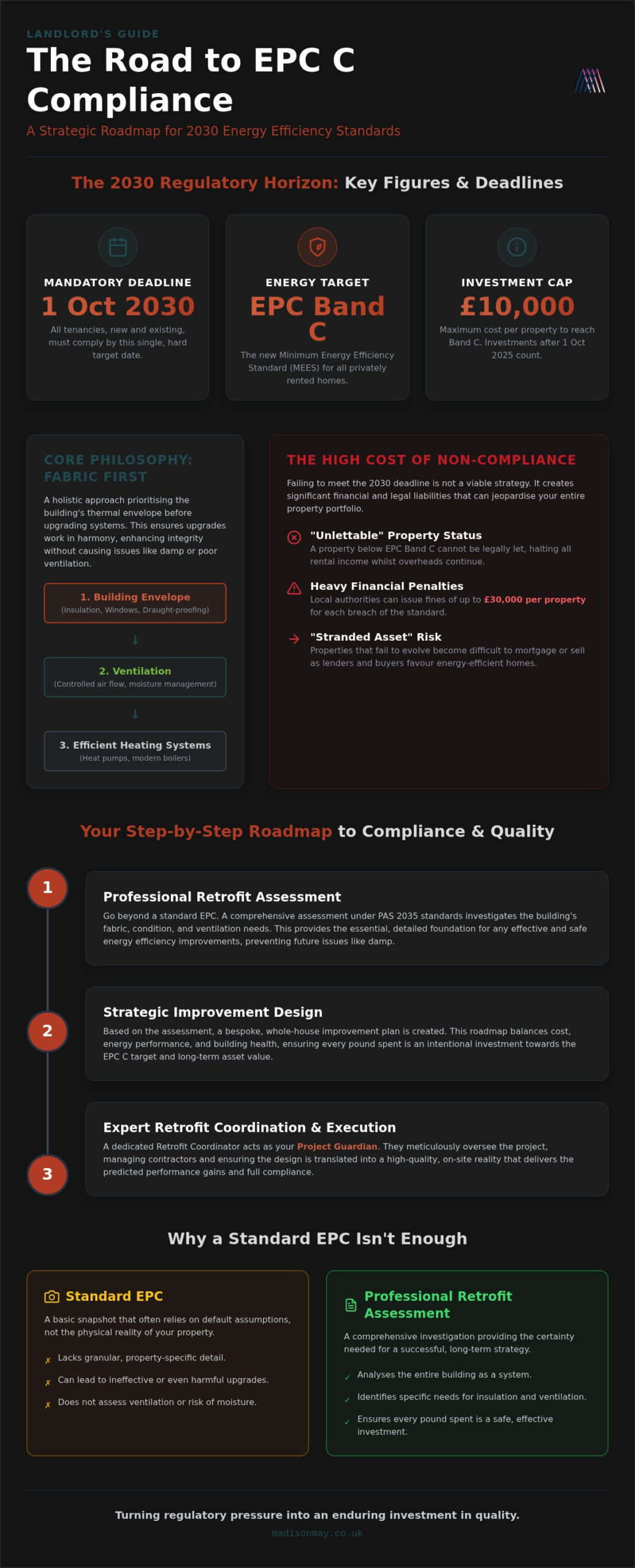
Your Step-by-Step Roadmap to Achieving EPC Band C
The transition from regulatory uncertainty to a position of quiet confidence requires a steady hand and a clear vision. Achieving compliance as a landlord – a step by step guide to energy efficiency improvement begins with a logical sequence of professional interventions designed to protect your investment. By following a structured roadmap, you can transform your property into a high-performing asset with minimal stress. The process unfolds through five essential stages:
- Step 1: Commission a professional Retrofit Assessment to establish an accurate, data-driven baseline of your property’s current performance.
- Step 2: Develop a tailored EPC Improvement Plan that prioritises fabric-first measures, ensuring every upgrade is intentional and effective.
- Step 3: Secure funding or available grants whilst planning works to coincide with void periods, minimising disruption to your tenants.
- Step 4: Appoint a Retrofit Coordinator to act as your project guardian, overseeing the installation to ensure all technical standards are met with precision.
- Step 5: Obtain an updated EPC and ensure the project is lodged on the TrustMark Data Warehouse to formalise your compliance.
This journey is not merely about ticking boxes; it’s about the meticulous craftsmanship required to elevate a building’s performance. By timing your improvements carefully, especially those made after 1 October 2025 which count towards the £10,000 cost cap, you ensure your capital is deployed with maximum impact.
Planning for Minimal Disruption
Sequencing works with care prevents the frustration of multiple visits and disjointed results. A whole-house strategy allows for a seamless transformation where each element, from insulation to ventilation, is installed in its logical order. Utilising comprehensive building surveys allows you to identify underlying structural issues before the retrofit begins, ensuring your investment isn’t compromised by hidden defects. This proactive approach turns a complex renovation into a graceful evolution of the space, protecting your rental stream whilst enhancing the property’s enduring appeal.
Securing Certification and Compliance
The final lodgement of your EPC is the definitive evidence of your commitment to quality. This document, alongside a meticulously maintained compliance file, serves as your protection against local authority inspections and future regulatory shifts. It’s more than just a certificate; it’s a testament to the property’s journey toward becoming a sustainable refuge. As you prepare for the next decade of standards, this documentation ensures you remain ahead of the curve, possessing a property that is as legally secure as it is beautifully efficient. To ensure your project meets these exacting standards from the outset, you can arrange a professional Retrofit Coordination consultation today.
Ensuring Excellence through Professional Retrofit Coordination
The final phase of achieving compliance as a landlord – a step by step guide to energy efficiency improvement is perhaps the most critical; it’s the moment where abstract plans become physical reality. Whilst a Retrofit Assessment provides the map, Retrofit Coordination provides the compass, ensuring that every installation is executed with the meticulous craftsmanship your property deserves. This role is often described as the “Project Guardian,” a title that reflects the deep responsibility of protecting both the landlord’s capital and the building’s long-term health. By overseeing the transition from design theory to on-site execution, a coordinator ensures that the high standards of PAS 2035 are not just met, but exceeded.
The Role of the Retrofit Coordinator
Acting as the single point of contact, the coordinator simplifies the communication between landlords and contractors, ensuring that the original intent of the EPC Improvement Plan is never lost. They take a holistic view of the project, ensuring that measures like wall insulation and heating upgrades work in harmony with the building’s unique heritage. A primary focus is the “ventilation gap.” The coordinator verifies that background and extract ventilation are sufficient to prevent damp and mould post-insulation, protecting the property from the unintended consequences of making a home more airtight. This attentive approach ensures that functionality and beauty remain effortlessly joined.
Crafting Your Bespoke Improvement Journey
Madison May’s coordination services are designed to navigate these complexities with a sense of grace and poise. By offering fixed-fee transparency, we provide the clarity needed for you to invest with quiet confidence. We believe that achieving compliance as a landlord – a step by step guide to energy efficiency improvement should be a transformative journey that reflects your personal commitment to quality. The emotional impact of a well-designed, warm, and compliant rental property cannot be overstated; it creates a refuge for tenants and a resilient asset for your future. To begin this journey and protect your property’s heritage, you can book your initial Retrofit Assessment consultation today, ensuring your portfolio is prepared for the standards of 2030 and beyond.
Securing Your Property’s Future with Vision and Precision
The evolution toward 2030 is more than a regulatory requirement; it’s a unique opportunity to curate a property that resonates with quality and care. By embracing a fabric-first philosophy and prioritising professional oversight, you ensure that every upgrade contributes to a healthier, more valuable home that serves as a true sanctuary. Achieving compliance as a landlord – a step by step guide to energy efficiency improvement is essentially a commitment to excellence, moving beyond simple checklists to create a space where refined aesthetics and thermal performance coexist effortlessly.
With the right guidance, the complexities of PAS 2035 and ventilation requirements become clear, logical steps in a rewarding property journey. You can request your professional EPC Improvement Plan from Madison May to benefit from our fixed-fee consultancy and PAS 2035 aligned retrofit assessments. Our expert damp and ventilation guidance ensures that your investment is protected whilst your tenants enjoy a warm, tranquil environment. Embrace the future of your portfolio with the quiet confidence that comes from visionary coordination and meticulous craftsmanship.
Frequently Asked Questions
What is the minimum EPC rating for landlords in 2026?
The current minimum energy efficiency standard for all privately rented properties in England and Wales is an EPC rating of E. Whilst this remains the legal baseline today, the government’s Warm Homes Plan has established a single deadline of 1 October 2030 for all properties to achieve Band C. Proactive owners are already transitioning toward this higher standard to ensure their assets remain resilient and desirable.
Can I still let my property if it has an EPC rating of F or G?
You cannot legally grant a new tenancy or continue an existing one if your property is rated F or G, unless a valid exemption is registered. Letting a non-compliant property carries significant risk, with potential fines reaching up to £30,000 per breach under the 2030 standards. It is essential to address these deficiencies promptly to protect your rental income and the property’s long-term viability.
How much does it cost to improve a property from EPC E to C?
Investment levels for transitioning from Band E to C are highly individual, as they depend on the specific architectural nuances and existing fabric of your property. Achieving compliance as a landlord – a step by step guide to energy efficiency improvement helps you navigate these investments by identifying the most impactful measures for your specific building. This strategic approach ensures your capital is deployed effectively, prioritising long-term performance over temporary fixes.
Is there a cost cap for energy efficiency improvements for landlords?
A legal cost cap of £10,000 per property applies to the energy efficiency improvements required to meet the upcoming EPC C standard. Any qualifying expenditure on measures from 1 October 2025 will count towards this total investment. If the property still hasn’t reached Band C after spending this amount, you may be eligible to register a high-cost exemption, provided the works were planned with meticulous care.
What is the difference between an EPC and a Retrofit Assessment?
An EPC is a high-level snapshot of energy cost, whereas a Retrofit Assessment is a technical investigation into a building’s fabric, services, and ventilation balance. Whilst a standard certificate provides a simple rating, a professional assessment aligned with PAS 2035 creates a sophisticated roadmap for improvement. This distinction is vital for achieving compliance as a landlord – a step by step guide to energy efficiency improvement whilst avoiding unintended structural consequences.
How do I register an exemption for the Minimum Energy Efficiency Standard?
Exemptions must be officially registered on the PRS Exemptions Register with supporting evidence from a qualified professional to be legally valid. Common grounds include the £10,000 cost cap being exceeded or the 10% value cap for properties valued at under £100,000. These exemptions are typically temporary, lasting five years, and are not transferable to a new owner, making them a strategic tool rather than a permanent solution.
Will adding insulation cause damp and mould in my rental property?
Insulation only poses a risk of damp and mould if the building’s ventilation balance is neglected during the installation process. By following the fabric-first approach and the PAS 2035 framework, you ensure that moisture is managed with the same care as heat retention. A professional assessment identifies the exact ventilation requirements for your property, transforming it into a warm, healthy sanctuary that breathes in harmony with its inhabitants.
Are there any grants available for landlords to improve energy efficiency?
The Boiler Upgrade Scheme currently provides significant support, offering grants of £7,500 for air source and ground source heat pumps. For properties transitioning from heating oil or LPG systems, an increased temporary grant of £9,000 is available until 31 March 2027. Whilst the Great British Insulation Scheme closed to new applications in early 2026, these heating grants remain a valuable resource for landlords seeking to decarbonise their properties with visionary intent.