

What if your home didn’t just shelter you from the British winter, but actively breathed with you, preserving warmth whilst ensuring the air remained as fresh as a spring morning? Many people feel a deep sense of trepidation when considering energy upgrades, fearing that airtightness might lead to damp or that the sequence of works will become a chaotic burden. This whole house retrofit guide for homeowners is designed to replace that uncertainty with a clear, sophisticated roadmap. We move beyond piecemeal fixes to embrace a rhythmic, PAS 2035-aligned transformation that treats your property as a single, harmonious system.
You likely recognise that the traditional approach of installing a single measure, like a new boiler or a bit of insulation, often fails to deliver the sanctuary you deserve. By reading on, you’ll discover how to navigate the latest standards to create a high-performance refuge that slashes energy bills and eliminates draughts for good. We will explore the essential role of the Retrofit Coordinator, the vital importance of ventilation, and the precise order of operations needed to future-proof your residence with quiet confidence.
Key Takeaways
- Understand why a holistic metamorphosis is superior to isolated, piecemeal repairs for creating a lasting sense of comfort and efficiency.
- Learn the “Fabric First” mandate that prioritises high-quality insulation to ensure your home remains a warm, draught-free sanctuary.
- Use this whole house retrofit guide for homeowners to navigate the PAS 2035 framework and the essential role of a Retrofit Coordinator.
- Discover the rhythmic, step-by-step roadmap for planning your property’s transformation from the initial vision to the technical assessment.
- Explore how a tailored approach ensures your home reflects your personal identity whilst meeting the latest UK energy performance standards.
Understanding the Philosophy of a Whole House Retrofit
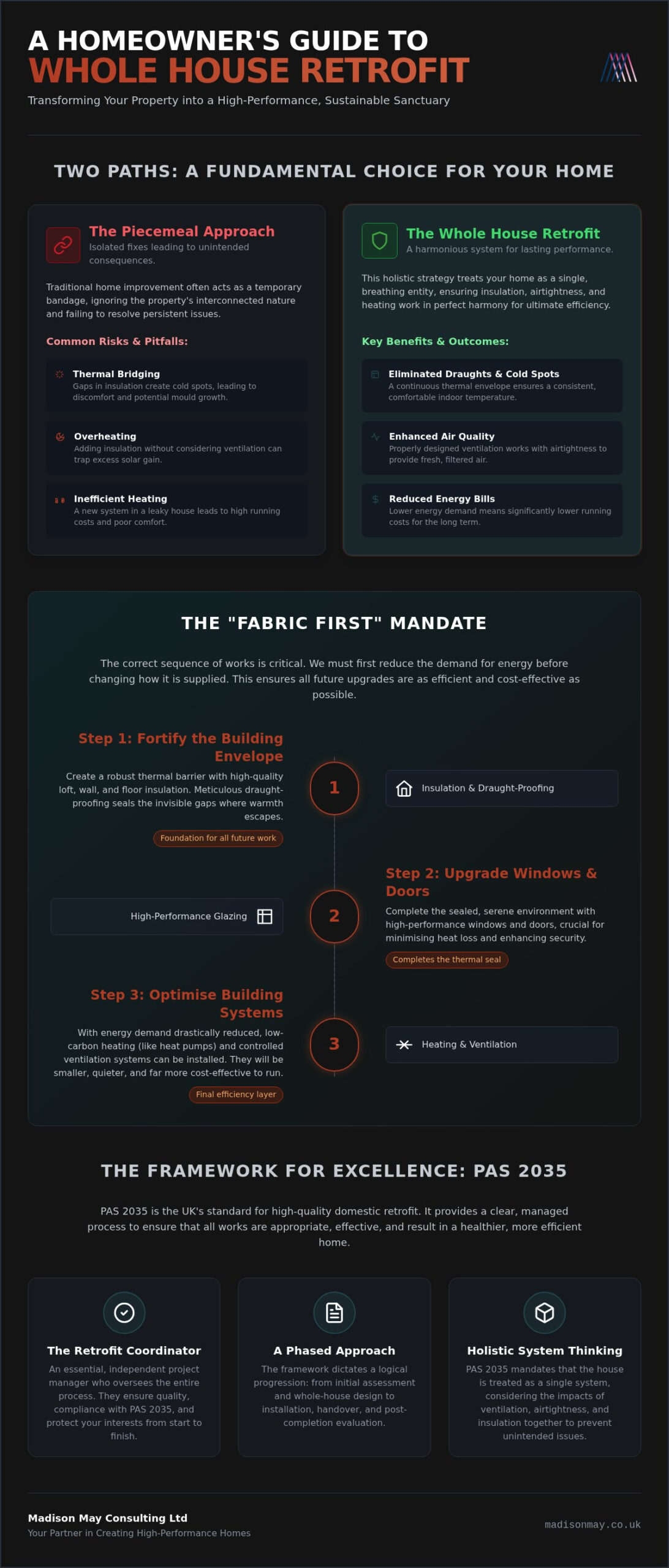
A whole house retrofit is far more than a collection of building works; it is a profound architectural and technical metamorphosis. Unlike the traditional piecemeal approach, where individual measures are installed in isolation, this strategy considers the residence as a living, breathing entity. When you replace a boiler without addressing draughts, or install double glazing without considering ventilation, the delicate balance of the home is often disturbed. This philosophy of a whole house retrofit ensures that every element, from the thickness of the loft insulation to the efficiency of the heat pump, works in absolute harmony. The result is a Sustainable Sanctuary where refined aesthetics meet high-performance engineering, creating a space that is as beautiful to inhabit as it is efficient to run.
This holistic approach avoids the common pitfalls of uncoordinated renovations, ensuring that your property remains healthy and durable. Key risks of the unguided path include:
- Thermal Bridging: Where gaps in insulation lead to cold spots and potential mould growth.
- Overheating: Often caused by adding insulation without considering solar gain or adequate ventilation.
- Inefficient Heating: Installing a low-carbon system in a leaky house, which leads to high running costs and disappointing comfort levels.
The Shift from Simple Repairs to Transformative Retrofit
Traditional home improvement often acts as a temporary bandage on deeper structural inefficiencies. Many homeowners find that isolated upgrades fail to resolve persistent cold spots or rising energy costs because they ignore the property’s interconnected nature. By treating the building as a single system, we can ensure that insulation, airtightness, heating systems, and renewable energy solutions from Azimuth Renewable Energy complement one another rather than competing. A whole house retrofit is a curated journey toward net-zero living, where every detail is intentional and every material is chosen with care.
Why Homeowners are Choosing the Whole House Path in 2026
The impetus for comprehensive property evolution has never been clearer. With nearly half of all homes in England now reaching an EPC rating of C or above, and the legally binding commitment to net-zero by 2050, homeowners are seeking long-term security against volatile energy markets. This whole house retrofit guide for homeowners highlights how a strategic approach protects your investment whilst enhancing your daily life. Beyond the financial logic, there is a visceral desire for a bespoke indoor climate. A home should be a refuge that supports your health, offering stable temperatures and filtered air, whilst significantly increasing the property’s market value through superior energy performance.
Prioritising the Building Fabric: The “Fabric First” Mandate
Before considering the complexities of low-carbon heating, the most meticulous homeowners focus on the building’s envelope. This philosophy, often described as the Fabric First Mandate, dictates that we must reduce the demand for energy before we change how it is supplied. By enhancing loft, wall, and floor insulation, we create a thermal barrier that retains heat with effortless grace. Draught proofing acts as an invisible shield, closing the minute gaps where warmth escapes, whilst high-performance windows and doors complete the narrative of a sealed, serene environment.
Identifying the right materials for your envelope is a central pillar of any whole house retrofit guide for homeowners. Adopting this order of operations ensures that any future heating upgrades, such as heat pumps, can be smaller, quieter, and far more cost-effective. It’s the permanent, passive layer of the home that requires no maintenance whilst providing constant, reliable protection against the elements.
Insulation Upgrades: Layers of Enduring Comfort
Selecting the right insulation is a deeply personal choice that depends on the heritage and structure of your property. External wall insulation can provide a striking architectural refresh, whilst internal or cavity solutions preserve the existing facade. Beyond the technical data, these energy efficient home improvements offer profound sensory benefits. Currently, homeowners can benefit from a 0% VAT rate on qualifying energy-saving materials until 31 March 2027, making this an opportune moment for fabric upgrades. High-quality insulation provides acoustic dampening, muting the outside world and creating a sense of profound calm. It ensures thermal stability, meaning the temperature remains consistent throughout the day.
The Essential Union of Insulation and Ventilation
A common fear in the retrofitting process is the risk of sealing a house so tightly that it cannot breathe. When we improve airtightness, we must simultaneously address how fresh air enters and stale air leaves. Without a sophisticated ventilation assessment, high levels of insulation can inadvertently trap moisture, leading to damp and mould. Meticulous damp remediation and the installation of controlled ventilation systems ensure that your sanctuary remains healthy and breathable. By balancing airtightness with high-quality indoor air, we create an environment that feels light and fresh, rather than heavy or stagnant. If you’re ready to explore how these principles apply to your property, a bespoke Retrofit Assessment is the most refined way to begin.
Navigating PAS 2035: The Framework for Excellence
To ensure the architectural harmony of your property is preserved whilst its performance is elevated, the UK relies on PAS 2035:2023. This rigorous standard acts as the definitive quality benchmark for domestic retrofit, moving away from the uncoordinated fixes of the past toward a disciplined, holistic methodology. By following this whole house retrofit guide for homeowners, you align your project with a framework designed to eliminate the risks of poor design and inadequate installation. This professional oversight is not merely a bureaucratic requirement; it is a shield that protects your investment and ensures your home becomes the high-performance sanctuary you envision.
Adhering to PAS 2035 is also a practical necessity for those seeking to access government support. Whether you are looking toward the current ECO4 scheme or the upcoming £15 billion Warm Homes Plan scheduled to begin in January 2027, compliance with these standards is often a mandatory gateway to funding. This structured approach provides peace of mind, ensuring that every measure installed is technically sound and perfectly suited to the unique heritage of your residence.
The Retrofit Assessor: Uncovering Your Home’s Story
The journey begins with a meticulous Retrofit Assessment, a process that far exceeds the scope of a standard Energy Performance Certificate (EPC). Whilst an EPC provides a broad snapshot, a professional assessment involves a deep-dive performance analysis and comprehensive building surveys to understand how your home actually behaves. The assessor captures precise data on the property’s dimensions, construction materials, and existing defects. This level of detail allows for a bespoke improvement plan that respects the building’s history whilst preparing it for a net-zero future, ensuring no detail is overlooked and no material is misplaced.
The Retrofit Coordinator: Your Project Guardian
If the assessor uncovers the story, the Retrofit Coordinator is the guardian of its execution. This vital role provides the rhythmic, steady oversight needed to manage a complex transformation from inception to completion. They act as a sophisticated guide, ensuring that various contractors, from insulation specialists to heating engineers, adhere to the overarching design philosophy. By managing the technical risks and verifying that each stage meets the required standards, the coordinator removes the burden of project management from the homeowner. This orchestration ensures a seamless experience, where the transition to a sustainable lifestyle feels like a calm, deliberate evolution rather than a series of stressful disruptions.
The Sequential Roadmap: Planning Your Property Metamorphosis
Transforming a property into a high-performance refuge requires more than technical skill; it demands a rhythmic and disciplined sequence of events. This whole house retrofit guide for homeowners views the process as a steady unfolding, ensuring that every intervention is timed to perfection. By following a structured roadmap, you avoid the common frustration of undoing previous work to accommodate new technology. The journey begins with a visioning session, where your personal aspirations for the space are paired with professional expertise to define the project’s ultimate identity.
- Step 1: Visioning: Establishing the emotional and functional goals of the refurbishment.
- Step 2: Assessment: Conducting the PAS 2035-aligned data collection to map the building’s current state.
- Step 3: Planning: Developing the improvement roadmap to guide long-term investment.
- Step 4: Sequencing: Prioritising the fabric before introducing new energy services.
- Step 5: Realisation: Executing the design with meticulous care and final performance verification.
The EPC Improvement Plan: A Roadmap for Your Sanctuary
A central document in this metamorphosis is the meticulous EPC improvement plan. This strategic roadmap is designed to prevent the “locking out” of future measures, ensuring that an insulation upgrade today does not obstruct the installation of a heat pump tomorrow. By identifying the most cost-effective sequencing, the plan allows for a phased approach that respects your budget whilst maintaining a clear path toward net-zero. It identifies which fabric improvements will offer the most immediate sensory impact, such as the elimination of cold spots in a primary living area, providing a logical flow to your investment.
Integrating Advanced Heating and Conservatory Upgrades
Once the building envelope is secure, the focus shifts to the sophisticated services that provide warmth and light. This is the ideal stage to introduce low-carbon heating, such as an air source heat pump, which currently benefits from a £7,500 grant under the Boiler Upgrade Scheme. For those seeking to reclaim underutilised spaces, conservatory upgrades offer a chance to turn a seasonal room into a permanent part of your sanctuary. The final layer of the metamorphosis involves balancing these systems, ensuring that your heating, ventilation, and architectural enhancements exist in a state of effortless equilibrium. To begin crafting your own bespoke roadmap, we invite you to book a visioning session with our expert team.
The Madison May Approach: Curating Your Home’s Future
At the heart of our philosophy is a commitment to visionary creativity and quiet confidence. We believe that a property is more than a structure; it’s an outward expression of individual identity and a deeply personal refuge. This whole house retrofit guide for homeowners has explored the technical rigour of PAS 2035, yet the Madison May approach transcends mere compliance. We listen to your personal story, using it as the foundation for a bespoke environment where every energy-saving measure is chosen with an eye for both performance and refined aesthetics. Our role is that of a trusted curator, moving beyond the functional aspects of refurbishment to consider the emotional impact of the finished space.
We see the intersection of functionality and beauty as a natural, effortless union rather than a compromise. A high-performance window is not just a thermal barrier; it’s a frame for your view of the world. A heat pump is not just a utility; it’s the silent engine that maintains the serenity of your sanctuary. This narrative-driven approach ensures that each sentence of your home’s story is written with care, moving logically from the initial spark of inspiration to the final, finished detail.
Bespoke Solutions for Discerning Homeowners
Begin Your Journey Toward a Refined Refuge
The first step in this transformative artistic journey is a simple, thoughtful conversation. We prioritise understanding your vision above all else, ensuring that our technical expertise serves your lifestyle goals. To provide absolute clarity and a sense of ease, our assessments operate on a fixed-fee basis. This eliminates the fear of hidden costs or unexpected burdens, allowing you to move forward with the calm deliberation of a high-end consultation. You can trust that your project is in capable, patient hands as we navigate the complexities of the design process together. We invite you to book your initial consultation today to begin the deliberate evolution of your home into a high-performance sanctuary.
Crafting Your High-Performance Sanctuary
The transition from a draughty property to a high-performance sanctuary is a rhythmic and deeply rewarding transformation. By prioritising the building fabric and following a disciplined, PAS 2035-aligned sequence, you ensure that every material and technical measure works in effortless harmony. This whole house retrofit guide for homeowners has highlighted the importance of viewing your residence as an interconnected system where comfort meets refined aesthetics. It’s a journey that moves beyond simple repairs to embrace a holistic vision for your home’s future.
Moving forward with quiet confidence requires a partner who understands the intersection of functionality and beauty. Through our PAS 2035 compliant assessments, meticulous EPC improvement roadmaps, and expert retrofit coordination, we act as a sophisticated guide through the complexities of property evolution. We invite you to begin your journey with a bespoke Retrofit Assessment from Madison May. Let us help you curate a living environment that isn’t just energy-efficient, but a true expression of your identity. Your property’s metamorphosis is a deliberate artistic journey, and the first chapter starts today.
Frequently Asked Questions
What is the difference between an EPC and a PAS 2035 Retrofit Assessment?
An EPC is a high-level snapshot of energy efficiency, whereas a PAS 2035 Retrofit Assessment is a deep-dive technical survey of the building’s fabric and ventilation. The assessment captures precise measurements and construction details to create a bespoke roadmap. It ensures that any proposed measures are technically sound and compatible with the specific heritage of your property, whereas an EPC relies on more generic assumptions.
How much does a whole house retrofit typically cost for a UK homeowner?
The investment for a comprehensive transformation varies significantly based on the property’s age, size, and the chosen sequence of measures. Costs are influenced by the depth of insulation required and the sophistication of the heating systems selected. Whilst we don’t provide specific figures here, it’s widely recognised that a holistic approach offers superior long-term value compared to piecemeal, uncoordinated repairs that may require future correction.
Can I carry out a whole house retrofit in stages or must it be done at once?
You can certainly execute a retrofit in stages, provided you have a meticulous EPC Improvement Plan to guide the sequence. This phased approach allows for a rhythmic evolution of your property, ensuring that each measure installed today doesn’t obstruct a future upgrade. It’s a practical way to manage your budget whilst maintaining a clear, sophisticated vision for your home’s eventual metamorphosis into a high-performance sanctuary.
Will adding insulation cause damp or mould in my older property?
Insulation only leads to damp if it’s installed without a professional ventilation assessment. Older properties must breathe, and a whole house retrofit guide for homeowners always emphasises the essential union of airtightness and fresh air flow. By using moisture-open materials and ensuring adequate controlled ventilation, we protect the building’s fabric from condensation, creating a healthy and stable indoor climate that preserves the structure for generations.
What is the role of a Retrofit Coordinator in my home improvement project?
The Retrofit Coordinator acts as your project guardian, overseeing the end-to-end technical transformation of your residence. They manage the technical risks and ensure that every contractor adheres to the PAS 2035 standards. By providing a steady, professional hand through the complexities of the design and installation process, they offer the homeowner a sense of ease and luxury, ensuring the finished result meets the highest quality benchmarks.
Are there government grants available for whole house retrofits in 2026?
Several government initiatives are currently active, including the ECO4 scheme for eligible households and the £7,500 Boiler Upgrade Scheme grant for heat pumps. Looking ahead, the £15 billion Warm Homes Plan is scheduled to launch in January 2027, aiming to upgrade five million properties by 2030. A PAS 2035-aligned assessment is often a mandatory requirement for accessing these funds, ensuring that public investment supports high-quality, long-term energy improvements.
How long does a typical whole house retrofit take from assessment to completion?
The timeline for a property’s metamorphosis typically spans several months, depending on the complexity of the measures and the property’s size. The initial assessment and design phase may take a few weeks, followed by a coordinated installation period. This measured pace ensures that every detail is intentional and every material is chosen with care, resulting in a seamless transition that respects your daily life whilst delivering a transformative result.
Does a whole house retrofit significantly increase property value?
Improving a home’s energy performance certificate (EPC) rating to a C or above is increasingly linked to higher market values in the UK. Beyond the financial uplift, a high-end retrofit adds a unique layer of exclusivity and desirability. Discerning buyers value the enduring quality of a draught-free, high-performance refuge. This investment turns your residence into a future-proofed asset that stands out for its superior comfort, sustainability, and sophisticated design.