


What if the looming October 2030 deadline for a Grade C rating wasn’t a regulatory burden, but the most significant opportunity to redefine your property’s market value? For many landlords, the pressure to meet evolving standards feels like a costly hurdle; yet, the ability to increase rental yield with epc improvements is quickly becoming the hallmark of a sophisticated investment strategy. It’s natural to feel a sense of trepidation as the Home Energy Model approaches in late 2026, especially when faced with the quiet anxiety of rising tenant turnover and the persistent threat of damp and mould.
We understand that a property should be a sanctuary of efficiency and comfort, rather than a source of endless maintenance cycles. This article promises to reveal how professional retrofit assessments and tailored energy efficiency upgrades can secure your asset’s future whilst significantly enhancing your monthly returns. We will guide you through a clear roadmap to achieving a Grade C rating, exploring how a strategic, whole-house approach to insulation and heating can transform your portfolio into a collection of high-performing, premium residences that attract discerning, long-term tenants.
Key Takeaways
- Understand how a superior EPC rating serves as a mark of quality, attracting discerning tenants whilst significantly reducing void periods through lower occupational costs.
- Shift your perspective from compliance costs to capital growth by exploring the direct correlation between energy efficiency upgrades and long-term property valuation.
- Master the fabric-first philosophy, where meticulous insulation and draught-proofing establish a sense of calm and efficiency before the introduction of new heating technologies.
- Discover how to increase rental yield with epc improvements by adopting a whole-house approach that harmonises energy efficiency with essential ventilation to protect your property’s heritage.
- Identify why a PAS 2035 aligned assessment is the essential first step in your journey from reactive maintenance to a curated, high-performance property portfolio.
The Intersection of Energy Performance and Rental Yield
A property’s Energy Performance Certificate (EPC) has evolved from a bureaucratic formality into a definitive statement of a home’s character and calibre. For the modern landlord, the ability to increase rental yield with epc improvements rests on understanding that energy efficiency is now a primary indicator of luxury and reliability. High-performing homes command what’s known as a “Green Premium” because they offer a superior living experience, free from the pervasive chill of inefficient builds. This translates into tangible financial gains, as properties with higher ratings often see shorter void periods. Tenants are increasingly looking at the total cost of occupation, where lower utility bills offset a higher monthly rent, creating a stable and profitable environment for the investor.
Neglecting these improvements carries a heavy, often invisible price. Low EPC ratings are frequently symptomatic of deeper structural issues such as poor insulation or inadequate ventilation, which inevitably lead to damp and mould. These problems don’t just damage the fabric of the building; they erode tenant trust and lead to costly, reactive maintenance cycles. Beyond the physical state of the asset, the risk of significant regulatory fines for non-compliance adds a layer of financial jeopardy that no serious portfolio manager should ignore. By addressing these factors, you aren’t just ticking a box; you’re curating a high-quality sanctuary that stands out in a crowded market.
The Shift in Tenant Behaviour and Priorities
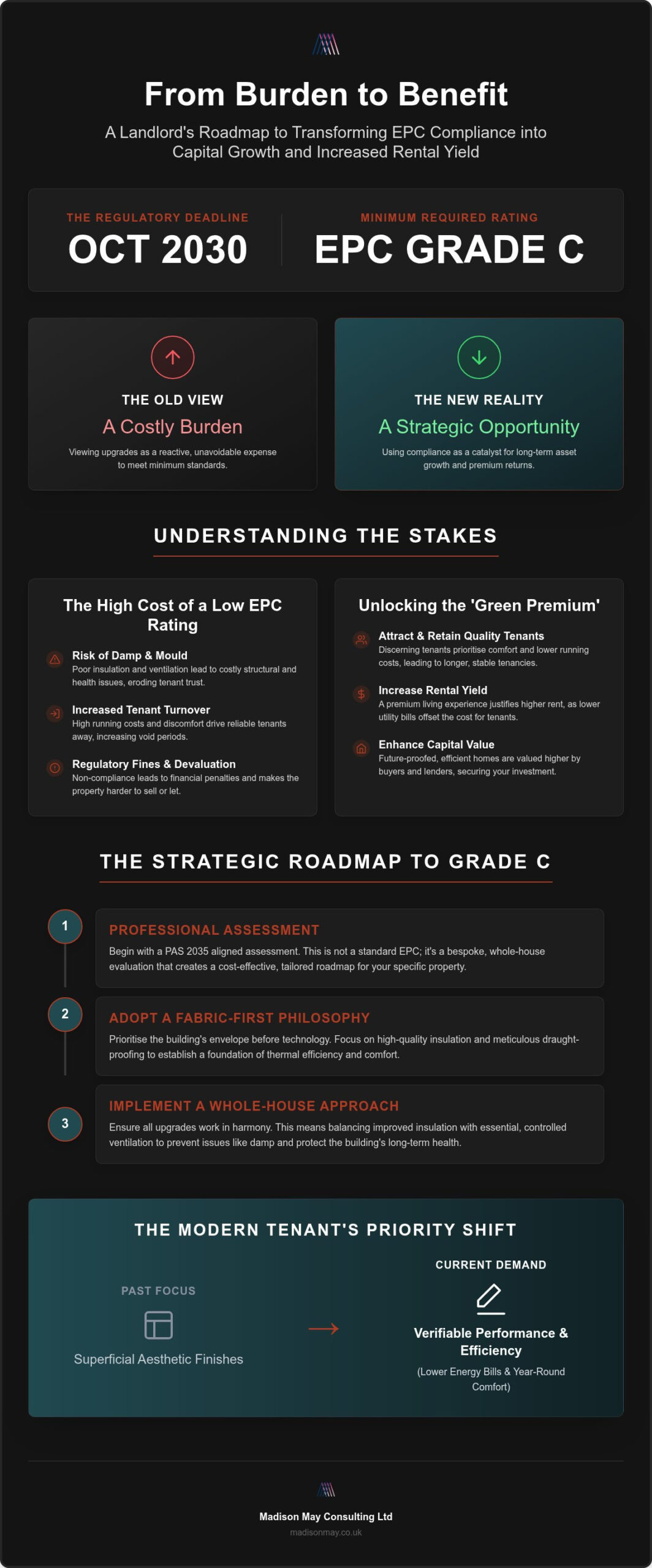
Tenants today are far more informed, often prioritising technical specifications like U-values and heating efficiency over superficial aesthetic finishes. They understand that a beautifully painted room offers little comfort if the windows allow warmth to escape. This shift in perspective means that transparent energy costs are now a central pillar of long-term tenancy agreements. When a home is easy to keep warm and free from draughts, tenant satisfaction naturally rises. This leads to significantly higher retention rates, as occupiers are far less likely to leave a home that is both comfortable and affordable to run.
Regulatory Compliance as a Catalyst for Growth
The trajectory of the UK rental market is clear, with Minimum Energy Efficiency Standards (MEES) moving resolutely towards a mandatory Grade C by October 2030. Whilst some may see this as a hurdle, proactive landlords recognise it as a catalyst for strategic growth. When you choose to increase rental yield with epc improvements ahead of time, you avoid the rush for qualified tradespeople and potential price hikes closer to the deadline. It ensures your asset remains competitive and legally compliant well before emergency measures become necessary. By securing a Grade C rating today, you protect the future value of your investment against upcoming legislative shifts, ensuring it remains a desirable asset in an increasingly regulated market. To see how these sustainability principles are being applied to large-scale infrastructure internationally, you can discover African Earth Energy Group and their utility-scale renewable projects.
Calculating the ROI of EPC Improvements
Viewing retrofit measures through the lens of a capital investment shifts the narrative from one of obligation to one of strategic growth. When you choose to increase rental yield with epc improvements, you’re not merely funding a refurbishment; you’re enhancing the intrinsic value of your asset. Statistical trends in the UK market suggest a clear correlation between improved energy ratings and capital appreciation, as buyers and lenders alike place a premium on homes that are future-proofed. Adhering to the minimum energy efficiency standards is just the baseline; the real financial reward lies in the tax efficiencies found when certain energy-saving measures are correctly classified as repairs or enhancements. The Yield Gap represents the quantifiable disparity in annual returns between a Grade E property, burdened by high running costs and regulatory risk, and a Grade C property that commands a premium for its superior efficiency and comfort.
The Value of a Meticulous EPC Improvement Plan
A standard EPC survey often lacks the nuance required for sophisticated financial planning. It’s a snapshot, not a strategy. In contrast, a detailed EPC improvement plan provides a bespoke roadmap, identifying the most cost-effective sequence of works to ensure every pound spent contributes to a higher rating. This meticulous approach prevents the creation of “stranded assets”—properties that might otherwise fall foul of future regulations despite previous, uncoordinated investments. By mapping out a staged retrofitting journey, you ensure that each material chosen and every detail refined serves the dual purpose of beauty and efficiency.
Short-Term Costs vs. Long-Term Capital Gains
While the initial outlay for measures like loft insulation or draught proofing may seem immediate, the payback period is often surprisingly brief when measured against reduced maintenance and increased tenant retention. Beyond the rental income, these upgrades unlock access to “Green Mortgages,” which offer preferential interest rates for energy-efficient homes. By aligning your portfolio with these standards, you can increase rental yield with epc improvements whilst simultaneously lowering your cost of capital. Conducting thorough building surveys before starting ensures that you avoid the expensive mistakes often associated with poorly planned refurbishments. For those seeking a guided path through these complexities, a bespoke retrofit assessment ensures your investment is managed with the quiet confidence it deserves.
High-Impact Retrofit Measures for Landlords
The journey to a more profitable portfolio begins with a “Fabric First” philosophy. Whilst it’s tempting to focus on visible aesthetic upgrades like high-end kitchens or contemporary bathrooms, these surface-level changes do little to address the fundamental performance of a building. To truly increase rental yield with epc improvements, one must first prioritise the thermal envelope. Reducing heat loss through the walls, roof, and floors ensures that any subsequent investment in heating technology operates at peak efficiency. This strategic sequencing prevents the common mistake of installing an oversized, expensive heating system in a home that simply cannot retain warmth. By focusing on performance-based refurbishments, you create a property that is inherently more valuable and cheaper to run, offering a level of comfort that far outlasts the trend of a seasonal colour palette.
Insulation: The Foundation of Thermal Comfort
Insulation represents the most significant opportunity to stabilise a property’s internal environment. The hierarchy typically begins with loft insulation, often the most cost-effective measure, followed by cavity wall or external house insulation for more traditional UK builds. When heat loss is minimised, the property becomes an ideal candidate for “bills-included” rental models, where the landlord can capture a higher headline rent by managing energy costs centrally. Many investors hesitate due to perceived disruption, yet most modern insulation installs are remarkably swift and non-invasive. When weighed against the long-term financial benefits of a high EPC rating, the initial inconvenience is a minor footnote in a much larger story of asset appreciation and tenant satisfaction.
Windows, Doors, and the Art of Draught Proofing
In older properties, windows and doors are often the primary culprits for both heat loss and a lack of kerb appeal. Choosing bespoke windows and doors allows a landlord to balance period charm with modern thermal performance, ensuring the property retains its character whilst meeting rigorous energy standards. This is where the art of draught proofing becomes essential; it’s a low-cost, high-impact measure that eliminates those subtle, chilling breezes that often plague heritage homes. By sealing the gaps around apertures and floorboards, you create a sense of calm and stillness that tenants deeply value. These refinements, combined with smart, responsive heating controls, allow you to increase rental yield with epc improvements by positioning your property as a meticulously maintained sanctuary that justifies a premium price point.
The Whole-House Approach: Beyond the EPC Certificate
True property performance is never achieved through isolated gestures; it requires a holistic vision that considers how every element of a building interacts. When you aim to increase rental yield with epc improvements, the most common pitfall is treating the certificate as a mere checklist rather than a living strategy. Adopting the PAS 2035 standard ensures that your investment follows a professional framework designed to improve energy efficiency whilst safeguarding the building’s health. A comprehensive building survey acts as the essential diagnostic tool in this process, protecting your asset from the unintended consequences of poorly planned upgrades. By viewing the property as a single, integrated system, you can justify premium rental prices by offering a home that is fundamentally superior in its construction and climate.
One of the most significant risks in modern retrofitting is the “Ventilation Gap.” This occurs when a property is made airtight through new windows and heavy insulation without a corresponding strategy for airflow. Without a proper assessment, these improvements can trap moisture, leading to the rapid development of damp and mould. This not only threatens the structural integrity of your rental asset but also diminishes the tenant’s experience of the space as a sanctuary. A whole-house approach ensures that every measure taken to retain heat is balanced by a sophisticated plan to manage air quality, creating a healthy, breathable environment that stands the test of time.
The Crucial Role of Ventilation in Retrofitting
Understanding Part F of the Building Regulations is essential for any landlord looking to modernise their portfolio. These regulations govern ventilation and are particularly critical when a home’s fabric is upgraded. Remediating damp is not simply about cleaning surfaces; it involves intelligent airflow management that allows the building to “breathe” whilst remaining thermally efficient. This breathability is the key to preserving the heritage of traditional UK properties. By prioritising these technical standards, you ensure that your property remains a high-quality refuge, free from the maintenance headaches that plague less meticulously managed homes.
Retrofit Coordination: Your Project Guardian
The role of a Retrofit Coordinator is to act as your project guardian, ensuring that separate measures like floor insulation and new heating systems work in perfect harmony. This professional oversight is vital to increase rental yield with epc improvements, as it prevents conflicting installs that could compromise the property’s performance. A coordinator reduces the inherent stress of property management by overseeing technical energy upgrades and ensuring all works meet the standards required for future government-backed schemes. This proactive management style transitions your portfolio from a series of reactive repairs to a curated collection of high-performing assets. To begin your journey towards a more resilient and profitable portfolio, book a professional retrofit assessment today.
Partnering with a Retrofit Professional for Long-Term Success
What to Expect from a Professional Retrofit Assessment
A professional assessment is an evocative, data-rich exploration of your property’s current state and its future potential. The process begins with a thorough collection of data, examining everything from the thermal integrity of the building fabric to the efficiency of existing ventilation systems. This isn’t a cursory glance; it’s a deep diagnostic exercise that respects the heritage of the build whilst identifying modern opportunities for growth. The resulting report provides a clear, prioritised roadmap, allowing you to sequence works in a way that maximises return on investment. This bespoke energy efficient home improvement plan stands in stark contrast to a generic EPC, offering the technical depth and personalised narrative required to transform a standard house into a high-performing residence.
Securing Your Investment with Madison May
Madison May Consulting Ltd serves as a trusted guide through the intricate requirements of PAS 2035, ensuring that every retrofit project is handled with grace and precision. We believe that a landlord’s journey should be one of calm deliberation rather than frantic, last-minute compliance. By partnering with independent experts rather than commission-led installers, you gain access to unbiased advice that prioritises the long-term health of your asset. This partnership ensures that your rental portfolio remains both legally robust and consistently profitable in an increasingly competitive environment. Our commitment to meticulous craftsmanship and visionary planning helps you increase rental yield with epc improvements by focusing on what truly works for your specific property. To safeguard your capital and enhance your returns, take the first step towards a more resilient future by booking a professional Retrofit Assessment today.
Securing the Future of Your Property Portfolio
Transforming a rental property into a high-performing asset requires a blend of technical expertise and visionary planning. By moving beyond the minimum standards, you create a residence that resonates with quality and comfort. You’ve learned that a “Fabric First” approach, balanced with intelligent ventilation, is essential for avoiding the pitfalls of damp and ensuring structural integrity. These strategic choices allow you to increase rental yield with epc improvements by attracting tenants who value efficiency as much as aesthetics.
Madison May Consulting Ltd provides the specialist retrofit consultancy and PAS 2035 aligned assessments needed to navigate these complexities with ease. Our detailed, cost-effective roadmaps serve as your guide to a more resilient and profitable future. Begin your journey to a high-yield, energy-efficient rental portfolio with Madison May and discover the peace of mind that comes from professional property stewardship. Your transition from reactive repairs to a curated sanctuary starts today.
Frequently Asked Questions
How much can EPC improvements actually increase my rental yield?
Properties with higher EPC ratings often command a “Green Premium,” with research suggesting rent increases of approximately 5% to 10% compared to lower-rated homes. Beyond the headline rent, you increase rental yield with epc improvements by reducing void periods and long-term maintenance costs. Tenants are far more likely to stay in a comfortable, efficient home, ensuring a steadier and more predictable income stream for your property portfolio.
What is the minimum EPC rating required for UK rental properties in 2026?
As of August 2026, the current legal minimum remains Grade E for all existing tenancies in England and Wales. However, the UK government has confirmed a mandatory shift to Grade C for all new and existing tenancies by October 1, 2030. Proactive landlords are already upgrading to avoid the inevitable rush for qualified installers and potential fines of up to £30,000 for non-compliance with these evolving standards.
Will my tenants need to move out whilst energy efficiency works are being carried out?
Most high-impact retrofit measures, such as loft insulation, draught proofing, and boiler upgrades, can be completed whilst tenants remain in the property. Professional coordination ensures that disruption is kept to a minimum, often requiring only a single day of access for specific installations. Only more invasive works, like internal wall insulation or major floor refurbishments, might necessitate temporary relocation, though these are rarely required for a standard Grade C target.
Is it worth upgrading to a Grade C EPC if my property is already at Grade E?
Upgrading is a strategic move to future-proof your investment against the 2030 deadline, even if your property is already compliant at Grade E. Moving to Grade C significantly enhances the property’s marketability and capital value, whilst reducing the risk of persistent damp and mould issues. It also opens access to “Green Mortgages” with lower interest rates, directly improving your monthly cash flow and long-term capital growth.
What is the difference between a standard EPC survey and a PAS 2035 Retrofit Assessment?
A standard EPC survey is a brief, visual inspection providing a generic snapshot of energy performance based on limited data. In contrast, a PAS 2035 Retrofit Assessment is a deep, technical diagnostic of the building’s fabric, ventilation, and occupancy patterns. This professional assessment provides a detailed, whole-house roadmap, ensuring that improvements are sequenced correctly to avoid unintended consequences like trapped moisture or structural damage to the property.
Can I get a grant to help with the cost of EPC improvements for my rental property?
Several government schemes are available, including the Boiler Upgrade Scheme, which provides £7,500 towards heat pumps until March 2030. Landlords may also access the ECO4 scheme if their tenants meet specific criteria, or the Warm Homes: Local Grant for properties with ratings of D to G. Eligibility varies, so it’s essential to investigate these options early to secure funding before the December 2026 deadline for some schemes.
How does better insulation affect the risk of damp and mould in a tenanted home?
Insulation improves thermal comfort by retaining heat, but it must be balanced with professional ventilation assessments to prevent moisture build-up. When insulation is installed without considering airflow, it can inadvertently trap humid air, leading to mould growth in older properties. A whole-house approach ensures that your property remains breathable and healthy, protecting the building’s heritage whilst creating a refuge that justifies premium rental prices.
What are the most cost-effective ways to improve an EPC rating quickly?
The swiftest gains often come from “Fabric First” measures like loft insulation, which is relatively inexpensive but offers high thermal retention. Draught proofing and upgrading to smart heating controls also provide immediate points on a certificate for minimal outlay. To increase rental yield with epc improvements, prioritising these low-cost aperture seals and insulation layers creates a solid foundation before considering more expensive technology like air source heat pumps.