


The easiest-looking replacement for spray foam isn’t always the right choice for your home. The best alternatives to spray foam insulation depend on where the material will go, how the building is constructed, and how moisture and ventilation are managed.
If you’re unsure whether a product will work in your roof, walls or floors, that’s a sensible concern. Insulation choices can affect more than warmth: the wrong approach may change how a building deals with damp and condensation. This guide compares common alternatives, including mineral wool, cellulose and insulation boards, and explains the trade-offs to consider without treating any one material as a universal solution.
You’ll also learn what to check before making a decision, from the existing building fabric to ventilation provision and the intended location of the insulation. A whole-property assessment can put those details in context and support a considered next step, rather than a premature removal or installation. The aim is to find an approach that suits your home, not simply to follow claims made about a product.
Key Takeaways
- Compare alternatives to spray foam insulation by material, format and intended location. One option may not suit every part of your home.
- Check whether the insulation is intended for a loft, roof slope, wall or floor, and have its suitability assessed for that specific construction.
- Before choosing, establish the roof condition and where insulation is fitted. Note any history of damp or condensation.
- Consider how insulation may interact with ventilation, heating and other improvements to the building fabric.
- Use evidence about the property to plan the next step. Don’t decide on removal or installation based on product claims alone.
Alternatives to spray foam insulation: why the building matters first
Alternatives to spray-applied foam include flexible rolls, loose-fill products and rigid boards, each with different installation requirements. An overview of building insulation materials can help you understand the range, but a material’s general properties won’t tell you whether it belongs in a particular roof, wall or floor.
That distinction matters. The options worth considering depend on the building’s construction, the existing layers and how moisture and ventilation are managed. A change that appears straightforward on paper can affect how the whole assembly performs, so start with the property, not a product preference.
Why homeowners look beyond spray-applied foam
Homeowners may consider other options because they want to retain access to roof timbers for inspection or future repairs, because an insulation installation has raised questions during a property transaction, or because they’re unsure what is already in place. These are practical reasons to investigate, not proof that every spray foam installation is defective. Establish where the foam is, what condition the roof and surrounding materials are in, and whether there is evidence of damp or condensation. Concerns call for evidence and assessment, not an automatic recommendation to remove insulation.
What makes an insulation alternative suitable?
Compare more than thermal performance. Consider how a material relates to moisture, whether it suits the intended location and how it will work alongside the existing construction. Roof type, the order of existing layers and building age can all affect which options are worth investigating. A pitched roof with an accessible loft, for example, presents a different arrangement from insulation fitted along a roof slope or within a wall.
A suitable insulation alternative is one that works with the whole building assembly, including its structure, moisture behaviour and ventilation. A different material isn’t automatically safer or more appropriate simply because it isn’t spray foam. Before selecting, removing or installing insulation, check the roof or wall construction, identify existing layers where possible and note any history of damp or condensation. An independent assessment can connect those observations with the property’s wider fabric and ventilation, rather than relying on a general product claim.
Which alternatives to spray foam insulation are available?
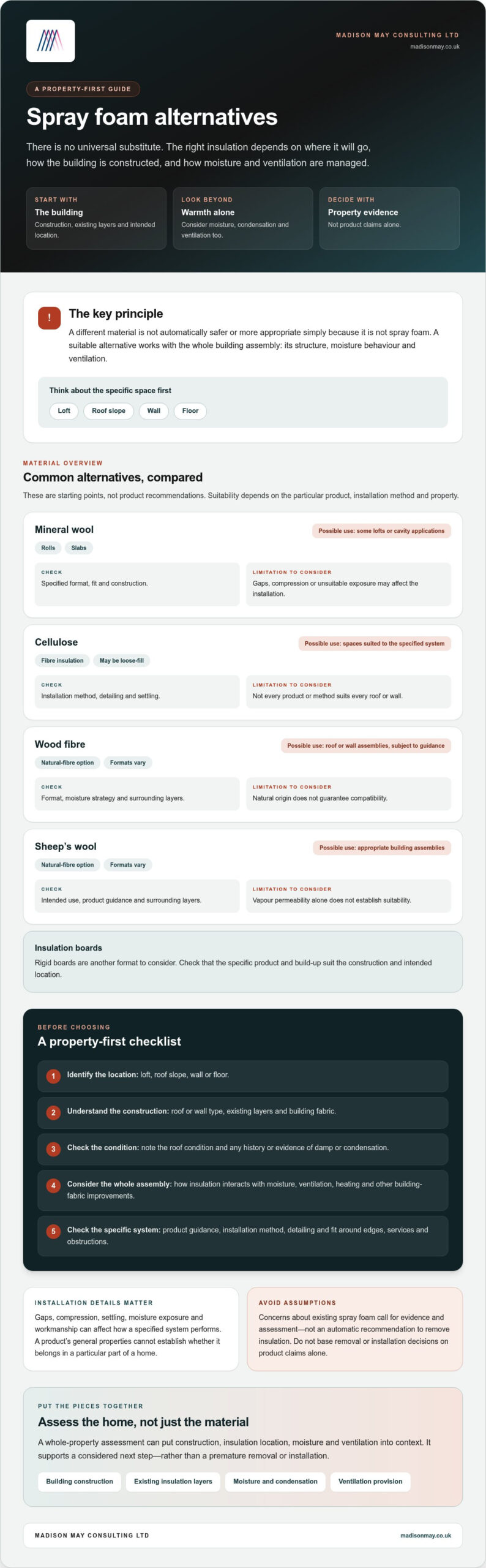
There isn’t one direct substitute for spray-applied foam. Mineral wool, cellulose, wood fibre and sheep’s wool come in different forms, and each needs to be considered in relation to the space, supporting structure and intended build-up. The table is a starting point, not a product recommendation. Availability, installation methods and suitability vary by product and property, so check the technical information for the specific system.
Mineral wool and cellulose insulation
Mineral wool is available in formats such as rolls and slabs, and may suit some loft and cavity applications where the construction and product specification allow. Cellulose is a fibre insulation that may be supplied for particular installation methods, including loose-fill systems. In either case, check how the material will fit around edges, services and obstructions, and whether the installation method suits the space. Gaps, compression, settling, moisture exposure and workmanship can affect how the specified system performs.
Wood fibre and sheep’s wool insulation
Wood fibre and sheep’s wool are natural-fibre options for appropriate building assemblies. Both are available in different formats, so check the intended use rather than assuming a product designed for one part of a building will suit another. Natural origin or vapour permeability alone doesn’t establish suitability. Check the product guidance, the surrounding layers and how the assembly is intended to manage moisture.
| Material | Possible application | Points to check | Limitations |
|---|---|---|---|
| Mineral wool | Some lofts or cavity applications | Specified format, fit and construction | Gaps, compression or unsuitable exposure may affect the installation |
| Cellulose | Spaces suited to the specified fibre system | Installation method, detailing and settling | Not every product or method suits every roof or wall |
| Wood fibre | Roof or wall assemblies, subject to product guidance | Format, moisture strategy and surrounding layers | Natural origin doesn’t guarantee compatibility |
| Sheep’s wool | Applications stated by the manufacturer | Product specification and installation details | Suitability depends on the assembly, not the fibre alone |
Before comparing products, identify where insulation is needed and what layers are already present. Check technical claims against the documentation for the specific product, rather than relying on broad descriptions of a material. If you need help relating options to your property, a retrofit assessment can consider insulation alongside the building fabric and ventilation.
How do spray foam alternatives compare for roofs, walls and floors?
A useful comparison goes beyond which material offers the highest thermal performance. First identify where insulation will sit, whether it can be installed continuously, how the assembly manages moisture, and whether key areas will remain accessible for inspection. Options that suit an open loft may not be suitable for a roof slope, cavity wall or floor.
Insulation performance depends on the complete building assembly and the quality of its installation, not on the material alone. Use the table below to identify questions for an assessment, not as a recommendation to use a particular product.
| Area | Context to distinguish | Suitability | Checks to make |
|---|---|---|---|
| Loft | Insulation at ceiling level, with the loft space above | Requires assessment | Roof condition, existing layers, ventilation paths, access and future inspection needs |
| Roof slope | Insulation follows the slope, enclosing the space beneath the roof | Requires assessment | Roof build-up, moisture strategy, ventilation and detailing around junctions |
| Walls | Solid-wall and cavity-wall construction need separate consideration | Requires assessment | Wall type, existing insulation, exposure to moisture and details at openings and edges |
| Floor | Suspended floors and solid floors have different construction | Requires assessment | Moisture exposure, floor build-up, junctions and access for fitting and inspection |
Choosing alternatives for a roof or loft
An accessible loft with insulation at ceiling level is different from a room enclosed by an insulated roof slope. In a loft, consider whether work could obstruct ventilation routes or make the roof structure harder to inspect. At roof-slope level, the existing layers and the roof’s moisture strategy become central. Check the roof’s condition and note any past repairs before comparing systems. Without knowing the construction and intended insulation position, it isn’t sensible to prescribe a material.
Considering alternatives for walls and floors
Solid walls, cavity walls, suspended timber floors and solid floors each present different constraints. Moisture exposure, existing layers and junction details can influence whether an option is appropriate and how it should be fitted. These are matters for a property-specific assessment, particularly where insulation meets windows, external walls or floors. Gaps and changes in the build-up may affect the result.
Consider insulation alongside other improvements to the home’s fabric, ventilation and services. A whole-property view keeps decisions grounded in the building’s construction and intended use, rather than treating one room or material in isolation.
How to choose a spray foam alternative without overlooking moisture
Before choosing, removing or installing insulation, build a clear picture of the property and the area involved. The same material can behave differently depending on the roof or wall construction, existing layers and how air and moisture move through the assembly. Treat moisture management and ventilation as connected parts of the decision, not separate product features.
A practical property-first checklist
Work through these checks before discussing a particular replacement:
- Identify the building and construction. Note the property type and, where known, whether the relevant wall is solid or cavity, or the roof space is an accessible loft or an insulated roof slope.
- Pinpoint the insulation. Record where it is installed, what it covers and whether you know which material or layers are present.
- Check the roof condition. Note visible damage, repairs or signs of water entry, and consider whether the insulation could affect future inspection access.
- Record moisture history. Note any known damp, condensation or recurring marks, including where and when they appear. These observations are useful evidence, but don’t assume insulation is the cause.
- Gather available records. Plans, previous survey reports, installation documents and details of earlier work may help explain the existing build-up.
Keep observations factual. Photographs and dates can help distinguish a current defect from an assumption. Before work starts, ask a suitably qualified professional what further inspection is appropriate and what evidence would support a recommendation. If you’re considering alternatives to spray foam insulation, ask how the proposed option, its installation details and the building’s ventilation will work together, rather than relying on a general claim about a material.
Insulation decisions should follow checks of the building fabric and ventilation. This brings the roof or wall condition, moisture history and intended changes into one considered view, instead of treating product choice as an isolated fix.
When a retrofit assessment can help
A retrofit assessment can put insulation in context by considering the building fabric, services and ventilation together. That wider picture may clarify which questions need answering before a material is selected, or how insulation could fit with other improvements. A comprehensive building survey may also help establish the condition and construction of the relevant parts of the property.
If you’d like an assessment-led view before deciding on insulation work, explore Madison May Consulting Ltd’s retrofit assessment support.
Plan insulation alternatives as part of a whole-home retrofit
Choosing insulation is one part of improving a home. It should be considered alongside ventilation, heating and the existing building fabric. For example, adding insulation may change how a room retains heat, while draught-proofing or changes to windows can also affect air movement. The right sequence depends on the property, so don’t treat a product purchase as a complete plan or assume it will deliver a particular energy-bill, comfort or EPC outcome.
Why insulation should not be planned in isolation
A considered plan starts with evidence about the building, then weighs up how potential measures relate to one another. That could mean looking at the roof or walls, ventilation provision and heating system before deciding what insulation work, if any, should come first. Where an EPC is part of the decision, a sequenced EPC improvement plan can put recommendations in context, rather than leaving homeowners to compare isolated measures without a clear order.
This approach can also make uncertainties visible. An assessment may identify a need for further investigation before work is specified. That’s useful information, not a reason to rush into removal or replacement. The alternatives to spray foam insulation worth considering should follow what is known about the property and how proposed changes fit together.
What to expect from an assessment-led next step
An assessment-led discussion can begin with information about the home and the questions you need answered. Madison May Consulting Ltd’s retrofit assessment approach considers the building fabric, services and ventilation, with data gathered about these aspects of the property. Recommendations should reflect the individual building and may identify where more investigation is needed before an intervention is chosen.
Madison May Consulting Ltd provides assessments, insulation recommendations, EPC improvement plans and retrofit coordination. Its role is advice and planning, not supplying insulation products or providing general insulation installation services. This keeps the next step focused: understand the home first, then consider options that suit its construction and wider needs.
You don’t need to arrive with a preferred material or a decision to remove existing insulation. A consultation can help clarify what is known, what still needs checking and which options may merit consideration. To discuss whether an assessment is appropriate for your home, explore Madison May Consulting Ltd’s retrofit services.
Choose the next step with confidence
The right alternatives to spray foam insulation depend on more than the material itself. Roof, wall and floor construction, existing layers, moisture behaviour and ventilation all shape what may be suitable. Compare options for the specific location, and use evidence about your home before deciding whether to remove or install insulation.
A considered plan can place insulation alongside ventilation, heating and other fabric improvements. Madison May Consulting Ltd provides PAS 2035 aligned retrofit assessments that consider the building fabric, services and ventilation, alongside EPC improvement plans with sequenced recommendations for property upgrades.
If you’d like a clearer view of what your home may need before choosing a material, explore Madison May Consulting Ltd’s retrofit assessment services.
Frequently Asked Questions
What is the best alternative to spray foam insulation?
There isn’t one best option for every property. Mineral wool, cellulose, wood fibre and sheep’s wool may all be worth investigating, but their suitability depends on the location, construction, existing layers and moisture strategy. The best alternatives to spray foam insulation are compatible with the specific roof, wall or floor assembly and its ventilation needs. Check product guidance and seek property-specific advice before selecting a material or planning work.
Can mineral wool replace spray foam insulation in a roof?
Mineral wool may be suitable for some roof or loft arrangements, but it isn’t an automatic replacement. Insulation at loft-floor level differs from insulation fitted along a roof slope, and each arrangement needs its own checks. Consider the roof condition, existing layers, ventilation paths, fit around junctions and access for future inspection. An assessment of the roof construction can help establish whether mineral wool, another system or further investigation is appropriate.
Is natural insulation always better than spray foam?
No. A natural fibre such as wood fibre or sheep’s wool isn’t automatically more suitable because of its origin. Product format, intended application, installation requirements and interaction with surrounding materials all matter. The same applies to other insulation types: compare technical information for the specific product and consider how the whole roof, wall or floor assembly manages moisture. Choose based on the building’s needs, not a broad claim about a material category.
Can changing insulation cause damp or condensation?
Changing insulation can affect how heat and moisture move through a building, so consider damp or condensation before work begins. Problems aren’t inevitable, but outcomes can depend on the construction, existing defects, ventilation and installation details. Record any known moisture history and investigate visible signs rather than assuming insulation is the cause. A property-specific assessment can help identify what needs checking and how proposed changes may interact with ventilation.
Do I need to remove spray foam before installing an alternative?
Not necessarily. Whether removal is appropriate depends on the existing installation, its condition, the roof or wall construction and the intended work. Don’t assume replacement is needed, or that a new material can simply be fitted over or alongside existing foam. First establish what is present and ask a suitably qualified professional what inspection is needed. That evidence can help inform whether to retain, repair, remove or replace insulation.
How do I choose insulation for an older home?
Start by identifying the home’s construction and the location of its existing insulation. Older properties can have different roof and wall build-ups, so check existing layers, roof condition, ventilation and any history of damp or condensation before comparing products. Gather plans and previous survey or installation records where available. A retrofit assessment can consider the building fabric, services and ventilation together, helping shape recommendations around the individual property rather than a generic specification.