


Could an energy upgrade reduce your bills yet raise a tax question when you sell or let your home? The tax on home energy improvements UK homeowners pay, if any, depends on the work, how the property is used and where it is, not simply on its energy-saving purpose. VAT, tax relief and grants are separate matters, even when they relate to the same project.
It’s sensible to check the position before agreeing to insulation or heating work. Qualifying installations of energy-saving materials are currently zero-rated for VAT until 31 March 2027, but that doesn’t automatically mean you can claim tax relief or receive a grant. The rules may also differ according to whether you live in the property, rent it out or plan to sell.
This guide explains how VAT, income tax, Capital Gains Tax and government support may apply, and what to check before work begins. It also covers which records to keep and when to seek advice from an accountant or tax adviser. A retrofit assessment and a clear sequence of improvements can help you organise project details and prepare questions, but they don’t replace tax advice.
Key Takeaways
- The tax on home energy improvements UK homeowners may face depends on the work, property use and location. Identify these details before seeking an answer.
- Check whether VAT treatment applies to the specific measure and installation. Don’t assume every product or project qualifies.
- If you rent out your property or may sell it, check how repairs and lasting improvements could be treated for tax.
- Check grant eligibility separately from tax treatment. Receiving support doesn’t automatically determine whether a tax deduction is available.
- Before work begins, confirm VAT and funding details, then keep quotes, invoices and evidence of the improvements.
Tax on home energy improvements in the UK: which rules apply to your project?
Before committing to insulation, a heating upgrade or another improvement, establish what the work involves and how you use the property. Its energy-saving purpose alone doesn’t determine the tax treatment. The answer may depend on the measures, who owns the property, whether it is occupied or rented, and where it is located. The phrase tax on home energy improvements UK can refer to several separate questions, not one universal tax or relief.
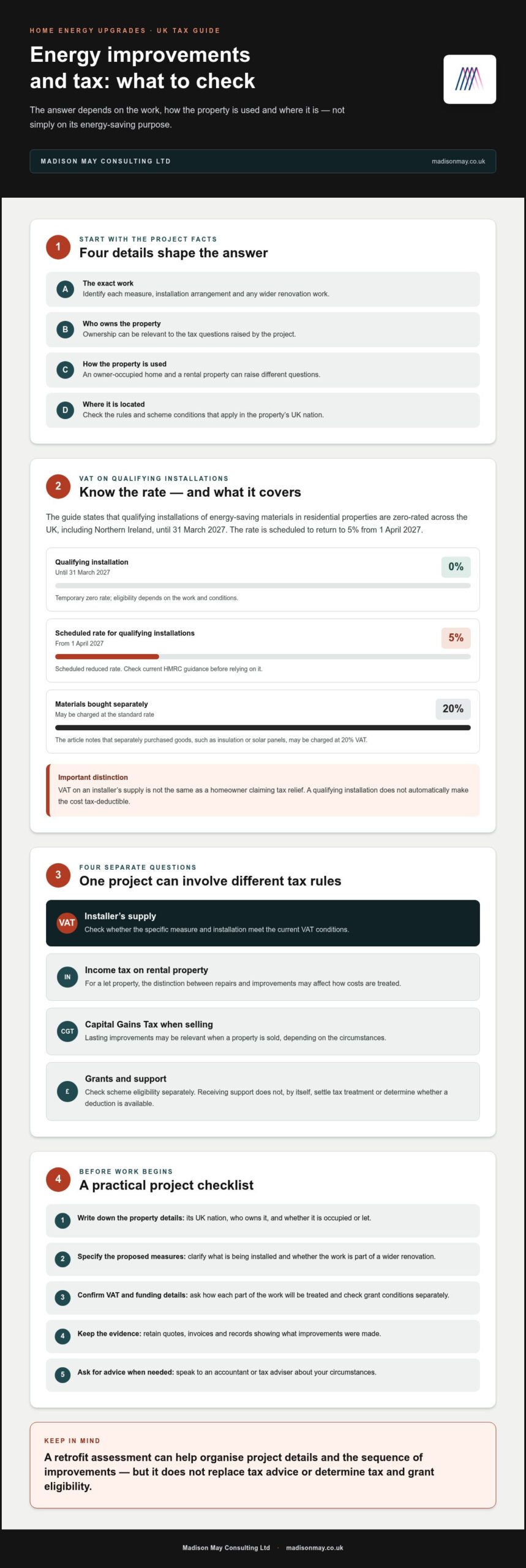
Start by separating four issues: VAT on qualifying work, income tax treatment of spending on a rental property, Capital Gains Tax (CGT) when a property is sold, and the terms of any grant or support scheme. They are not interchangeable. VAT is charged on a contractor’s supply; tax relief is a separate claim, available only where the relevant rules allow it. Receiving a grant doesn’t, by itself, settle either question.
As at September 2026, qualifying installations of energy-saving materials are subject to a temporary 0% VAT rate until 31 March 2027, with a reduced 5% rate scheduled from 1 April 2027. This doesn’t mean every product, labour charge or wider renovation qualifies. For historical context, see the Energy efficiency in British housing overview. Check current HMRC guidance and scheme terms before relying on a rate or eligibility condition, as these can change.
What does “tax on home energy improvements” mean?
A single project can raise different tax questions. The installer’s invoice shows the VAT charged on the supply; it doesn’t automatically give the homeowner an income-tax deduction. For a main residence, don’t assume personal spending qualifies for income-tax relief. If the property is rented out, the distinction between repairs and improvements may affect how costs are treated. Lasting improvements may also be relevant to CGT when a property is sold, depending on the circumstances.
Why your location and property use matter
VAT arrangements and scheme conditions can depend on location. The temporary 0% rate for qualifying installations is currently aligned across the UK, including Northern Ireland, but check the rules that apply where the property is situated and confirm that the work meets the conditions. Property use matters too: an owner-occupied home and a rental property can raise different income-tax and record-keeping questions. This article is general information, not individual tax or legal advice. Ask a qualified adviser about your circumstances.
Before work begins, note the property’s UK nation, who owns it, whether it is occupied or let, and the exact measures in the proposal. A retrofit assessment can help clarify the home’s needs and the potential sequence of improvements, but it cannot determine tax or grant eligibility. Use those project details to frame questions for your accountant or tax adviser.
VAT on UK home energy improvements: check the work and installation conditions
VAT treatment depends on the measure, how it is supplied and installed, and the circumstances of the project. As at September 2026, the installation of qualifying energy-saving materials in residential properties is zero-rated across the UK, including Northern Ireland, until 31 March 2027. From 1 April 2027, the rate is scheduled to return to 5%. These rates don’t automatically apply to every product or charge on a home-improvement invoice. Check the current VAT on energy-saving materials guidance before agreeing the work.
Check VAT eligibility against the actual work, installation arrangements and current HMRC rules. A qualifying installation may receive a particular VAT treatment, but that doesn’t mean the homeowner can claim the cost as tax relief.
Can insulation, heating upgrades or renewable technologies qualify?
Some insulation, heating controls and low-carbon technologies appear on HMRC’s list of qualifying energy-saving materials, but the measure’s name alone doesn’t confirm eligibility. Check the current list and any conditions that apply. The rules generally concern installation: if you buy materials separately, such as insulation or solar panels, you may pay the standard 20% VAT rate on the goods. If the upgrade is part of a wider renovation, the wider project may affect the VAT treatment. Ask how each part will be handled.
What should you check on a contractor’s VAT invoice?
Before work starts, ask the contractor which VAT rate they intend to charge and why. Request a written description that separates qualifying energy-efficiency work from other renovation tasks, where relevant. Compare the final invoice with the agreed scope, checking whether it covers materials, installation and additional work. If the explanation is unclear or you disagree with the treatment, seek clarification from HMRC or a qualified tax professional rather than assuming the project qualifies.
| Question to check | Why it matters |
|---|---|
| Qualifying measure | Confirm the specific material or system appears on HMRC’s current list and meets its conditions. |
| Installation arrangement | Check whether the quote is for supply and installation or materials alone, and whether the work sits within a wider project. |
| Location | Confirm the rules in force for the property’s UK nation. Don’t rely on an older quote or guidance. |
| Invoice treatment | Ask the contractor to explain the rate applied to each part of the work and retain the itemised paperwork. |
A property assessment can help clarify which upgrades are being considered before you request or compare quotes. Madison May Consulting Ltd offers retrofit assessments and EPC improvement plans to support that planning; these don’t determine VAT eligibility. Explore retrofit assessment and improvement planning to organise the project details you’ll need to discuss with your contractor or tax adviser.
Homeowners, landlords and capital gains tax: how property use changes the answer
The tax on home energy improvements UK property owners may face depends partly on whether they live in the home, let it to tenants or later sell it. Don’t assume an energy upgrade automatically creates an income-tax deduction. How a cost is treated may depend on the work, why it was needed and whether it has already been claimed elsewhere.
| Situation | Question to consider |
|---|---|
| Owner-occupier | Is this a personal home improvement, rather than an expense connected with taxable income? |
| Landlord | Is the work a repair, or does it improve or alter the property? Check current HMRC rules before claiming against rental income. |
| Future property seller | Could the expenditure meet the conditions for enhancement costs in a Capital Gains Tax calculation? |
Are energy upgrades deductible against rental income?
For landlords, the broad distinction is between restoring or maintaining a property and improving it beyond its previous condition. Replacing a failed heating component or adding insulation may raise different questions depending on the facts. The description on a quote alone doesn’t settle the tax treatment. Before filing, check current HMRC guidance or ask a qualified tax adviser to assess the work, property and records.
Could improvement costs matter when you sell your home?
Some expenditure that enhances a property may be relevant when working out a chargeable gain, but detailed conditions apply. GOV.UK explains when you may deduct costs of improving your property. Ordinary maintenance is treated differently, and costs already deducted elsewhere shouldn’t simply be counted again. Keep invoices and evidence of the work, then ask a tax professional whether each item qualifies. The answer depends on the property and your circumstances.
For a main home, don’t treat capital improvements as an income-tax deduction simply because they improve energy performance. If you sell, whether CGT applies and whether an improvement cost can be considered are separate questions. Check eligibility for any relief or deduction rather than assuming it applies.
Planning documents can help you describe what was proposed, why it was done and how the work was sequenced. An EPC improvement plan can provide useful context, but it isn’t tax advice and doesn’t establish that a cost is deductible. Keep it with quotes, invoices and completion records, then confirm the tax treatment with an adviser.
Grants, records and tax claims: a practical checklist before work begins
Preparation can make the tax on home energy improvements UK questions easier to resolve later. Before accepting a quote or funding offer, work through these steps and keep a record of your decisions.
- Identify the measure. Record exactly what is proposed, such as insulation or a heating upgrade, and separate it from wider renovation work.
- Confirm the location. Note which UK nation the property is in, then check the applicable VAT rules and scheme terms.
- Ask about VAT. Ask the contractor to explain the rate they expect to charge and how it applies to the specific work. Request an itemised quote.
- Check funding. Confirm whether a scheme is open, whether you and the property meet its current eligibility criteria, and what conditions apply before work starts.
- Retain records. Keep the quote, invoice, evidence of payment and completion documents with funding paperwork and property records.
Scheme details can change, so check current information with the provider before relying on a programme. For example, as at September 2026, ECO4 is scheduled to end on 31 December 2026, while the Great British Insulation Scheme closed to new applications on 31 March 2026. These dates don’t confirm that a particular household or project qualifies. Check availability, eligibility and any tax implications against the scheme’s latest terms.
How should you check a grant’s tax treatment?
Read the current offer documents and identify who provides the support. Check whether it is a grant, discount, loan or another form of assistance, and note any conditions on how the money must be used. A grant and a tax deduction are separate matters. Don’t assume funding creates a deduction or determines how costs are treated for income tax or a future property sale. Ask a tax adviser how the support applies to your circumstances before filing a claim.
What documents should you retain?
Keep dated, itemised invoices describing the work, materials and VAT charged, alongside the original quotation and proof of payment. Retain grant applications, approvals, terms and payment records, plus tenancy or other documents showing how the property was used. Assessment reports and improvement plans can help explain why measures were selected and how the project was sequenced. Store everything securely so you can retrieve it if a tax adviser asks for evidence.
For context on choosing and sequencing measures, consult an energy-efficient home improvements guide. A retrofit assessment and EPC improvement plan can also help you understand the property and organise project information, without establishing tax or grant eligibility. Explore retrofit assessment and improvement planning to prepare for the work and the questions to take to your tax adviser.
Plan energy improvements with confidence, and get advice on your tax position
A well-planned project starts with understanding the home, then checking tax questions before agreeing to work. For the tax on home energy improvements UK householders face, relevant details may include the property’s condition, the measures selected, its use and location, and how each part of the work is funded. Keep project evidence together as decisions are made, rather than trying to reconstruct the details later.
- Assess the property and identify its needs.
- Define the proposed measures and the order in which they may be carried out.
- Ask the contractor about VAT, and check funding terms with the scheme provider.
- Speak to HMRC or a qualified tax adviser about your individual position.
- Retain quotes, invoices, grant documents and completion evidence.
How a whole-home assessment supports better decisions
Improvements should respond to the home as a whole. Reviewing the building fabric, heating and other services, and ventilation can help you understand how proposed measures relate to one another. For example, understanding existing insulation and ventilation can inform discussions about the sequence of upgrades, rather than treating each element as an isolated purchase.
Madison May Consulting Ltd provides PAS 2035-aligned retrofit assessments and EPC improvement plans to help identify property needs and organise potential measures. Retrofit coordination can support project planning and technical compliance. These services can help you prepare for conversations with contractors, but they don’t establish VAT or grant eligibility, determine a tax deduction, or promise a particular EPC rating, tax saving or reduction in energy bills.
When to speak to a retrofit consultant or tax adviser
Seek retrofit guidance if you need help understanding which improvements may suit the property or how to sequence them. If you’re a landlord, ask a qualified tax adviser whether expenditure may be treated as a repair or improvement before filing. If you’re selling, get advice on any Capital Gains Tax calculation. For unclear VAT treatment, check current HMRC guidance or consult a tax professional. A retrofit consultant can inform the improvement plan, but isn’t a substitute for tax advice.
With a clear scope of work and orderly records, you can make project decisions with greater confidence while leaving tax questions to the right specialist. If you’re considering measures for your property, explore home energy improvement guidance from Madison May Consulting Ltd.
Take the next step towards a well-planned home upgrade
The tax on home energy improvements UK homeowners may face depends on the work, property use and location. Don’t assume VAT treatment, tax relief and grant support are the same thing. Check current rules before agreeing to work, and keep clear records of quotes, invoices, funding and completed improvements. If you rent out a property or may sell it, ask HMRC or a qualified tax adviser how the rules apply to your circumstances.
A considered improvement plan starts with the home itself. Madison May Consulting Ltd offers PAS 2035-aligned retrofit assessments for domestic properties, EPC improvement plans to help sequence potential upgrades, and retrofit coordination to support project planning. These services can help you understand property needs and prepare useful questions, but they don’t determine tax eligibility or replace professional tax advice.
Explore a considered plan for improving your home, and take your next steps with greater clarity and confidence.
Frequently Asked Questions
Is VAT reduced on home energy improvements in the UK?
Yes. Qualifying installations of energy-saving materials in residential properties currently have a 0% VAT rate across the UK, including Northern Ireland. This temporary rate is in place until 31 March 2027, with a reduced 5% rate scheduled from 1 April 2027. It won’t necessarily cover every item in a project: eligibility depends on the measure and installation arrangements. Check current HMRC guidance and your contractor’s explanation before agreeing to the work.
Can I claim tax relief on insulation or heating improvements to my home?
Don’t assume you can claim income-tax relief for improvements to a home you live in. VAT treatment on an installation is separate from tax relief on your spending. If the property is rented out, different rules may apply depending on whether the work is a repair or an improvement. The tax on home energy improvements UK homeowners can claim depends on their circumstances, so ask a qualified tax adviser before making a claim.
Are energy-efficiency grants taxable in the UK?
There isn’t one tax answer for every energy-efficiency grant. Treatment can depend on the scheme, the recipient and how the property is used, so don’t assume funding is either taxable or tax-free. Read the provider’s current terms and identify whether the support is a grant, discount, loan or another form of assistance. If you’re a landlord or plan to sell the property, ask a tax adviser how the funding affects your accounts or future calculation.
Can landlords deduct energy improvements from rental income?
Sometimes, but landlords shouldn’t treat every energy upgrade as an allowable rental expense. HMRC distinguishes repairs, which restore or maintain a property, from improvements that enhance it. The facts and nature of the work matter. Insulation or a heating replacement may need individual assessment rather than classification by its label alone. Check current HMRC guidance or ask a qualified tax adviser before filing, and keep invoices and evidence describing the work.
Does installing insulation affect capital gains tax when I sell my home?
It may be relevant if the insulation qualifies as enhancement expenditure under the Capital Gains Tax rules, but eligibility depends on the circumstances and detailed conditions. Routine maintenance generally isn’t treated the same way, and you shouldn’t claim a cost twice if it has already been deducted elsewhere. Keep invoices and records showing what was installed and when. Before including the cost in a calculation, check current HMRC guidance or speak to a tax professional.
How much VAT will I pay for energy-saving home improvements?
For a qualifying installation of energy-saving materials in a residential property, the current VAT rate is 0% until 31 March 2027; a 5% rate is scheduled from 1 April 2027. Materials bought separately may be charged at the standard 20% rate, and wider renovation work may receive different treatment. Ask for an itemised quote explaining the VAT on each part. Verify the work and current rules with HMRC before relying on a rate.
What records should I keep for home energy improvements and tax?
Keep dated quotations, itemised invoices, proof of payment and completion documents that clearly describe the work and materials. Save any grant application, approval, scheme terms and payment record, as well as relevant tenancy or property-use evidence. Assessment reports and improvement plans can help explain why measures were selected and how the project was sequenced. Store the paperwork securely, then share relevant records with your accountant or tax adviser when checking a claim or future property sale.