
Finding a grant is only half the decision: the insulation must suit the home, too. If you’re searching for local authority grants for home insulation, start by separating scheme eligibility from the question of which improvements are appropriate for your property. Schemes change, eligibility depends on several factors and starting work before funding is agreed could leave you facing unexpected costs.
This guide explains grant routes that may help fund insulation, how household income, property details and an EPC rating can affect eligibility, and what information to gather before applying. It also covers the current status of ECO4, which is scheduled to run until 31 December 2026, and the Great British Insulation Scheme, which closed to new applications on 31 March 2026.
You’ll learn what to prepare, how to distinguish a funding route from a guarantee of approval, and why a property-specific retrofit assessment can help identify appropriate measures before work proceeds. A considered plan lets you explore funding while taking account of your home’s condition and character.
Key Takeaways
- Compare local-authority insulation grant routes with national schemes, and distinguish open schemes from routes that have closed.
- Eligibility can depend on household circumstances, tenure, property characteristics and EPC evidence. Compare your details with the active scheme’s criteria.
- Gather property information, tenure evidence and EPC records to prepare for an eligibility enquiry.
- Funding approval and a suitable insulation plan are separate considerations. An assessment can help identify measures that fit the home’s fabric, services and ventilation.
- Use a property-specific improvement plan to consider the right sequence of work, rather than choosing insulation solely because funding may be available.
How local authority home insulation grants work in 2026
A local-authority insulation grant is funding provided through a programme that a council delivers, administers or helps residents access. The arrangement determines who handles applications and how residents enter the process. A council may manage applications directly, work with a delivery partner or signpost residents to a national scheme. A referral or eligibility assessment can help identify a possible route, but neither is the same as grant approval.
Eligibility and available support depend on the active programme. Each scheme sets its own rules for household circumstances, property type, energy-performance evidence and eligible work. A loan must be repaid, while general energy-efficiency advice can help you plan improvements without providing funding. Treat each step separately: an enquiry or initial assessment does not mean funding has been agreed, so don’t commit to installation costs on that assumption.
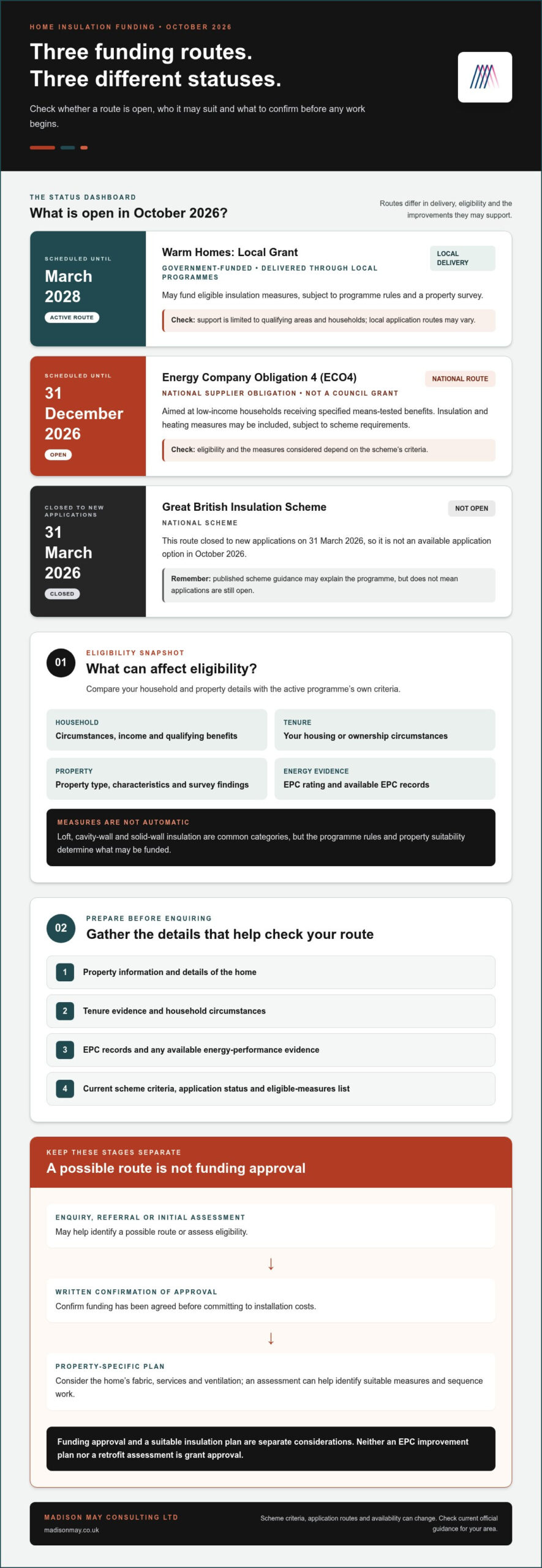
The national Energy Company Obligation (ECO) scheme is separate from a council-administered grant. The Energy Company Obligation (ECO) scheme provides background on how it supports energy-efficiency measures. As at October 2026, ECO4 is scheduled to run until 31 December 2026, while the Great British Insulation Scheme closed to new applications on 31 March 2026. Check a route’s current status before spending time preparing an application.
What can a home insulation grant cover?
Common insulation categories include loft, cavity-wall and solid-wall insulation, but a familiar measure isn’t automatically eligible. The programme’s published rules determine which improvements it will fund. Property features and survey findings may also affect what is suitable. Some schemes may include measures beyond insulation, such as heating upgrades; ventilation or wider retrofit support may sit under separate arrangements. Read the permitted-measures list alongside the eligibility criteria, and compare it with the work proposed for your home.
That distinction matters for the property itself. An insulation measure should respond to the building’s fabric and ventilation needs, not simply to the presence of funding. A retrofit assessment gathers information about these elements, while an EPC improvement plan can set out a practical sequence of property-specific measures. Neither document is a grant approval, but both can help clarify which improvements make sense before a funded project proceeds.
Why grant availability can differ between councils
Funding rounds, local delivery arrangements and remaining budgets can affect whether applications are being accepted and how a programme operates. A scheme’s name alone doesn’t mean there is an open application route in every area, or that every listed measure is available to every household. Use the relevant council or programme’s current official guidance to check application status, criteria and delivery arrangements.
Before taking the next step, look for application dates, eligible measures and the stated approval process. Distinguish an expression of interest or referral from written confirmation that funding has been approved. This helps you explore support without treating a possible grant as a promise of payment or overlooking the home’s wider needs.
Which insulation funding routes may be relevant to your home?
The relevant route depends on whether support comes through a council-delivered programme or a national scheme. That distinction affects who handles applications, which measures are considered and how work is arranged. The comparison below reflects scheme information current as at October 2026; criteria and application routes can change.
- Warm Homes: Local Grant: A government-funded grant delivered through local programmes. The route is active and scheduled to run until March 2028, but support is limited to qualifying areas and households. Eligible insulation measures may be funded, subject to programme rules and a property survey.
- ECO4: A national supplier obligation, rather than a council grant. It remains open until 31 December 2026 and is aimed at low-income households receiving specified means-tested benefits. Insulation and heating measures may be included, subject to eligibility and scheme requirements.
- Great British Insulation Scheme: This route closed to new applications on 31 March 2026. The GOV.UK scheme guidance provides official information, but it is not an available application option in October 2026.
These routes don’t provide the same kind of support. A grant programme can fund approved improvements, while ECO4 operates through supplier obligations and its own delivery arrangements. An assessment or referral may help identify a possible route, but it is not approval or a promise that installation will be funded. Coverage and eligibility depend on current scheme rules, so don’t assume a particular amount or measure will be covered before the application is assessed.
How council-delivered and national schemes differ
National schemes set broad programme rules, while local arrangements can shape how residents access a scheme and how delivery is organised. The Warm Homes: Local Grant is delivered through local programmes, with qualifying areas and application routes shaped by those arrangements. The same national scheme can have locally specific application routes because councils and programme partners organise delivery within the scheme’s rules.
What to check before relying on a scheme name
Before making plans, establish whether applications are open, paused or closed. Then check the current guidance for tenure, property requirements and the insulation measure you’re considering. Warm Homes: Local Grant eligibility can involve household income, means-tested benefits or a qualifying area, alongside EPC and property criteria. ECO4 has its own benefit and property rules. Neither a familiar scheme name nor an initial enquiry confirms eligibility, funding or installation timing.
A retrofit assessment can connect funding criteria with the home’s actual needs. By considering building fabric, services and ventilation, it can inform practical insulation recommendations; an EPC improvement plan can help sequence measures. These are planning tools, not grant decisions. A property-specific retrofit assessment can help clarify which improvements may suit the home before grant-linked work proceeds.
Who may qualify for local authority insulation support?
Eligibility is usually assessed through several connected checks, not a single income figure or postcode. For anyone researching local authority grants for home insulation Bradford, the active Warm Homes: Local Grant criteria provide a current example: privately owned and privately rented homes in qualifying areas may be considered, with household circumstances and property evidence also relevant. Meeting one condition doesn’t guarantee approval; the scheme’s full rules and assessment determine the outcome.
Household, tenure and property checks
For the active Warm Homes: Local Grant, household eligibility may be based on annual income, receipt of certain means-tested benefits, or living in a designated high-deprivation postcode. The income threshold is typically £36,000 or less a year, although other criteria can apply. These are scheme-specific thresholds, not a general test for every insulation grant. Check the current programme guidance before relying on them.
Tenure matters, too. Owner-occupiers and private tenants may both fall within a programme’s scope, but a tenant may need the landlord’s involvement for work affecting the property. Private landlords can receive funded work on one property under the current local grant arrangement, while a contribution is required for subsequent properties. Other schemes may set different tenure conditions, so don’t assume that rules for one programme apply to another.
Property characteristics can shape both eligibility and the work considered suitable. The current grant criteria require an EPC rating of D, E, F or G. The proposed measure must also be relevant to the home: existing insulation, construction and the building’s condition can affect whether loft, wall or another insulation improvement is appropriate. A qualifying postcode alone is not enough to make a grant automatic.
How an EPC and home assessment can inform eligibility
An EPC gives a standard indication of a property’s energy performance and can provide important evidence where a scheme sets a rating requirement. It isn’t a complete inspection of the building fabric or ventilation, however, and its rating alone won’t identify every practical consideration before insulation work. A home assessment can collect information about fabric, services and ventilation, helping distinguish what might meet a funding rule from what is suitable for the property.
Prepare the household and property details requested by the programme, including tenure information and EPC evidence where required. If the home is rented, clarify the landlord’s role before progressing. For a broader view of how measures can be sequenced beyond a single grant application, an EPC improvement plan can map practical upgrades to the individual home’s needs. It supports planning, but does not approve funding or guarantee eligibility.
How to check eligibility and prepare an insulation grant application
Preparation can make an application clearer, but it can’t replace the programme’s eligibility decision. Follow the process in order: identify a live route, compare its rules with your household and property, provide the evidence requested, then wait for written confirmation before arranging funded work.
A practical five-step eligibility check
- Identify the scheme and check its status. Use the programme’s current official guidance to establish whether applications are open, paused or closed, and note application dates or local delivery arrangements. A scheme mentioned in an older article may no longer accept applications.
- Compare the published criteria with your circumstances. Review household, tenure and property requirements together. Check whether the programme considers owner-occupiers, private tenants or landlords, and whether the proposed insulation measure is eligible. If you rent, clarify what information or involvement is required from the landlord.
- Gather the evidence requested. Depending on the application, this may include the property address and details, proof of tenure, an EPC or rating information, and household records relevant to income or qualifying benefits. Provide only the documents requested through the active process, and keep copies of what you submit.
- Complete the application and any assessment. Answer consistently and describe the home accurately, including existing insulation and any known concerns with damp or ventilation. A survey or assessment may be needed to establish which measures are suitable; an initial referral or eligibility check isn’t the same as approval.
- Wait for written approval and read its conditions. Check which measures have been agreed, what the programme will cover, and any specifications or conditions that apply. Don’t book work or assume it will be funded until the programme has confirmed approval in writing.
What to understand before insulation work begins
Approval relates to the programme’s agreed scope, not necessarily every improvement you might want to make. Read the written decision carefully and make sure the proposed measure, property and conditions match what has been assessed. If the scope changes, follow the programme’s stated process before proceeding. Work outside the approval may not be covered.
Insulation should also be planned with moisture and ventilation in mind. Improving the building fabric can alter how air moves through a home, so existing ventilation and signs of damp deserve attention before work begins. A retrofit assessment considers building fabric, services and ventilation, helping identify suitable measures rather than treating insulation as an isolated upgrade. The home energy improvements guide offers wider retrofit context.
If you’re preparing to apply, a property-specific retrofit assessment can help clarify suitable insulation measures and plan next steps. It informs the home-improvement plan, but it doesn’t award funding or guarantee eligibility.
Plan grant-linked insulation around the needs of the whole home
Grant support can make eligible improvements more accessible, but funding rules may limit the choice of measures or when work can proceed. Treat a grant as one factor in the decision, alongside the home’s condition, existing construction and energy-efficiency needs. A funded measure isn’t automatically the best first step for every property.
For instance, a home in Bradford may appear to need additional insulation, yet an assessment could identify ventilation or moisture concerns that should inform the design and sequence of work. Ignoring those details can leave important issues unaddressed. A considered plan connects proposed insulation with the building fabric and services, rather than viewing one funded improvement in isolation.
Why insulation decisions need a whole-home view
Insulation recommendations should reflect the existing construction, the condition of the building and the way the home is used. Changes that affect airtightness can also alter ventilation needs, so consider these alongside fabric improvements. The right insulation choice is the one supported by evidence about the individual property, not simply the measure attached to a funding offer.
This whole-home perspective matters even when a grant route specifies particular eligible measures. A survey can record relevant information about fabric, services and ventilation, helping clarify whether a proposed improvement fits the home and what else may need attention. If the property has signs of damp, include those observations in the planning conversation rather than setting them aside because insulation funding is available.
Funding can also bring practical constraints: the scheme may define which work is in scope, require an assessment, or operate within a particular application period. Keep those conditions distinct from your longer-term improvement priorities. If a suitable measure isn’t covered, or the timing doesn’t fit, an improvement plan can still help you understand how it might sit within a broader sequence of work.
How Madison May Consulting Ltd can support a considered next step
Madison May Consulting Ltd provides PAS 2035-aligned retrofit assessments that gather information on the building fabric, services and ventilation. The findings inform practical, property-specific insulation recommendations before a grant-linked project proceeds. An assessment supports planning; it isn’t a funding decision and doesn’t guarantee eligibility or approval.
An EPC improvement plan sets out suitable measures in a considered order, including insulation and related upgrades where appropriate. This roadmap helps you weigh proposed work against the home’s broader needs, rather than treating a grant as a standalone reason to proceed. Madison May Consulting Ltd also provides retrofit coordination to support management of the process and relevant technical standards.
For a clearer view of how your home’s fabric, services and ventilation can shape an improvement plan, explore Madison May Consulting Ltd’s retrofit assessment and planning support for local authority grants for home insulation Bradford.
Make your next insulation decision with confidence
Let the funding route inform your plans, but don’t let it define the home’s entire improvement journey. Set out what matters most to the property, then consider how eligible insulation work can fit into a practical sequence of upgrades. This keeps the focus on the home as a whole, rather than a single funded measure.
For anyone exploring local authority grants for home insulation Bradford, sound planning can bring greater clarity before a project moves forward. A PAS 2035-aligned retrofit assessment considers the building fabric, services and ventilation. An EPC improvement plan can help order property upgrades, while retrofit coordination supports project management and relevant technical standards. These services inform decisions, but don’t determine grant eligibility or approval.
Explore Madison May’s retrofit assessment and insulation planning support to shape a property-specific plan for your next steps. With a clearer understanding of the home and its priorities, you can move forward thoughtfully.
Frequently Asked Questions
Are local authority grants for home insulation available in 2026?
Yes, some routes are available, but their status and application arrangements differ. As at October 2026, the Warm Homes: Local Grant route discussed in this guide is active and scheduled to run until March 2028; ECO4 is due to end on 31 December 2026, and the Great British Insulation Scheme closed to new applications on 31 March 2026. For searches such as local authority grants for home insulation Bradford, use the relevant scheme’s live application guidance rather than relying on a referral page alone.
Can I get a grant for loft or cavity-wall insulation?
Possibly, if the active scheme includes the measure and it suits the property. Existing insulation and construction may affect whether a loft or cavity-wall improvement is appropriate. Check the scheme’s eligible-measures list and provide the property details it requests. A measure being commonly funded elsewhere doesn’t mean it will be included in your offer, so wait for the programme’s written decision before arranging work.
Do I need a particular EPC rating to qualify for insulation funding?
Some schemes use an EPC rating as part of their eligibility test, while others may use different criteria. The Warm Homes: Local Grant and ECO4 criteria described in this guide include homes rated D, E, F or G, but requirements can change and don’t automatically apply to every route. Check that your EPC information relates to the property and meets the active scheme’s rules. The rating alone doesn’t confirm approval or identify the right measure.
Can landlords apply for home insulation grants for a rented property?
Some schemes include private rented homes, although landlord terms can differ from those for owner-occupiers. Under the Warm Homes: Local Grant arrangement discussed here, private landlords may receive funded work on one property, with a contribution required for subsequent properties. Tenants should establish the landlord’s involvement and any consent needed before planning work. Check the current scheme conditions for the specific property, as eligibility and contribution rules aren’t universal.
Should insulation work begin before a grant is approved?
No. Don’t assume that work started before approval will qualify for funding. An application, referral or survey may be only one stage of the process, rather than confirmation that costs will be covered. Before committing, read the written decision and note the approved measure and any conditions or timing requirements. If the work has already begun, don’t assume the programme will reimburse it; the scheme’s terms determine what can be funded.
Does a grant-funded insulation project still need ventilation considerations?
Yes, ventilation belongs in the planning, even when insulation is the funded measure. Changes to the building fabric can affect how heat and air move through a home, so existing airflow and any signs of moisture are useful details to raise during an assessment. If a room already feels damp or poorly ventilated, include that in the property information. The suitable approach depends on the building and the proposed work.
Can a retrofit assessment guarantee that I will receive an insulation grant?
No. A retrofit assessment documents the property and informs suitable improvement recommendations, but the scheme responsible for funding makes the eligibility and approval decision. Madison May Consulting provides PAS 2035-aligned assessments that consider building fabric, services and ventilation, helping homeowners and landlords plan with clearer evidence. An EPC improvement plan can also help sequence upgrades, but neither service guarantees that an application will be accepted or funded.