


Could your home qualify for ECO4 when household benefits, the EPC rating and landlord permission all need to be considered together? It’s understandable if the rules feel difficult to untangle. Eligibility depends on several details, and promotional claims can make funding sound more certain than it is. For anyone searching for the ECO4 scheme, the same national scheme criteria apply, while ECO4 Flex arrangements may vary between local authorities.
This checklist explains the household routes that may apply, the general EPC criteria for owner-occupied and rented homes, and the property details and permissions to gather. It also explains why the home and proposed package of improvements need to be assessed, rather than assuming one measure or a particular funding outcome is guaranteed.
ECO4 is due to end on 31 December 2026, and new applications are now very limited. This guide covers the benefits and local-authority flexibility routes, the role of property condition and assessment, and practical next steps if ECO4 may not suit your circumstances. If funding is uncertain or unavailable, an EPC improvement plan from Madison May Consulting Ltd can help you consider energy-efficiency improvements with greater clarity.
Key Takeaways
- Use household circumstances, property tenure and the EPC rating as a first checklist, not a guarantee of approval or funded work.
- Compare the benefits route with ECO4 Flex. Local-authority criteria may offer another route, but they are not identical.
- For searches such as “ECO4 scheme eligibility West Yorkshire”, remember that local Flex criteria can vary between authorities.
- Before making enquiries, gather the property’s EPC, relevant household benefit or income details, and landlord permission if you rent privately.
- If ECO4 may not fit, a PAS 2035-aligned retrofit assessment and EPC improvement plan can help clarify suitable improvements and next steps.
ECO4 scheme eligibility: what the checklist can, and cannot, tell you
ECO4 is the fourth phase of the Energy Company Obligation, a UK scheme that places obligations on energy suppliers to support energy-efficiency improvements in eligible homes. Its broad purpose is to improve how homes use energy, with measures that may address heat loss or inefficient heating. For background on the scheme’s history and aims, see the Energy Company Obligation (ECO) scheme.
A checklist helps organise the questions that matter, but it cannot confirm an application outcome. ECO4 eligibility is a set of checks, not an automatic grant entitlement. A household may appear to meet one route and still need its property and proposed work assessed before a decision is made. Don’t assume funding or a particular improvement from an initial match alone.
What ECO4 may support in a home
Depending on the circumstances, possible measure categories include insulation and heating improvements. The right work is not selected from a fixed menu. It depends on the home’s construction and existing systems, its energy performance, and the rules that apply to the case. A home losing heat through its walls, for example, may need a different approach from one where the main concern relates to the heating system.
A boiler replacement is therefore not the standard outcome for every applicant. It may be considered as part of a broader package, or another improvement may be more suitable once the property has been assessed. The aim is to identify work that fits the home and scheme criteria, not to promise an installation before the relevant details are understood.
Why meeting one criterion may not be enough
Household circumstances are only one part of the picture. A household might meet a qualifying route while the property falls outside the relevant criteria. Alternatively, the home may need work that is not suitable under the applicable scheme rules. Tenure, the recorded energy rating, the building’s physical condition and the practicality of proposed measures can all affect the assessment.
For example, a benefit-related household check may suggest a possible route, but it does not establish that the property qualifies or that a specific measure is appropriate. In a rented home, the tenant’s circumstances and the landlord’s permission are separate considerations. Each answers a different question, and neither proves the other.
An installer or scheme administrator must consider the full circumstances before confirming whether support or work can proceed. A property assessment can clarify the building’s fabric, heating and ventilation needs, while an EPC improvement plan can set out considered options for improving performance. Madison May Consulting Ltd provides PAS 2035-aligned retrofit assessments and tailored EPC improvement plans to help homeowners and landlords understand their property and plan practical next steps. That information can support future improvement planning even when ECO4 eligibility remains uncertain.
ECO4 eligibility checklist: household, tenure and EPC rating
A useful first check has three parts: who lives in the property, who owns it, and what its current Energy Performance Certificate (EPC) says. The same national framework applies to searches for “ECO4 scheme eligibility West Yorkshire”, although local-authority arrangements may affect the Flex route. Use the criteria below to identify what to gather, then compare your circumstances with current GOV.UK guidance and any relevant local requirements.
Which household and benefit routes may apply?
Start with the household. The current benefit-based route includes Universal Credit, Pension Credit, income-based Jobseeker’s Allowance, income-related Employment and Support Allowance, Income Support and Housing Benefit. Child Tax Credit, Working Tax Credit and Child Benefit may also be relevant, subject to income thresholds. Check the current official list and conditions before relying on a particular benefit: receiving a listed benefit does not, by itself, confirm ECO4 approval.
If no qualifying benefit applies, ECO4 Flex may offer a separate route. Local authorities can set criteria to identify households facing factors such as low income, health conditions affected by a cold home, or other indicators of fuel poverty. This is not an interchangeable version of the benefits route. Whether it applies depends on current local arrangements and the household’s evidence.
How tenure and EPC rating affect the checks
Next, note whether the property is privately owned, privately rented or social housing. GOV.UK guidance gives an EPC range of D to G for private homeowners, and E to G for private rented homes. It also identifies E to G for social housing, subject to the relevant route and conditions. Eligibility criteria vary by tenure and route, so check EPC thresholds against current guidance.
Find the property’s EPC and check that it relates to the home’s current address and circumstances. The rating is a starting point, not a decision on the whole application. If you can’t locate a current certificate, record that rather than guessing the rating. Accurate property information can affect what needs to happen next.
For a rented home, permission is a separate practical check. A private tenant needs the owner’s agreement for improvement work, while a social housing tenant should establish the relevant housing provider’s permission process. Household circumstances may support one route, but they do not replace the owner’s or provider’s role in considering work to the building.
- Household: record relevant benefits or information that may support an ECO4 Flex assessment.
- Tenure: identify the owner, landlord or housing provider and any permission needed.
- Property: locate the EPC and note its rating and date.
Keeping these details together makes it easier to describe your starting point without assuming the outcome. If the EPC or the home’s condition raises further questions, a domestic retrofit assessment can clarify its fabric, heating and ventilation needs as part of considered improvement planning.
ECO4 Flex or benefits route: how to compare possible eligibility paths
There are two broad ways a household might be considered under ECO4: meeting the conditions for a qualifying benefit route, or being assessed through ECO4 Flex. These are separate pathways, not interchangeable guarantees. Both sit alongside checks on the property, tenure, EPC rating and suitability of possible improvements. Identifying a potential route is a starting point, not an approval.
| Route | What the household may need to establish | What it doesn’t confirm |
|---|---|---|
| Qualifying benefit | That a household member receives a benefit included in the current scheme criteria, and that any relevant conditions are met. | That the property or a proposed improvement meets the scheme’s requirements. |
| ECO4 Flex | That the household may meet the applicable local-authority criteria and can provide information supporting that assessment. | That Flex applies in the area, or that a measure or funding will be approved. |
When the benefits-based route may be relevant
If someone in the household receives a benefit that currently qualifies, the benefits route may be relevant. Check the latest official criteria, including any conditions attached to specific benefits, rather than relying on a remembered list. Benefit status is one part of the assessment. Tenure and the applicable EPC threshold still matter, as does whether suitable work can be identified for the property.
For instance, a household may appear to meet the benefit conditions while the home’s EPC or proposed improvements need further consideration. A formal assessment determines whether support can proceed; the benefit alone does not settle the application.
What ECO4 Flex means for a household
ECO4 Flex allows local authorities to use applicable scheme arrangements to identify households that may qualify through routes beyond receipt of a qualifying benefit. Depending on current rules, these routes can relate to factors such as household income, health conditions affected by a cold home, or vulnerability to fuel poverty. Criteria and administration can differ, so Flex is not a guaranteed alternative when no benefit route applies.
Before pursuing this pathway, establish which local arrangements currently apply and what evidence they require. Don’t assume that meeting a broad description, such as having a health condition or a low income, is sufficient. The relevant authority’s criteria and the full scheme assessment determine whether the circumstances fit.
Whichever route seems closer, keep household eligibility separate from the home’s energy performance. An EPC improvement plan can clarify the property’s needs by setting out potential improvements in a considered order. Madison May Consulting Ltd’s EPC improvement plan guide explains how this type of planning can help homeowners understand property performance, without implying that an ECO4 application will be approved.
For a practical comparison, write down the evidence for the household route, then list what remains to establish about the property: tenure, EPC rating, condition and possible measures. This gives an installer or scheme administrator a clearer picture to assess and keeps expectations grounded until the full circumstances have been reviewed.
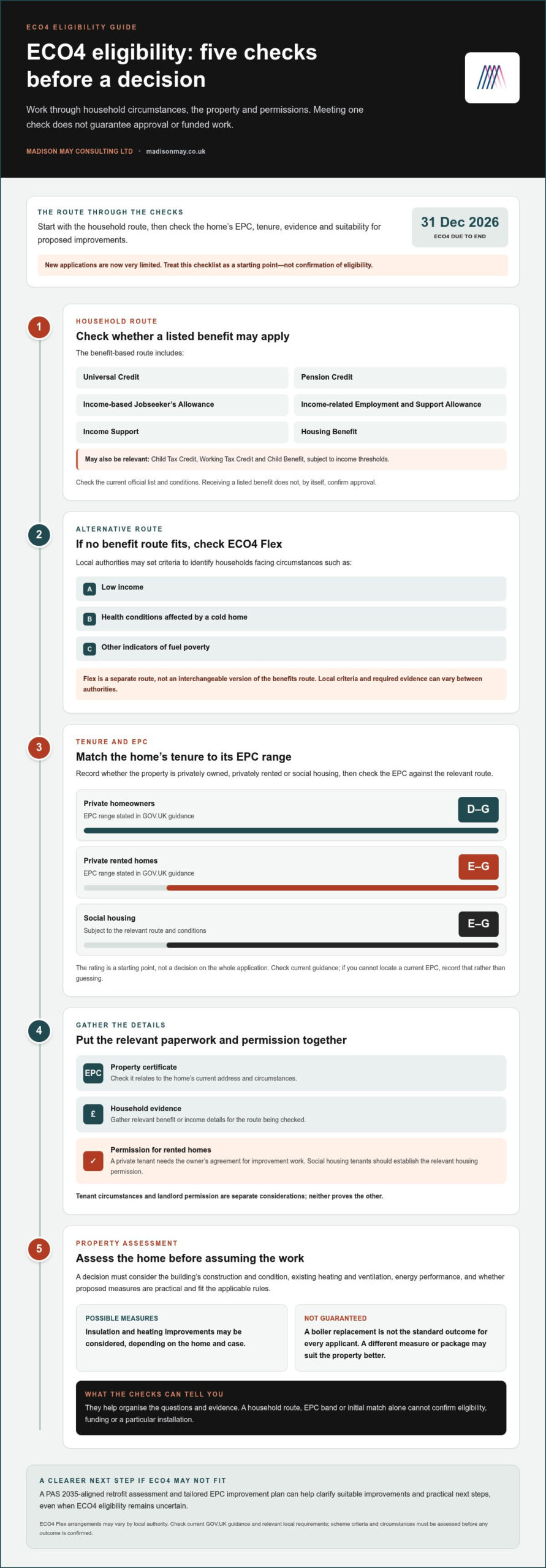
Before applying for ECO4: a practical property and paperwork checklist
Preparing the details can make an eligibility enquiry clearer, even though having documents ready does not secure approval. Use this sequence to organise what you know about the home and household, and note any gaps rather than guessing. This gives an assessor a more useful starting point and separates confirmed details from questions that still need investigating.
- Check the tenure. Record whether the home is owner-occupied, privately rented or social housing. If you rent, note who owns or manages the property and what permission may be needed before improvements can be considered.
- Locate the EPC. Find the Energy Performance Certificate and record its rating and date. Check that the property address matches, and flag the certificate if you can’t find one or think it may not reflect the home’s current condition.
- Review the household route. Note any currently relevant benefits or circumstances that may be considered under ECO4 Flex. Keep the information accurate and be prepared to provide supporting records if requested.
- Describe the home’s concerns. Note what you’ve observed about insulation, draughts, heating performance, condensation or ventilation. Specific observations are more useful than assuming which measure the property needs.
Information to gather before an eligibility enquiry
Useful records may include the EPC, tenancy or ownership details, information about household circumstances, and existing reports or paperwork relating to heating or previous improvements. If the home is rented, establish the appropriate owner or housing-provider permission process. These details explain the starting point, but they do not replace an assessment of the household, property and proposed work.
As you prepare, distinguish what you know from what you suspect. For example, record that a room feels cold or condensation appears without deciding that a particular insulation or heating upgrade is the answer. The energy-efficient home improvements guide offers context for considering measures as part of a broader plan.
What to expect from a property assessment
A property assessment considers how the different elements of a home work together. Its fabric, existing services such as heating, and ventilation all influence which improvements may be suitable. Addressing one feature in isolation may not resolve the underlying performance concern. Assessment findings can shape a considered improvement plan, but do not confirm ECO4 eligibility or guarantee funding.
Where the building’s condition needs a closer review, comprehensive building survey guidance can help explain why understanding the property matters before planning work. This broader view supports better-informed decisions, whether or not an ECO4 route proves suitable.
For anyone researching “ECO4 scheme eligibility West Yorkshire”, a practical next step is to bring household records and property observations together, then assess the home’s needs. Arrange a retrofit assessment to gain a clearer picture of the building’s fabric, heating and ventilation needs and plan improvements with care.
If ECO4 may not fit: plan the next step with a retrofit assessment
An uncertain ECO4 check doesn’t make it any less useful to understand how your home performs. Knowing where heat may be lost, how heating and ventilation work together, and which improvements may be suitable can help you make considered decisions, whether you pursue funding or plan work independently.
How a retrofit assessment can clarify improvement priorities
A retrofit assessment considers the property as a whole, gathering information about its building fabric, services and ventilation. Rather than focusing on one visible issue, it can help show how different features interact. A cold room, persistent condensation or uneven heating, for example, can each prompt questions about the home’s fabric, systems or airflow that should be understood before choosing improvements.
Madison May Consulting Ltd provides PAS 2035-aligned retrofit assessments and reports. The findings can help shape a practical sequence of potential improvements suited to the home, rather than an assumed package of measures. The assessment supports property planning; it is not an ECO4 eligibility decision and cannot confirm grant approval or funding.
How to turn assessment findings into a considered plan
An EPC improvement plan turns information about a property into a tailored roadmap of potential upgrades. It can clarify priorities and show how possible work relates to the home’s energy performance, giving you a basis for planning even if ECO4 is unsuitable or the outcome remains uncertain. The aim is a coherent view of the home, not a promise that every suggested measure will be funded or installed.
When improvements move into a project, retrofit coordination can support the planning and oversight of work so the different stages are considered together. This support is distinct from grant approval. Coordination can help organise a technically compliant improvement project, but it does not determine whether a household or measure is accepted under ECO4.
A useful next step is to bring together what you know about the property and decide what you want it to do better, from retaining warmth to improving comfort and ventilation. A clear assessment can turn those observations into a more grounded plan, with options whether or not scheme support is available.
If you’d like to explore a considered route from understanding your home to planning potential improvements, explore retrofit assessment and improvement planning.
Make your next home improvement decision with clarity
A scheme check is only one part of deciding what to do with a home. Whether support is possible or not, understanding the building can help you choose improvements that respond to its condition and your priorities, rather than acting on a broad promise or assuming one solution will fit. For anyone searching “ECO4 scheme eligibility West Yorkshire”, a useful next step is to build a clearer picture of the property and its options.
Madison May Consulting Ltd’s PAS 2035-aligned retrofit assessments, detailed EPC improvement plans and retrofit coordination can help bring that picture into focus, from identifying needs to planning domestic improvement work. This support informs considered decisions; it does not guarantee ECO4 approval or funding.
Explore Madison May Consulting Ltd’s retrofit assessment and EPC improvement planning to take a thoughtful step towards a home that better supports comfort and energy performance.
Frequently Asked Questions
Who qualifies for the ECO4 scheme in 2026?
A household may qualify through a member receiving a benefit included in the current ECO4 criteria, but eligibility also depends on the home and suitable improvements. Benefits that may count include Universal Credit, Pension Credit, income-based Jobseeker’s Allowance, income-related Employment and Support Allowance, Income Support and Housing Benefit. Child Tax Credit, Working Tax Credit and Child Benefit may also apply, subject to income conditions. Check current official guidance before relying on a benefit.
Can I qualify for ECO4 if I do not receive benefits?
Possibly. ECO4 Flex may allow a household to be considered under local-authority criteria even if no one receives a qualifying benefit. These criteria can relate to low income, health conditions affected by a cold home, or other indicators of fuel poverty. A gross household income below £31,000 is a common threshold, but it isn’t universal. Local criteria and the property assessment determine whether this route may apply.
What EPC rating does a property need for ECO4?
As a general guide, privately owned homes may need an EPC rating of D, E, F or G, while privately rented and social housing properties may need E, F or G. Thresholds can depend on the route and current scheme guidance, so check the certificate and applicable rules rather than relying on an old assessment. An EPC rating is one part of the decision, not confirmation that a measure will be funded.
Can private tenants apply for ECO4 support?
Private tenants may be considered, with the tenant’s household circumstances forming part of the eligibility check and the property assessed separately. The landlord’s permission is needed before improvement work can be carried out. Discussing the possibility of an assessment with the property owner early can help, particularly if the home may need insulation or heating changes. Permission alone does not establish that the household, property or proposed work meets ECO4 requirements.
Is ECO4 still open in 2026, and when does it end?
ECO4 is scheduled to end on 31 December 2026. However, the end date doesn’t mean support is available to every new applicant: most funding has been allocated, and new applications are now very limited. If you’re considering an application, use current official guidance and remember that a preliminary eligibility check isn’t an approval. Don’t plan around a funded improvement until the full assessment and decision are complete.
Does ECO4 guarantee a free boiler or insulation?
No. ECO4 doesn’t guarantee a free boiler, insulation or any other specific measure. The work considered depends on the home’s condition, the applicable scheme requirements and the assessment outcome. ECO4 may support insulation or heating improvements, but a boiler replacement isn’t a standard result for every household. Treat claims promising a particular installation as unconfirmed until the scheme decision identifies what support and work, if any, may proceed.
How do I check whether ECO4 Flex applies to my household?
Start by finding your local authority’s current ECO4 Flex information, often published in its Statement of Intent, and compare the criteria with your circumstances. For searches such as “ECO4 scheme eligibility West Yorkshire”, remember that Flex arrangements can differ between authorities. Gather relevant household details, such as income information or evidence of a health condition, and use the authority’s current criteria and formal assessment to establish whether the route applies.
What can I do if my home does not qualify for ECO4?
You can still make informed decisions about improving your home. A retrofit assessment can examine the building fabric, heating and ventilation, while an EPC improvement plan can organise potential upgrades into a considered roadmap. Madison May Consulting Ltd provides PAS 2035-aligned assessments, detailed plans and retrofit coordination for domestic projects. These services support property planning, not ECO4 approval or funding, and can help clarify possible next steps even if the scheme isn’t suitable.