

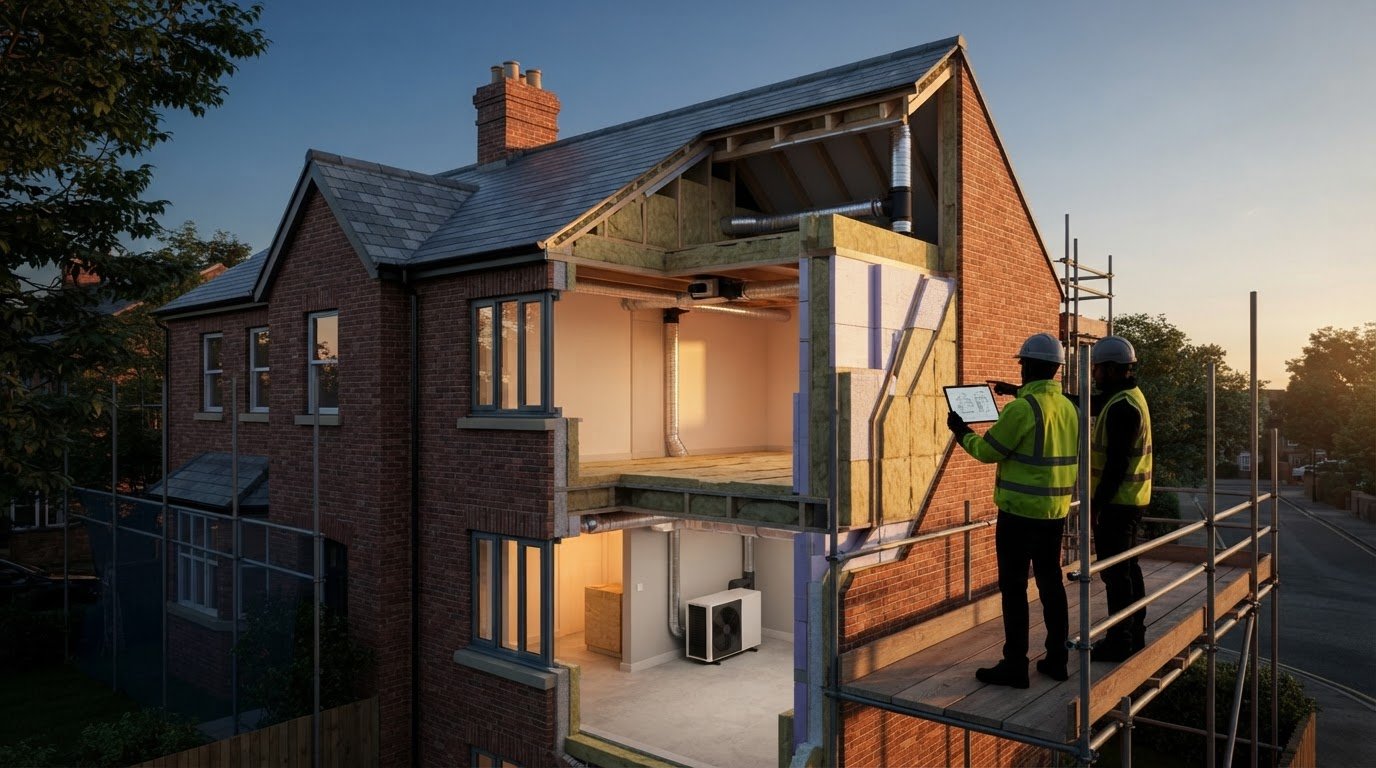
That’s a wide range because improving a home involves more than one isolated upgrade. The right combination of insulation, draught-proofing, windows and heating depends on where heat is escaping and how the building performs.
It’s understandable to want a clear figure before committing, especially when the work may involve several parts of your home. This guide explains typical insulation costs, what can influence a whole-house budget, potential energy-bill savings and funding options, so you can see how the choices fit together. It also explores the bigger goal behind a retrofit: reducing heating demand, not simply replacing one heating system with another.
Key Takeaways
- Compare insulation options by the part of your home they address: wall, loft and floor measures have different typical costs.
- Use potential bill savings to understand the value of upgrades, while remembering that results depend on your home and heating system.
- Explore funding before planning heating upgrades: according to Ofgem, the Boiler Upgrade Scheme offers a maximum grant of £7,500 for an air source heat pump.
- Check whether reduced VAT may apply: according to HM Revenue & Customs, energy-saving materials used in passive house construction and installation work in the UK may be eligible for a reduced VAT rate of 5%.
- Think beyond individual improvements: coordinating insulation, ventilation and heating measures can help reduce the amount of heat your home needs.
Cavity, internal, external, loft and underfloor insulation costs
The figures below show how insulation, heating and other components can contribute to a project budget.
Insulation measure costs
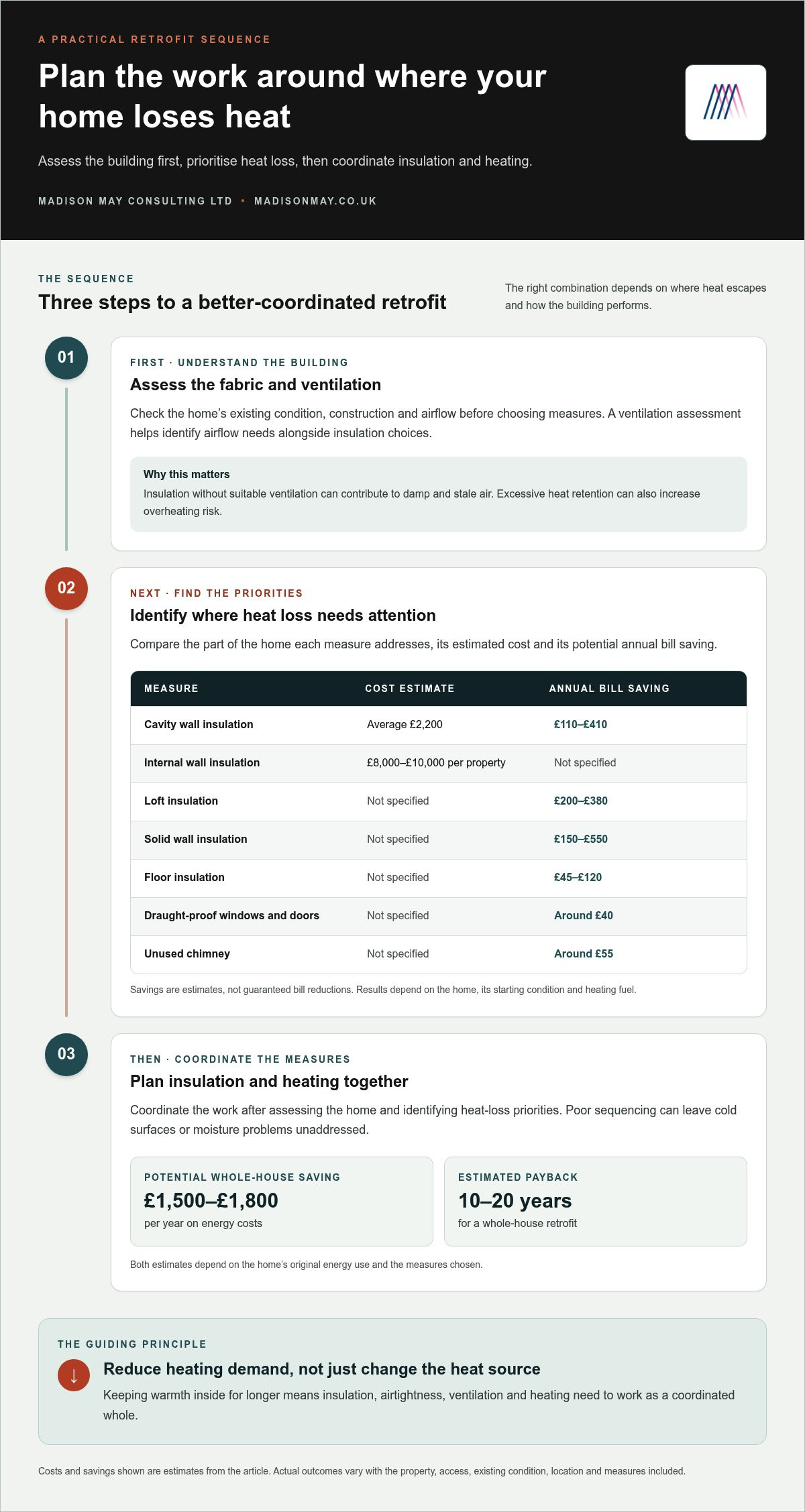
Insulation costs depend on the building fabric, access and the area being upgraded, making the measure important to price individually. Cavity wall insulation averages £2,200, whilst internal wall insulation costs £8,000-£10,000 per property. These measures can improve comfort by reducing heat loss, but each suits different walls, roofs and floors.
Costs by property size and type
Property size and construction affect the materials and labour a retrofit requires. Location, existing condition and the number of measures included can also shift the overall cost.
Common component estimates can help build a more complete budget. For a typical three-bedroom detached home, estimates include:
- Solar panels: £5,000-£8,000 for a 4 kW system.
Allow for qualified-engineer labour when estimating installed measures.
A completed typical bungalow renovation illustrates how extensive work adds up. A charge point for an electric vehicle cost £700.
Plan the work in sequence: assess the home’s fabric and ventilation, identify heat-loss priorities, then coordinate insulation and heating measures. Poor sequencing can leave cold surfaces or moisture problems unaddressed. Insulation without suitable ventilation can contribute to damp and stale air, while excessive heat retention can increase overheating risk. A ventilation assessment helps identify airflow needs alongside insulation choices.
Energy bill savings and property value
Retrofit savings come from reducing heat loss and using energy more efficiently. The value depends on the measures installed, the home’s starting condition and its heating fuel.
Estimated energy-bill savings
Estimated bill savings show how upgrades may affect household energy spending, helping you compare measures with their upfront cost. UK estimates put annual savings at £200-£380 for new loft insulation, £110-£410 for cavity wall insulation and £150-£550 for solid wall insulation. Floor insulation may save £45-£120 per year. Draught-proofing windows and doors can save around £40 per year, whilst an unused chimney may save around £55.
Energy savings and payback
Payback compares the cost of an upgrade with the savings it generates over time. A whole-house retrofit is estimated to save £1,500-£1,800 per year on energy costs, with a payback period of 10-20 years. The outcome depends on the home’s original energy use and the measures chosen. Heat-pump savings also depend partly on the fuel replaced, because electricity and gas costs differ.
Individual measures can have different payback profiles. Cavity wall insulation in a semi-detached home can save around £280 per year on average, while an air-source heat pump can save approximately £340 annually. Compare these estimates with the relevant installation cost, but also consider comfort and reduced heat loss. Savings figures are estimates, not a household’s guaranteed bill reduction.
Reduced heating demand
Reducing heating demand means keeping warmth inside for longer, rather than relying solely on a new heat source. The Anglesey bungalow retrofit reduced heating demand by 81%, from 286 kWh/m².a to 65 kWh/m².a. Its owners are estimated to save around £3,700 each year in energy costs, while annual electricity bills are estimated at around £1,100.
Lower demand can also reduce carbon emissions. An energy-efficient UK home fitted with renewable technologies can achieve a 95% reduction in CO₂ emissions. A separate whole-house estimate places gas bills before retrofit at £2,200 per year, compared with total energy costs of £400-£700 per year afterwards. These figures illustrate how insulation, airtightness, ventilation and heating work together.
Energy upgrades may also affect a home’s sale value, though figures vary by improvement. Combined efficiency improvements could increase a UK home’s value by an average of £10,000. Estimates attribute £5,000-£8,000 to an air-source heat pump, £1,350-£5,400 to solar panels, and around £5,000 to an electric vehicle charge point. These are potential value effects, distinct from bill savings.
To understand which combination may reduce heat loss in your property, a retrofit assessment can help identify practical measures and their relationship to heating demand.
Government retrofit grants and funding
Government funding can reduce the upfront cost of selected retrofit measures, but schemes differ by technology and location. The practical first step is to match planned work to the relevant scheme’s eligibility rules, rather than assume every part of a whole-home project will be funded.
Boiler Upgrade Scheme
For an air source heat pump, the Boiler Upgrade Scheme offers a maximum grant of £7,500, according to Ofgem. The scheme can also contribute towards some other low-carbon heating options. These grants relate to heating installations, not insulation or general construction work.
There is a higher grant value for a specific off-gas-grid situation: the scheme provides £9,000 towards an eligible air-to-water or ground source heat pump when replacing oil or LPG heating. That distinction matters when setting a budget, as the existing fuel and proposed system affect which support applies. Treat grant funding as one contribution to the heating element, not as a full retrofit allowance.
Support for insulation and wider improvements
In England, the support described is for households with gross annual income below about £30,000 who own or privately rent a home with an EPC rating of D or worse. The support was being expanded to more people in April 2023. This gives eligible households a route to explore improvements such as insulation, though the measures available depend on the scheme and assessment.
Regional programmes also matter. Scotland’s options include the Home Energy Scotland Grant and Loan and Energy Efficient Scotland: Area Based Schemes. These differ from support in England, so the nation where a property is located affects the funding route. A detached home needing external wall insulation may require different work from a smaller property needing a heating upgrade; consider funding alongside the construction scope.
Planning a funded retrofit
The government’s Warm Homes Plan aims to upgrade up to 5 million homes by 2030, according to the Department for Energy Security and Net Zero. For an individual household, this wider ambition does not replace scheme-specific eligibility. Keep the project plan focused on the home’s needs, the measures that address heat loss, and which funding route applies to each part.
A useful sequence is to establish the property’s condition and energy priorities, identify suitable improvements, then map eligible measures against available funding. This helps distinguish grant-supported heating from separately budgeted insulation, ventilation or external wall work. It also clarifies how much of the construction programme remains outside a grant, so the overall retrofit budget reflects the funding accurately.
Retrofit financing and standards
Financing a retrofit means planning how to cover available support and the remaining project costs. Building requirements can affect the scope of retrofit work, so check what applies to your property before starting.
Retrofit financing options
Separate the budget into fabric improvements, heating, ventilation and professional work. This makes it easier to see which measures address heat loss and which reduce carbon or electricity use. Funding schemes may support specific technologies, while other work needs a separate budget. Treat any grant as support for eligible measures, not a contribution to every part of the project.
Tax treatment can also affect the final cost. According to HM Revenue & Customs, energy-saving materials used in passive house construction and installation work in the UK may be eligible for a reduced VAT rate of 5%. Eligibility relates to the relevant materials and work, so it should not be assumed to apply to every retrofit item. Include VAT treatment when comparing quotes and planning the project’s cash flow.
Consider the order of spending as well as the total. Addressing the building fabric before sizing replacement heating can help align the system with the home’s reduced demand. At the time of writing, gas was cheaper than electricity, so the fuel a heat pump replaces affects its running costs and potential energy-bill savings. This makes the energy source an important part of a financing comparison.
Standards and building rules
Standards and building rules shape how retrofit measures are assessed, designed and installed. PAS 2035 applies to compliance requirements for the whole retrofit process, while PAS 2030 applies to certified installers carrying out retrofit work in the UK. These standards matter because cavity insulation, ventilation and heating upgrades need to be considered as parts of the home’s overall performance.
To find qualified professionals, look for retrofit assessors and coordinators working within the PAS 2035 process, and installers certified to PAS 2030. TrustMark covers professionals carrying out energy-efficiency work, including retrofits, and is linked to PAS 2035. These named frameworks help distinguish assessment, coordination and installation roles when organising a project.
Planning permission and listed-building controls can affect choices for external changes, such as external wall insulation. A building warrant may be needed depending on the property type or whether the home is in a conservation area. Include the home’s construction and status early in the design process, as these can influence suitable materials, appearance and installation methods.
Whole-house retrofit and heating-demand reduction
A whole-house retrofit aims to reduce the heat a home loses before deciding how to supply what remains. This distinction matters: improving insulation, airtightness and ventilation can change an existing property’s heating demand, rather than simply replacing its heating system.
The scale of the opportunity is substantial across the UK: 24 million homes need upgrading to reach ideal minimum energy-efficiency standards or above. Results depend on the home’s construction, condition and starting energy use. A retrofit at Elliott Drive in Wellesbourne, Warwickshire, is expected to reduce heating consumption by around 85%, showing how coordinated measures can change demand in an existing home.
Think of the work as connected parts, not a catalogue of separate upgrades:
- Reduce heat loss: improve the building fabric through suitable insulation and airtightness work.
- Manage fresh air: include ventilation in the design, particularly as draughts and uncontrolled air leakage are reduced.
- Match heating to demand: plan the heating system around the home’s improved performance.
- Consider generation: solar panels may complement an electrified home, but they don’t replace fabric improvements.
Ventilation is part of performance, not an optional afterthought. A mechanical ventilation and heat recovery system can recover up to 95% of the heat from extracted air. Its role is to provide controlled air movement while retaining warmth; its design needs to suit the building and the retrofit measures. In homes with less heat loss, heating equipment can be considered against the lower demand rather than the original condition.
Heating demand and energy bills are related, but they are not the same. Demand describes the heat needed to maintain indoor warmth; bills also reflect heating-system efficiency, fuel and how occupants use the home. An improved EPC rating alone therefore cannot capture every change in comfort or running costs. A fabric-led approach can address cold surfaces and uneven temperatures alongside energy use.
Keep the sequence coherent: understand the home, identify heat-loss paths, coordinate fabric and ventilation improvements, then align heating and any renewable technologies. For a practical view of how those elements relate in your property, arrange a retrofit assessment.
Madison May Consulting: Energy efficient home improvements
Madison May Consulting Ltd helps homeowners and landlords identify practical ways to improve their homes’ energy efficiency. Its PAS 2035-aligned retrofit assessments consider the building fabric, services and ventilation, then set out suitable measures in a compliant report and detailed EPC Improvement Plan.
This can be a useful next step if you’re weighing up insulation, heating or window upgrades and want to understand how they work together. Madison May Consulting Ltd offers windows and doors, conservatory upgrades, and ventilation assessments or damp remediation, supporting improvements that consider both heat loss and indoor conditions.
To discuss your home and possible next steps, contact Madison May Consulting Ltd.
Shape the next step around your home
As you refine your estimate of the whole-house retrofit cost in the UK, turn the figures into a considered plan for your property. Start with the outcome you value most, whether that’s a warmer living space, fewer draughts or a home better prepared for future energy needs. Then consider how each improvement fits the building, rather than treating every measure as a separate decision.
The right priorities depend on your home’s condition and how you use it. Madison May Consulting offers energy efficient home improvements, including windows and doors and conservatory upgrades, bringing practical changes into consideration with your home’s character and comfort.
A thoughtful assessment can help make the next decision clearer, from identifying where heat escapes to considering which improvements belong together. If you’re ready to explore what could suit your property, contact Madison May Consulting and take the next step towards a home that feels more comfortable and works more efficiently.
Frequently Asked Questions
How much does it cost to retrofit my home?
Your budget is shaped by the home’s size, construction, condition and the improvements included. A property needing targeted insulation differs from one requiring wall, floor and roof work alongside heating and ventilation changes. Separate the estimate into measures, labour and professional work to see what drives the total.
What are the key retrofit measures?
Key measures include insulation, draught-proofing, window and door improvements, heating upgrades and ventilation. The right combination depends on the building: cavity walls may call for a different approach from solid walls, while a home with moisture concerns needs ventilation considered alongside insulation. For example, sealing draughts without considering airflow can affect indoor air quality. Treat measures as connected choices, not a fixed package for every property.
Why a Whole House Retrofit?
A whole-house approach helps improvements work together rather than solve one issue while overlooking another. Reducing heat loss, for example, can change the heating a home needs, and increased airtightness makes ventilation design more important. This is especially useful in older or hard-to-treat homes, where construction details influence suitable solutions. A coordinated plan can also organise work around priorities such as comfort, energy use or future property improvements.
How long does a complete retrofit take?
There’s no single timeline for every complete retrofit: it depends on the assessment, design, approvals and construction work required. A home receiving a few measures has a different programme from one needing several fabric and heating upgrades. Access, the condition of existing materials, sequencing between trades and planning or building requirements can also affect progress. Planning the measures together helps clarify dependencies before work begins.
Retrofitting Costs UK 2026: How Much Will You Pay?
These are broad project estimates, not a price for every home. The final scope reflects the building’s existing fabric, location, access and chosen measures, including whether heating or ventilation upgrades are included.
Will Retrofitting Increase An EPC Rating?
Retrofit measures can improve an EPC rating when they improve features considered in the assessment, such as insulation or heating efficiency. The effect depends on the property’s starting point and the improvements made. An EPC Improvement Plan can map possible measures and their likely sequence, giving homeowners a clearer basis for deciding what to address. A rating is one measure of performance, alongside comfort, heat loss and energy use.
What is the average cost of a whole-house retrofit in the UK?
A detached home needing extensive fabric work may require a different budget from a smaller home receiving targeted improvements.
How much can UK grants and schemes such as ECO4 and the Boiler Upgrade Scheme reduce retrofit costs?
The Boiler Upgrade Scheme offers a maximum grant of £7,500 for an air source heat pump, according to Ofgem. The grant can reduce eligible heat-pump costs, but it doesn’t represent funding for every part of a retrofit. ECO4 support is also relevant to eligible households and measures; include only funding that applies to your circumstances when estimating the remaining project budget.