


A new homeowner may be able to claim under warranties for insulation work if the cover transfers with the property. Some insulation warranties are transferable, while others remain with the original owner. The written terms determine whether cover continues after a change of ownership. What matters is not simply who paid for the installation, but whether the new owner can make a claim.
It’s understandable to expect a long warranty to protect a home for its full term, but the word “guarantee” alone doesn’t explain what is covered or who can claim. This guide explains the differences between workmanship cover, manufacturer warranties and insurance-backed guarantees, as well as what can affect cover and how to document and raise a claim. It also covers what to do when you’ve bought a home with existing insulation, so you can review the paperwork and plan practical next steps before arranging repairs.
Key Takeaways
- Find out whether the cover protects the installation, the insulation materials or both, as each type responds to different faults.
- For cavity wall insulation, the UK Government says it should be guaranteed for 25 years by CIGA or have an independent insurance-backed guarantee.
- Read the written terms for transfer rules, registration requirements and maintenance conditions; an advertised guarantee length alone doesn’t explain the full cover.
- If you spot a problem, contact the original installer promptly and keep photographs, dates and records of any related costs.
- When buying a home, look for the insulation paperwork and establish whether the warranty can pass to you before relying on it.
What Are The Best Practices For Warranty Claims On Insulation Installations By Contractors?
A useful first step is to identify whether the fault concerns the insulation material or its installation. The warranty wording, approved system and evidence of the problem can help determine who should respond.
Manufacturer and Workmanship Warranties
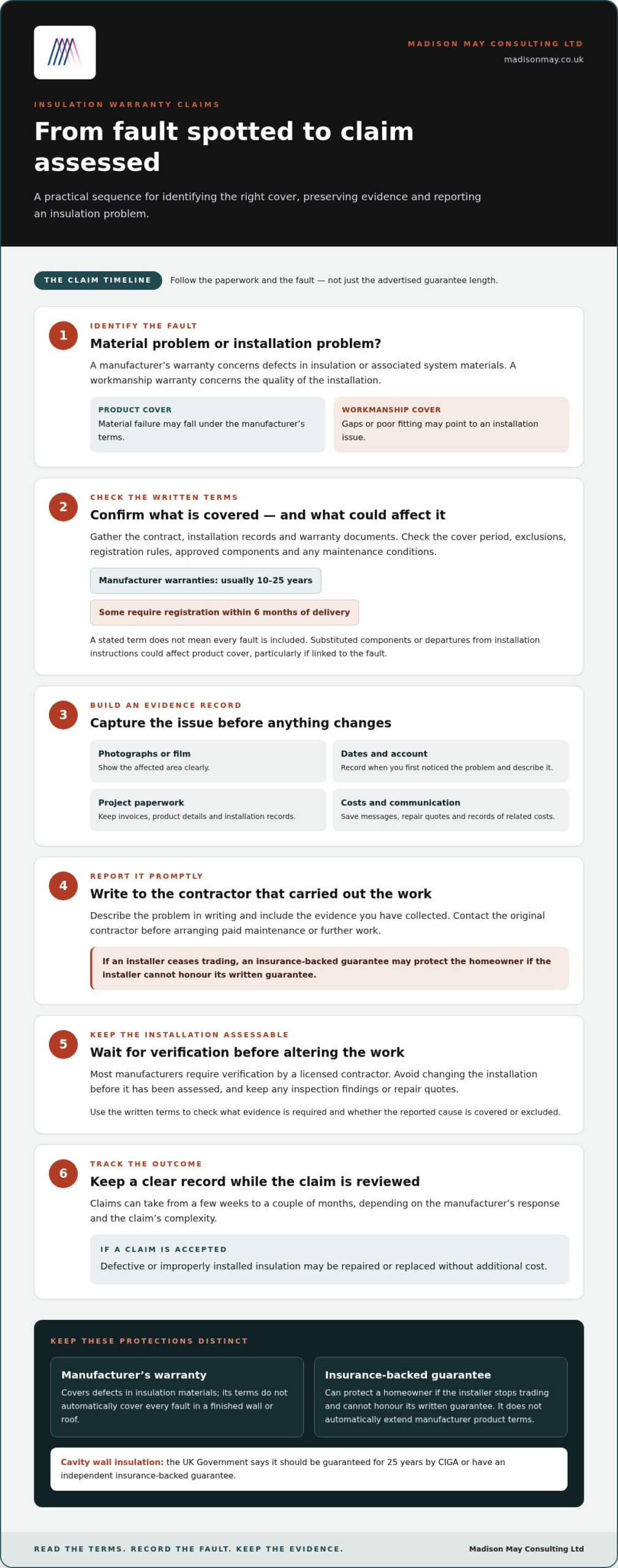
A manufacturer’s warranty covers defects in insulation or associated system materials, while a workmanship warranty concerns the quality of the installation. The distinction matters because the same visible fault can have different causes: damaged material may fall under product cover, while gaps or poor fitting may point to a workmanship issue.
Keep the contract, installation records and warranty documents together. Manufacturer warranties usually last between 10 and 25 years, but the actual term and covered faults depend on the product, system and project. A long stated period does not mean every defect is included.
For a claim, contact the contractor that carried out the work and describe the problem in writing. Photograph or film the affected area, record when you first noticed it, and retain relevant invoices and messages. Most manufacturers require verification by a licensed contractor, so avoid altering the installation before it is assessed.
- Match the fault to the warranty’s material or workmanship wording.
- Keep dated photographs and a clear account of the problem.
- Save repair quotes and records of any work already completed.
Some warranties require registration within 6 months of delivery. Check the paperwork for that condition, since missing a stated registration step may affect a claim.
Manufacturer Responsibilities and Material Cover
A system manufacturer sets the material warranty for its insulation and associated components. The terms depend on the system and project type. This is separate from the installer’s responsibility to fit the system correctly.
Manufacturer cover generally applies to defects directly caused by supplied materials, rather than every fault in a finished wall or roof. For example, material failure may be considered under the product terms, while an incorrectly fitted system may fall outside them. Read the exclusions as well as the cover period.
Approved systems and components matter because insulation products are designed to work together. If a contractor substitutes a component or departs from the manufacturer’s installation instructions, product cover could be affected, particularly if the fault relates to that change. Keep product details and installation records to show which materials were used.
Where a claim is accepted, defective or improperly installed insulation may be repaired or replaced without additional cost. Contact the original contractor before arranging paid maintenance, and keep any repair assessment or quote. Claims can take from a few weeks to a couple of months, depending on the manufacturer’s response and the claim’s complexity.
Insurance Backed Guarantee vs Manufacturer’s Warranty: What’s the Difference?
An insurance-backed guarantee and a manufacturer’s warranty protect different parts of an insulation project. Knowing which documents apply helps you direct a claim and understand what protection remains if the installer stops trading.
Installation Cover and Product Cover
An insurance-backed guarantee can protect a homeowner if the installer ceases trading and cannot honour its written guarantee. By contrast, a manufacturer’s warranty covers defects in insulation materials. The distinction matters: poor fitting is an installation issue, while a defective product concerns material cover.
For cavity wall insulation, it should be guaranteed for 25 years by CIGA or have an independent insurance-backed guarantee, according to the UK Government. Read the guarantee’s conditions to see which faults it covers and what evidence a claim requires. An insurance policy does not automatically extend a manufacturer’s product terms.
Before work starts, establish whether the installer will provide an insurance-backed guarantee and obtain its written terms. Check who underwrites it, what happens if the installer ceases trading, and whether the cover applies to the work at your property. The retrofit coordinator and installer also have roles in managing the project; external wall insulation installed under PAS 2035 and PAS 2030 involves shared maintenance and repair responsibilities.
Requirements and Warranty Exclusions
Installation requirements set out the methods, components and maintenance conditions needed to keep cover in force. They matter because a warranty may exclude incorrectly fitted systems or faults not directly caused by the materials.
For example, a product warranty may exclude water intrusion, while an insurance-backed guarantee may focus on installation faults. Some insulation warranties also require periodic inspections or maintenance. Keep records of completed maintenance and instructions supplied with the system, so you can show that the conditions were followed.
Use the written terms to distinguish an excluded cause from a covered defect. If a problem appears, photograph it and report it to the installer before paying for further work. Keep any repair quote and cost record to support your account of the fault and when it occurred.
Guarantee Costs and Warranty Documents
The price depends on the case and is given after a quote request; the guarantee provider’s assessment can reflect the insulation system, project scope, cover period and risk. There is no single price that applies to every installation, so compare the written protection and exclusions rather than considering cost alone.
Before agreeing to insulation work, obtain the estimate, contract, written guarantee, manufacturer’s warranty and product details. Confirm how to register the cover, whether it transfers to a new owner, and what maintenance conditions apply. Keep the final invoice as proof of purchase and installation.
For a project involving several retrofit measures, a retrofit assessment can help identify the work planned for the property and its relationship to the building as a whole.
The difference between advertised guarantees and warranty terms
An advertised guarantee is only a headline. Its written terms define the cover. Compare the stated duration with the covered faults, exclusions, claim process and conditions for keeping protection valid.
Types of Insulation Guarantees
A guarantee may come from a council or funded scheme, an industry-backed arrangement, or the installer’s workmanship commitment. Identify its source, as each type of cover can have different responsibilities and claim conditions.
Some qualifying council and funded insulation schemes in the United Kingdom may provide guarantees of up to 25 years. Industry-backed external wall insulation guarantees typically last for 25 years or more and can protect customers if the installer goes out of business. Private external wall insulation work does not automatically require an industry-backed guarantee.
An advertised “25-year guarantee” is not enough to establish what is covered. Look for the guarantee provider, the work and materials included, exclusions, transfer rules, and the process for making a claim. Under ECO1, wall insulation measures without an appropriate guarantee are awarded a default lifetime of two years unless alternative assurance is available, according to the UK Government.
Workmanship Cover and Exclusions
An insulation workmanship warranty covers faults caused by the installation, rather than defects in the insulation materials. This matters because a poorly fitted system and a faulty product may be covered by different documents.
For example, gaps caused by incorrect fitting may relate to workmanship, while a material defect may fall under the manufacturer’s warranty. Workmanship cover may exclude damage caused by water intrusion, pests, later alterations or failure to follow maintenance requirements. The written terms determine which faults and remedial work are included.
A basic guarantee is legally required for building work in the UK, but that doesn’t mean every advertised warranty is comprehensive. Read the contract and warranty together. Check the covered work, exclusions, duration, claim steps and any conditions that could limit a remedy.
Installer and Warranty Checks
To check TrustMark or PAS 2030 status, compare the installer’s name and the relevant insulation measure against the registration or certification details provided for the project. The named business, measure and scope should align across the project paperwork and warranty.
Certification and guarantee cover are different things. A TrustMark or PAS 2030 reference does not, by itself, describe the warranty’s duration or exclusions. Ask for the actual guarantee wording and identify who backs it, who handles claims, and whether cover applies if the installer ceases trading.
Before agreeing to work, keep the estimate, contract, installer details, warranty documents and any scheme paperwork together. These records help establish what was promised and which guarantee applies if a fault appears later.
Warranty exclusions and potential causes of voided coverage
An insulation warranty protects only against the faults and circumstances described in its terms. For wall insulation, check whether cover applies to the materials, installation or both before arranging repairs.
Cavity wall or spray foam insulation doesn’t automatically determine a home insurance or mortgage decision. Insurers and lenders assess the property, the installation and their relevant policy or lending criteria. Disclose the insulation when asked and keep the installation records available.
External wall insulation product warranties may exclude incorrectly fitted systems and cover only problems directly caused by the materials. This distinction matters when a fault appears: a defect in a supplied component is different from damage caused by installation, water ingress or later alteration. The warranty wording identifies which causes are covered.
Some external wall insulation guarantees also require silicone sealant to be reapplied periodically. The sealant may not last as long as the system, so missing specified maintenance can affect cover. Keep maintenance instructions and receipts with the installation documents, especially if future repairs involve the rendered surface.
Common reasons for insulation cover to be voided include improper installation, water damage, pest infestation and failure to meet maintenance requirements. A roof leak that damages attic insulation, for example, may be treated differently from a material defect. Report damage promptly, as delays can worsen the problem and may affect eligibility.
- Follow the system manufacturer’s maintenance instructions and keep evidence.
- Use approved fixings for attachments to external wall insulation.
- Record leaks, pest activity or visible damage as soon as noticed.
- Contact the original installer before commissioning additional maintenance.
Take care when attaching items to external wall insulation. Hanging baskets, fencing and satellite dishes can damage the system if fixed inappropriately. Check the system instructions before drilling or adding fixtures, and keep details of any approved fixings used.
Insurance-backed cover may protect against an installer’s failure to honour a written guarantee after ceasing to trade. It doesn’t necessarily cover every insulation system, fault or later alteration. Read the policy schedule for the insured work, exclusions, claim procedure and any conditions related to installation or maintenance.
Keep the estimate, final invoice, product information, warranty and photographs together. If you suspect a fault, document its location and when you noticed it, then notify the installer before paying for repairs. Save repair quotes and cost records to support the claim and help establish what happened.
Warranty transfers to subsequent homeowners
Some insulation warranties transfer to a new homeowner, but transfer depends on the written terms. Establish whether cover follows the property, whether the new owner can claim, and whether any transfer steps are required. The remaining term alone doesn’t prove that a new owner can use the warranty.
Start with the original warranty and identify its named holder. Look for terms covering a sale, change of ownership, notification deadlines, registration and any transfer fee. The document may allow cover to pass automatically, require the seller or buyer to notify the provider, or limit claims to the original customer. Follow the wording and keep evidence of any required notification.
Ask the seller for documents identifying the insulation system and original installation. These may include the contract, final invoice, product details, installer’s written guarantee and manufacturer’s warranty. Check that the property address and work description match across the records. Resolve any discrepancy before relying on the cover.
Transferability and claim eligibility are separate questions. A warranty may pass to a new owner but still exclude faults caused by water damage, later alterations or missed maintenance. For example, a new homeowner might inherit cover for a product defect but not damage caused by an unrepaired roof leak. Read both the transfer clause and the exclusions.
For cavity wall insulation, the stated 25-year guarantee through CIGA or an independent insurance-backed guarantee does not, by itself, establish how a sale affects the individual claim. Check the guarantee documents for the transfer conditions and confirm whether registration or ownership details need updating. Keep written proof of each completed step with the property records.
If a problem appears after you move in, notify the named warranty contact and explain that ownership has changed. Include the property address, installation evidence, photographs and when you first noticed the fault. Keep copies of your correspondence. A clear record helps show that you’re the current owner and lets the provider assess the issue under the relevant terms.
Act before exchange where possible. A seller may lose a non-transferable insulation warranty after owning the house for 7 years, so the purchase date and warranty wording can matter. Ask for the original documents as part of the property handover, rather than relying on a listing that describes the insulation as “guaranteed”.
For homeowners planning further insulation changes, a retrofit assessment can help identify how proposed upgrades relate to the property’s fabric and existing measures.
Madison May Consulting: Energy efficient home improvements
Madison May Consulting Ltd helps homeowners plan insulation upgrades as part of wider energy-efficiency improvements. Its retrofit assessments consider the building fabric, services and ventilation to identify practical measures and how they relate to the home as a whole.
This wider view is useful when insulation concerns sit alongside damp, ventilation issues or planned changes to windows, doors or a conservatory. An assessment can help clarify which improvements suit the property, rather than treating each measure in isolation.
If you’re considering insulation or related home improvements, contact Madison May Consulting Ltd to discuss your property and next steps.
Make your next home improvement decision with confidence
A warranty is one part of a home’s longer story. When planning future changes, keep insulation records alongside information about the building so decisions reflect how its elements work together. This is especially useful when considering a broader programme of energy-efficient improvements rather than treating each upgrade in isolation.
Madison May Consulting Ltd offers energy-efficient home improvements, including windows and doors and conservatory upgrades. If you’re considering how these changes could suit your property, contact the team to discuss the next step in context, with the home’s character and everyday comfort in mind.
For a thoughtful starting point, contact Madison May Consulting Ltd to discuss your plans. With a clear view of the project and its paperwork, you can move forward with greater confidence in the choices you make for your home and its warranties for insulation work.
Frequently Asked Questions
Can I file a claim if I wasn’t the original homeowner?
Yes, if the warranty terms allow it to transfer to a new owner. Check whether the document requires the seller or buyer to notify the provider, update ownership details or complete registration. For example, if the property address is covered but the original owner is still named, ask the provider to record the change of ownership before making a claim. Keep the transfer confirmation with the home’s documents.
Do I need a professional inspection for a warranty claim?
Often, yes. Manufacturers may require a contractor to verify an insulation warranty claim, so photographs alone may not establish the cause of the fault. If insulation is damaged, take clear images, note when you noticed the problem and contact the original installer or warranty contact. Avoid removing or altering the affected material before assessment, as this could make the fault harder to diagnose.
So, what does a “25-year guarantee” actually guarantee?
A guarantee covers only the faults, work and materials described in its written terms for the stated period. The word alone doesn’t tell you whether cover applies to installation quality, product defects, building damage or all three. Check the named provider, exclusions, maintenance conditions and claim process. For instance, a guarantee may cover a system defect but exclude damage caused by water ingress or unauthorised changes.
What types of warranties are available for insulation work in the UK?
Homeowners may encounter a contractor’s workmanship guarantee, an insulation manufacturer’s product warranty, an insurance-backed guarantee or cover attached to a funded scheme. Each applies in different circumstances. Workmanship cover concerns installation, while manufacturer cover concerns material defects. An insurance-backed guarantee can protect you if the installer stops trading and cannot honour its written guarantee, subject to the policy terms.
How long do insulation installation warranties typically last in the UK?
There isn’t one term for every insulation type or cover document. Manufacturer warranties usually last between 10 and 25 years, whilst professionally installed external wall insulation should come with a warranty of at least 10 years. Cavity wall insulation should be guaranteed for 25 years by CIGA or have an independent insurance-backed guarantee, according to the UK Government. Check the specific documents for the installation.
Do insulation materials have separate manufacturer warranties in the UK?
Yes, insulation materials can have a separate manufacturer’s warranty, distinct from the contractor’s workmanship cover. For example, a product warranty may address a defect in the insulation material, while a workmanship guarantee concerns how it was installed. Keep the product details and installer’s paperwork together. If a fault appears, the material, system and cause help establish which terms apply.
What is an insurance-backed guarantee for insulation work and how does it work?
An insurance-backed guarantee can protect a homeowner if the installer ceases trading and cannot honour its written guarantee. It doesn’t replace the manufacturer’s warranty, which covers material defects. The guarantee terms define the faults and work included. Keep the certificate and policy wording; if the installer has stopped trading, contact the guarantee provider using the claim process in those documents.
What should I do if insulation work is defective or the installer stops trading?
Record the fault and report it promptly to the installer or, if they’ve ceased trading, the insurance-backed guarantee provider. Take dated photographs, describe when the problem appeared, and keep the original contract, invoice and warranty documents. Don’t arrange paid repairs before reporting the issue, as the work may be covered. Keep any repair quote and correspondence as evidence if the claim is disputed.