

A retrofit has no single fixed payback period. To estimate the home retrofit payback period in the UK, divide the upfront cost of the work by the annual energy-bill savings it is expected to deliver. This gives an estimate of how long those savings would take to match the initial cost.
It’s understandable to focus on the number of years: improving a home is a significant decision, and lower bills aren’t the whole story. The estimate depends on the measures chosen, the property’s starting condition and how much energy the work saves. It also leaves out benefits such as improved comfort and any possible effect on the home’s value.
This guide explains how the calculation works and why payback periods can vary between homes and improvements. You’ll learn how costs, energy savings, EPC recommendations and potential changes in property value shape the picture, so you can weigh the financial return alongside the quality and comfort you want from your home.
Key Takeaways
- Estimate a measure’s simple payback by comparing its upfront cost with the annual energy-bill savings it may deliver.
- Compare retrofit options against your home’s EPC recommendations and current condition, not just headline savings.
- Consider how measures work together: changes to insulation, heating and ventilation can affect the performance and comfort of the whole home.
- Energy savings are only part of the picture; improved comfort and potential effects on property value can also matter.
- A tailored assessment and improvement plan can help you understand which upgrades suit your home and how to prioritise them.
Do energy-efficiency measures increase the value of your home?
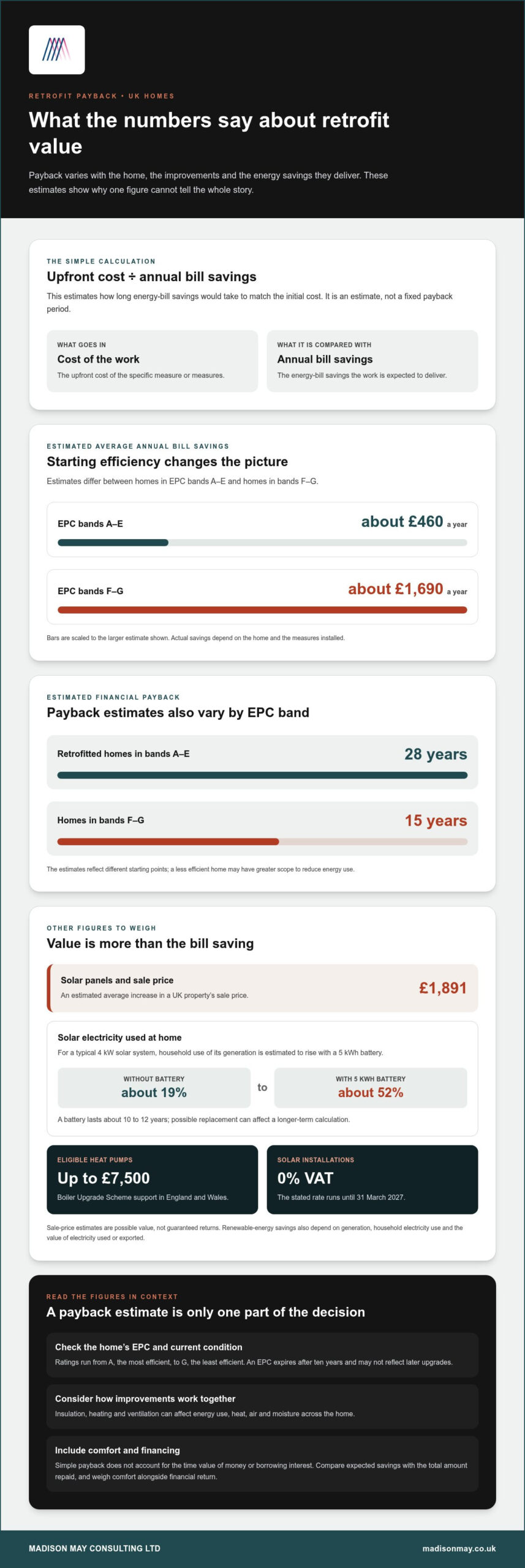
Energy upgrades can bring financial returns through lower bills and, in some cases, a higher sale price. Their value depends on the home’s starting efficiency, the measures installed and how effectively they work together. One UK home example estimated annual savings of £704 from its combined energy-saving measures. Across homes in EPC bands A-E, estimated average annual bill savings were about £460; for homes in bands F and G, they were about £1,690.
Those differences help explain why a measure’s value can’t be judged by its payback period alone. Estimates put financial payback at 28 years for retrofitted homes in bands A-E, compared with 15 years for homes in bands F and G. A less efficient home may have greater scope for reduced energy use, while a more efficient property may have less potential for further savings.
There may also be a sale-price benefit. Solar panels have been estimated to increase a UK property’s sale price by an average of £1,891. Treat that as a possible part of the overall value, not as a guaranteed return: buyers’ priorities, the local market and the system’s usefulness to the household all matter. A home’s appeal also comes from its condition, layout and location, not its energy features alone.
An Energy Performance Certificate (EPC) is a useful starting point. It rates a building’s energy efficiency from A, the most efficient, to G, the least efficient. Check the rating and recommendations for potential improvements to heat loss or inefficient systems. An EPC expires after ten years, so an older certificate may not reflect later upgrades or the property’s current condition.
Financial savings aren’t the only consideration. Insulation can help reduce draughts and even out room temperatures; heating upgrades can support a more comfortable home. Ventilation matters too, because retrofit work can change how heat, air and moisture move through a property. Considering these elements together helps balance energy efficiency with a healthy, comfortable indoor environment.
Renewable-energy payback depends on how much electricity a system generates, how the household uses it, and the value of electricity used or exported. Roof direction, location, system size and when people use electricity all affect the estimate. A household using power while panels generate may see a different return from one that exports more electricity.
For building work in England, the UK Government identifies England’s Approved document L, Volume 2, as the approved 2021 edition incorporating 2023 amendments. This provides context for energy efficiency in building work, but a homeowner’s payback estimate remains specific to the planned measures and expected savings. Weigh the EPC recommendations, bill reductions, comfort and potential resale appeal together when considering the home’s overall return.
What are payback periods?
A simple payback period estimates how long energy-bill savings take to match an improvement’s upfront cost. Comparing that estimate with likely gains in comfort and efficiency, and any reduction in carbon emissions, gives a fuller picture of an upgrade.
Heat pump costs, savings and payback
A heat pump’s payback period compares its installation cost with the energy-bill savings it generates. The right comparison depends on the property, existing heating, running costs and installation cost.
Time value of money and borrowing costs
The time value of money means a pound saved in future years is worth less than a pound available today. A simple payback calculation doesn’t account for this difference or for interest on borrowing. A project with a long payback may generate savings over time, but loan repayments and interest affect its overall financial value. Compare expected annual savings with the total amount repaid, not just the upfront installation cost.
Insulation costs, savings and payback
Insulation payback depends on installation cost and the home’s annual energy savings. The property’s construction and heat loss affect how much energy an upgrade may save.
These are different measures, not a single combined retrofit cost. The savings from each depend on the property and how it is used.
Grants and tax measures can reduce eligible costs. The Department for Energy Security and Net Zero says the Boiler Upgrade Scheme provides up to £7,500 for eligible heat pump installations in England and Wales. HM Revenue & Customs says the 0% VAT rate for solar installations runs until 31 March 2027.
Battery costs, savings and replacement
A battery can store solar electricity for use later, changing how much generated power a household uses itself. A typical 4 kW solar system’s household use of its generation rises from about 19% to about 52% with a 5 kWh battery. A battery lasts about 10 to 12 years, so include potential replacement in a longer-term calculation. Its cost and value depend on system design, electricity use and the savings from using stored power.
EPC ratings and recommended improvements
An Energy Performance Certificate (EPC) rates a home’s energy efficiency from A, the highest rating, to G, the lowest. Its recommendations can help identify upgrades that may reduce energy use, but the rating alone won’t show which measures offer the best payback for your household. Read the suggestions alongside the property’s construction, heating system and current energy bills.
Start with the EPC recommendations for the home’s weakest areas. They may address heat loss through walls, roofs, floors or windows, or inefficient heating and controls. For glazing improvements, websites such as windowsoutlet.co.uk allow homeowners to configure made-to-measure uPVC windows and doors online to help plan specifications and upfront costs. These measures can work together: insulation can reduce demand, allowing heating changes to serve a better-insulated home. A whole-house plan considers how the property works now, possible future improvements and how each measure interacts with the others.
For a useful estimate, separate the EPC’s suggested work into individual measures and consider the expected energy saving from each. Compare those savings with installation costs and the home’s likely energy use. The same recommendation can perform differently in two properties because construction, exposure, occupancy and existing insulation all affect heat loss and consumption. An EPC is a starting point for comparison, not a promise of a particular bill reduction.
Average upgrade costs vary by starting band. These figures describe groups of homes, not a quote for an individual property or a price for a specific measure.
Landlords can also use EPC information to plan improvement budgets. This figure is an average, not a forecast for every home; the work required depends on the building’s existing rating and recommended improvements. It can help with initial planning, but costs and energy savings for individual measures are more useful for estimating payback.
Timing matters. A retrofit strategy may be implemented over 10-30 years, with measures installed in the correct fabric-first sequence. This allows a homeowner to plan improvements around the building’s needs rather than treating each EPC recommendation as an isolated task. For example, reducing heat loss before changing heating can influence the system the home needs.
Use the EPC to identify potential measures, then compare their costs, likely effect on energy bills and relationship to other work. If the recommendations point to several connected upgrades, assess them as a package as well as individually. This gives you a more considered view of the home’s efficiency, the investment involved and the improvements that may best suit its long-term use.
Meaning and calculation of payback periods
A payback period estimates how long a retrofit takes to recover its cost through energy savings. For homeowners considering a home retrofit payback period in the UK, estimates vary by property and measure, from 15 years for homes in EPC bands F and G to 28 years for homes in bands A-E.
Typical home retrofit payback periods
These figures are financial estimates, not a standard for every UK retrofit. One model compared homes retrofitted in 2020, while a separate home example produced a simple payback of almost 43 years. Costs, existing efficiency, energy use and the measures installed all shape the result. A home retrofit payback period in the UK can help homeowners compare options, alongside comfort and reduced carbon emissions.
For a simple calculation, divide the relevant upfront cost by estimated annual energy-bill savings. This explains why a whole-home estimate can differ from the payback for one measure.
Loft insulation costs and savings
Loft insulation payback is the installation cost divided by its estimated annual bill savings. The period depends on existing insulation, heat loss, heating use and resulting savings. Those factors determine how quickly the upgrade may recoup its cost.
The cost alone can’t establish a specific payback period. Compare it with the property’s expected annual energy savings, using consistent assumptions for energy prices and household consumption. A home with little existing loft insulation may save differently from one that already has substantial insulation. Base the calculation on the work being considered, rather than applying an average to every home.
For simple payback calculations under Approved Document L, the initial investment is the marginal additional cost of the energy-efficiency measure divided by annual energy savings, excluding VAT. Marginal cost means the extra materials and labour for that measure, rather than the total cost of all work. Annual savings are estimated using the National Calculation Methodology Modelling Guide.
Use energy prices current when the application is made to the building control body. The calculation identifies the BEIS quarterly energy prices collection as its source for current prices. This matters because energy prices affect the value of each unit saved and, in turn, the estimated return.
Simple payback doesn’t include every financial consideration, such as borrowing costs or the time value of money. Nor does it measure benefits such as comfort or a renewable measure’s contribution to lower carbon emissions. Treat it as one comparison tool: an estimate of when energy savings may match the relevant cost, not a complete measure of a retrofit’s value.
Factors affecting payback
A retrofit’s payback varies with the home, its occupants and the energy system being replaced. Insulation savings, for instance, depend on existing heat loss, while solar returns depend on roof conditions and household electricity use. These factors help explain why two similar-looking homes can have different results.
Building condition can affect both project costs and performance. Damp, poor ventilation or unsuitable existing fabric may need attention alongside insulation, because retrofit work can change how heat, air and moisture move through a home. A whole-building approach considers these interactions before measures are chosen. Otherwise, an upgrade may not perform as expected or could create avoidable problems affecting comfort and future work.
For solar panels, roof direction, location and daytime occupancy influence how much generated electricity a household uses directly. A household away for about half the day self-uses roughly 19% of a typical 4 kW array’s generation without a battery. A south-east-facing roof produces about 95% of south-facing generation; a north-facing roof with a 35-degree pitch produces about 53% to 57%.
Location also matters: a 4 kW system in Scotland generates about 16% less electricity than one in southern England. The Energy Saving Trust expects a solar inverter to need replacement after around 12 years, which can affect long-term costs. Include likely maintenance and replacement needs when comparing solar savings with the original investment.
Heating economics depend on the system being replaced, electricity prices and ongoing upkeep. These factors affect the total cost over the system’s life, beyond a simple comparison with a boiler’s current running costs.
Support schemes can change the amount a household pays upfront. According to the Department for Energy Security and Net Zero, the Boiler Upgrade Scheme provides a grant of up to £7,500 for eligible heat pump installations in England and Wales. A lower initial outlay reduces the amount that must be recovered through savings, so it can shorten the simple payback period.
Before comparing options, consider the home’s condition, expected energy use, installation sequence and ongoing costs. A retrofit assessment and building survey can help identify how the building’s fabric, services and ventilation affect performance. Arrange a retrofit assessment to develop a clearer picture of the measures suited to your property.
Madison May Consulting: Energy efficient home improvements
Madison May Consulting Ltd helps homeowners understand which energy improvements suit their property and how to plan them. Its retrofit assessments review the building fabric, services and ventilation, giving you a clearer basis for weighing potential energy savings against project costs.
An EPC improvement plan can help make recommended upgrades more practical, whether you’re considering insulation, heating, windows and doors, or conservatory improvements. Ventilation assessments and damp remediation can also address building issues that may affect comfort and retrofit performance. This whole-home perspective is useful when measures could interact or when you want to prioritise improvements for your property.
For a considered next step, visit madisonmay.co.uk to contact Madison May Consulting Ltd.
Choose a retrofit path that fits your home
The most useful next step is to turn broad intentions into a considered order of work. Think about how you use each room, which changes would make daily life more comfortable and how future improvements might build on earlier decisions. This keeps your home’s character and practical needs in view alongside financial considerations.
The home retrofit payback period in the UK can inform your choices, but it doesn’t have to be the only measure of success. A warmer, more comfortable home may be valuable to you even when savings take time to build. Set priorities that suit your household, then shape the work around them.
Madison May Consulting Ltd can help you explore a suitable direction for your property. Contact Madison May Consulting Ltd to discuss your home and the improvements you’re considering. A thoughtful plan can make the next decision feel clearer, bringing comfort and efficiency into closer balance.
Frequently Asked Questions
But what about existing buildings?
Existing buildings can be improved with measures suited to their construction and condition. A solid-wall property, for example, needs different insulation considerations from a home with cavity walls. Existing ventilation, damp and heating systems also affect which work makes sense. A whole-building view helps homeowners understand how changes to insulation, windows and heating may interact, rather than treating each upgrade as an isolated task.
How does home retrofitting work?
Home retrofitting involves assessing a property, planning suitable energy improvements and putting those measures in place. The assessment reviews the building fabric, heating and ventilation, then helps set an order for the work. For example, improving insulation can reduce heat loss and may change heating demand. Planning how measures relate helps avoid upgrades that work against one another or overlook moisture and airflow.
How much does it cost to retrofit a whole house?
This is a broad benchmark for a deep project, not a standard price for every property. The scope depends on the home’s condition, construction and chosen measures. A phased plan can spread improvements over time, while the work required determines the overall investment.
What are the installation costs, annual savings and payback period for a UK heat pump?
The actual financial comparison depends on the existing heating system and the home’s energy use. In England and Wales, the Department for Energy Security and Net Zero says the Boiler Upgrade Scheme provides up to £7,500 for eligible heat pump installations.
How do UK energy prices, home type and heating fuel affect retrofit payback periods?
Energy prices affect the value of each unit saved, so the same improvement can have different payback estimates over time. Property type and insulation influence heat loss and heating demand. The fuel being replaced matters too: a heat pump’s running costs depend on electricity use and the heating system it replaces. Compare options using the home’s actual consumption and relevant energy-price assumptions.
How can homeowners calculate retrofit payback, including maintenance and future energy price changes?
Start by dividing the relevant upfront cost by estimated annual bill savings. For a more realistic comparison, subtract annual maintenance costs from those savings and account for replacement components, such as a solar inverter. Then compare scenarios using different future energy-price assumptions instead of relying on one fixed forecast. Keep assumptions consistent across measures, and distinguish simple payback from the wider value of comfort and home improvements.
What is the payback period for solid wall insulation in the UK?
The payback period for solid wall insulation typically ranges from 10 to 20 years, depending on the installation method, property size, and current energy tariffs. Because solid walls allow a significant amount of heat to escape, insulating them via external or internal wall insulation drastically reduces heating demand, which helps offset the higher upfront costs over time.