
Being eligible on paper no longer means a property can receive insulation through the Great British Insulation Scheme: it ended on 31 March 2026 and is closed to new installations. Whilst it was open, the scheme had two eligibility groups, and households could be asked to contribute towards installation costs, which varied by measure and other factors.
It’s understandable to want a clear answer before planning work, especially when costs and property suitability matter as much as household eligibility. This guide from Madison May Consulting Ltd explains what Great British Insulation Scheme eligibility generally involved—such as for a typical area like Leeds—which insulation measures the scheme could support, and why homeowners might still have had to contribute towards installation.
You’ll also learn how the former scheme criteria related to a home’s EPC rating, Council Tax band and household circumstances, and what to consider now that new installations are closed. This helps distinguish past eligibility from practical options for improving your property today.
Key Takeaways
- The scheme focused on one insulation measure per home; identify whether loft, cavity wall or solid wall insulation best fits your property.
- A property assessment considered whether the building was suitable for the proposed work, not just whether the household met eligibility criteria.
- In England, the general group’s criteria included an EPC rating from D to G and Council Tax bands A to D.
- Leeds eligibility routes also considered household circumstances, including income, qualifying benefits and health concerns linked to a cold home.
Insulation measures available
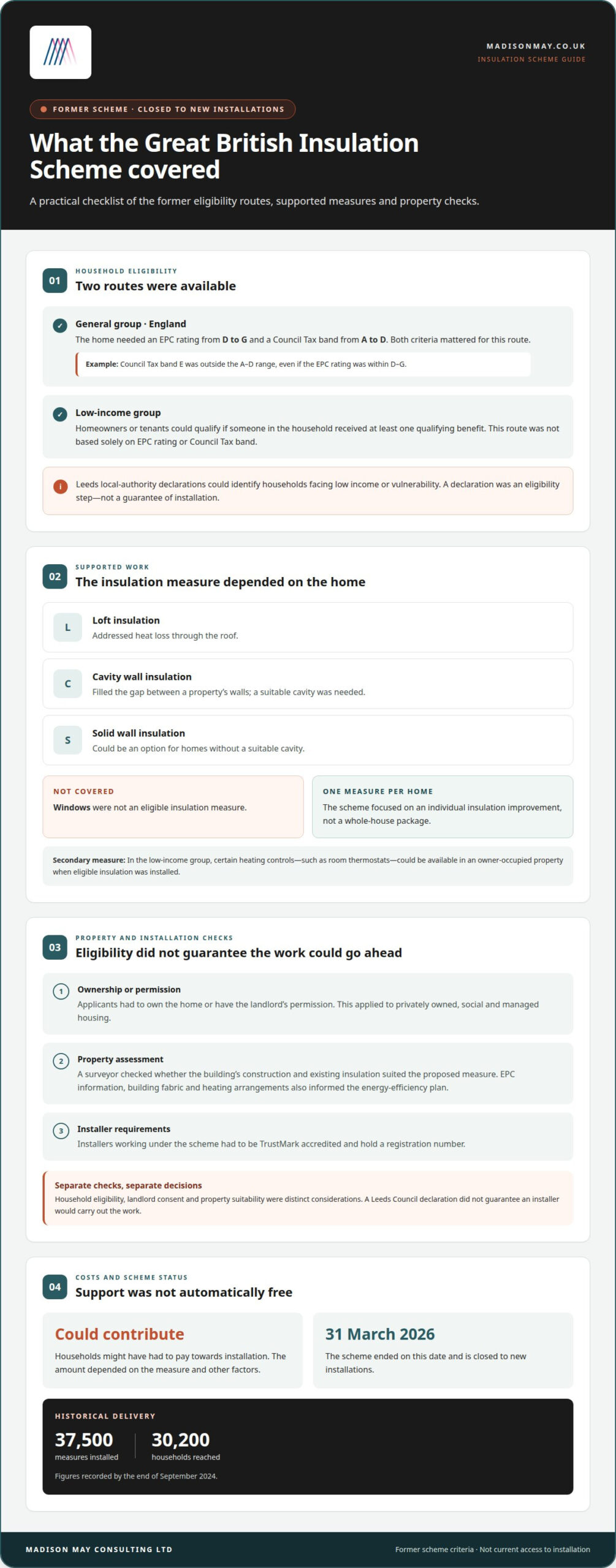
The scheme supported eligible insulation work, not every energy-efficiency upgrade. Eligible homes could receive loft, cavity wall or solid wall insulation, with the suitable measure depending on the property.
Eligible insulation measures
Loft insulation addressed heat loss through the roof, while cavity wall insulation filled the gap between a property’s walls. Solid wall insulation was an option for homes without a suitable cavity. The property’s construction and existing insulation helped determine which measure could be installed.
Windows were not covered by the Great British Insulation Scheme, so window replacement was not an eligible insulation measure. The scheme focused on individual insulation improvements rather than a whole-house package like the approach associated with ECO4. In the low-income group, certain heating controls, such as room thermostats, could be available as a secondary measure in an owner-occupied property when eligible insulation was installed.
Although people often refer to insulation grants, the scheme was not a grant scheme. Support could vary, and households might have had to contribute towards installation costs. The amount depended on the measure and other factors, so eligibility did not automatically mean installation was free.
Measures per home and installation timing
The Great British Insulation Scheme provided one insulation measure per home. A home receiving loft insulation, for example, would not also receive cavity wall insulation as a second scheme measure. This single-measure design differed from a whole-house approach, which can consider several upgrades together.
By the end of September 2024, 37,500 measures had been installed in 30,200 households through the scheme. Measures funded outside the scheme at the same property had to be installed either before or after all scheme measures were completed. The scheme ended on 31 March 2026 and is now closed to new installations, so these measures describe its former offer rather than current access to it.
Property suitability and installation assessment
Household criteria alone didn’t determine whether a Leeds property could receive insulation. The building’s construction and a surveyor’s assessment also shaped the proposed work.
The Great British Insulation Scheme is closed to new installations, so Leeds residents can no longer apply for work through it. While it operated, eligibility checks covered both household and property criteria, followed by an assessment of whether the home could accommodate the measure.
Ownership and landlord permission
Applicants had to own their home or have the landlord’s permission for the work. This applied to homes owned by private landlords, social housing providers and management companies. For privately rented homes in Leeds, landlord consent was typically needed before insulation could proceed.
For a rented property, permission mattered because installation alters the building. A landlord’s agreement did not establish household eligibility or property suitability; these were separate considerations. The home still had to meet the relevant scheme criteria, and the proposed work had to suit its structure.
Eligibility checks and property surveys
While the scheme was open, a property assessment followed the initial eligibility checks. A surveyor considered whether the work could be carried out, including whether the home’s structure suited the insulation measure. For example, cavity wall insulation requires a suitable cavity, rather than solid walls.
The scheme’s property assessment also considered the home’s energy performance and heating context. An energy performance certificate provided information about the property’s rating, while the building fabric and heating arrangements helped shape an energy-efficiency plan. These details could help identify heat loss and appropriate improvements, but did not replace the surveyor’s check that installation was feasible.
Leeds residents asking how to check eligibility and apply should note the distinction: the former process involved household criteria and a property assessment, but the scheme no longer accepts applications for new installations. A Leeds Council eligibility declaration did not guarantee that an installer would carry out work, and a survey still assessed the property’s suitability.
Am I Eligible For The Scheme?
The Great British Insulation Scheme had two eligibility groups: a general group and a low-income group. For Leeds households, the route depended on the home’s rating and tax band, or qualifying household circumstances.
For the general group in England, the UK Government says homes could qualify with an Energy Performance Certificate rating from D to G and a Council Tax band from A to D. Both property criteria mattered for this route. For example, a home in band E fell outside the general group’s A-to-D Council Tax range, even if its EPC rating was within D to G.
The low-income group used a different household test. Homeowners or tenants could qualify if someone in the household received at least one qualifying benefit. This route was not based solely on Council Tax band or EPC rating, although the property and proposed measure still had to meet scheme requirements. Income, benefits and property details therefore played different roles across the two groups.
Leeds also had local-authority routes for identifying households facing low income or vulnerability. A council declaration recorded that a household met the relevant route, but did not guarantee an installer would carry out the work. A declaration was an eligibility step; property suitability and installation were separate decisions.
Installers working under the scheme had to be TrustMark accredited and hold a registration number. This requirement applied to installers carrying out scheme measures; it did not make every energy-efficiency company an approved scheme installer. Leeds Council officers checked and verified evidence before issuing declarations. A third party acting for the authority could not take over that responsibility.
These criteria describe the scheme while it was operating, rather than a route to new funding now. The Great British Insulation Scheme closed to new installations on 31 March 2026, so its former eligibility rules cannot be used to apply for a new installation today.
Great British Insulation Scheme eligibility in Leeds
Leeds households could qualify through local flexibility routes as well as the scheme’s general and low-income groups. These routes considered income, living circumstances and health, alongside the property’s rating and suitability.
Under Route 1, owner-occupied and privately rented households could qualify if gross annual household income was less than £31,000. Route 2 required a combination of two eligible proxies, rather than one condition alone. One possible proxy involved living in an eligible Lower-layer Super Output Area ranked 1-3 for deprivation in England.
Other Leeds criteria recognised vulnerability to cold. Route 3 covered households where an occupant’s health could be adversely affected by a cold home, including cardiovascular or respiratory conditions, immunosuppression or limited mobility. Warm Well Homes criteria also treated households with children up to age 5 as eligible for ECO4 or GBIS Flex.
Proxy combinations had specific limits: Route 2 Proxy 1 and Proxy 3 could not be used together, while Proxy 7 could not be combined with Proxy 5 or Proxy 6. These restrictions meant that meeting one local criterion did not necessarily satisfy the full route. A Leeds local-authority officer was responsible for checking evidence and issuing declarations.
There were important exclusions and risks. GBIS funding could not be combined with funding from other government schemes or grants for the same measure, and a declaration did not guarantee installation. Most importantly, the scheme ended on 31 March 2026, so these Leeds criteria describe former eligibility, not a current application route.
For households assessing insulation options now, a property-specific review can help clarify which improvements suit its construction and condition. Plan suitable insulation upgrades as a considered next step for your home.
Madison May Consulting: Insulation upgrades
Madison May Consulting Ltd helps homeowners and landlords plan insulation upgrades suited to their property, rather than relying on the Great British Insulation Scheme, which has closed to new installations. Its retrofit assessments gather information about the building fabric, services and ventilation, then produce a PAS 2035-compliant report and an EPC improvement plan.
A retrofit assessment is a useful next step if you want to understand where your home loses heat and which energy-efficient improvements may be appropriate. It can put insulation in context with other possible upgrades, including windows and doors or conservatory improvements, so decisions reflect the home as a whole.
For a considered plan tailored to your property, contact Madison May Consulting Ltd.
Shape the next step around your home
Understanding Great British Insulation Scheme eligibility in Leeds can help frame your decision, but a comfortable, efficient home depends on how its different elements work together. Consider your property as it stands today: where warmth escapes, how each room is used, and which improvements would best support everyday living.
Madison May Consulting Ltd offers energy-efficient home improvements, including windows and doors and conservatory upgrades. Considering these elements together can help you understand how the home’s fabric and layout contribute to comfort, rather than treating each change in isolation. The right plan should respond to the building and how you want to live in it.
For a thoughtful conversation about your home and possible improvements, contact Madison May Consulting Ltd. A clearer sense of what matters most can make your next decision feel more assured.
Frequently Asked Questions
Did homeowners have to pay to have an energy-efficiency measure installed?
Yes, some households could be asked to contribute towards installation, so scheme support did not always mean a fully funded measure. The contribution depended on the insulation work and other factors. Before the scheme closed, homeowners needed to understand the proposed contribution and measure, rather than assume eligibility meant there would be no cost.
Does loft insulation work and with GBIS help make energy savings?
Loft insulation helps slow heat escaping through the roof, which can make rooms easier to keep warm and reduce the energy needed for heating. The amount saved depends on the home, its existing insulation and energy use. GBIS is closed to new installations, so it can no longer fund new loft insulation work through the scheme.
How are government grants benefiting homeowners in Leeds?
Government-backed support can help households improve energy efficiency by contributing towards eligible home upgrades. The Great British Insulation Scheme has closed, and Leeds City Council’s Warm Homes: Local Grant is not accepting new applications because demand has exceeded available capacity. Homeowners planning work can still consider which improvements suit their property and how insulation fits into wider energy-efficiency needs.
How does cavity wall insulation work, and what are the cost savings with GBIS?
Cavity wall insulation fills the gap between a home’s inner and outer walls, helping reduce heat transfer through the wall. A semi-detached house could save around £240 a year on energy bills, but this is an estimate, not a guaranteed result. GBIS is closed to new installations, so that figure does not represent a current scheme offer.
Who is eligible for the Great British Insulation Scheme in Leeds?
While the scheme operated, Leeds households could qualify through its general group, low-income group or local flexibility routes. Criteria included the property’s EPC rating and Council Tax band, qualifying benefits, household income, or circumstances such as health affected by a cold home. Eligibility also depended on the property being suitable for the proposed work. New installations are no longer available through GBIS.
What are the income and benefits criteria for the scheme?
In Leeds, Route 1 allowed owner-occupied and privately rented households to qualify with gross annual income below £31,000. Route 2 required a combination of two eligible proxies. Separately, the scheme’s low-income group included homeowners or tenants receiving at least one qualifying benefit. These were distinct eligibility routes, and GBIS is now closed to new installations.