

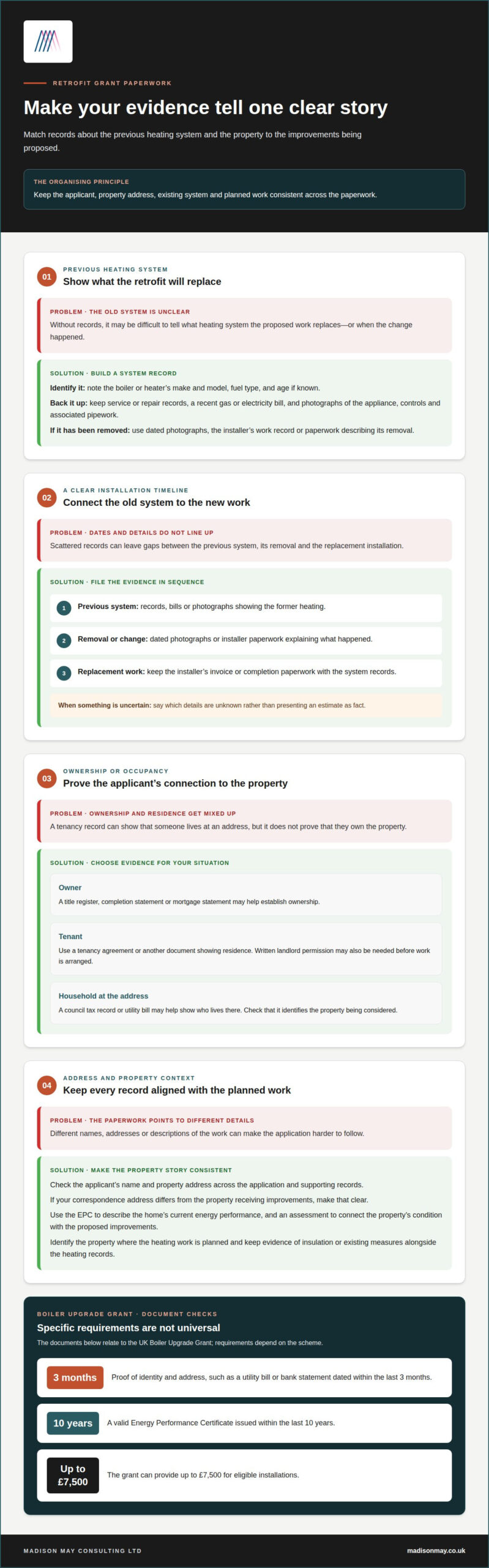
There is no single paperwork bundle for every retrofit grant. Which documents you need for a retrofit grant depends on the scheme, but for the UK Boiler Upgrade Grant, prepare proof of identity and address, such as a utility bill or bank statement dated within the last 3 months, and a valid Energy Performance Certificate issued within the last 10 years. The grant can provide up to £7,500 for eligible installations.
Before you apply for a retrofit grant, gather records that identify your household, property and proposed improvements. The exact documents depend on the grant and measure, but income or benefit evidence, property details, an energy performance certificate (EPC) and information about the existing heating system are useful starting points. This guide explains how to organise the paperwork and where a retrofit assessment can help.
Key Takeaways
- Match the support to the property and household: the Warm Homes: Local Grant lists combined annual household income of £36,000 or less as one eligibility route, according to the Department for Energy Security and Net Zero.
- Gather records that show what heating system the property has had, as this evidence can help clarify whether a proposed upgrade fits the scheme.
- Prepare documents that establish ownership or occupancy, and keep property details consistent across the application.
- For the Boiler Upgrade Grant, use a certified installer to qualify, according to Ofgem; the installer’s quotation and certification are important evidence to understand.
1. Independent homeowner advice and practical retrofit support
If you’re asking “what documents do I need for a retrofit grant?”, start by identifying the scheme, since each route has its own criteria. For the Warm Homes: Local Grant, the Department for Energy Security and Net Zero lists combined annual household income of £36,000 or less as one eligibility route. This is not a universal income limit for UK retrofit grants.
For the Great British Insulation Scheme or ECO4, prepare documents that identify the household, property and proposed insulation work. Depending on the application route, useful evidence may include household income or benefit records, property details and an energy performance certificate. The question “what documents do I need for a retrofit grant?” is best answered by the scheme’s own guidance, which sets out what to submit.
For income or benefit evidence, use records that show your household’s financial circumstances or qualifying benefit status, such as income documents or benefit award letters. Eligibility rules differ between programmes. For example, the Warm Homes: Local Grant income route considers combined household income. An assessment and EPC can help describe the property and explain why particular improvements are proposed.
Your application should link the property’s condition to the planned improvements. In England and Wales, a building may need an EPC rating that meets the scheme’s minimum standards. Eligibility depends on the programme and proposed work, so there is no single income limit that applies to every grant. If you are asking, “What documents do I need for a retrofit grant?”, start by gathering evidence about the household and property.
Business retrofit funding follows separate rules. Scotland has a similar scheme, the Scottish Industrial Energy Transformation Fund. Applications may require project details, energy-use evidence and funding information, organised in line with the relevant scheme guidance.
First identify the relevant programme and read its guidance. Then gather household and property records and submit the application with the supporting evidence it requests. Keep documents for other funding with the project records, and make clear which measures each funding stream relates to. Requirements vary across UK nations and programmes, so follow the correct application route.
2. Evidence of the previous heating system
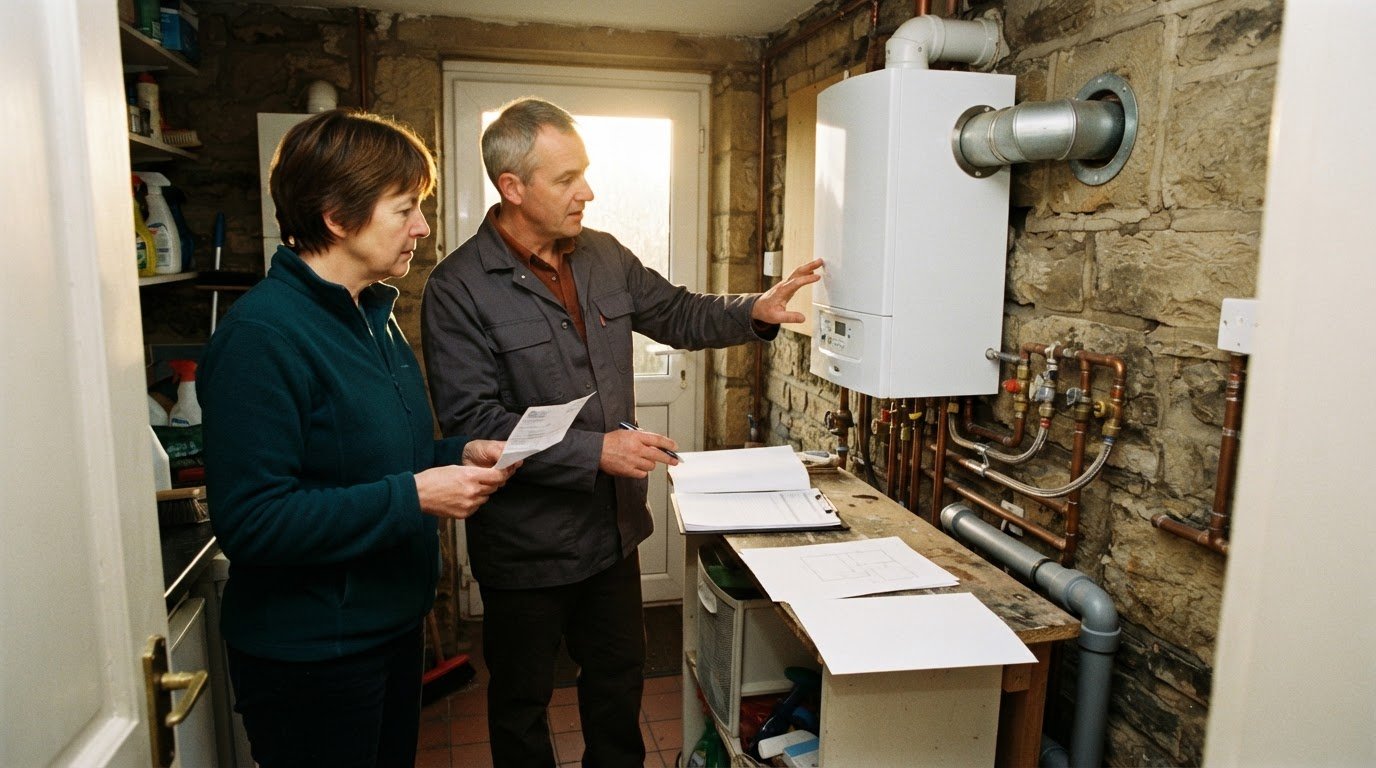
Records of the existing heating system help show what the proposed retrofit will replace. Gather the boiler or heater’s make and model, fuel type, age if known, and any service or repair records. A recent gas or electricity bill can help identify the fuel used, while photographs can show the appliance, controls and associated pipework. Together, these details give an assessment a clearer picture of the home’s heating.
Keep evidence even if the old appliance has already been removed. Dated photographs, an installer’s work record or paperwork describing its removal can explain the change from the previous system to the new installation. If records are incomplete, note which details are uncertain instead of presenting an estimate as fact. Keep the timeline clear: the previous system, its removal and the replacement installation should fit together.
The Boiler Upgrade Scheme focuses on an eligible new heating system, and the installation date is relevant: the scheme requires the new system to have been installed on or after 1 April 2022. Evidence of the former system can help distinguish a replacement from other home improvements, but the scheme’s criteria determine eligibility. Keep the installer’s invoice or completion paperwork with the system records, so the proposed or completed work is identifiable.
Fuel type provides useful context. Records showing an oil boiler, gas boiler or biomass system describe the starting point without assuming that every grant treats each system in the same way. Pair them with evidence of insulation, such as an assessment or details of existing measures. Insulation can be an important consideration when assessing whether a home qualifies for a grant.
For a practical review of the heating changes alongside insulation needs, heating upgrades can be considered as part of a home improvement plan. Keep the evidence in one dated file, with a short note linking each record to the old system or proposed installation.
3. Property ownership or occupancy evidence
A grant application needs to connect the applicant to the property receiving energy efficiency improvements. For an owner, a title register, completion statement or mortgage statement may help establish that connection. A council or scheme may specify which documents it accepts, so keep the property address and applicant’s name consistent across the application and supporting records.
Landlords and tenants generally need different evidence. Landlords can prepare ownership records, while tenants can use a tenancy agreement or another document showing that they live at the property. A tenant applying for funding may also need written permission from the landlord before work is arranged. Follow the scheme’s requirements, as a tenancy agreement alone does not prove ownership.
Occupancy evidence can help show who lives at the address. A council application, for example, may request a recent household document such as a council tax record or utility bill. Keep a copy with the application and check that it shows the property being considered. If your correspondence address differs from the property receiving the improvements, make that clear.
Property evidence can support other eligibility details. An EPC describes the home’s current energy performance, while an assessment can connect its condition to the proposed improvements. For example, a boiler replacement application should identify the property where the heating work is planned. The documents should present a consistent account of the address, applicant and proposed work.
Before submitting, organise records by purpose: ownership or occupancy, property condition and proposed work. If the property is jointly owned, include records showing the ownership arrangement and any requested authorisation. For a rented home, keep the landlord’s details and the tenant’s occupancy evidence together. Clear organisation makes it easier to answer requests for clarification and keep the application aligned with the programme’s requirements.
4. Installer quotation and MCS certification
A quotation connects the proposed heating upgrade to the property and its existing system. Keep a copy that shows the property address, the recommended heat pump or other system, and the work included. If the quotation covers several improvements, make sure the heating installation is distinct from insulation or other work. This gives the application a clear record of what is proposed.
For the Boiler Upgrade Grant, applicants must use a certified installer to qualify, according to Ofgem. The installer’s quotation can help identify who will carry out the work, while certification evidence helps show the installer meets the scheme’s requirement. Keep the quotation and relevant installer documents together, rather than relying on a verbal description of the planned installation.
MCS certification is relevant to renewable heating installations, including heat pumps. Keep any MCS certificate or installation paperwork provided for the system alongside the quotation and completion documents. These records can identify the equipment installed and link it to the property. They are also useful if the application asks for evidence about the installer or completed upgrade.
Before submitting, check that the paperwork is consistent. The property address, installer details, system type and installation description should match across the quotation, application and certificate. If the quotation changes during the project, keep the revised version as well as the earlier one so the paperwork reflects the final scope. For example, a change to a different heat pump model should appear in the updated documents.
Keep copies of invoices, commissioning or handover paperwork, and any correspondence that explains changes to the installation. These documents support a clear record from proposal through completion, without treating every item as a universal scheme requirement. To shape the wider home project around a suitable heating upgrade, discuss your heating upgrade.
Madison May Consulting Ltd
Madison May Consulting Ltd helps homeowners and landlords make sense of property evidence and practical retrofit options. Its retrofit assessments gather information about building fabric, services and ventilation, then provide a PAS 2035-compliant report. An EPC Improvement Plan can set out considered improvements, connecting the property’s condition with potential energy-efficient home improvements.
A retrofit assessment can help when you are unsure how an EPC, the property’s condition and proposed improvements fit together. Its findings can inform decisions about windows and doors, conservatory upgrades, or ventilation assessments and damp remediation, based on the property’s needs. When planning envelope improvements such as draught-proofing around newly installed fixtures, insights from Metro Reconstruction Services, Inc. offer useful practical guidance on selecting the right sealants and materials.
If you’d like help understanding your home’s retrofit evidence and improvement options, contact Madison May Consulting Ltd.
Turn your paperwork into a considered home plan
Knowing what documents do I need for a retrofit grant is a useful first step. Next, use that evidence to decide which improvements make sense together, rather than treating every measure in isolation. A considered plan can balance energy efficiency with everyday comfort while taking the property’s character into account.
Madison May Consulting Ltd offers energy efficient home improvements, including windows and doors and conservatory upgrades. If you’re ready to explore how your home’s needs could guide its next improvements, contact Madison May Consulting Ltd for support. A thoughtful conversation can help you move from paperwork towards a home plan that feels purposeful and personal.
Frequently Asked Questions
What Retrofit Grants are available?
Domestic support includes the Warm Homes: Local Grant for eligible home improvements and the Boiler Upgrade Scheme for eligible low-carbon heating installations. ECO4 was scheduled to run in Great Britain until March 2026, so it is not a current route for new applications. Local-authority programmes may also offer support, with eligibility and application arrangements set by each scheme.
Which UK retrofit grants are currently available, and who provides them?
For homeowners, current routes to consider include the Warm Homes: Local Grant and the Boiler Upgrade Scheme. The Department for Energy Security and Net Zero sets national policy for the Warm Homes: Local Grant, which local authorities deliver; Ofgem administers the Boiler Upgrade Scheme. The right route depends on the property, proposed improvements and scheme criteria. No single grant covers every retrofit.
What documents are required for a local council home retrofit grant?
A council application commonly asks for information identifying the applicant, property and proposed work. It may also request household eligibility evidence, such as income or benefit records, and details supporting the planned improvements. Councils use scheme-specific forms and evidence rules, so organise documents under these categories and provide the versions requested in the application pack.
Do retrofit grant applications require proof of ownership or landlord consent?
Applications need to show the connection between the applicant and the home. The evidence depends on the scheme and whether the applicant owns or rents. An owner might provide ownership records; a tenant may need occupancy evidence and written landlord permission for proposed work. For a rented property, keep the landlord’s authorisation with the application so consent and the planned work are documented together.
Are energy bills, an EPC, or a retrofit assessment required for a grant application?
Requirements vary by scheme and measure. An EPC can help establish a property’s energy performance, while bills may describe its existing energy use, but neither is a universal requirement. A retrofit assessment gives a broader view of the home’s fabric, heating and ventilation, helping explain why improvements are proposed. The scheme’s application rules determine which evidence you need.
Are there application fees, upfront costs, or grant limits for retrofit work?
Grant limits vary by measure and eligibility. A grant contributes towards eligible work; compare its amount with the quotation and any applicant contribution specified by the scheme.