

The cheapest insulation to install may not offer the best value over its lifetime. The lifecycle cost of insulation materials depends on more than the product price: heat-loss reduction, installation requirements and durability all shape the decision.
It’s also worth looking beyond household energy use. Manufacturing, transport, recycled content and end-of-life options affect a material’s wider impact. And what suits a wall may not suit a roof or floor. A sound choice balances these factors with the home’s structure and needs.
This guide compares common insulation options by lifecycle cost, thermal performance, embodied energy, installation requirements and end-of-life impact. It explains how to weigh those factors together, and why identifying where heat escapes through walls, roofs, windows and floors is a useful first step when planning upgrades.
Key Takeaways
- Compare insulation by more than its upfront cost: consider heat-loss reduction, installation needs and how long it is expected to perform.
- Look at embodied energy alongside operational savings to understand the material’s wider environmental impact.
- Assess recycled content and end-of-life options as part of choosing insulation that suits the home and its construction.
- Use a whole-home view of walls, roofs, windows and floors to identify where insulation upgrades may make the most sense.
Embodied energy and insulation lifecycle impacts
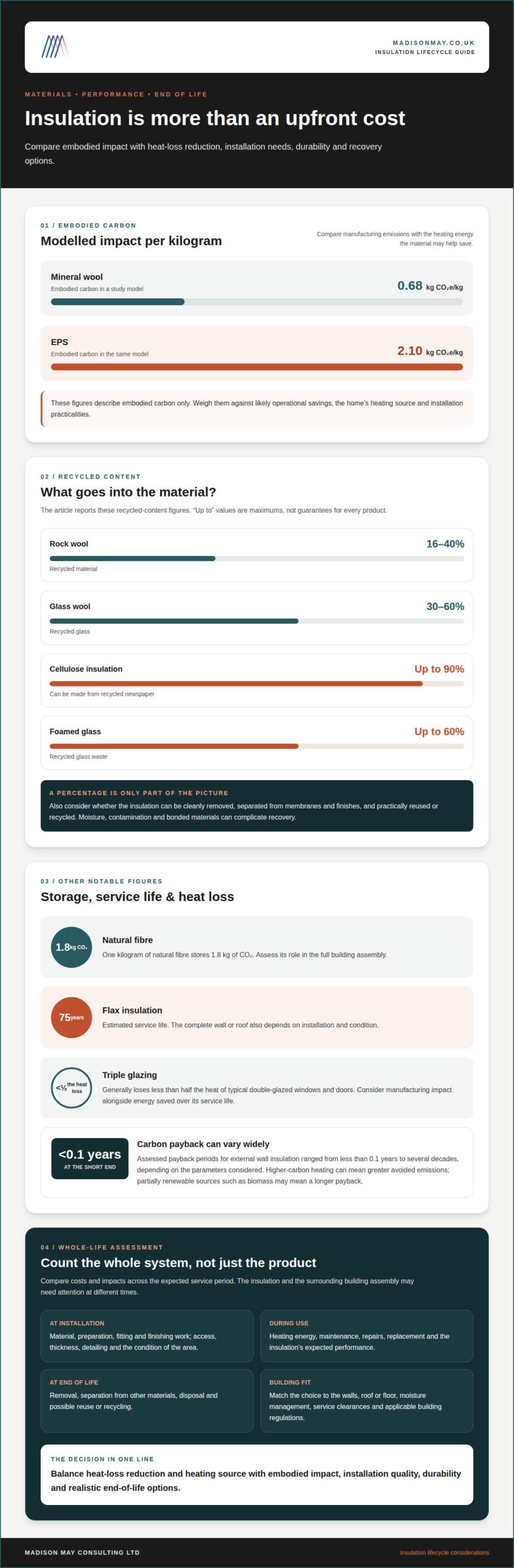
The lifecycle cost of insulation materials reflects both heating energy saved and emissions created before installation. Rock wool is made by melting raw materials at around 1600°C. A study model gives mineral wool embodied carbon of 0.68 kg CO₂e per kilogram, compared with 2.10 kg CO₂e per kilogram for EPS. Compare these impacts with likely operational savings.
UK grants and tax incentives aren’t a fixed part of the lifecycle cost of insulation materials. Support depends on current schemes and household circumstances, so assess any eligible assistance separately from projected energy-bill savings.
Heating fuel affects carbon payback. For external wall insulation, assessed payback periods ranged from less than 0.1 years to several decades, depending on the parameters considered. Savings can avoid more emissions where heating has a high carbon footprint; payback may take longer with partially renewable sources such as biomass.
In a home with a heat pump, better insulation can reduce heat demand and compressor running time. This may lower electricity use, depending on the building and heating system. Insulation can also reduce demand from gas or other heating sources, potentially lowering fuel use and household bills.
Glazing contributes to heat loss, although it isn’t an insulation material. Triple glazing generally loses less than half the heat of typical double-glazed windows and doors. When comparing options, consider its embodied impact alongside the operational energy saved over its service life.
| Option | Embodied impact | Operational consideration |
|---|---|---|
| Mineral wool | Modelled at 0.68 kg CO₂e per kilogram | Can reduce heat loss when suited to the building fabric |
| EPS | Modelled at 2.10 kg CO₂e per kilogram | Compare embodied emissions with expected heating savings |
| Natural fibre | One kilogram stores 1.8 kg of CO₂ | Assess its role in the full assembly |
| Triple glazing | Consider manufacturing impact alongside use | Generally loses less than half the heat of typical double glazing |
Compare embodied impact with likely heat-loss reduction, the home’s heating source and the practicalities of installation.
Recycled content and end-of-life disposal
Recycled content can reduce demand for virgin resources, but the percentage alone doesn’t show a material’s full lifecycle impact. Rock wool can contain 16% to 40% recycled material, whilst glass wool generally contains 30% to 60% recycled glass. Cellulose insulation can be made from up to 90% recycled newspaper, and foamed glass can use up to 60% recycled glass waste.
End-of-life planning matters too. Insulation may need to be separated from membranes, fixings or finishes before it can be reused or recycled. Moisture, contamination and bonded materials can make removal and disposal more difficult. For example, a product that is hard to separate from a wall assembly may have fewer practical recovery options, even if it contains a high proportion of recycled material.
A life-cycle cost assessment should consider the full insulation system, not just the insulation product. Account for installation, energy use, maintenance, repairs, replacement and eventual removal. Compare these across the expected service period, including whether a later replacement would involve disturbing finishes or other building elements.
Material service life and system service life are related, but they aren’t identical. The insulation may remain in place whilst another part of the assembly needs repair; conversely, damage to the surrounding construction can require insulation removal. Flax insulation has an estimated service life of 75 years, but the performance of a complete wall or roof also depends on its installation and condition.
- Compare recycled content with the material’s likely recovery route.
- Consider how cleanly the insulation can be removed and separated.
- Include repair, replacement and disposal in the lifecycle assessment.
For a whole-building view, a retrofit assessment can consider insulation alongside the fabric and ventilation, helping align material choices with the property.
Balancing insulation performance, installation and structural requirements
Insulation work in the UK must meet the building regulations that apply to the property and project, including relevant thermal performance, fire safety and ventilation requirements. The applicable provisions depend on the building and the work involved.
Material choice is only part of the decision. Weigh thermal performance against installation requirements, structural constraints and the risk of future remedial work.
Material and Installation Costs
Initial costs cover the insulation, preparation, fitting and any finishing work. They vary with the material, access, thickness, detailing and condition of the area being upgraded. For example, a loft installation has different access and finishing requirements from wall insulation, so comparing material prices alone can overlook essential work.
Performance also needs to suit the available space. In one study model, EPS had thermal conductivity of 35.0 mW/m·°C, while mineral wool measured 36.5 mW/m·°C. These figures describe the modelled materials, not every product. A retrofit design must also account for wall build-up, moisture management and clearances around services.
Installation quality affects value over time. Gaps, compression or poorly fitted edges can reduce an insulation layer’s effectiveness, while difficult access may add labour or finishing work. Compare the complete installed system and its expected performance, rather than choosing on material cost alone.
Risks That Increase Lifecycle Costs
Damp, fire, pests and poor installation can all raise lifecycle costs through damage, reduced performance, repairs or replacement. For example, moisture entering a building assembly can affect insulation and nearby finishes, so repairs must address the cause as well as the damage. Fire performance depends on the material and the complete construction, so assess suitability for the intended location.
Installation safety matters too. Cutting or handling some insulation can create dust, so follow the product’s instructions and use suitable protective measures. Poorly controlled dust can make work less safe and disrupt installation. The material, cutting method, ventilation and handling practices all affect the approach.
Before installation, assess the building fabric, access, service routes and ventilation. This can bring structural constraints and risks to light early, while the design can still account for them. A well-matched system balances thermal performance with a suitable fit, safe installation and the building’s condition.
What are the maintenance and repair costs for insulation materials over time?
Insulation usually needs little direct attention while the surrounding construction remains dry and intact. Repairs may be needed if leaks, building movement or service work disturb the insulation layer. For example, a roof leak can wet loft insulation, while pipe replacement can leave a gap that allows heat to escape. Repairs should address the cause as well as the affected insulation.
In traditional externally insulated duct systems, damage to the vapour barrier can let moisture into the insulation. Wet material may perform less effectively and need repair or replacement. Consider the barrier, insulation and outer finish as one system. Repairing only visible damage without restoring the protective layer can leave the same route for moisture to return.
Access affects the work involved. Insulation behind plasterboard, cladding or fitted finishes may require those layers to be opened and reinstated. Accessible loft insulation, by contrast, can be easier to inspect after roof or plumbing work. Record where insulation is located and which areas have been disturbed, so future maintenance can focus on them.
- Trace moisture to its source before replacing affected insulation.
- Restore gaps and damaged protective layers after building or service work.
- Include access, removal and reinstatement in repair planning.
Maintenance depends on the complete assembly, not just the insulation material. In a wall, the external finish and moisture-control layers can affect how well the insulation stays protected. In a loft, displaced material around access points or services can leave sections less effective. Repair planning should therefore account for adjacent components and finishing work.
For a property-specific review of insulation condition and potential upgrades, arrange an insulation upgrade assessment as part of a whole-home approach.
Madison May Consulting Ltd: Insulation upgrades
Madison May Consulting Ltd helps homeowners and landlords plan insulation upgrades as part of wider energy efficient home improvements. Its retrofit assessments and EPC improvement plans can help you compare material performance with your property’s needs and identify ways to reduce heat loss.
A whole-home view brings together the building fabric and the areas where heat escapes. Depending on the property, relevant improvements may also include windows and doors or conservatory upgrades. Considering these elements together puts insulation choices in the context of your home.
For practical guidance on planning improvements for your property, contact Madison May Consulting Ltd.
Make the next upgrade part of a considered plan
The next step is to put your priorities into a sequence of improvements that suits your home, rather than treating each decision in isolation. A whole-property perspective can connect insulation choices with windows and doors, conservatory upgrades and other energy efficient home improvements, while keeping comfort and practical constraints in view.
The lifecycle cost of insulation materials is a useful way to frame decisions, not a single figure that determines the answer. The material, installation and surrounding building elements all matter. A clear plan helps you decide what to address first and how each change supports the home you want.
To discuss the next steps for your property, contact Madison May Consulting Ltd. A thoughtful plan can make energy improvements feel more coherent, considered and personal.
Frequently Asked Questions
What is the typical installed cost per m² of common insulation materials in the UK?
There isn’t one typical installed cost per m² that applies across UK homes. The total depends on the insulation type and thickness, the area being treated, access, preparation and finishing work. For example, fitting insulation in an accessible loft differs from upgrading a wall that needs its finishes removed and reinstated. Compare the full installation scope, not just material prices.
How do insulation materials compare on thermal performance and cost per unit of insulation?
Thermal conductivity indicates how readily heat passes through a material: lower values mean better insulating performance for a given thickness. Thermal performance varies between insulation materials and should be considered alongside other factors. Cost per unit of insulation also depends on thickness, installation and the building assembly, so conductivity alone can’t identify the best-value option for every property.
What are the expected service lives and replacement costs of insulation materials?
Service life varies with the material, installation quality and conditions within the building assembly. Replacement costs also depend on whether the insulation is accessible or concealed behind finishes. For example, replacing loft insulation may cause less disruption than removing wall finishes to reach an affected layer. When planning future maintenance, consider access, removal and reinstatement work alongside expected durability.
How much can different insulation materials save on UK energy bills over their lifetime?
Bill savings depend on how much heat an upgrade prevents from escaping, the home’s existing insulation, household heating patterns and the fuel used. Insulating a poorly performing area can reduce heat demand, but the effect on bills varies with the whole property and energy use. Compare expected heat-loss reductions with installation and upkeep over the system’s useful life, rather than relying on material type alone.
How do embodied carbon and environmental disposal costs compare across insulation materials?
Environmental impact varies with manufacturing, transport, recycled content and what happens when insulation is removed. Consider whether it can be separated from membranes, finishes or fixings, and whether moisture or other contamination affects recovery. A material’s environmental profile depends on the complete assembly and its condition at removal, not just its composition. Include removal and end-of-life handling when comparing options.
How do installation costs vary by insulation type, property, and region in the UK?
Installation costs vary with material, thickness, access, preparation and the complexity of fitting around services or building details. The property layout matters: an open loft and a solid wall requiring internal work have different labour and finishing needs. Labour and transport costs can also vary by region. For a useful comparison, set out the same scope for each option, including preparation and reinstatement.