


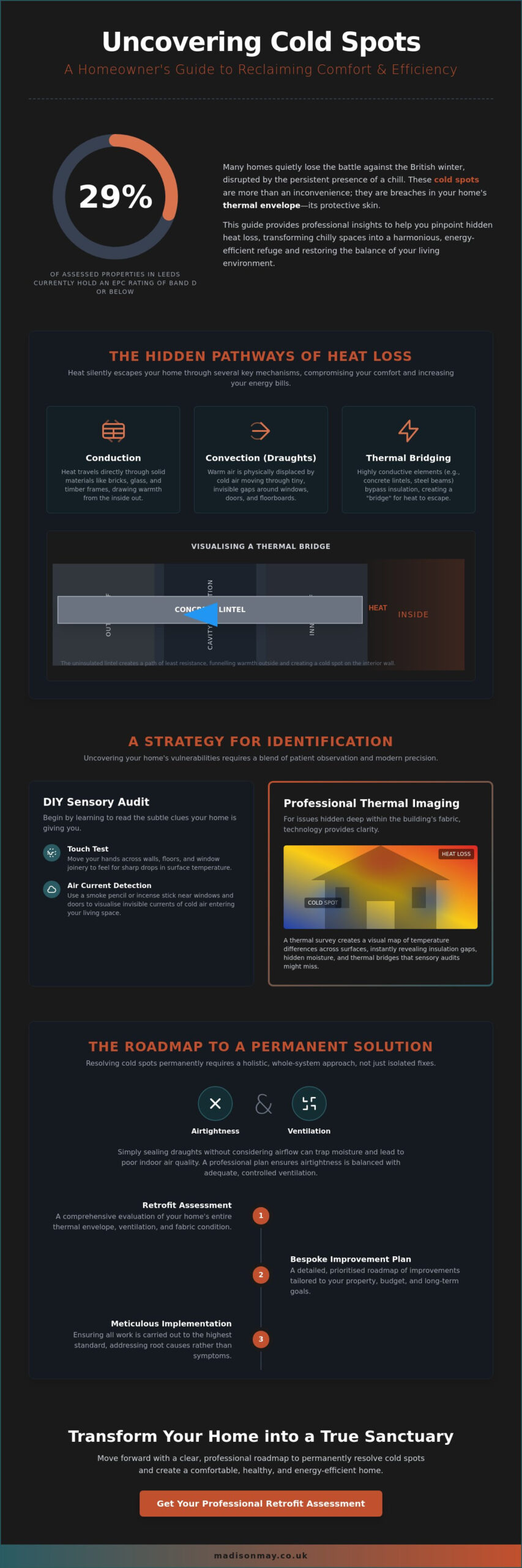
With 29% of assessed properties in Leeds currently holding an EPC rating of Band D or below, many of our city’s beautiful homes are quietly losing the battle against the British winter. Identifying cold spots in my house Leeds is often the first step toward reclaiming a sense of true comfort in a space that should feel like a sanctuary. You’ve likely felt that unsettling shift in temperature as you move between rooms, or perhaps you’re concerned about the subtle appearance of damp in a shadowed corner whilst your energy bills continue to climb. It’s frustrating when your home feels like it’s working against you rather than providing the warmth and serenity you deserve.
This guide will show you how to pinpoint hidden heat loss through professional retrofit insights, helping you transform those chilly spaces into a harmonious, energy-efficient refuge. We’ll explore a whole-system approach to home improvements, from sophisticated insulation upgrades to the clarity provided by a professional EPC improvement plan, ensuring your home is treated with the care and precision it requires. Discover how to restore the balance of your living environment and move forward with a clear, professional roadmap for a more sustainable future.
Key Takeaways
- Understand how the thermal envelope acts as your home’s protective skin and why localised temperature drops disrupt the harmony of your sanctuary.
- Learn refined techniques for identifying cold spots in my house Leeds, from sensory exploration of wall surfaces to the delicate use of air current detection.
- Discover the hidden pathways of heat loss, such as thermal bridging and insulation bypasses, that compromise your energy efficiency and comfort.
- Recognise why enhancing airtightness must be balanced with a professional ventilation assessment to maintain a healthy, damp-free living environment.
- Explore how a holistic Retrofit Assessment provides a bespoke, professional roadmap to permanently resolve cold spots through meticulously planned improvements.
What Are Cold Spots and Why Do They Compromise Your Home’s Sanctuary?
A home should be a place of absolute stillness and repose, a sanctuary where the external world fades away. Yet, this sense of calm is often disrupted by the subtle, persistent presence of a chill that refuses to lift. These localised areas, known as cold spots, occur where the internal surface temperature of a wall, floor, or ceiling is significantly lower than the rest of the room. They represent more than just a minor inconvenience; they are the physical manifestations of a breach in your home’s thermal envelope, which acts as the protective skin of your living space.
To truly understand What Are Cold Spots and Why Do They Compromise Your Home’s Sanctuary?, one must look beyond the thermostat and consider the delicate balance of heat exchange within the building fabric. When you begin the process of identifying cold spots in my house Leeds, you’re essentially mapping the vulnerabilities where your home’s identity as a refuge is being compromised. You might notice a sudden draught whilst sitting perfectly still, or find a lingering chill amongst the shadows of a north-facing wall that never seems to catch the light. These sensations create a deep sense of unease, reminding us that our environment is not as secure or harmonious as we desire.
The Invisible Intruder: How Heat Loss Occurs
Heat loss is a silent, constant movement. It occurs through conduction, where warmth travels through solid materials like brick or stone, and convection, where moving air carries your expensive heating away through tiny, invisible gaps. Because cold surfaces naturally draw heat away from the human body, standing near a cold spot can make you feel chilled even if the air temperature is high. Your home is a living system where every element must work in perfect balance. When one part of the envelope fails, the entire rhythm of the house is thrown into discord, turning a room of relaxation into a space of discomfort.
The Consequences of Ignoring the Chill
Leaving these cold areas unaddressed invites more than just a high energy bill. When warm, moisture-laden air meets a cold surface, it can lead to interstitial condensation, a hidden moisture build-up within the walls. Over time, this compromises the building fabric and creates an environment where mould growth can flourish in forgotten corners. Identifying cold spots in my house Leeds is the first step in a transformative journey. By resolving these issues, you aren’t just performing maintenance; you’re making a deliberate investment in your property’s longevity and your own personal well-being, restoring the quiet confidence that a true sanctuary provides.
Sophisticated Methods for Identifying Cold Spots in Your House
Uncovering the hidden vulnerabilities of your home requires a blend of patient observation and modern precision. When you begin identifying cold spots in my house Leeds, you aren’t just looking for problems; you’re learning to listen to the architecture of your sanctuary. A simple sensory audit is the most personal way to start. By moving your hands across the surfaces of your walls, floors, and along the intricate joinery of windows, you can often feel the subtle, sharp contrast where the thermal envelope has been breached. These variances in temperature are the first clues in a much larger story of how your home breathes and retains its warmth.
Conducting a Sensory Audit of Your Space
Pay close attention to the junctions where different elements of the building meet. The corners where walls join the ceiling or floor are frequent sites for heat to escape, often due to gaps in insulation or structural shifts over time. On a particularly windy day, observing the behaviour of curtains or the flicker of a candle flame near a window can reveal the presence of draughts that go unnoticed in calmer weather. For a more deliberate test, a smoke pencil or even a simple incense stick can visualise the invisible currents of cold air as they enter your living space. Mapping these findings with a digital thermometer provides a quantitative baseline, allowing you to document the specific temperature drops that disrupt your comfort.
The Power of Thermal Imaging Technology
Whilst DIY methods provide a valuable starting point, certain issues remain hidden deep within the building’s fabric. This is where Sophisticated Methods for Identifying Cold Spots, such as professional thermal imaging, become indispensable. Infrared thermography captures heat patterns that are invisible to the naked eye, translating them into a vivid colour palette. Deep blues and purples on the screen indicate significant heat loss, pinpointing exactly where the cold is intruding without the need to lift floorboards or disturb the peace of your home. It’s a non-intrusive process that offers a complete, holistic view of your property’s performance.
Identifying cold spots in my house Leeds is the essential prelude to any meaningful transformation. Once you have visualised the thermal story of your space, you can begin to consider the most effective energy efficient home improvements to restore the harmony of your sanctuary. This data-driven approach ensures that every intervention is intentional, moving you away from guesswork and towards a home that feels consistently warm, balanced, and refined.
The Root Causes: From Thermal Bridging to Draughty Envelopes
Identifying cold spots in my house Leeds is a journey of discovery that inevitably leads to the structural heart of the property. Behind the elegant facades of our city’s homes, hidden architectural choices often dictate our daily comfort. These cold spots aren’t merely random occurrences; they are the result of physical phenomena that compromise the thermal integrity of your sanctuary. Understanding the “why” behind the chill is essential for anyone seeking a permanent resolution rather than a temporary fix. It requires a shift in perspective, viewing the home not as a collection of separate rooms, but as a single, sophisticated system that must remain in balance.
Understanding Thermal Bridging in Detail
Imagine your home is wrapped in a soft, protective blanket. A thermal bridge is a deliberate tear in that fabric. It acts as a high-speed highway for heat to escape, occurring where conductive materials like steel lintels, concrete beams, or even dense brickwork pierce through the insulation layer. Because these materials transfer heat far more efficiently than the surrounding walls, they create localised areas where the surface temperature plummets. Corners and junctions are particularly susceptible, as the geometry of the building often makes it difficult to maintain a continuous thermal barrier. A professional can demonstrate How a Retrofit Assessment Resolves Cold Spots by pinpointing these structural weak links, allowing for targeted interventions that restore the harmony of the room.
The Role of Air Infiltration and Draughts
Whilst thermal bridging deals with heat moving through solids, air infiltration is the movement of the air itself. There’s a vital distinction to be made between intentional ventilation, which keeps your home healthy, and unintentional air leakage, which steals your warmth. Draughts are often driven by pressure differences. As warm air rises and escapes through the upper levels of the house, it creates a subtle vacuum that pulls cold air in through tiny, forgotten gaps. Common culprits include recessed lighting fixtures, uninsulated loft hatches, and the spaces around traditional sash windows. These draughts don’t just lower the temperature; they carry your comfort away, making a space feel restless and unsettled. Identifying cold spots in my house Leeds requires looking at the home as a complete, interconnected system where every gap, no matter how small, disrupts the quiet confidence of your living environment.
Often, the issue isn’t a lack of insulation, but how it’s been laid. Gaps caused by material settling or hurried installation create “thermal bypasses”. These are secret corridors where cold air circulates behind the insulation, effectively rendering it useless. By addressing these root causes, you move beyond merely treating symptoms and begin the true work of restoring your home’s identity as a place of lasting warmth and repose.
Why Targeted Insulation Requires a Professional Ventilation Assessment
In the pursuit of identifying cold spots in my house Leeds, it’s easy to focus solely on sealing every gap to preserve warmth. However, a home is not a static box; it’s a living environment that requires a delicate exchange of air to remain healthy and vibrant. When we insulate without a corresponding strategy for airflow, we risk creating what professionals call the Ventilation Gap. By making a sanctuary too airtight, we inadvertently trap moisture-laden air produced by daily life, from morning showers to the simple act of breathing. This moisture will always seek out the coldest surface to settle upon, often leading to hidden issues that compromise the very peace we’re trying to restore.
A sophisticated approach to damp remediation always begins with a deep understanding of airflow. In a sealed environment, moisture doesn’t simply vanish; it migrates to the remaining vulnerabilities in the thermal envelope. If you’ve successfully addressed three cold spots but left a fourth unmanaged, the moisture will concentrate there with greater intensity, potentially leading to mould growth in corners you rarely see. This is why identifying cold spots in my house Leeds must be paired with a professional assessment of how your home breathes, ensuring that every intervention is balanced and sustainable.
The Science of Indoor Air Quality
Adhering to the principles outlined in Part F building regulations is essential for maintaining a healthy sanctuary. These guidelines govern the necessity of adequate ventilation, ensuring that your pursuit of warmth doesn’t lead to a decline in air quality. Modern extract and supply systems work in quiet harmony with high-quality insulation, ensuring that stale air is removed whilst fresh, filtered air is introduced to your living spaces. The result is a sensory experience that feels light and restorative. You’ll find your home is no longer stuffy or heavy, but possesses a crisp, clean atmosphere that perfectly complements its newfound warmth.
Avoiding the Pitfalls of DIY Insulation
It’s tempting to take a DIY approach to plugging the gaps, yet without a professional understanding of building physics, this can be counterproductive. Misplaced insulation can shift a cold spot to a more dangerous, hidden location, such as behind a fitted wardrobe or within a floor void, where damp can flourish unseen. Choosing a professional consultant ensures they act as the guardian of your home’s structural health, making certain that every material is chosen with care and every detail is intentional. To ensure your home remains a true refuge, consider a professional Ventilation Assessment to harmonise your insulation efforts with the necessary movement of air.
Crafting Your Roadmap: How a Retrofit Assessment Resolves Cold Spots Permanently
Resolving the thermal imbalances in your home requires more than isolated fixes; it demands a visionary strategy that treats your property as a single, interconnected entity. Adopting the PAS 2035 standard establishes a gold standard for home energy improvements, ensuring that every intervention is considered within the context of the whole building. This meticulous approach moves beyond the surface level, as a professional Retrofit Assessment provides a holistic view of your property’s performance. By identifying cold spots in my house Leeds through this rigorous lens, we can create a bespoke EPC improvement plan that is tailored to your personal story and the unique heritage of your home. Having a Retrofit Coordinator oversee the process offers a rare peace of mind, as they act as a sophisticated guide through the complexities of the design and installation journey.
The Step-by-Step Retrofit Journey
The path toward a warmer, more elegant environment follows a measured and logical sequence. This structured flow ensures that no detail is overlooked and every material is chosen with care:
- Step 1: A comprehensive data collection process where the building fabric, existing services, and ventilation systems are documented with quiet precision.
- Step 2: An expert analysis of heat loss allows for identifying cold spots in my house Leeds with absolute clarity, revealing the hidden thermal narrative of the space.
- Step 3: The design of a cost-effective sequence of upgrades, ensuring that each improvement builds upon the last to create a harmonious whole.
- Step 4: Professional oversight ensures that every technical standard is met with poise, guaranteeing that the finished work resonates with quality and enduring value.
Your Home as a Sustainable Sanctuary
The transition from a draughty, unsettled house to a sustainable sanctuary is a transformative artistic journey. These improvements do more than just lower energy bills; they enhance the functional and aesthetic value of your property, creating a space that feels deeply personal and consistently calm. Your home should be an outward expression of your identity, a place where functionality and beauty exist in a natural, effortless union. This rhythmic consistency in design and performance helps to establish a home environment that is reliable, serene, and consistently high-quality across every room.
By resolving cold spots permanently, you restore the harmony of your living environment and ensure your sanctuary remains a place of refuge for years to come. The final result is a home that reflects your values and provides the enduring comfort you deserve, allowing you to move through your space with a sense of ease and luxury that only a truly balanced home can provide.
Reclaiming the Quiet Comfort of Your Home
Transforming a house into a true sanctuary requires moving beyond temporary fixes to embrace a meticulous, whole-house approach to energy efficiency. We’ve explored how identifying cold spots in my house Leeds is the vital first step in uncovering the hidden thermal story of your property. By understanding the science of thermal bridging and the necessity of balanced ventilation, you can protect the structural health of your home whilst significantly enhancing your daily well-being. This journey is about more than just numbers; it’s about restoring the rhythm and harmony of your living environment.
A permanent resolution is found through the clarity of a PAS 2035 aligned Retrofit Assessment and an expert EPC improvement plan. These professional roadmaps ensure that every material is chosen with care and every detail is intentional, reflecting your personal story through a space that is both functional and beautiful. Begin your journey to a warmer home with a professional Retrofit Assessment and discover the peace of mind that comes from a home treated as a complete, harmonious system. Your sanctuary is ready to be restored, offering a future of enduring warmth and refined serenity.
Frequently Asked Questions
How do I find a cold spot in a wall without professional equipment?
You can begin by performing a sensory audit, using the back of your hand to move slowly across the wall surface during a cold evening. This tactile approach often reveals sharp temperature drops at junctions or behind furniture where air circulation is restricted. Alternatively, a simple candle or incense stick can visualise subtle air currents near windows or skirting boards, pinpointing exactly where the thermal envelope has been breached.
Can cold spots cause mould even if there are no visible leaks?
Yes, cold spots are a primary cause of mould growth due to the phenomenon of condensation. When warm, moisture-laden air from daily activities meets a significantly colder surface, the air loses its ability to hold water, causing droplets to form. This localised moisture provides the ideal environment for mould spores to flourish, even in the absence of external structural leaks or plumbing issues.
Is it worth insulating just one cold room, or do I need a whole-house approach?
While insulating a single room provides temporary relief, a whole-house approach is essential to maintain the long-term harmony of your sanctuary. Treating rooms in isolation can inadvertently shift the dew point to other uninsulated areas, potentially creating new cold spots or moisture issues elsewhere. A holistic strategy ensures that the entire building fabric works in balance, preserving energy efficiency and structural health throughout the property.
What is the most common cause of cold spots in older UK properties?
Thermal bridging is the most frequent culprit, particularly in the solid-walled or back-to-back terraced houses common across Leeds. These structures often lack a continuous insulation layer, allowing heat to escape rapidly through conductive materials like stone or brick. Identifying cold spots in my house Leeds often reveals that these structural highways for heat loss are most prevalent at corners, floor junctions, and uninsulated lintels above windows.
Will new windows and doors automatically fix my cold spots?
High-quality windows and doors will significantly reduce draughts, but they won’t necessarily resolve cold spots located within the walls or floors. If the surrounding wall suffers from poor insulation or thermal bridging, the new joinery might even highlight the temperature difference more starkly. A professional assessment ensures that your investment in new glazing is part of a broader, successful strategy for your home’s thermal envelope.
What is a thermal imaging survey and how long does it take?
A thermal imaging survey uses infrared technology to capture heat patterns that are invisible to the naked eye, revealing exactly where warmth is escaping. For a typical residential property, the process is non-intrusive and usually takes between one and two hours to complete. This visual data provides a definitive map of your home’s thermal performance, allowing for a precise and intentional approach to future improvements.
How does a retrofit assessment differ from a standard EPC?
While a standard EPC offers a generic snapshot based on statistical averages, a Retrofit Assessment is a deep, bespoke exploration of your home’s unique physics. It involves a detailed survey of the building fabric, ventilation, and occupancy patterns to create a personalised roadmap for improvement. Identifying cold spots in my house Leeds through a Retrofit Assessment provides the technical depth required by the PAS 2035 standard, ensuring your home is treated with the care it deserves.