


The abolition of Section 21 by May 2026 isn’t merely a legislative shift; it’s a profound invitation to redefine what it means to be a mindful custodian of a West Yorkshire home. You likely feel the weight of these upcoming changes, perhaps worrying how your historic stone terrace or suburban villa will meet the rigorous new energy standards while maintaining its inherent soul. It’s natural to feel a sense of unease as the traditional frameworks of the assured shorthold tenancy evolve into a more permanent landscape for renters. We understand that your property is more than just an asset; it’s a curated space that deserves a meticulous approach to both law and design.
This guide provides the clarity you need to transform these regulatory hurdles into a journey toward property excellence. You’ll learn how to master the complexities of the 2026 Renters’ Rights Act while simultaneously elevating your home into a high-performance sanctuary. We explore the intersection of meticulous compliance and bespoke interior improvements, offering a clear path to reduced energy costs and superior EPC ratings that reflect the true quality of your investment. This is your roadmap to creating a residence that is as legally secure as it is beautiful.
Key Takeaways
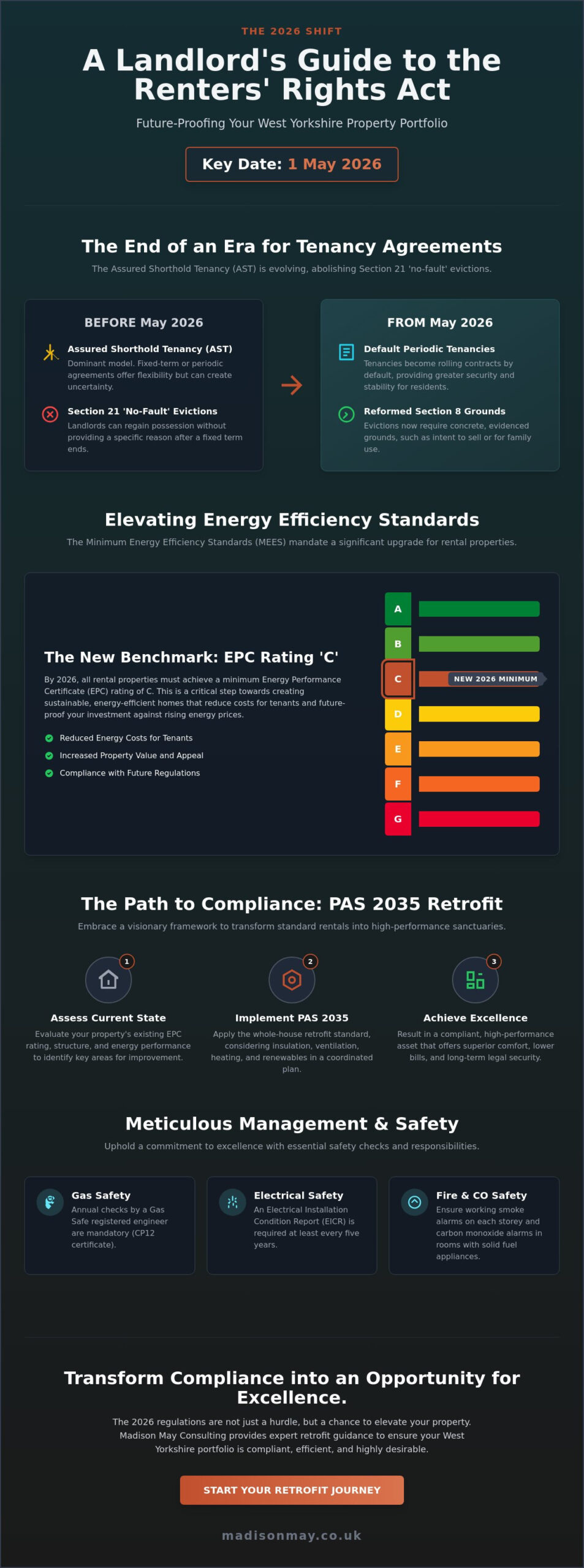
- Understand the pivotal shift arriving on 1 May 2026 as the traditional assured shorthold tenancy evolves under the Renters’ Rights Act, ensuring your West Yorkshire portfolio remains both compliant and refined.
- Navigate the transition away from Section 21 “no-fault” evictions by mastering the new reliance on concrete grounds, allowing you to maintain a professional and balanced relationship with your residents.
- Prepare for the 2026 MEES requirements by elevating your property to a minimum EPC rating of C, a meticulous step toward creating an energy-efficient and sustainable sanctuary.
- Uphold a commitment to excellence through a curated schedule of essential safety checks, ensuring the “quiet enjoyment” of a home that is as secure as it is beautiful.
- Embrace the PAS 2035 retrofit standard as a visionary framework to future-proof your investment, transforming standard rental stock into a high-performance sanctuary of bespoke quality.
Understanding the Assured Shorthold Tenancy in the 2026 Landscape
The home is more than a physical structure; it is the quiet backdrop to our most cherished memories. Within the rolling hills and historic towns of West Yorkshire, the assured shorthold tenancy has functioned as the primary legal bridge between property owners and those seeking a place to belong. This agreement, often seen as a mere formality, is actually the meticulous framework that ensures a residence remains a sanctuary. As we approach the 1 May 2026 transition date for the Renters’ Rights Act, this framework is undergoing a sophisticated evolution, refining how we perceive security and tenure in the private sector.
For a contract to be classified as an Understanding the Assured Shorthold Tenancy, specific criteria must be met with precision. The property must be let by a private landlord to an individual, serving as their primary residence. Financial boundaries are equally important; the annual rent must sit between £250 and £100,000. At Madison May, we view these regulations not as constraints, but as the essential architecture that allows a house to breathe and a tenant to feel truly at home. It’s about creating a space where the soul can rest, supported by a clear and fair legal narrative.
The Evolution of Rental Agreements in West Yorkshire
The story of the modern rental market began with the 1988 Housing Act, which introduced the flexibility needed for a growing economy. Over the decades, this has matured into the 2026 reforms, which seek to harmonise the interests of all parties involved. Whether dealing with the industrial charm of Halifax terraces or the secluded beauty of rural cottages near Ilkley, these changes reflect a deeper commitment to quality and longevity. The assured shorthold tenancy provides a secure foundation that allows tenants to invest emotionally in their surroundings while protecting the heritage of the property.
Types of Tenancies: Fixed-Term vs. Periodic
Historically, landlords and tenants often chose between the structured certainty of a fixed-term agreement and the fluid nature of a periodic tenancy. A fixed-term might last six or twelve months, providing a defined horizon, while a rolling periodic agreement offers flexibility for those in transition. The 2026 legislation marks a significant departure from this choice, moving toward a default periodic structure to eliminate the uncertainty of fixed-end dates. In West Yorkshire, notice periods are now more uniform; tenants generally provide one month of notice, while landlords must follow specific protocols, typically requiring two months, to ensure the rhythm of the household remains undisturbed.
The Renters’ Rights Act 2026: Navigating the Transition
The Renters’ Rights Act 2026 marks a profound evolution in the West Yorkshire rental market, moving away from transient agreements toward a more stable, curated living experience. For those currently managing an assured shorthold tenancy, the landscape is shifting with purpose and grace. Agreements signed before the May 2026 deadline will eventually transition into a new periodic framework, designed to foster a sense of sanctuary and enduring security. This legislative update isn’t merely a set of rules; it’s a recalibration of the home as a reflection of the self, ensuring that every resident feels a deep sense of belonging within their space.
The Abolition of Section 21 in West Yorkshire
The removal of “no-fault” evictions shifts the landlord’s role from a simple provider to a meticulous narrator of their property’s future. In Leeds, Huddersfield, and beyond, reclaiming a property now demands concrete grounds under a reformed Section 8, such as a genuine intent to sell or a requirement for a family member to move in. This change doesn’t diminish control; it refines it. By following the Landlord and Tenant Responsibilities, owners can maintain a harmonious balance between investment security and the tenant’s peace of mind, ensuring every transition is handled with poise and clarity.
New Rent Increase Regulations
Rent adjustments in the 2026 economy follow a steady, annual rhythm that prioritizes fairness and transparency. Landlords are limited to one review every 12 months, with any disputes regarding market rates in West Yorkshire settled by the First-tier Tribunal. Approaching these adjustments with grace is vital for maintaining the soul of a home. Providing data-backed reasoning and clear communication helps tenants feel respected rather than squeezed. It’s a sophisticated approach to property management that prioritizes the longevity of the client journey and the essence of a stable, high-quality living environment.
Adopting these changes requires a personality of quiet confidence and a focus on meticulous craftsmanship in how we manage our relationships. The shift toward “concrete grounds” and annual reviews ensures that every assured shorthold tenancy remains a well-designed space where functionality and beauty are seamlessly integrated. For landlords who view their portfolio as a collection of stories rather than just assets, bespoke property management offers a way to align with these 2026 standards while maintaining an air of understated elegance. By treating the transition as a transformative journey, we can create environments that resonate on a personal level for years to come.
Tenancy Compliance and the MEES Energy Standards
The legal framework of an assured shorthold tenancy acts as the foundation of the landlord-tenant relationship, yet its strength relies heavily on the physical sanctuary provided. West Yorkshire’s architectural heritage, defined by its iconic gritstone and solid-wall terraces, presents a unique challenge for those seeking to meet the evolving Minimum Energy Efficiency Standards (MEES). By 2026, the expectation for rental properties to achieve a minimum EPC rating of C has become a central pillar of portfolio management, requiring more than just a cursory glance at a certificate. It’s a shift that demands a marriage of legal compliance and architectural sensitivity. Landlords must look beyond the government guidance on tenancy agreements to ensure their properties remain viable and desirable in a market that increasingly values sustainability and warmth.
The Critical Role of the EPC in 2026
A standard Energy Performance Certificate is no longer a mere administrative hurdle; it’s a strategic blueprint for asset preservation. For the sophisticated landlord, a basic assessment fails to capture the nuances of a period property’s thermal narrative. Instead, a meticulous EPC improvement plan serves as a curated roadmap, outlining specific interventions that enhance efficiency without stripping away character. This proactive approach is essential because the penalties for non-compliance in the Yorkshire region are substantial. Local authorities now have the power to levy fines of up to £30,000 for properties that fall below the required standards. Investing in a bespoke energy roadmap ensures that every assured shorthold tenancy issued is backed by a property that is both legally sound and environmentally responsible.
Addressing Damp and Ventilation in Period Rentals
The introduction of the “Decent Homes Standard” into the private rental sector has redefined the expectations for interior health. In West Yorkshire, where the damp climate meets traditional stone construction, the intersection of insulation and breathability is paramount. Modern interventions like internal wall insulation can inadvertently trap moisture if not handled with care, making damp remediation in West Yorkshire a critical skill for the modern property owner. A home must be a breathable sanctuary, not a sealed box. To ensure your property remains a healthy environment for tenants, consider this essential checklist:
- Install mechanical extract ventilation (MEV) in high-moisture areas like kitchens and bathrooms to manage humidity levels.
- Utilize breathable lime-based plasters and paints that allow moisture to move through solid stone walls naturally.
- Implement intelligent heating controls to maintain a consistent ambient temperature, preventing the cold spots that lead to condensation.
- Conduct annual gutter and masonry inspections to ensure the external envelope remains watertight against the Pennine rain.
By harmonising these technical requirements with the aesthetic demands of a high-end rental, you create a space that feels as good as it looks. This thoughtful approach to compliance doesn’t just satisfy the law; it fosters a sense of well-being that encourages long-term tenancies and protects the soul of the building for generations to come.
Meticulous Management: Landlord and Tenant Responsibilities
An assured shorthold tenancy thrives when viewed not as a mere transaction, but as a partnership in property stewardship. This shared commitment ensures the home remains a sanctuary while protecting the long-term value of the asset. Landlords must facilitate an environment of safety through rigorous compliance. This includes an annual Gas Safety check, an Electrical Installation Condition Report (EICR) every five years, and ensuring smoke and carbon monoxide alarms meet the 2022 regulatory standards. It’s about more than ticking boxes; it’s about preserving the integrity of the living experience for those who call the space home.
The tenant’s right to quiet enjoyment is the cornerstone of a peaceful residency. It grants them the freedom to live without unnecessary intrusion, allowing the property to truly become a reflection of their own life. In return, the landlord’s right to meticulous maintenance ensures the building’s narrative is preserved for future generations. By 2026, the landscape for pet ownership has shifted significantly under the Renters’ Rights Act. Landlords can no longer unreasonably refuse a tenant’s request to keep a pet. They can, however, require the tenant to hold insurance to cover potential damage. This change reflects a modern understanding of the home as a place of emotional connection and shared life, rather than just a physical structure.
Deposit Protection and Inventories
Securing a deposit within a government-approved scheme like the TDS or DPS is a non-negotiable legal requirement that must be completed within 30 days of receipt. Beyond the legalities, we recommend using high-end, photographic inventories. These documents do more than list items; they capture the essence and condition of the space at the start of the journey. In West Yorkshire, clear documentation is the most effective tool for dispute resolution, providing an objective record that protects the financial interests of both parties while maintaining a sense of professional grace.
The Importance of Professional Building Surveys
Engaging in building surveys before a tenancy begins offers a layer of protection that standard inspections often miss. Identifying structural nuances early prevents minor issues from becoming disruptive assured shorthold tenancy disputes later. We find that thermal imaging is particularly valuable for verifying a property’s warmth narrative, ensuring the sanctuary remains efficient and comfortable through the Pennine winters. This proactive approach demonstrates a level of care and visionary creativity that discerning tenants deeply appreciate, fostering a relationship built on transparency and trust.
Elevating Your Rental: The Retrofit Approach to Future-Proofing
The transition from a standard assured shorthold tenancy into a high-performance rental sanctuary begins with a profound shift in perspective. It’s about viewing a Victorian terrace in Huddersfield or a stone-built cottage in the Calder Valley as more than a simple investment; it’s an architectural legacy that requires stewardship. By adopting a retrofit mindset, you move beyond basic maintenance to create a living space that offers both thermal comfort and enduring elegance. This transformation ensures your property remains a desirable haven for years to come.
Why a PAS 2035 Assessment is Essential
A standard Energy Performance Certificate offers a fleeting glance at a building’s efficiency, but a PAS 2035 assessment in West Yorkshire provides a deep, granular narrative of its physical health. This framework is the meticulous gold standard, moving away from fragmented fixes toward a cohesive strategy. Within this process, a Retrofit Coordinator acts as a project guardian, overseeing the journey from the initial risk assessment to the final handover. They ensure that every intervention is technically sound and aesthetically sympathetic.
The whole-house approach is a philosophy that treats a property as a single, integrated system where insulation, ventilation, and heating must exist in perfect harmony to prevent damp and ensure longevity. The professional assessment follows a clear, rhythmic path:
- Risk Assessment: Identifying the unique vulnerabilities of the specific building fabric.
- Whole-Dwelling Survey: A detailed capture of the property’s dimensions, condition, and energy use.
- Retrofit Design: A bespoke plan that sequences improvements to avoid conflicting technical issues.
- Installation and Handover: Meticulous execution of the design followed by a thorough briefing for the occupants.
Investing in West Yorkshire’s Architectural Heritage
Our region is defined by its rugged stone and industrial history, elements that provide a soulful foundation for any home. Integrating energy efficient home improvements doesn’t mean stripping away this character. Instead, it involves the seamless integration of modern technology with traditional materials. High-quality internal wall insulation or heritage-grade glazing can significantly reduce heat loss while preserving the visual story of the property.
The financial rewards of this commitment are as compelling as the aesthetic ones. Data from 2023 suggests that properties with higher energy ratings command a premium in the market, often increasing capital value by over 3% when moving from an EPC band D to C. For a property valued at £200,000, this represents a meaningful £6,000 uplift in equity. By refining the environment of your assured shorthold tenancy, you attract discerning, long-term tenants who value the quiet luxury of a warm, efficient home.
If you’re ready to secure your property’s future and elevate your rental portfolio, we invite you to book a bespoke consultation. Let’s begin the journey of transforming your investment into a resilient, high-performance sanctuary.
Securing the Future of Your West Yorkshire Heritage
Navigating the evolution of the assured shorthold tenancy requires more than a cursory glance at the Renters’ Rights Act 2026. It demands a deep commitment to the meticulous standards of the 2026 MEES regulations. Owners of West Yorkshire’s distinctive stone properties must balance these rigorous energy requirements with the preservation of architectural soul. By integrating high-level compliance with refined design, your property transcends its functional role to become a true sanctuary for residents.
At Madison May, our Halifax-based team serves as PAS 2035 aligned retrofit experts who understand the intricate breathability of local gritstone. We don’t just meet the minimum legal thresholds; we elevate every dwelling through a curated approach that honors heritage while securing future value. Our process ensures that every structural improvement contributes to a seamless narrative of quality and comfort, focusing on the emotional impact of a well-designed space. We’re here to guide you through the complexities of the 2026 landscape with quiet confidence and visionary creativity.
Begin your property’s transformation with a bespoke Madison May Retrofit Assessment
Let’s work together to craft a rental legacy that stands as a testament to craftsmanship and care.
Frequently Asked Questions
What is the main difference between an AST and the new 2026 tenancy rules?
The primary shift involves the transition from fixed-term tenancies to a single system of periodic tenancies where the traditional “no-fault” eviction is removed. Under the Renters’ Rights Act 2024, the fixed-term assured shorthold tenancy is replaced by rolling monthly agreements that offer tenants greater security from day one. This change ensures that every West Yorkshire home becomes a stable sanctuary rather than a transient dwelling for the resident.
Can I still evict a tenant in West Yorkshire after May 2026?
You can still reclaim your property after May 2026 by utilizing specific, strengthened grounds for possession under Section 8 of the Housing Act 1988. While the Section 21 “no-fault” route is abolished, landlords can seek possession if they intend to sell the property or move into it themselves, provided they give the required 4-month notice period. These curated legal pathways protect your investment while respecting the tenant’s right to a secure, lasting home.
Does a stone-built cottage in Halifax need to meet the same EPC standards as a new build?
Every rental property, including heritage stone-built cottages in Halifax, must achieve a minimum EPC rating of C by 2030 under current government proposals. While a new build might reach this through modern insulation, your historic cottage requires a more bespoke approach to retrofit energy efficiency without losing its architectural soul. Meticulous attention to breathable materials ensures your property meets the 2030 deadline while preserving the unique character of the West Yorkshire landscape.
What happens to my current Assured Shorthold Tenancy agreement on May 1st, 2026?
Your current assured shorthold tenancy agreement will automatically convert into the new periodic system on the implementation date of May 1st, 2026. This transition is designed as a seamless integration into the new regulatory landscape, so you don’t need to issue a brand-new contract immediately. The original terms of your agreement remain valid, provided they don’t conflict with the new statutory rights regarding notice periods and property standards.
Are pets now legally allowed in all West Yorkshire rental properties?
Tenants now possess a legal right to request a pet in their rental home, and you cannot unreasonably refuse this request under the 2024 legislation. To provide peace of mind for the landlord, you can require the tenant to maintain insurance against potential pet damage to the property’s curated interiors. This balance allows the house to truly feel like a sanctuary for the whole family while protecting the meticulous craftsmanship of your investment.
How much can I increase the rent on an AST in 2026?
Rent increases are limited to once per year and must reflect the prevailing market rates in West Yorkshire via the formal Section 13 notice procedure. This ensures that the financial journey of the tenancy remains transparent and fair for both parties involved. By aligning your property’s value with the refined quality of the space, you maintain a sustainable investment that respects the local economic climate and the tenant’s personal story.
What is the “Decent Homes Standard” for private landlords?
The Decent Homes Standard is a regulatory benchmark that now requires private rentals to be free from serious health hazards and provide a reasonable state of repair. It mandates that properties possess modern facilities and efficient heating, ensuring every tenant enjoys a safe and dignified living environment. This standard serves as a foundation for property excellence, encouraging landlords to view their holdings as a curated reflection of quality, safety, and care.
Why should a landlord invest in a PAS 2035 assessment for an AST property?
Investing in a PAS 2035 assessment provides a meticulous roadmap for energy efficiency improvements, ensuring that retrofitting work is both effective and high-quality. This professional evaluation protects your property from common issues like damp or poor ventilation that can arise from ill-advised upgrades. It’s a visionary choice for any landlord who values the long-term health and structural integrity of their investment within the historic West Yorkshire market.