


A home is a deeply personal refuge, yet in an era of volatile energy markets, it must also function as a high-performance financial asset. You likely feel the weight of responsibility when choosing between renewable technologies and structural insulation, especially whilst navigating conflicting advice and the anxiety of poor installations. It’s entirely natural to seek a sense of poise and certainty before committing your capital to a retrofit project.
This guide empowers you by masterfully calculating ROI on energy efficient upgrades UK, ensuring that every decision enhances both your immediate sanctuary and your property’s long-term liquidity. We will provide a clear mathematical framework to evaluate your investments, from leveraging the £7,500 Boiler Upgrade Scheme to understanding how EPC improvements elevate your home’s value. You’ll gain the confidence to select the most effective measures and the foresight to protect your asset against the shifting landscape of energy costs.
Key Takeaways
- Learn to distinguish between immediate payback periods and the total lifecycle value of your home improvements to ensure long-term financial security.
- Master a step-by-step framework for calculating ROI on energy efficient upgrades UK by utilising accurate baseline utility data and current EPC ratings.
- Identify high-performance measures, such as fabric-first insulation and heating transitions, that offer the most significant impact on both comfort and capital value.
- Discover how improving your EPC rating can unlock preferential mortgage rates and future-proof your property against evolving building regulations.
- Understand why professional Retrofit Coordination is the essential safeguard for preventing technical failures and ensuring your investment delivers its promised returns.
Understanding the Fundamentals of Energy Efficiency ROI in the UK
Return on Investment is often viewed through a purely clinical lens, yet for the UK homeowner, it represents something far more profound. It is the measure of how effectively your capital transforms a draughty, high-maintenance structure into a resilient sanctuary of comfort. When calculating ROI on energy efficient upgrades UK, we must look beyond a simple percentage. We are measuring the restoration of control over your domestic environment whilst ensuring your property remains a liquid, desirable asset in a discerning market.
Whilst a simple payback period tells you when you’ll break even, it fails to account for the total lifecycle value of an upgrade. A high-quality window installation or a precision-engineered insulation layer does more than lower a bill; it preserves the very fabric of your building for decades. By viewing these improvements as long-term wealth preservation rather than a temporary expense, you align your home’s performance with the highest modern standards.
The Triad of Residential Return
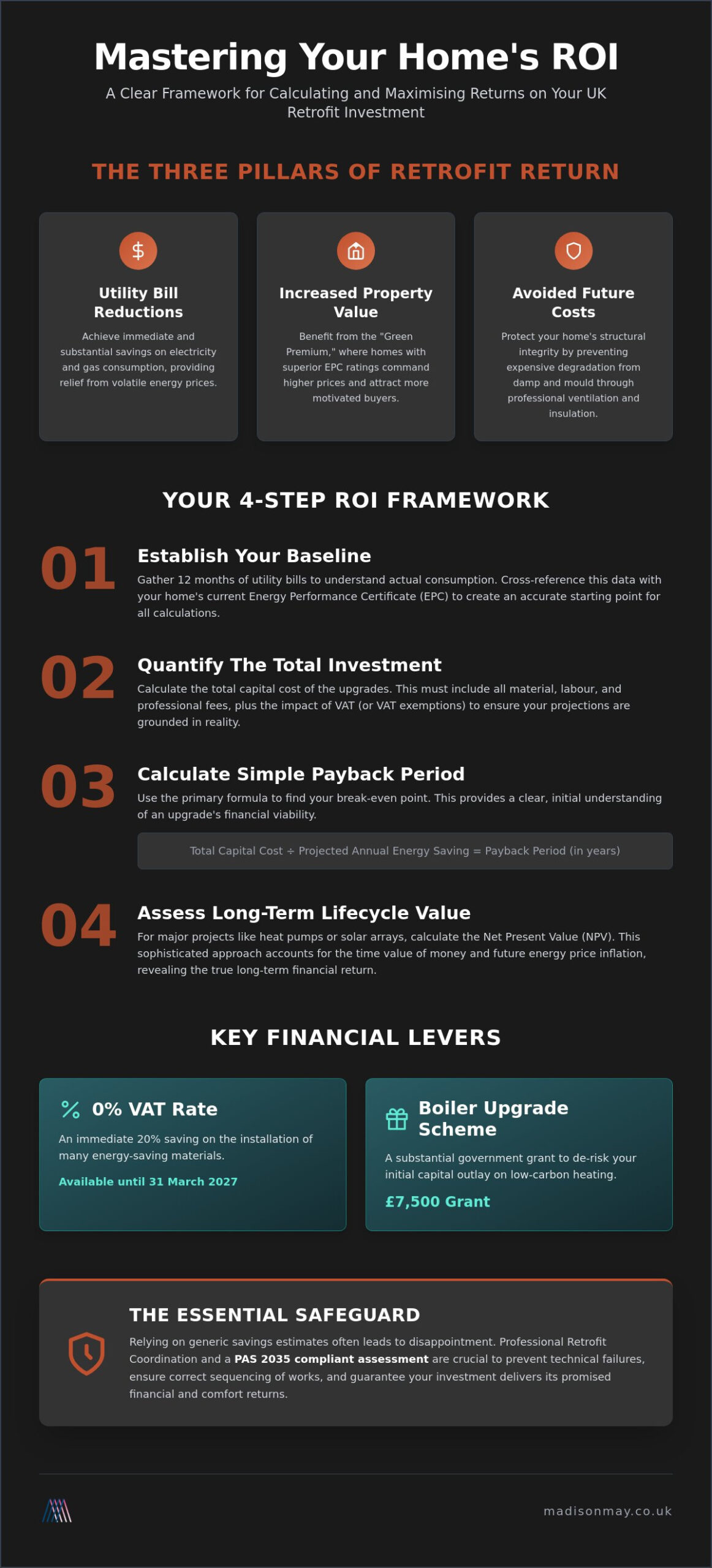
The financial rewards of a refined retrofit reside in three distinct areas. First, there’s the immediate relief of utility bill reductions. With the energy price cap set at £1,862 for a typical household as of July 2026, the savings from reduced electricity and gas consumption are substantial. Second, we see the “Green Premium.” Evidence suggests that homes with superior EPC ratings command higher prices and attract more motivated buyers. Finally, there’s the quiet benefit of avoided costs. By investing in professional ventilation and insulation, you prevent the expensive degradation caused by damp and mould, effectively protecting your home’s structural integrity from the inside out.
Why Baseline Data is Your Most Valuable Asset
Before committing to any capital expenditure, you must establish an unimpeachable starting point. The evolution of UK housing energy efficiency standards has made the Energy Performance Certificate (EPC) a critical document, yet it’s merely the beginning. A truly sophisticated investment requires a detailed understanding of heat loss parameters specific to your property’s unique architecture. This is the “due diligence” phase of your project.
Relying on generic estimated savings often leads to disappointment. Without professional modelling and a PAS 2035 compliant assessment, the theoretical ROI can quickly erode through poor sequencing or incompatible materials. Think of an expert EPC Improvement Plan as your investment prospectus. It ensures the measures you choose aren’t just popular, but perfectly calibrated to deliver the maximum financial and emotional return for your specific home.
The Step-by-Step Framework for Calculating Your Return
A home’s financial narrative is written in its data. To begin calculating ROI on energy efficient upgrades UK, you must first assemble a clear portrait of your property’s current performance. This involves gathering twelve months of utility bills to establish a baseline of actual consumption whilst cross-referencing these figures with your latest Energy Performance Certificate. This initial due diligence allows you to quantify the total investment cost, including professional fees and the nuanced impact of VAT, ensuring your projections are grounded in reality rather than optimistic estimates.
The Mathematics of Retrofitting
The most accessible metric is the simple payback formula, where you divide the total capital cost by the projected annual energy saving. However, for sophisticated homeowners, this is merely the surface. True financial mastery involves calculating the Net Present Value (NPV) for long-term investments like air source heat pumps or solar arrays. This approach accounts for the time value of money and the inevitable inflation of energy prices. When referencing government energy saving guidance, it’s clear that the most resilient returns come from a structured, phased approach. By factoring in standardised U-value improvements, you can project a 10-year financial trajectory that includes non-cash benefits like enhanced thermal comfort and superior indoor air quality.
Hidden Variables: VAT and Incentives
The UK fiscal landscape currently offers unique advantages that can dramatically de-risk your initial capital outlay. Until 31 March 2027, a 0% VAT rate applies to the installation of many energy-saving materials, representing an immediate 20% saving on typical costs. Additionally, the Boiler Upgrade Scheme provides a substantial £7,500 grant for heat pump transitions, which significantly shortens the payback period. Engaging a professional for retrofit coordination ensures these intricate variables are harmonised and that every eligible incentive is meticulously maximised.
Beyond the spreadsheet, these upgrades provide a sense of security that is difficult to price. A home that maintains its temperature effortlessly through high-performance insulation offers a level of serenity that transcends mere savings. To ensure your calculations are grounded in professional rigour, consider beginning with a bespoke EPC Improvement Plan to map your journey with precision.
Comparing High-Impact Upgrades: Payback Periods and Performance
Selecting the right sequence of improvements is an exercise in both logic and artistry. When calculating ROI on energy efficient upgrades UK, you must prioritise the “envelope” of your home before introducing complex technologies. This fabric-first philosophy ensures that any heat generated is retained within your sanctuary, preventing the expensive waste that occurs when high-performance heating systems are installed in poorly insulated structures. By addressing the building’s thermal integrity first, you create a stable foundation for all future investments.
Fabric First: The Foundation of Financial Return
Loft insulation remains a cornerstone of residential investment due to its remarkable simplicity and rapid payback period. It acts as a thermal blanket, significantly reducing the 25% of heat that typically escapes through an uninsulated roof. Whilst more complex, external wall insulation offers a transformative return by protecting the building’s longevity and drastically altering its aesthetic character. This measure is particularly effective for solid-wall properties where internal space must be preserved. To achieve a truly harmonious result, integrating high-performance windows and doors is essential. These bespoke elements do more than secure your home; they eliminate draughts and cold spots, ensuring that the thermal performance of your walls is not compromised by outdated glazing.
Renewables and High-Tech Upgrades
Once the fabric is secure, your attention can turn to the sophisticated world of low-carbon heating. Transitioning from a traditional gas boiler to an air source heat pump is a significant move towards future-proofing your property. To model the financial return accurately, you must understand the Seasonal Coefficient of Performance (SCoP), which measures how many units of heat are produced for every unit of electricity consumed. With the £7,500 Boiler Upgrade Scheme grant available until 2028, the initial capital hurdle is substantially lowered, making the transition increasingly attractive.
Solar PV and battery storage systems also offer a compelling narrative in the post-feed-in-tariff era, as they allow you to harvest and store energy for use during peak evening hours. However, the true value of these high-tech upgrades is only realised when paired with professional ventilation assessments. Without managed airflow, a highly sealed, energy-efficient home can become susceptible to condensation. By ensuring proper ventilation, you protect your investment from the costs associated with damp remediation, securing the long-term health of both the building and its inhabitants. Secondary measures, such as precision draught proofing and smart heating controls, serve as the final refinements, allowing you to curate your environment with effortless poise.
Beyond the Spreadsheet: Factoring in Property Value and Longevity
Whilst the immediate reduction in utility bills provides a tangible monthly reward, the most profound financial impact of your investment is often found in the long-term resilience of your property’s value. In a market that is becoming increasingly sensitive to environmental performance, calculating ROI on energy efficient upgrades UK must include the “Green Premium” and the evolving expectations of lenders. High-performance homes are no longer a luxury; they are becoming the benchmark for liquidity and capital security. This is a direct reward for meticulous stewardship.
The emergence of “Green Mortgages” has transformed the financial landscape for the diligent homeowner. Many UK lenders now offer preferential interest rates for properties with an EPC rating of A or B, acknowledging the reduced risk and higher disposable income of the inhabitants. This lower cost of borrowing acts as a direct, ongoing return on your capital, effectively subsidising the initial cost of your improvements whilst enhancing your home’s appeal to future buyers. A property that holds its value is the ultimate sanctuary.
This focus on long-term financial health is a cornerstone of a secure future; for readers also considering their retirement health strategy, Medicare Mentors offers expert guidance on navigating complex insurance landscapes with clarity.
The cost of inaction is perhaps the most overlooked variable in the ROI equation. As energy prices remain volatile and building standards tighten, homes that fail to adapt risk becoming “stranded assets” that are difficult to sell or let. This erosion of equity is a silent drain on your wealth. By contrast, a property that meets or exceeds modern standards is a protected asset, shielded from the regulatory shifts that are reshaping the UK housing market. Quality endures where neglect fades.
The EPC Improvement Plan as a Financial Roadmap
To ensure your capital is deployed with maximum efficiency, a structured EPC improvement plan is indispensable. It serves as your financial roadmap, preventing the common pitfall of “wasted” investment where measures are installed in an illogical sequence. For instance, installing a high-capacity heating system before addressing fabric heat loss is a fundamental error that destroys your potential return. Adhering to PAS 2035 standards provides a certified mark of quality, assuring both you and future owners that the work was coordinated with professional rigour.
Regulatory Compliance for Landlords
For those with investment portfolios, the Minimum Energy Efficiency Standards (MEES) have redefined the “ROI of Compliance”. The risk of unrentable property, coupled with potential fines for non-compliance, makes energy upgrades a mandatory aspect of asset management rather than an optional refinement. The Future Homes Standard acts as a definitive catalyst for immediate action, ensuring that your property remains competitive in a market where tenants and buyers alike are prioritising thermal comfort and low running costs. To secure your property’s future and master the financial metrics of your next project, explore our bespoke retrofit consultancy services.
Navigating the Retrofit Journey with Professional Guidance
Transitioning from the clinical mechanics of financial spreadsheets to the lived experience of a high-performance home requires a bridge of professional expertise. When calculating ROI on energy efficient upgrades UK, the most significant risk isn’t the cost of the technology itself, but the potential for technical failure through poor integration. A professional retrofit assessment provides the clarity needed to move from speculative spending to strategic investment, ensuring that every pound deployed works in harmony with your home’s unique character.
This journey is often complicated by conflicting advice and the anxiety of selecting reliable installers. A Retrofit Coordinator acts as your guardian against these uncertainties, overseeing the technical details that ensure your investment delivers its promised value. By coordinating the interaction between insulation, ventilation, and heating, they prevent the ROI erosion that occurs when measures are installed in isolation. This level of oversight transforms a simple renovation into a meticulously curated transformation of your sanctuary.
The Madison May Approach to Certainty
Madison May Consulting Ltd organises your path to efficiency with the calm deliberation of a high-end consultation. Our process begins with detailed building surveys that uncover hidden heat loss and damp risks, ensuring your strategy is grounded in the physical reality of the structure. We prioritise PAS 2035 alignment, which serves as the national standard for quality in domestic retrofitting. This commitment to excellence ensures that your upgrades aren’t just compliant, but are executed with a level of craftsmanship that preserves the heritage and emotional impact of your space. We treat your home as a unique financial and emotional project, where functionality and beauty are never forced to compromise.
Next Steps for Your Property Investment
The path to a resilient home begins with establishing an unimpeachable baseline. Booking an initial consultation allows us to review your current EPC and identify the “quick win” opportunities that offer immediate relief whilst planning for more substantial, long-term improvements. This meticulously planned strategy provides the peace of mind that comes from knowing your capital is being used to its fullest potential. By moving beyond the role of a passive consumer and becoming an active steward of your property’s performance, you secure a future defined by thermal comfort, reduced environmental impact, and enduring asset value. Your home’s story is still being written; let us ensure its next chapter is one of efficiency and poise.
Refining Your Property’s Performance and Financial Legacy
Transforming your home from a high-maintenance structure into a high-performance sanctuary is a profound act of stewardship. We’ve explored how a fabric-first philosophy preserves your building’s integrity whilst the triad of residential return ensures your capital is protected. By calculating ROI on energy efficient upgrades UK through a lens of both immediate savings and long-term liquidity, you elevate your property from a mere dwelling to a resilient financial asset.
Quality is never accidental; it’s the result of meticulous planning and professional rigour. Whether you’re navigating the complexities of green mortgages or future-proofing against evolving building standards, the clarity provided by expert guidance is indispensable. You can now move forward with the quiet confidence that your home’s evolution is grounded in data and visionary design.
Secure your property’s future with a professional Retrofit Assessment from Madison May. Our approach combines PAS 2035 aligned assessments with expert EPC improvement roadmaps and specialist retrofit coordination to ensure your journey is seamless and rewarding. Your home deserves nothing less than a visionary strategy for its enduring comfort and value.
Frequently Asked Questions
What is a good ROI for home energy efficiency upgrades in the UK?
A successful return on investment is one that balances immediate utility savings with the long-term preservation of your property’s capital value. Whilst bill reductions provide a tangible monthly gain, a truly effective project also secures a “Green Premium” by elevating your home into a higher EPC bracket. When calculating ROI on energy efficient upgrades UK, most homeowners should look for measures that pay for themselves through energy savings within their expected lifespan whilst simultaneously enhancing the building’s marketability.
How much does an EPC rating increase a UK house price?
Improving a property’s EPC rating can have a profound impact on its market value, with some industry reports suggesting that moving from a D to a C rating can add significant value to a typical British home. In a discerning market, buyers are increasingly willing to pay a premium for “turnkey” energy efficiency. This reflects the desire for lower running costs and the peace of mind that comes from a home that already meets modern environmental standards.
Can I calculate ROI if energy prices keep changing?
You can establish a reliable projection by using the current energy price cap as a baseline whilst applying a conservative inflation buffer for future years. As of July 2026, the price cap stands at £1,862 for a typical dual-fuel household. By utilising this figure alongside your historical consumption data, you can create a resilient financial model that accounts for market volatility and ensures your investment remains sound even as unit rates fluctuate.
Is a retrofit assessment worth the cost for a single-family home?
An expert retrofit assessment is the essential due diligence phase of any significant property investment. It prevents the financial erosion that occurs when measures are installed in an illogical sequence or without proper technical coordination. By identifying hidden heat loss and damp risks early, the assessment ensures that your capital is deployed only on high-performance upgrades that are perfectly calibrated to your home’s unique architectural requirements.
How long is the typical payback period for solar panels in 2026?
The typical payback period for a solar PV system currently ranges between six and ten years, depending on your household’s self-consumption rates and the use of battery storage. With the average cost of a system at approximately £7,829 and the 0% VAT incentive remaining in place until March 2027, the initial entry cost is lower than in previous decades. When you factor in Smart Export Guarantee payments, which typically range from 5p to over 15p per kWh, the financial narrative for solar remains highly compelling.
Does adding insulation always lead to a positive financial return?
High-quality insulation almost always delivers a positive return, provided it is installed as part of a “whole-house” strategy that includes managed ventilation. Fabric-first measures like loft and cavity wall insulation are amongst the most cost-effective ways to reduce heat loss, often paying for themselves in just a few years. However, the return can be compromised if poor installation leads to damp or mould, which is why professional coordination is vital to protect your investment.
What is the difference between simple payback and ROI in retrofitting?
Simple payback is a basic calculation that tells you how many years it will take to recover your initial outlay through energy bill savings alone. In contrast, calculating ROI on energy efficient upgrades UK provides a more sophisticated portrait of value. It incorporates property appreciation, the availability of preferential mortgage rates, and the avoided costs of future maintenance. This holistic view reflects the true financial impact of transforming your home into a high-performance asset.
How do I factor in government grants when calculating my return?
You should treat government grants as a direct reduction of your initial capital expenditure, which immediately shortens your payback period and increases your percentage return. For example, the Boiler Upgrade Scheme provides a £7,500 grant for heat pump installations, which significantly de-risks the transition from a traditional gas boiler. By subtracting these incentives from the total project cost before running your projections, you gain a more accurate understanding of your personal financial commitment.