

What if the most significant investment in your financial future isn’t found in a ledger, but within the quiet efficiency of your home’s architecture? For many, the journey of learning how to improve epc for green mortgage eligibility feels clouded by technical jargon and the daunting prospect of high retrofitting costs. It’s a common anxiety to worry that a standard recommendation report might lead to unintended consequences, such as trapped moisture or a loss of character in a cherished space. You deserve a home that feels as light on the environment as it does on your conscience, whilst also securing the preferential interest rates offered by modern lenders.
Achieving a higher rating requires more than just ticking boxes; it demands a meticulous, whole-house philosophy that respects the integrity of your property. By adopting a sequenced roadmap, you can elevate your Energy Performance Certificate rating to a prestigious ‘A’ or ‘B’ and unlock the financial benefits of sustainable living. This article reveals how a professional retrofit strategy provides the clarity you need to invest wisely. We shall explore the transition from confusing assessments to a clear plan of action, ensuring your home becomes a high-performing sanctuary that resonates on a personal level.
Key Takeaways
- Understand why lenders prioritise Band A and B ratings and how these thresholds translate into tangible financial rewards for your property stewardship.
- Learn the mechanics of the points-based assessment and discover the precise elevation required to bridge the gap between a standard Band D and mortgage-ready status.
- Discover why a “fabric first” philosophy is essential to prevent unintended consequences, ensuring every improvement works in harmony with your home’s unique character.
- Identify the most impactful upgrades, from high-performance glazing to loft insulation, as you master how to improve epc for green mortgage applications through strategic investment.
- Recognise the importance of a professional Retrofit Assessment as the essential first step to prevent wasted expenditure and ensure long-term sustainability.
The Synergy of Sustainability: Why EPC Ratings Unlock Green Mortgages
A home is far more than a simple structure of brick and mortar; it is a deeply personal refuge and an outward expression of individual identity. When we choose to enhance its efficiency, we aren’t merely ticking boxes on a government form; we are engaging in a form of property stewardship that rewards both the soul and the spirit. Modern lenders have begun to recognise this commitment through the introduction of green mortgages. These are financial products designed to reward homeowners who maintain high energy standards, typically favouring those whose properties achieve an EPC Band A or B. Understanding What is an Energy Performance Certificate? is the essential starting point for any owner looking to bridge the gap between traditional borrowing and these preferential rates. For those wondering how to improve epc for green mortgage eligibility, the journey begins by viewing the property as a single, breathing entity where every detail matters.
What exactly is a Green Mortgage?
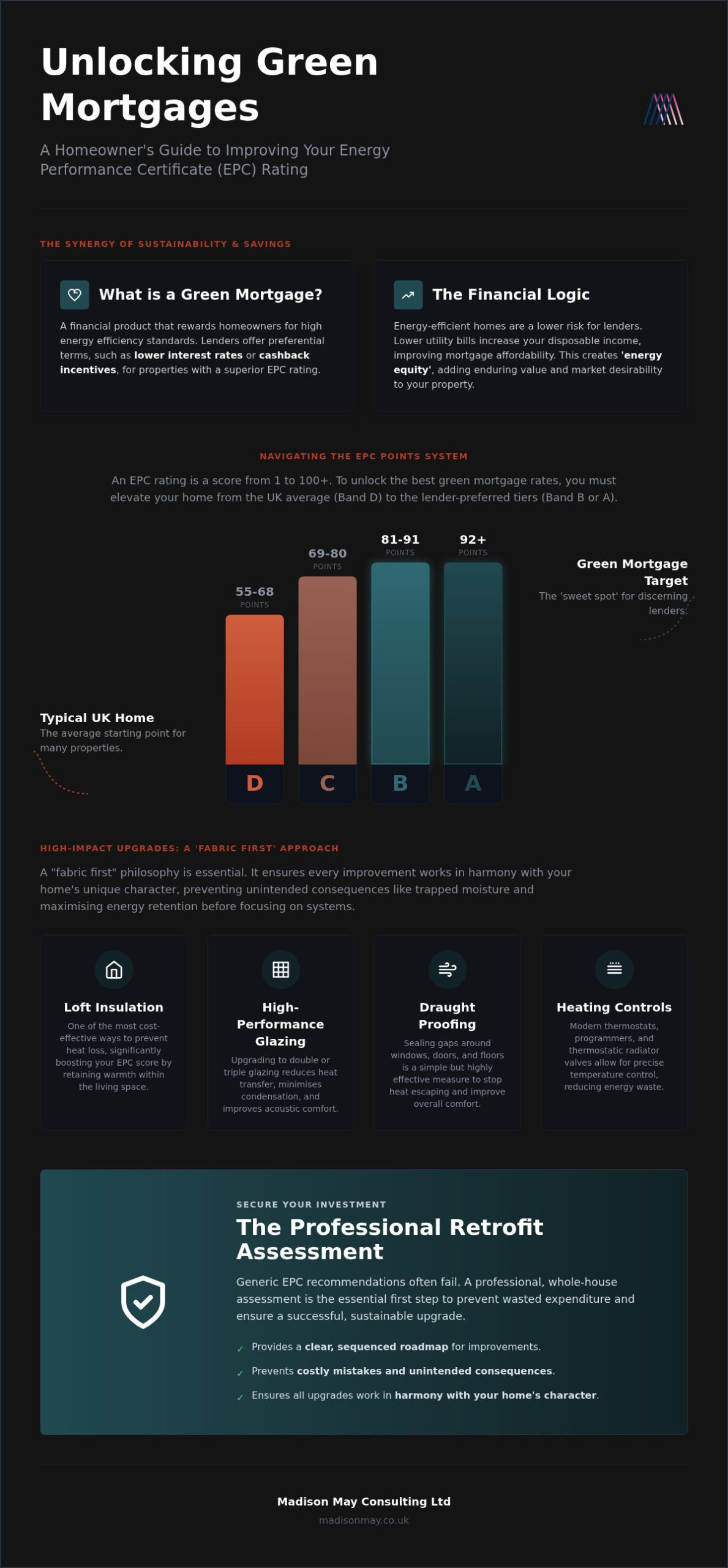
A green mortgage is a sophisticated financial instrument that links the performance of your property to the cost of your borrowing. Unlike traditional loans that focus solely on your credit profile, these products offer lower interest rates or significant cashback incentives based on the building’s environmental impact. It’s a recognition of the property’s quality and its future-proof design. Whether you are looking at a green purchase mortgage for a new sanctuary or exploring green remortgaging options for an existing residence, the mechanism remains the same: a higher EPC rating translates into more attractive terms. It’s a tangible reward for those who prioritise meticulous craftsmanship and sustainable living.
The financial logic of the EPC threshold
Lenders view energy-efficient homes as lower-risk investments, and this logic is grounded in the reality of modern household management. A property with a high EPC rating benefits from lower utility bills, which naturally increases a homeowner’s disposable income and their ability to service a mortgage comfortably. Whilst Band A and B remain the gold standard for the best rates, Band C is rapidly becoming the minimum requirement for future-proofing your investment against shifting regulations. This creates what we might call “energy equity”. By investing in efficiency, you are not just saving on monthly costs; you are adding a layer of enduring value to your home. It ensures your property remains a desirable, high-performing asset in a market that increasingly values calm, comfort, and environmental responsibility. This strategic approach transforms home improvement from a chore into a visionary journey of refinement.
Strategic Targeting: Deciphering the EPC Points System
To truly understand how to improve epc for green mortgage eligibility, one must look beneath the surface of the lettered bands. An Energy Performance Certificate is actually a numerical score, ranging from 1 to over 100 points. Most homes in the United Kingdom currently sit within Band D, which typically requires a score between 55 and 68 points. To unlock the financial grace of a green mortgage, you must aim for the higher echelons of efficiency. Before you begin, it is wise to check your property’s current EPC to identify your baseline score and see exactly how many points you need to ascend. This isn’t merely a bureaucratic exercise; it’s the first step in a visionary journey toward a more sustainable and refined way of living.
The points required for Band A and B
Band B, which spans from 81 to 91 points, is often regarded as the ‘sweet spot’ for discerning lenders. It represents a home that’s exceptionally well-insulated and thoughtfully managed. Achieving Band A, requiring 92 points or more, is a rare feat of architectural excellence that positions your home amongst the most sustainable in the country. Often, the difference between a high C and a qualifying B is a matter of just a few points. These can be found in the subtle, meticulous details, such as the precision of your draught proofing or the calibration of your heating controls. These small, rhythmic improvements can bridge the gap and elevate your property to a new tier of financial and physical comfort.
Why generic EPC recommendations often fail
Standard EPC assessments rely on the Reduced Data Standard Assessment Procedure (RdSAP). This is a software model that often struggles to capture the nuances of older, heritage properties. This automated approach can lead to suggestions that feel impersonal and, at times, counterproductive. You might find that a high-cost measure yields a surprisingly low point gain, whilst a smaller, more refined adjustment could have a transformative effect. This is why a bespoke EPC improvement plan is essential. It moves away from the ‘computer says no’ mentality and provides a tailored roadmap that respects the unique story of your home. By shifting your mindset from merely passing a test to optimising your personal sanctuary, you ensure that every pound spent is an investment in both your comfort and your financial future. If you seek a partner to guide you through this visionary journey, exploring the expertise at madisonmay.co.uk can provide the clarity you require.
The Whole House Approach: Beyond the Checklist
Approaching property improvement as a simple shopping list of tasks is a common misstep that often leads to fragmented results. When you are exploring how to improve epc for green mortgage eligibility, the most successful outcomes arise from a “Whole House Approach”. This philosophy treats your home as a living, breathing entity where every alteration influences the next. It moves away from the rudimentary checklist and embraces a narrative of property evolution, where craftsmanship meets modern environmental science. The goal is to create a sanctuary that feels as balanced as it is efficient, ensuring that your investment enhances the home’s character whilst securing its financial future.
A truly high-performing property offers a unique sensory experience. It provides a consistent, deep warmth during the winter months without ever feeling stifling or stagnant. By viewing the building as a single ecosystem, you ensure that measures like high-performance glazing and wall insulation work in harmony with the building’s natural rhythm. This holistic perspective prevents the disjointed feeling that can occur when upgrades are handled in isolation. It transforms the technical process of retrofitting into a visionary journey of refinement, positioning your home as a sophisticated refuge that resonates on a personal level.
The Ventilation Gap: Protecting the building fabric
One of the most frequent unintended consequences of modern retrofitting is the “ventilation gap”. When we seal a property to prevent heat loss, we inadvertently restrict the natural airflow that traditional British architecture relies upon. Adding thick layers of insulation without a corresponding ventilation assessment can trap moisture within the walls, leading to damp and mould. Maintaining the “breathability” of the structure is essential for long-term health. Integrating professional damp remediation and air quality assessments into your strategy ensures that your path to a higher EPC rating doesn’t compromise the integrity of the building fabric.
PAS 2035: The gold standard of retrofit coordination
To navigate these complexities with confidence, discerning owners look to PAS 2035. This is the established framework for quality assurance in domestic energy improvements, ensuring that every measure is appropriate for the specific property. A professional Retrofit Coordinator acts as a sophisticated guide through this process, overseeing the journey from the initial survey to the final installation. Their role is to ensure that improvements are implemented in the correct sequence, preventing wasted expenditure and ensuring that each upgrade builds upon the last. This coordinated approach provides the peace of mind that your home is in capable, patient hands.
High-Impact Measures for Maximum EPC Gains
When considering how to improve epc for green mortgage eligibility, the focus must shift toward the structural integrity of the property’s envelope. Whilst renewable technologies often capture the imagination, the most profound gains are found in the quiet, foundational elements of the home. By prioritising the building’s fabric, you ensure that every subsequent investment in heating or energy generation is utilised to its fullest potential. For those looking to integrate these technologies, Greener Energy Group provides essential guidance on the advantages and disadvantages of solar power. This layered approach creates a residence that is not only efficient on paper but also deeply comfortable in practice, providing a sense of enduring quality that resonates through every room.
Fabric First: The foundation of efficiency
The “fabric first” philosophy posits that insulating the home’s shell is significantly more effective than simply upgrading a boiler. If a property cannot retain its heat, even the most sophisticated heating system will struggle to maintain a serene atmosphere. For properties with cavity walls, injecting high-quality insulation is a seamless way to boost points. In contrast, older heritage homes may require external wall insulation, which acts as a protective, thermal waistcoat for the building. Draught proofing remains an understated yet powerful measure. It is a low-disruption refinement that eliminates the subtle chills that can undermine a home’s sanctuary-like feel, providing a rhythmic balance to the internal climate.
Advanced glazing and thermal performance
Windows and doors are the apertures through which a home breathes and connects with the world, yet they are often the primary source of thermal loss. Moving beyond standard specifications toward bespoke windows and doors allows for a natural union between aesthetic harmony and technical excellence. Modern glazing units with low U-values significantly reduce heat transfer, directly translating into higher EPC points. In period homes, these high-performance solutions can be designed to mirror original features, ensuring that your journey toward sustainability does not come at the cost of your property’s unique heritage. It is a meticulous marriage of form and function.
Once the foundation is secure, renewable technologies and smart controls provide the final polish to your score. Solar PV panels and air-source heat pumps represent a visionary shift toward energy independence, often providing the necessary points to ascend from Band B to the prestigious Band A. Small details, such as intelligent heating controls and high-efficiency lighting, ensure the home operates with effortless precision. These measures represent the final steps in your property’s evolution, securing both your comfort and your financial future. To begin your own bespoke journey of improvement, you can book a professional retrofit assessment to identify the most impactful path for your specific home.
Securing Your Investment: The Professional Assessment
The final stage of your property’s evolution is not found in the physical installation itself, but in the clarity of the vision that precedes it. Whilst a standard Energy Performance Certificate offers a useful baseline, it often lacks the granular depth required for a truly transformative project. For those seeking to master how to improve epc for green mortgage applications, the value of a professional Retrofit Assessment cannot be overstated. It provides a level of scrutiny that standard surveys simply cannot match, ensuring that every decision is backed by empirical data and every pound is spent with purpose. This expert guidance offers more than just technical precision; it provides the peace of mind that comes from knowing your home is in the hands of thoughtful curators who value its heritage as much as its performance.
A professional assessment removes the guesswork that often plagues home improvement projects. Instead of a series of disconnected chores, you receive a cohesive strategy that prevents wasted expenditure on low-impact measures. This ensures that your investment is protected and that the improvements you make deliver the maximum possible gain for your EPC score. It is a process of quiet confidence, where the complexity of the design process is handled by visionary experts, allowing you to focus on the emotional impact of your evolving space. Your home becomes a legacy of efficiency and refined design, a sanctuary that reflects your commitment to quality and sustainability.
The roadmap to a Green Mortgage
A successful transition requires a clear, sequenced strategy that respects the unique story of your property. By utilising a detailed building survey, hidden areas of heat loss that escape the notice of automated software are identified with precision. This allows for a bespoke plan where upgrades are organised to match both your financial goals and your lifestyle requirements. At Madison May Consulting Ltd, we facilitate this journey by acting as a sophisticated guide, moving your property from a typical Band D to a mortgage-ready Band B through a series of intentional, high-impact refinements. It is a process of crafting a more resilient and refined environment that stands as a testament to your stewardship.
Taking the first step toward your sanctuary
Timing is often as critical as the technical measures themselves. Engaging in an early consultation before you begin your mortgage application ensures that you have a robust EPC Improvement Plan in place. This document serves as the essential evidence required by lenders to verify your property’s future performance and eligibility for preferential rates. By gathering this data early, you position yourself as a discerning and prepared borrower. Your home is a deeply personal refuge, and its journey toward efficiency should be treated with the same care as its interior design. To begin this visionary journey, you can request your bespoke EPC Improvement Plan today and secure the financial future of your sanctuary.
Crafting Your Sustainable Legacy
Securing a green mortgage is far more than a simple financial manoeuvre; it’s a profound act of property stewardship that preserves the heritage of your home whilst enhancing its future performance. You’ve seen that the transition from a standard Band D to a prestigious Band B requires a shift in mindset, moving away from fragmented checklists toward a coordinated, whole-house philosophy. By prioritising the building’s fabric and mastering the nuances of the points system, you ensure every refinement contributes to a harmonious and efficient sanctuary.
Gaining a clear understanding of how to improve epc for green mortgage applications is merely the start of a visionary journey. With the support of PAS 2035 aligned Retrofit Coordinators, you can navigate these complexities with quiet confidence. Our specialists in whole-house energy strategies provide the expert guidance required for domestic property compliance, ensuring your home remains a high-performing refuge. Begin your journey to a more efficient home with a bespoke EPC Improvement Plan and embrace the calm deliberation of a home designed for the future. Your sanctuary is ready for its next chapter of elegance.
Frequently Asked Questions
What EPC rating do I need for a green mortgage?
Most lenders require your property to achieve an EPC Band A or B to qualify for their most attractive green mortgage products. Whilst some providers offer incentives for Band C, the most significant interest rate reductions and cashback offers are reserved for high-performing homes that demonstrate exceptional energy stewardship. It’s essential to verify the specific thresholds with your chosen lender before you begin learning how to improve epc for green mortgage eligibility through strategic renovations.
Can I get a green mortgage if I am buying a fixer-upper?
You can certainly access green finance for a property that requires refinement, though the path often involves a green remortgage once the works are complete. Some lenders provide specific green additional borrowing products, allowing you to fund energy-efficient upgrades at a lower rate. Once your property reaches the required Band A or B threshold, you can transition to a full green mortgage product, rewarding your commitment to creating a sustainable sanctuary from a neglected space.
How much can a green mortgage actually save me on my monthly payments?
The financial rewards vary amongst lenders, but you can typically expect a reduction of between 0.1% and 0.5% on your interest rate compared to standard products. For a substantial mortgage, this small percentage translates into significant annual savings. Additionally, many providers offer cashback incentives of several hundred pounds upon completion. These savings, combined with lower utility bills, create a compelling financial argument for investing in a meticulous, whole-house approach to energy efficiency.
Why did my EPC rating not improve after I installed a new boiler?
An EPC rating often remains stagnant if the building’s fabric continues to allow heat to escape, rendering the new boiler’s efficiency less impactful. The RdSAP software used for assessments prioritises the overall thermal envelope; if your walls and loft lack sufficient insulation, a boiler upgrade alone may not provide enough points to jump a band. This highlights the necessity of a coordinated roadmap that addresses heat retention before focusing solely on the heating source itself.
What is the difference between an EPC and a Retrofit Assessment?
An EPC is a basic, cost-based snapshot of a property’s efficiency, whereas a Retrofit Assessment is a comprehensive, PAS 2035 aligned deep-dive into the building’s health. The assessment considers ventilation, occupancy, and structural condition to create a bespoke plan that avoids unintended consequences like damp. Whilst an EPC tells you where you are, a Retrofit Assessment provides the visionary coordination required to transform your home into a high-performing, sustainable refuge with confidence.
Is it possible to achieve a Band B rating in a Victorian terrace house?
Achieving a Band B in a Victorian terrace is entirely possible through a rigorous fabric first strategy that respects the building’s heritage. By utilising internal wall insulation, high-performance glazing, and sophisticated draught proofing, you can significantly elevate the property’s score. When these measures are combined with modern heating controls or solar technology—often designed and installed by specialists like Empire Electrical Innovations—even the most traditional home can ascend to the higher echelons of energy efficiency, securing its place as a future-proofed investment.
How long does it take for an EPC improvement plan to be created?
A bespoke EPC improvement plan is typically finalised within five to seven working days following the initial site visit. This measured pace allows experts to meticulously analyse the data and craft a sequenced roadmap tailored to your property’s unique architecture. This deliberation ensures that the final document provides a reliable and imaginative guide, allowing you to organise your renovations and financial planning with absolute clarity and poise.
Do I need a new EPC certificate immediately after completing the works?
You must commission a new EPC assessment once your energy improvements are finalised to provide the lender with formal evidence of your new rating. This updated certificate serves as the key that unlocks your green mortgage benefits, confirming that your property has reached the required Band A or B status. It’s the final, rhythmic step in your journey, transforming your meticulous craftsmanship into a tangible financial reward and a more comfortable, enduring sanctuary.