

What if the very apertures that invite light into your home are the silent thieves stealing its warmth and character? It’s a common frustration for owners of heritage properties who find themselves shivering in draughty rooms while watching energy bills climb. You might be considering energy efficient heating upgrades many heritage properties often require to combat the chill, yet even the most sophisticated boiler cannot compensate for windows that fail to hold the heat. It’s understandable to feel hesitant about modern replacements, especially when the fear of uninspiring finishes threatens to disrupt the architectural story of a cherished home.
We believe that your living space should be a sanctuary of calm, where technical performance and aesthetic elegance exist in perfect harmony. This guide will show you how to navigate the complexities of thermal performance and solar gain through a meticulous, whole-house approach to window replacement. You’ll discover how to enhance your EPC rating and reduce consumption without losing the soul of your property. We’ll explore how to select windows that feel like a natural extension of your home’s history while ensuring a serene, draught-free environment for years to come.
Key Takeaways
- View your windows as the critical thermal skin of your home, where technical performance meets the emotional impact of a draught-free sanctuary.
- Master the nuances of U-values and solar gain to ensure your new glazing balances natural light with exceptional heat retention.
- Discover how to select timber or aluminium frames that harmonise your property’s architectural heritage with contemporary thermal break technology.
- Understand why windows must be integrated into a broader strategy for energy efficient heating upgrades Yorkshire residences require for a superior EPC rating.
- Learn why a professional retrofit assessment is the essential first step to protect your home from damp whilst ensuring a truly holistic energy solution.
Beyond the Glass: The Philosophy of Energy Efficient Windows
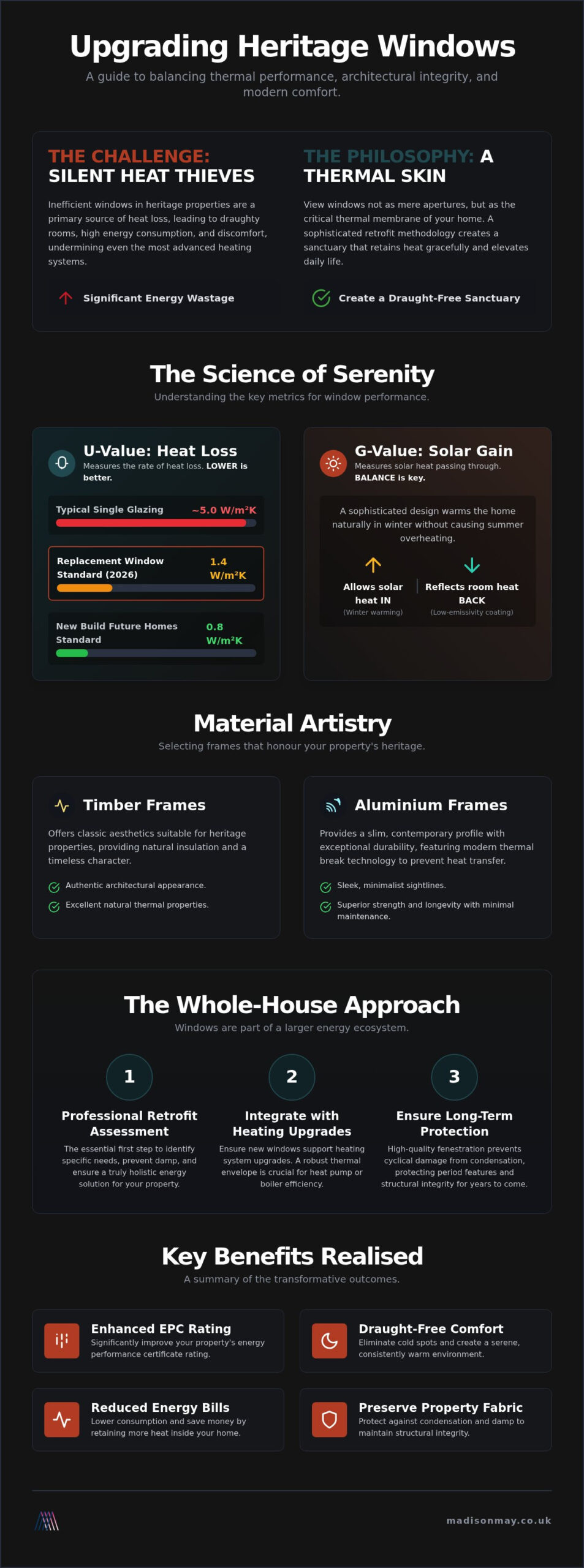
Windows are often perceived as mere apertures for light, yet they function as the primary thermal skin of your domestic sanctuary. This delicate membrane dictates the relationship between your interior world and the external elements. When homeowners explore energy efficient heating upgrades Yorkshire properties frequently require, the focus often rests solely on the boiler or heat pump. However, the most sophisticated heating system remains hindered if the building’s envelope allows warmth to bleed away through inefficient glazing. Shifting your perspective from simple window replacement to a sophisticated retrofit methodology is the first step in creating a home that breathes with intention and retains its heat with grace.
Choosing high-performance fenestration is an investment in the long-term heritage of a property. It’s about more than just numbers on a utility bill; it’s a commitment to preserving the fabric of the building whilst elevating the daily experience of those within it. A draught-free, light-filled environment transforms the atmosphere of a room, replacing the restless chill of a winter evening with a profound sense of stillness and thermal security.
The Thermal Narrative of a Home
The dialogue between interior comfort and the outdoors is written in the glass and frames you choose. Every material choice should be an intentional part of your property’s story, honouring its architectural past whilst embracing a future of efficiency. There is a subtle but vital difference between standard double glazing and high-performance units. True thermal elegance relies on the meticulous application of low-emissivity coatings and inert gas fills, concepts that are central to the science of insulated glazing. By selecting units designed for superior heat retention, you ensure that your windows are no longer the weakest link in your home’s thermal narrative but are instead its most protective feature.
Sustainability as a Lifestyle Choice
Embracing energy efficiency is a transformative artistic journey that aligns your living space with your personal values. Moving beyond the functional necessity of reducing a carbon footprint, high-quality fenestration serves as a cornerstone of property preservation. It prevents the cyclical damage caused by condensation and internal temperature fluctuations, protecting period features and structural integrity. This holistic approach ensures that any energy efficient heating upgrades Yorkshire residents undertake are supported by a robust thermal envelope. Ultimately, these improvements cultivate a sense of personal sanctuary, where the external world is invited in through light but held at bay by a silent, invisible barrier of warmth.
The Science of Serenity: Decoding U-Values and Performance
Achieving a truly tranquil home environment requires a shift from aesthetic appreciation to technical precision. While the visual appeal of a window defines a room’s character, its invisible components determine its soul. True thermal comfort isn’t merely about the absence of a draught; it’s the result of a carefully engineered balance between heat retention and solar management. When planning energy efficient heating upgrades Yorkshire homeowners often discover that the most advanced heat pump cannot reach its full potential if the building’s apertures are inefficient. Understanding the metrics of performance allows you to transform your home into a vessel of consistent, enduring warmth.
The U-Value Explained
The U-value is the rate of heat loss through a square metre of a window. A lower numerical value represents a more refined thermal barrier, indicating that less energy is escaping your living space. Under the current 2026 building regulations, replacement windows must achieve a maximum U-value of 1.4 W/m²K or meet a Window Energy Rating of at least band B. For those embarking on new build projects, the standards are even more stringent, requiring a U-value of 0.8 W/m²K to align with the Future Homes Standard. These benchmarks ensure that every installation contributes meaningfully to the property’s overall efficiency.
Beyond the U-value, we must consider the G-value, which measures solar gain. This represents the amount of heat from the sun that passes through the glazing. A sophisticated design balances this gain to warm the home naturally in winter without causing overheating during the summer months. Modern units achieve this through low-emissivity coatings that invisibly reflect internal heat back into the room. This technology is supported by warm-edge spacer bars and inert gas fills, such as argon, which sit between the panes to eliminate the thermal bridging that traditionally caused cold spots and condensation at the glass edges.
Double vs Triple Glazing: A Nuanced Comparison
Choosing between double and triple glazing requires a thoughtful analysis of your property’s specific needs. Triple glazing offers a significant leap in thermal performance, making it a worthy investment for north-facing elevations or homes in particularly exposed locations. Beyond heat retention, the extra pane provides a secondary gift of acoustic insulation, creating a profound sense of hush in busy urban environments. For many, a professional retrofit assessment is the most reliable way to determine where triple glazing will provide the greatest return on comfort.
In many instances, high-performance double glazing remains an excellent choice for south-facing rooms where solar gain is a priority. The decision should never be uniform across the entire house. Instead, it should be a tailored strategy that considers the orientation of each room and its role in your daily life. By aligning these technical choices with your broader energy efficient heating upgrades Yorkshire strategy, you create a home that is as scientifically sound as it is beautiful.
Material Artistry: Selecting Frames that Honour Your Property
Selecting the frame material for your windows is a decision that extends far beyond mere durability. It is the physical manifestation of your home’s architectural story. Whilst technical metrics like U-values provide the framework for efficiency, the material itself provides the sensory experience. When considering energy efficient heating upgrades Yorkshire homeowners must ensure their choice of frame complements the wider thermal strategy of the property. A frame is not just a border; it is a structural element that either anchors a room in its heritage or propels it into a contemporary era of design.
Timber: Heritage and High Performance
Wood possesses an inherent, organic warmth that synthetic materials often struggle to replicate. Its cellular structure makes it a superb natural insulator, making it a cornerstone of energy efficient home improvements for period residences. For those who value the architectural soul of a traditional home, timber frames offer a sympathetic dialogue with the past. The common myth of high maintenance has been elegantly addressed by modern micro-porous paints and stains. These finishes allow the timber to breathe whilst providing a protective barrier that remains resilient against the elements for decades without the need for constant attention.
Aluminium and Contemporary Elegance
For properties that lean towards a more minimalist or modern aesthetic, aluminium provides an unmatched combination of slim sightlines and structural integrity. The strength of the metal allows for larger glass spans, inviting more natural light into your sanctuary without compromising on warmth. This is achieved through sophisticated thermal break technology, where a non-conductive material is placed between the internal and external profiles to prevent heat transfer and condensation. Finished with a bespoke polyester powder coating, these frames offer an enduring elegance that requires minimal intervention to maintain its pristine appearance across the seasons.
Modern uPVC has also undergone a significant artistic refinement. High-quality foils now allow for sophisticated finishes, including realistic woodgrain effects that provide a polished look without the requirement for painting. For those seeking the ultimate union of durability and aesthetic grace, composite materials offer a compelling solution. By combining the natural insulation of timber with the weather-resistant properties of synthetic outer layers, composite frames serve as a resilient guardian for your home. These materials ensure that any energy efficient heating upgrades Yorkshire projects involve are supported by a frame that is both technically sound and visually harmonious.
The Holistic Perspective: Why a Retrofit Assessment is Essential
Viewing a home as a collection of separate components is a common oversight that can compromise both thermal comfort and structural integrity. When windows are replaced in isolation, the delicate balance of the building’s ecosystem is often disrupted. For those pursuing the energy efficient heating upgrades Yorkshire properties require for modern standards, it’s vital to recognise that the house functions as a single, breathing entity. Improving one area without considering the impact on another, such as ventilation or wall insulation, can lead to unintended consequences that far outweigh the benefits of new glazing.
The approach taken by Madison May Consulting Ltd is rooted in data-driven thermal improvement. By utilising professional building surveys, we ensure that your investment is part of a coherent, PAS 2035 aligned strategy. This methodology identifies the correct sequence for energy efficient heating upgrades, ensuring that every modification supports the next. A holistic survey ensures that your window installation is timed perfectly alongside other energy efficient heating upgrades Yorkshire homeowners may be considering, creating a seamless transition to a high-performance home.
The Risks of Over-Insulation
A common pitfall in the pursuit of efficiency is making a property too airtight. Without a planned ventilation strategy, sealing a home can trap moisture, leading to the growth of mould and damp. Part F of the building regulations mandates healthy air exchange, often achieved through the subtle integration of trickle vents. These features allow for a controlled flow of fresh air, maintaining a serene indoor environment whilst preserving the thermal gains of your high-performance windows. Balancing heat retention with healthy air exchange is essential for a home that feels as fresh as it is warm.
The Value of a Fixed-Fee Assessment
Traditional sales-led approaches often rely on guesswork, but a professional assessment provides a clear, forensic roadmap. By identifying hidden heat loss through thermal imaging, we can create a meticulous EPC improvement plan. This ensures that your new windows work in perfect harmony with your loft and wall insulation, rather than competing with them. This whole-house perspective transforms a simple home improvement into a visionary act of property stewardship, moving from generic replacements to a tailored thermal sanctuary.
Secure the future of your property and ensure every detail is intentional by commissioning a professional retrofit assessment before you begin your journey.
Securing Your Sanctuary: The Journey to Installation
The transition from a conceptual design to a physically transformed home is a journey that requires both vision and professional discipline. It begins with the quiet deliberation of defining your thermal goals, where you consider the emotional impact of every room alongside a realistic investment budget. This initial stage is not merely about selecting products; it’s about curating a lifestyle that prioritises enduring comfort. By commissioning a professional retrofit assessment from Madison May Consulting Ltd, you gain a sophisticated roadmap that ensures any energy efficient heating upgrades Yorkshire projects require are grounded in technical reality and architectural respect.
Selecting bespoke windows and doors is perhaps the most evocative part of the process. These elements must resonate with your property’s unique character whilst meeting the stringent performance standards discussed in previous chapters. To navigate the complexities of this installation, a Retrofit Coordinator acts as your project guardian. They oversee every technical detail, ensuring compliance with PAS 2035 and verifying that the craftsmanship matches the visionary design. This professional oversight ensures that the dialogue between your home’s heritage and its new thermal skin remains harmonious throughout the build.
Planning for Excellence
Navigating the intricate requirements of planning permissions is essential, particularly for those residing in conservation areas or listed buildings where heritage must be preserved with absolute care. We prioritise your peace of mind by ensuring all installations meet FENSA or CERTASS certification standards, providing a verified mark of quality and legal compliance. A thoughtfully constructed project timeline is equally vital. It should respect the rhythm of your daily life, ensuring the transition to a more efficient home feels like a seamless evolution rather than a disruption to your sanctuary. Whilst energy efficient heating upgrades Yorkshire residents choose often focus on internal systems, the final installation of high-performance glazing is what truly seals the building envelope.
Long-Term Stewardship of Your Home
The completion of your installation marks the beginning of a new chapter in property stewardship. To ensure enduring performance and aesthetic beauty, a simple but consistent maintenance routine will protect the integrity of your frames and the clarity of your glazing. Once the work is finished, updating your Energy Performance Certificate rating is a rewarding final step. It provides a documented reflection of your home’s improved efficiency and increased value. There is a profound sense of calm that comes from knowing your home is protected by a strategy coordinated by Madison May Consulting Ltd, ensuring that every detail of your thermal refuge is intentional and secure.
Embracing a Future of Thermal Harmony
Crafting a home that balances architectural heritage with modern thermal performance is a transformative journey. By viewing your windows as the primary thermal skin rather than a commodity, you ensure that every material choice honours your property’s unique story. We’ve explored how technical precision, from U-values to material artistry, creates a sanctuary of stillness and warmth. This holistic approach is the essential foundation for any broader energy efficient heating upgrades Yorkshire homeowners might pursue, ensuring that heat is retained with grace and intention.
Madison May Consulting Ltd provides the professional expertise required to navigate this complexity with ease. Through our PAS 2035 aligned assessments and expert retrofit coordination, we move beyond sales guesswork to deliver a data-driven EPC improvement plan. Our fixed-fee consultations offer the clarity needed to begin your project with confidence, ensuring your home remains a personal refuge for years to come. Your property deserves this level of care.
Frequently Asked Questions
What is the most energy efficient window frame material available for UK homes?
Timber is traditionally considered the most naturally insulating material, though modern aluminium with advanced thermal breaks and high-quality uPVC now offer comparable performance. The choice often depends on the architectural requirements of your property. For those integrating windows into broader energy efficient heating upgrades Yorkshire homes need, the focus should be on the total system performance rather than just the frame material. High-performance units must balance thermal retention with aesthetic elegance.
How much can I realistically save on my energy bills with new high-performance windows?
Realistic savings depend entirely on your property’s current condition and how the windows interact with other insulation measures. Whilst new glazing significantly reduces heat loss, the greatest financial impact is achieved when windows are part of a coordinated EPC improvement plan. By addressing the building fabric as a whole, you can reduce the demand on your heating system. A professional assessment provides the data needed to understand the specific returns for your unique domestic sanctuary.
Do I need to replace all my windows at once for maximum thermal efficiency?
You don’t have to replace every window simultaneously, but a phased approach should follow a professional roadmap to avoid thermal imbalances. Prioritising the coldest or most exposed rooms can provide immediate comfort gains whilst you plan for future improvements. We recommend using a PAS 2035 aligned retrofit assessment to identify the most effective sequence. This ensures that each stage of your energy efficient heating upgrades Yorkshire project builds towards a cohesive and thermally efficient environment.
Will energy efficient windows stop condensation on the inside of the glass?
High-performance windows are designed to keep the internal pane of glass warmer, which significantly reduces the likelihood of surface condensation. However, making a home more airtight can trap moisture inside the building if ventilation isn’t managed. It’s essential to balance new glazing with a professional ventilation assessment to prevent damp and mould elsewhere. This whole-house perspective ensures that your journey to a more efficient home doesn’t compromise the air quality of your sanctuary.
What is the difference between a standard window quote and a retrofit assessment?
A standard window quote is typically a sales-focused estimate for a specific product, whereas a retrofit assessment is a forensic, data-driven survey of your entire home. Our assessments follow the PAS 2035 framework, examining building fabric, services, and ventilation. This provides a comprehensive roadmap for improvements rather than just a price for glass. A fixed-fee assessment ensures you receive impartial advice that prioritises the long-term health and efficiency of your property over a simple sale.
Are triple glazed windows worth the extra cost in the UK climate?
Triple glazing is often a worthy investment for north-facing elevations or properties in particularly exposed locations where heat loss is most prevalent. In the UK climate, the extra pane provides a superior thermal barrier and exceptional acoustic insulation, creating a profound sense of hush. Under the 2026 Future Homes Standard, triple glazing is becoming the benchmark for new builds to achieve the required 0.8 W/m²K U-value, representing the pinnacle of domestic thermal security.
How do I ensure my new windows comply with Part F ventilation regulations?
Ensuring compliance with Part F of the building regulations involves a meticulous review of your property’s air exchange. New windows often require the integration of trickle vents to provide background ventilation without compromising your thermal gains. A professional retrofit coordinator can oversee this process, verifying that your home remains healthy and breathable after the installation. This careful balance between airtightness and fresh air is vital for maintaining a comfortable, damp-free living environment across all seasons.
Can I install energy efficient windows in a listed building or conservation area?
You can certainly install energy efficient windows in heritage properties, provided the design respects the original architectural story. Listed buildings and conservation areas usually require sympathetic timber frames that replicate historical details whilst incorporating high-performance slimline glazing. Navigating these planning permissions requires a thoughtful approach and expert guidance. By choosing bespoke units that honour the property’s heritage, you can achieve modern thermal standards without losing the soul or character of a traditional residence.