


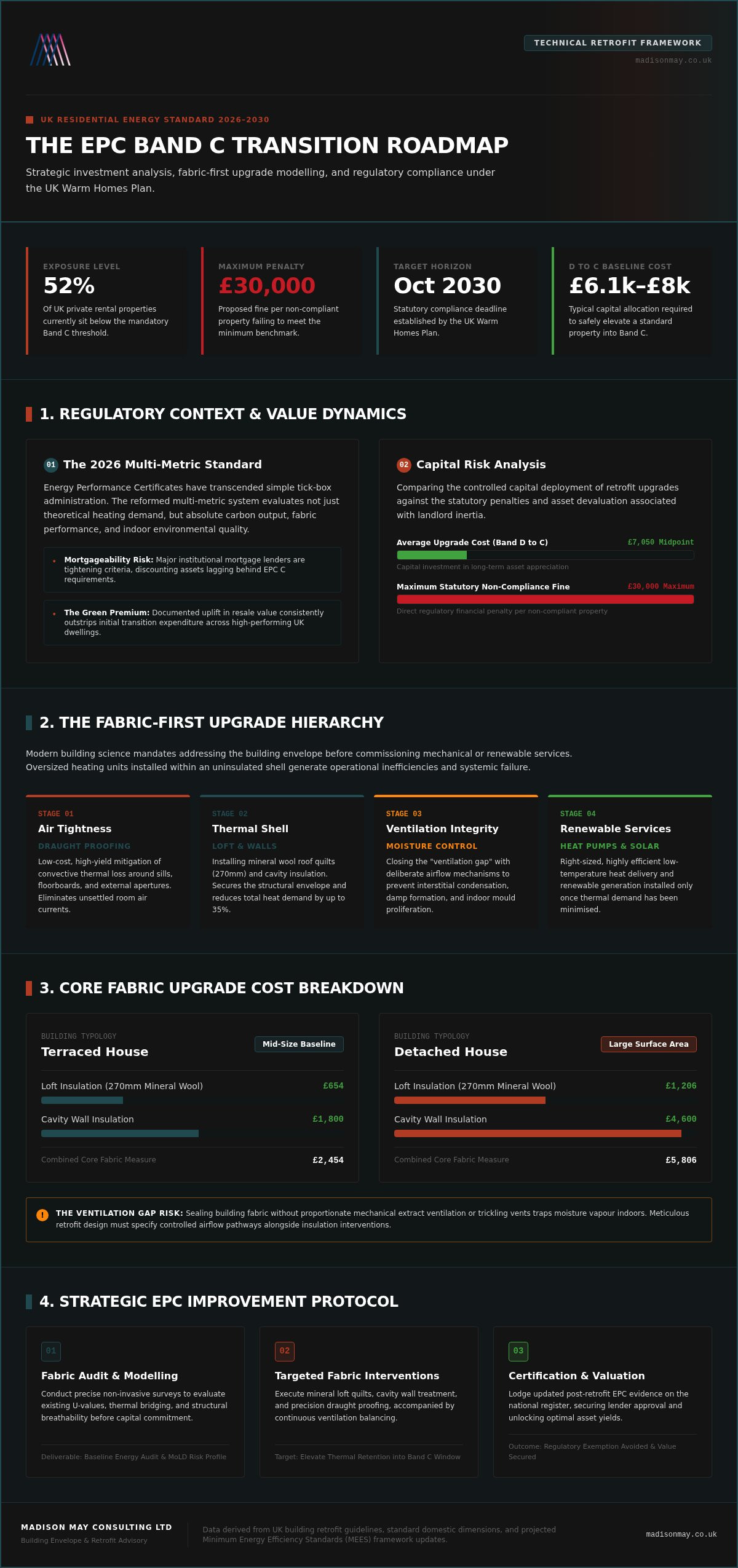
Did you know that 52% of privately rented properties in the UK currently sit below the proposed EPC ‘C’ threshold, leaving owners vulnerable to a shifting regulatory landscape and potential fines of up to £30,000? Transforming a house into a high-performing, energy-efficient sanctuary is a journey of meticulous craftsmanship, yet many homeowners find themselves stalled by conflicting advice and the fear of unintended consequences like damp. You likely want a home that feels as refined as it looks, but the uncertainty surrounding the actual cost of improving epc rating uk can make the first step feel daunting.
At Madison May Consulting Ltd, we understand that your property is more than just an asset; it’s a personal refuge that deserves a thoughtful, fabric-first approach. This guide promises to clarify the investment required to harmonise your building’s envelope with modern technology, ensuring you achieve compliance without compromising the integrity of your space. We’ll explore a detailed roadmap of costs, from essential insulation to the sophisticated integration of renewables, providing you with the quiet confidence to create a warmer, more sustainable future.
Key Takeaways
- Adopt a fabric-first philosophy to ensure your property’s envelope is perfectly prepared before integrating sophisticated low-carbon heating solutions.
- Evaluate the cost of improving epc rating uk as a meaningful investment in capital appreciation, with typical transitions from D to C requiring a budget of £6,100 to £8,000.
- Master the nuances of the 2026 multi-metric EPC system to ensure your property remains a compliant and high-performing sanctuary ahead of the 2030 deadline.
- Mitigate the risk of the “ventilation gap” by prioritising professional assessments that prevent damp and protect the long-term health of your building fabric.
- Utilise a bespoke EPC Improvement Plan to sequence your upgrades logically, allowing you to enhance your home’s efficiency with the calm deliberation of a master craftsman.
Understanding the EPC as a Value Driver for Your Property
In the evolving landscape of the British property market, the Energy Performance Certificate (EPC) has transcended its origins as a mere administrative requirement. By 2026, it has become a central pillar of property valuation, acting as a transparent record of a building’s efficiency and environmental stewardship. Viewing the cost of improving epc rating uk as a simple expense is a perspective of the past; instead, modern homeowners recognise these upgrades as essential capital appreciation. It’s a meticulous process of refining the home’s character, ensuring that the physical structure performs with the same grace and elegance as its interior design.
This shift is deeply psychological. We no longer talk simply about saving pennies on a utility bill; we speak of creating a sanctuary. A home with a superior energy rating offers a sense of calm and permanence, where the air is fresh and the temperature remains a steady, comforting embrace regardless of the season. Beyond the emotional resonance, a high-performing property demands less from its mechanical systems, significantly reducing long-term maintenance burdens and preserving the integrity of the building’s heritage for generations to come.
The Move from Band D to C: A Regulatory Necessity
The current regulatory environment has turned the transition from Band D to C into a matter of necessity rather than choice. Under the government’s Warm Homes Plan, the policy objective aims for all private rented properties to reach a minimum EPC rating of ‘C’ by October 2030. For the modern landlord, the financial risks of inertia are substantial, with proposed fines for non-compliance reaching as high as £30,000 per property. Beyond the threat of penalties, “Grade C” is rapidly becoming the benchmark for mortgageability, as lenders increasingly favour assets that meet future-proofed standards of efficiency. Furthermore, residential specialists such as Taylors Estate Agency note that properties with strong efficiency ratings hold a distinct advantage when attracting prospective buyers in today’s market.
Calculating the ROI of Energy Efficiency
Whilst the immediate reduction in energy expenditure is a welcome benefit, the true return on investment lies in the “Green Premium” now evident across the UK housing market. Research indicates that the average cost of improving epc rating uk to move a property from a D to a C rating sits between £6,100 and £8,000, a figure that is often eclipsed by the resulting uplift in resale value. Buyers are increasingly willing to pay a premium for homes that promise lower operational costs and a reduced carbon footprint. Ultimately, the EPC serves as a chapter in a property’s architectural storytelling, illustrating a commitment to quality that resonates with the values of a new generation of homeowners. For insights into how professionals approach the valuation of high-quality assets, you can discover JSRE Sàrl.
Fabric-First Upgrades: The Core Costs of Insulation
The foundation of a truly high-performing home is found in the quiet efficiency of its walls and roof. This fabric-first philosophy dictates that we must secure the building envelope before considering sophisticated heating systems. It prevents the inefficiency of oversized equipment and ensures the heat you pay for remains within your sanctuary. When assessing the total cost of improving epc rating uk, starting with the property’s shell is the most logical and rhythmic approach, ensuring every subsequent upgrade performs to its full potential.
Before committing to major structural changes, consider the humble impact of professional draught proofing. It’s a low-cost, high-impact essential that preserves the stillness of a room, removing those minute, unsettling currents of cold air that can undermine even the most beautiful interior designs. By addressing these gaps around windows, doors, and floorboards, you create a more stable environment that feels as refined as it looks.
Loft and Cavity Wall Insulation Costs
Loft insulation remains one of the most accessible steps in the enhancement process. For a typical terraced house, installing 270mm of mineral wool quilt costs approximately £654, whilst larger detached properties may require an investment of £1,206. Cavity wall insulation offers a more substantial barrier, with costs ranging from £1,800 for a mid-terrace to £4,600 for a detached home. Labour for older, traditional UK builds often requires a more meticulous touch to ensure the insulation is distributed evenly without compromising existing features. For those seeking more detailed regional insights, our guide to energy efficient home improvements offers a closer look at these essential measures.
The Complexity of Solid Wall Insulation
Whilst the initial cost of improving epc rating uk for solid wall properties can be significant, the long-term protection of the building fabric is invaluable. For these homes, the choice between internal and external insulation involves a delicate balance of cost and property character. External wall insulation can be transformative for a building’s performance, yet it requires a sensitive touch to preserve architectural heritage. Conversely, internal insulation protects the facade but slightly reduces the internal floor area. According to the UK Government Energy Efficiency Guidance, managing the breathability of traditional materials is vital to avoid moisture buildup. Professional building surveys are indispensable here, ensuring that your investment enhances the building without compromising its structural health. A bespoke EPC Improvement Plan ensures every material choice is intentional and every detail is handled with care.
Modernising Services: Heating Systems and Renewable Costs
Transitioning from the building’s shell to its internal heartbeat requires a thoughtful shift in perspective. In the 2026 property market, an Energy Performance Certificate is no longer just about how much heat you lose, but how cleanly you generate it. The rating now leans heavily on the carbon intensity of your fuel source. As the national grid continues to decarbonise, electricity has become the preferred medium for those seeking both environmental stewardship and long-term compliance. When calculating the cost of improving epc rating uk, the transition to low-carbon heating often represents the most significant technical investment, yet it’s the one that most profoundly transforms the home’s operational character.
The 2026 reality of Air Source Heat Pump (ASHP) installation is one of refined technology and supportive policy. Typical supply and installation costs currently range between £3,000 and £15,000, depending on the system’s complexity and the property’s scale. The Boiler Upgrade Scheme (BUS) grant of £7,500 remains a vital catalyst for many, often bringing the net investment for a sophisticated air-to-water system down to a level that rivals traditional gas boiler replacements. For homes currently reliant on heating oil, this grant increases to £9,000, providing a clear pathway away from fossil fuels toward a more sustainable sanctuary.
Solar Battery Storage Cost UK: An In-Depth Look
Achieving true energy independence involves capturing the sun’s generosity and storing it for when the house is at its most quiet and reflective. A 5kWh battery system typically requires an investment between £3,500 and £5,000, whilst a more substantial 10kWh system can reach £8,000. These systems are essential for maximising nap-energiás efficiency, ensuring that the power harvested during the day isn’t simply lost to the grid but is available to illuminate your evening. Retrofitting a battery to an existing solar array involves additional labour and hardware costs, usually around £500 to £1,000, but it effectively turns a passive installation into an intelligent energy hub.
Heat Pumps and High-Efficiency Windows
A successful heat pump installation often necessitates a review of how warmth is distributed through your rooms. Because these systems operate at lower temperatures, upgrading to larger radiators or underfloor heating ensures the heat is emitted with a gentle, steady grace. This efficiency is preserved by your choice of glazing. Whilst double glazing is the expected standard, triple glazing can offer the marginal gains in EPC points needed to reach a high B or A rating. Choosing the right windows and doors is a critical part of this harmony, ensuring the cost of improving epc rating uk results in a home that is as thermally secure as it is aesthetically pleasing.
Strategic EPC Improvement Plans: Navigating Compliance
While every property receives a list of automated recommendations on its standard certificate, these generic suggestions often lack the nuance required for a truly bespoke enhancement. A standard report might suggest a solar array without considering the shading of a heritage chimney or recommend internal insulation that could compromise original cornicing. Understanding the true cost of improving epc rating uk requires more than just ticking boxes; it demands a strategic vision that treats the building as a living, breathing entity. By investing in professional consultancy, you ensure that every pound spent contributes to a cohesive narrative of efficiency rather than a disjointed collection of upgrades.
Sequencing is the silent guardian of your investment. Embarking on a heating upgrade before securing the building’s fabric often leads to “locking in” poor performance, where an expensive heat pump must work twice as hard to compensate for a draughty loft. A professional roadmap allows you to phase costs over several years, aligning improvements with natural refurbishment cycles. This measured approach ensures that each step builds upon the last, protecting the property’s structural health and your financial peace of mind.
The Meticulous Roadmap to Grade B or A
Moving a property beyond the standard Grade C requires a deeper level of technical deliberation. There is often a “tipping point” where measures become more capital-intensive, such as transitioning from simple loft insulation to sophisticated triple glazing or floor insulation. Using SAP calculations during the planning phase allows you to predict post-improvement ratings with surgical precision, removing the guesswork from your investment. Our EPC improvement plan provides this exact level of foresight, ensuring your journey toward an A-rated sanctuary is both logical and inspired.
Landlord Compliance and MEES Exemptions
For the modern landlord, navigating the Minimum Energy Efficiency Standards (MEES) is a matter of legal and financial survival. With the policy objective of all private rentals reaching a ‘C’ rating by 2030, the proposed spending cap of £10,000 per property serves as a vital benchmark. If a property cannot reach the required grade after this investment, a professional assessment becomes the essential evidence needed to register an exemption. Meticulous documentation of the cost of improving epc rating uk is your best protection against potential fines of up to £30,000, ensuring your portfolio remains both compliant and prestigious. To ensure your property meets these rigorous standards with poise, you can book a professional retrofit assessment to clarify your next steps.
Beyond the Certificate: The Madison May Retrofit Strategy
True property enhancement transcends the simple arithmetic of a certificate. While the initial cost of improving epc rating uk often focuses on heat retention, a sophisticated retrofit must also consider how a building breathes. At Madison May, we believe that property enhancement is an architectural journey where technical precision meets a deep respect for the building’s character. Adhering to the PAS 2035 standards isn’t merely a regulatory requirement; it’s a commitment to protecting your financial investment through a whole-house approach. By positioning a Retrofit Coordinator as the guardian of your project, we ensure that every measure is harmonised to prevent the unintended consequences that often plague uncoordinated works.
A significant component of the cost of improving epc rating uk involves the often-overlooked necessity of ventilation. When we seal a property to retain warmth, we risk trapping moisture, which can lead to a compromised living environment. Our strategy ensures that your home remains a healthy, breathable refuge, where the air is as fresh as the design is elegant. We look beyond the immediate rating to ensure the long-term structural health of your sanctuary, avoiding the “ventilation gap” that can undermine even the most expensive insulation upgrades.
The Ventilation Gap and Damp Remediation
Modern energy retrofits must comply with Part F of the Building Regulations, which governs ventilation standards. Neglecting this requirement is a gamble that often results in expensive mould remediation and structural damage further down the line. Integrating mechanical solutions, such as decentralised Mechanical Extract Ventilation (dMEV) or sophisticated Mechanical Ventilation with Heat Recovery (MVHR) systems, is essential. While these systems require a specific allocation within your budget, they are far more cost-effective than the future remediation required by “cheap” insulation projects that fail to manage moisture balance effectively.
Your Personal Journey to a Sustainable Home
Ultimately, the data found within an EPC report should serve as the foundation for a more meaningful transformation. We move beyond technical metrics to craft a refined living environment that reflects your identity and values. Our approach balances the cold logic of functionality with the enduring beauty of meticulous craftsmanship. We invite you to begin this transformative journey with a partner who understands that your home is your most personal refuge. To begin your journey with confidence, Contact Madison May for a Professional Retrofit Assessment and discover how we can elevate your property’s performance with grace and expertise.
Crafting the Future of Your British Sanctuary
Transforming a property’s energy performance is an act of stewardship that harmonises modern efficiency with architectural heritage. By prioritising a fabric-first philosophy and addressing the vital ventilation gap, you protect the structural health of your home whilst meeting the 2030 regulatory horizon. A clear vision of the cost of improving epc rating uk empowers you to invest with intention, ensuring every structural upgrade enhances both your comfort and your property’s capital value. It’s about more than just a certificate; it’s about creating a healthy, breathable refuge that stands the test of time.
Through our PAS 2035 Aligned Assessments, Expert Retrofit Coordination, and Bespoke Energy Roadmaps, we act as the dedicated guardians of your property’s transformation. We invite you to move beyond generic advice and embrace a strategy that values quality and craftsmanship above all else. Refine your property’s performance with a bespoke EPC Improvement Plan from Madison May and step into a warmer, more sustainable future with quiet confidence.
Frequently Asked Questions
How much does it cost to move from EPC D to C in 2026?
Moving a property from an EPC rating of D to C typically requires an investment between £6,100 and £8,000. This range varies depending on the property type; a small mid-terrace house averages around £6,400, whilst larger detached homes can exceed £12,000. These figures reflect the meticulous fabric-first upgrades and service modernisations necessary to meet the 2026 standards of energy efficiency, ensuring your home remains a high-performing sanctuary.
Is there a limit on how much a landlord must spend on EPC improvements?
Under the current policy framework for 2026, the proposed spending cap for landlords to reach an EPC rating of ‘C’ is £10,000 per property. If you invest up to this amount and the property still doesn’t reach the required grade, you may be eligible to register for an exemption. This cap ensures that the financial burden of compliance remains manageable whilst encouraging meaningful enhancements to the quality of rental housing stock.
Can I improve my EPC rating for under £1,000?
It is entirely possible to make impactful improvements for under £1,000, particularly by focusing on the building’s fabric. Installing 270mm of loft insulation in a terraced house typically costs around £654, whilst professional draught proofing offers a high-impact, low-cost solution. These measures are often the most effective starting points for reducing the overall cost of improving epc rating uk whilst immediately enhancing the internal comfort and stillness of your home.
Do solar panels and battery storage significantly boost an EPC score?
Solar PV systems and battery storage provide a substantial boost to EPC scores by reducing the property’s reliance on the national grid. In the 2026 multi-metric assessment, these technologies are highly valued for their ability to lower energy costs and improve smart readiness. Integrating a 5kWh or 10kWh battery ensures that the clean energy you harvest is available whenever you need it, significantly elevating the property’s performance and environmental credentials.
What is the most cost-effective measure for a Victorian terrace?
For a traditional Victorian terrace, the most cost-effective measure is usually a combination of loft insulation and meticulous draught proofing. These fabric-first interventions address significant heat loss areas without compromising the property’s heritage or internal floor space. By securing the building’s envelope first, you create a stable thermal environment that allows any future service upgrades, such as a new heating system, to operate with much greater efficiency and grace.
Why did my EPC rating stay the same after I installed a new boiler?
An EPC rating might remain unchanged after a boiler replacement if the new system still relies on fossil fuels, which have a higher carbon intensity in modern metrics. Since October 2026, the assessment methodology prioritises fabric performance and low-carbon heating solutions. If the building’s insulation remains poor, the efficiency gains from a new boiler may not be enough to move the property into a higher band without addressing the underlying heat loss.
Is a professional Retrofit Assessment worth the additional cost?
A professional Retrofit Assessment is an invaluable investment that provides a bespoke roadmap for your property’s enhancement. Unlike a standard EPC report, it identifies the specific technical requirements of your building, ensuring that insulation upgrades don’t lead to unintended consequences like damp. This whole-house approach protects your financial investment and ensures that the cost of improving epc rating uk results in a healthy, breathable, and truly sustainable living environment.
How do heat pumps affect the EPC rating compared to gas boilers?
Heat pumps typically result in a higher EPC rating than gas boilers because they utilise electricity, which has a lower carbon intensity in the 2026 assessment procedure. By drawing heat from the air or ground, these systems are significantly more efficient than traditional combustion. When combined with adequate insulation, a heat pump transforms the property’s energy profile, moving it closer to the aspirational Grade B or A sought by discerning homeowners.