


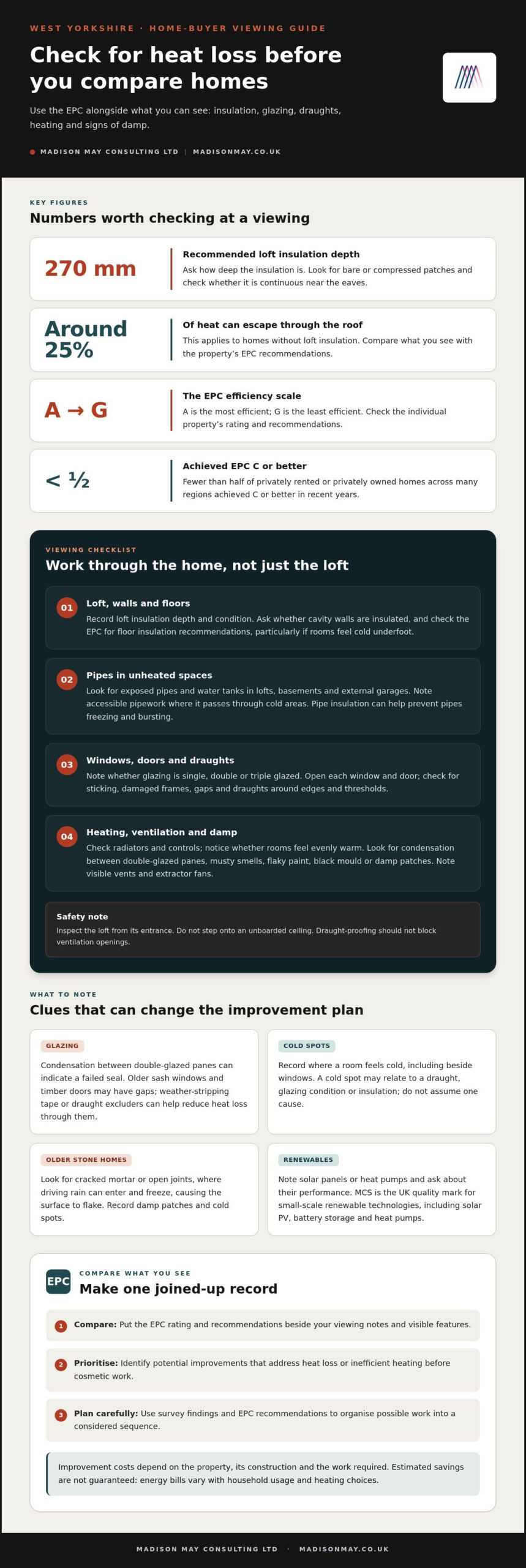
The smartest first step is to compare a property’s current Energy Performance Certificate (EPC) with what you can see during a viewing. An energy-efficient home checklist for buyers in West Yorkshire should cover insulation, windows and doors, heating, and signs of damp or draughts. For loft insulation, the recommended depth is 270 mm.
It’s easy to focus on a home’s layout and finish, but everyday comfort and running costs also depend on less visible details. A careful check can help you spot where heat may be escaping and identify improvements that could make the property warmer and more efficient. This energy efficient home checklist for buyers in West Yorkshire shows how to assess insulation and draughts, consider practical upgrades and explore funding options. Use it to compare properties and focus on the questions that matter before you decide.
Key Takeaways
- Check loft insulation depth and look for exposed pipes in unheated spaces to spot potential heat-loss concerns.
- Inspect glazing and seals, and try opening windows and doors to notice draughts or sticking.
- Compare the EPC recommendations with visible features such as insulation and heating to identify possible upgrades.
- Explore local grant eligibility alongside other funding options before planning energy-saving work.
Loft insulation
Begin by asking whether the loft is insulated and how deep the material is. The recommended depth for loft insulation is 270 mm. In homes without loft insulation, around 25% of heat escapes through the roof. At a viewing, look for insulation across the loft floor and note any bare or compressed patches. Ask whether the insulation is continuous near the eaves, where gaps can leave parts of the ceiling colder.
From the loft entrance, look for visible issues without stepping onto an unboarded ceiling. Check for exposed pipes and water tanks in unheated spaces such as lofts, basements and external garages. Insulating exposed pipes can help prevent them freezing and bursting. Note where pipes pass through cold areas, as these spots may need attention alongside the loft.
- Loft: Record the visible depth and condition, and compare the details with the property’s EPC recommendations.
- Walls: Ask whether cavity walls have been insulated; the EPC can help identify this as an improvement to investigate.
- Floors: Check the EPC for floor insulation recommendations, particularly if rooms feel cold underfoot.
- Pipes: Look for insulation around accessible pipework in unheated spaces, not just across the loft floor.
Consider the whole building, not just the loft insulation. Walls and floors can also contribute to heat loss, and the heating system needs to work well with the home’s insulation. If an existing boiler is faulty or nearing the end of its lifespan, guidance from heating specialists like Blueflame Boilers Ltd can help you budget for necessary repairs or replacements. Use the EPC recommendations to make a list of possible upgrades, then compare it with what you can see during the viewing. This helps you understand what may need attention after purchase.
Note whether solar panels or heat pumps are installed, and ask about their performance. MCS is the UK quality mark for small-scale renewable technologies, including solar PV, battery storage and heat pumps. Record any systems alongside your notes on insulation, lighting and heating. Considering these features together gives you a fuller picture of the home’s energy use than focusing on one upgrade alone.
Checking windows and doors for draughts
During the viewing, check the radiators and heating controls, and notice whether rooms feel evenly warm. Compare the EPC with visible insulation, note whether the windows are single, double or triple glazed, and open each window and door to check for sticking or draughts.
Inspect the frames, seals and glazing. Condensation between double-glazed panes can indicate a failed seal; also note any cracked or damaged frames. Older sash windows and timber doors may have gaps around the edges. Weather-stripping tape or draught excluders can help reduce heat loss through these gaps.
- Windows: Record the glazing type and general condition, because double glazing is more energy-efficient than single glazing.
- Doors: Check for movement or gaps at the frame, and notice whether the door closes firmly.
- Draughts: Feel near window edges and door thresholds, especially in living rooms and bedrooms.
- Ventilation: Note visible vents and extractor fans; draught-proofing should not block ventilation openings.
Before planning upgrades to an older home, ask the surveyor to assess signs of damp, ventilation and insulation. Musty smells, flaky paint or black mould can indicate damp. Check around windows and ceilings, inside cupboards and behind furniture. Ask whether the ventilation is suitable and how proposed draught-proofing could affect airflow and the home’s temperature.
Also consider how the heating system responds in different rooms, and whether radiators appear to warm spaces consistently. A cold spot beside a window may relate to a draught, glazing condition or insulation, so record its position rather than assuming one cause. These observations help shape a considered plan for windows, doors and ventilation. For a coordinated approach, explore draught-proofing and ventilation improvements as part of the home’s energy-saving work.
Energy-saving improvements in West Yorkshire
There isn’t one EPC rating that represents every property. The scale runs from A, the most efficient, to G, the least efficient; across many regions, fewer than half of privately rented or privately owned homes achieved C or better in recent years. Check the individual property’s current EPC and recommendations rather than assuming its rating from age or appearance. Buyers can use an energy-efficient home checklist to compare properties consistently.
To estimate household energy bills, consider the EPC recommendations alongside the heating system’s type, condition and controls. The EPC assesses insulation, heating, windows and construction, then recommends ways to improve the rating and reduce bills. Use it to compare properties, while remembering that household habits and choices about heating and hot water also affect running costs.
Older stone-built homes need particular care. Look for cracked mortar or open joints, where driving rain can enter and freeze, causing the surface to flake. Note damp patches and cold spots, too, as these can affect which improvements should come first. Buyers using an energy efficient home checklist can record these observations alongside the EPC and survey findings.
- Compare: Put the EPC rating, recommendations and visible features beside your viewing notes.
- Prioritise: Identify improvements that address heat loss or inefficient heating before cosmetic work.
- Record: Note solar panels or other renewable technologies, and ask about their performance.
- Plan: Use survey findings and EPC recommendations to organise potential work into a considered sequence.
Improvement costs depend on the property, its construction and the work required. Madison May Consulting Ltd recommends using your checklist to connect visible issues and EPC recommendations with potential upgrades when discussing the purchase. Treat estimated savings as estimates, not guaranteed income: energy bills vary with household usage and heating choices.
If energy bills are difficult to manage, contact your supplier to discuss a payment plan or hardship funds. Bring the EPC, survey findings and viewing notes together to consider how insulation, heating, windows and renewable panels could form a coordinated improvement plan.
Grants, funding and finance options
Before budgeting for insulation or heating work, identify which funding routes may suit the property and household. Review the household’s circumstances, location and EPC together when considering eligibility.
For heating changes, UK homeowners replacing an oil, gas or inefficient electric system with a heat pump or biomass boiler may be eligible for a Boiler Upgrade Scheme discount of up to £7,500, according to Ofgem. Check how the proposed system fits the property’s heating needs and planned improvements. This can help you compare a grant-supported option with other ways to improve winter comfort and reduce carbon emissions.
Government support can also include the Winter Fuel Payment and Warm Home Discount Scheme. These help with household energy costs, rather than directly funding external improvements such as insulation or solar panels. Keep bill support separate from home-upgrade funding when planning: one helps with energy costs, while the other may contribute towards eligible work.
- Check eligibility: Compare household circumstances, the property’s area and its EPC band against grant criteria.
- Define the work: List improvements such as insulation or a heating-system replacement before weighing funding routes.
- Review the plan: Match proposed upgrades to the home’s condition and the comfort issues you noticed during viewing.
- Allow for your contribution: Grants and discounts have eligibility conditions, so plan finances around the work and funding available.
For privately rented homes, landlords must provide tenants with an EPC. Buyers considering a rental property can use its rating and recommendations to understand potential efficiency improvements. The requirement to provide an EPC does not, by itself, establish a minimum rating.
Bring the EPC and proposed improvements together before deciding how to fund work. Explore energy-efficient home improvement planning to help shape a considered upgrade plan.
Madison May Consulting: Energy efficient home improvements
Madison May Consulting Ltd can turn your viewing notes into a considered plan to improve a home’s energy efficiency. Its retrofit assessments and EPC improvement plans identify practical ways to reduce heat loss, taking account of the building fabric, services and ventilation.
An assessment can be a useful next step when an EPC recommends several upgrades or damp, draughts or an older conservatory raise questions about priorities. Madison May Consulting Ltd provides windows and doors, conservatory upgrades, ventilation assessments and damp remediation, tailored to the property’s needs.
Contact Madison May Consulting Ltd to discuss the home and your viewing notes, and take the next step towards a practical improvement plan.
Shape the next step around the home you want
Buying a home is also an opportunity to decide what comfort, character and everyday efficiency mean to you. Keep your viewing notes and EPC together, then use them to set priorities for the property you’re considering. An energy efficient home checklist for buyers in West Yorkshire can turn first impressions into a thoughtful plan that respects the home’s individual style.
Madison May Consulting Ltd supports energy-efficient home improvements, including windows and doors and conservatory upgrades. The right changes depend on the property and your priorities, whether you want a warmer living space or a considered approach to improving the home.
When you’re ready to explore possibilities, discuss your home improvement plans with Madison May Consulting Ltd. A considered next step can bring clarity as you shape a home that feels welcoming and better suited to the way you live.
Frequently Asked Questions
How do I get started?
Ask the seller or agent about known repairs and energy-related work, then record the answers for each property. When browsing listings with residential property sales specialists such as fsgestateagent.co.uk, you can often review the EPC rating and request details of past heating or insulation upgrades in advance. Use the same headings at every viewing, such as insulation, windows, heating and signs of damp, to make comparisons easier later. If photographs are permitted, take them with brief notes. Separate essential repairs from improvements you could plan after moving in.
Why does it matter?
Energy efficiency affects more than room comfort: it can also shape your household budget after purchase. A home that needs upgrades may call for a different financial plan from one that already meets your needs. Considering efficiency before making an offer helps you weigh the property’s condition, likely work and day-to-day practicality.
What energy efficiency information should home buyers check in a property’s EPC in England?
Check the EPC’s overall rating, from A, the most efficient, to G, the least efficient, and read its recommendations. The report assesses factors such as insulation, heating, windows and construction. Compare it with the property’s visible features, and note the issue date to judge whether it reflects the home as it is now. Treat its recommendations as a starting point for further assessment.
What energy efficiency improvements are common in West Yorkshire homes, including insulation and heating?
Potential improvements include loft, wall or floor insulation, draught-proofing, window or door upgrades, and changes to heating systems or controls. The right combination depends on the home’s construction and condition. For an older stone property, investigate the building fabric and ventilation before planning insulation, so you address heat loss without overlooking damp concerns.
How much do loft, cavity wall and solid wall insulation cost in West Yorkshire?
Costs depend on the insulation type, the area being treated, access, wall construction and the preparation required. Loft work differs from cavity-wall work, while solid-wall insulation needs an approach suited to the property’s fabric and installation method. A property assessment can clarify the scope before you budget. Compare recommendations with the home’s condition rather than relying on a generic figure.
What are current UK grants or schemes for energy efficiency improvements available to home buyers?
Ofgem says eligible homeowners replacing certain heating systems may receive up to £7,500 through the Boiler Upgrade Scheme. The Winter Fuel Payment and Warm Home Discount Scheme may also help with energy costs.