

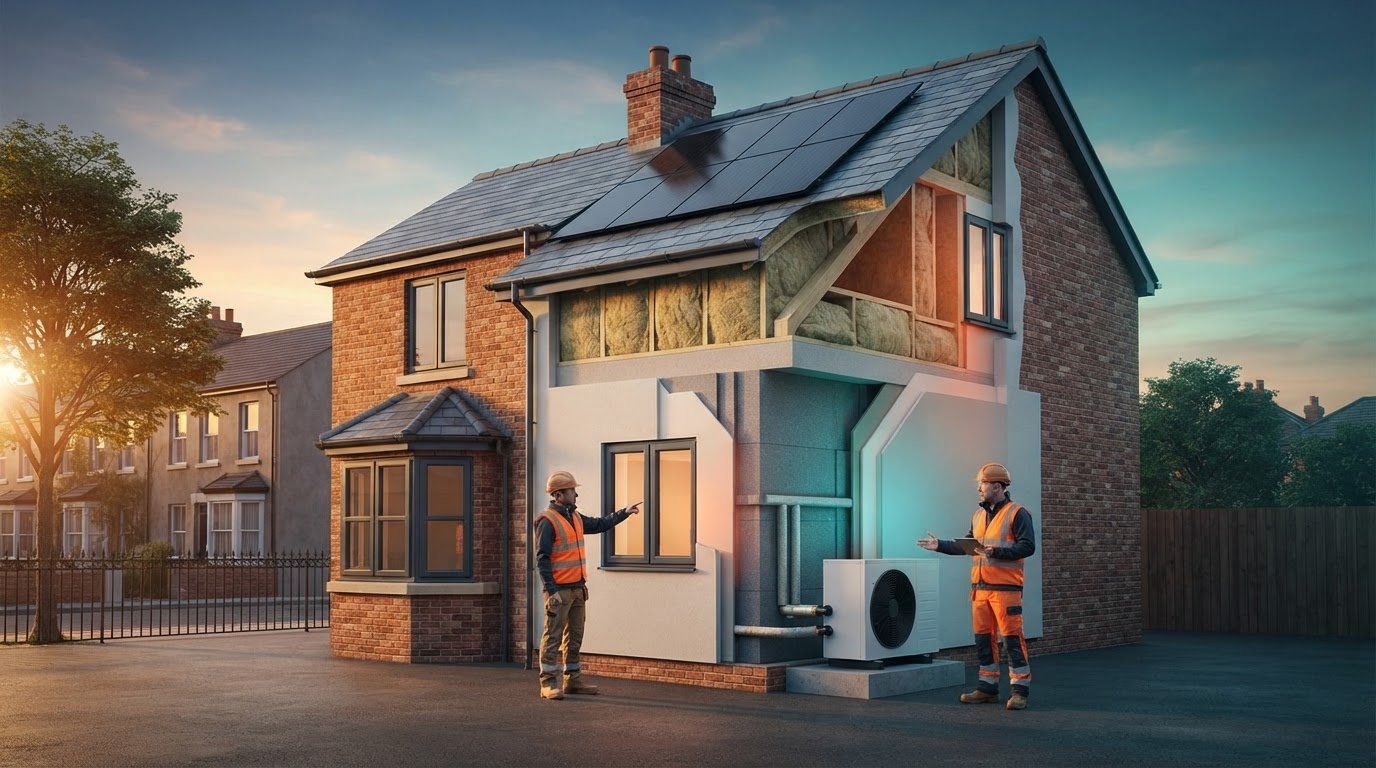
A home retrofit is a planned set of improvements to make a property more energy-efficient, often through better insulation, upgraded heating or reduced draughts. The ROI on a home retrofit in the UK can include lower energy bills, a stronger EPC rating, reduced carbon emissions and, in some cases, increased property value. The return depends on the home’s starting condition and which upgrades work well together.
It’s natural to weigh the upfront work against potential savings and long-term value. A retrofit is not simply a list of upgrades: measures need to suit the building and work together, improving comfort and efficiency while respecting the home’s character.
This article explains what retrofit involves and how it can affect household energy use, EPC ratings, property value and emissions. It also explores why financial returns vary between homes, helping you decide what to consider before choosing improvements.
Key Takeaways
- Compare likely bill savings with the cost and payback of suitable upgrades, rather than treating every retrofit measure as equally valuable.
- Use an EPC improvement plan to understand how changes to a home’s energy performance may influence its appeal and value.
- Consider insulation and heating together to see how a coordinated retrofit can reduce reliance on fossil fuels and household emissions.
- Look at the whole property before choosing improvements, including windows, doors, ventilation and how each measure works alongside the others.
Energy-bill savings
Retrofit savings depend on a home’s starting efficiency, the upgrades selected and how they work together. The ROI on a home retrofit in the UK can reflect lower bills as well as wider benefits, including greater comfort and improved environmental performance.
Whole-house energy-use reductions
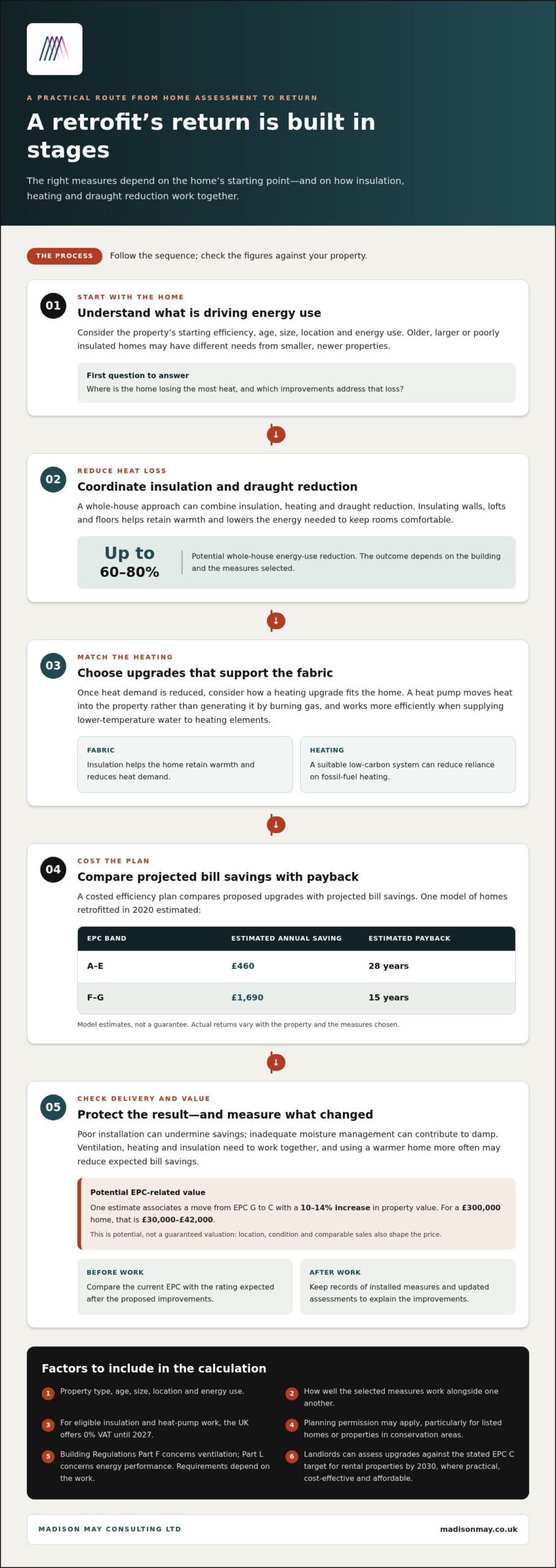
A whole-house retrofit coordinates insulation, heating and draught reduction to improve energy efficiency across a property. It can cut energy use by up to 60-80%, though the outcome depends on the building and measures chosen. Older, larger or poorly insulated homes can have different needs from smaller, newer properties. Insulation limits heat loss, while heating upgrades can reduce demand further. The best balance of financial return and carbon savings depends on the home’s main sources of energy use.
Costed efficiency plans and returns
A costed efficiency plan compares proposed upgrades with projected bill savings to assess return on investment. In a model of homes retrofitted in 2020, estimated annual savings were £460 for EPC bands A-E and £1,690 for bands F and G. Estimated payback periods were 28 years and 15 years respectively. The ROI on a home retrofit in the UK varies with property type, age, size, location, energy use and chosen measures. Landlords can assess upgrades against the stated target for rental properties to reach EPC C by 2030, where practical, cost-effective and affordable.
HM Revenue & Customs says the UK offers 0% VAT on insulation and heat pumps until 2027. This can affect the overall calculation for eligible work.
Planning permission may apply to some projects, particularly listed homes or properties in conservation areas. UK Government Building Regulations Part F concerns ventilation, while Part L concerns energy performance; relevant requirements depend on the work.
Poor installation can undermine savings, while inadequate moisture management can contribute to damp problems. Rebound effects matter too: using a warmer home more often may reduce expected bill savings.
At a home energy fair, compare practical advice on insulation, heating and electric options. Then consider which upgrades address your home’s greatest heat loss.
EPC rating improvements and property value
A higher EPC rating makes a home’s energy performance easier to understand and may influence how buyers assess its appeal. The effect on valuation depends on the property and local market.
EPC improvements and home valuation
An EPC records a home’s energy performance, giving buyers a way to compare expected efficiency between properties. In Great Britain, 48% of households had an EPC rating of A-C in 2022, while around 14 million UK homes are below EPC C. One estimate associates moving from EPC G to C with a 10-14% increase in property value. For a £300,000 home, that equates to £30,000-£42,000. These figures illustrate potential, not a guaranteed valuation; location, condition and comparable sales also shape the price.
Climate resilience can strengthen the practical value of improvements. Better insulation helps limit heat loss in cold weather, while suitable ventilation supports moisture management. Together, these measures can help maintain a more comfortable indoor environment as outdoor conditions change. Homeowners should consider how insulation, ventilation and heating interact, rather than judging each upgrade in isolation. A renewable heating system, such as a heat pump, may complement fabric improvements by reducing reliance on fossil-fuel heating.
Combined retrofit improvements
A whole-house retrofit coordinates improvements so they support the home’s overall performance. For example, insulation can reduce heat demand, while a heat pump provides heating more efficiently when the building retains warmth. Considering measures together helps you assess their effects on energy use, comfort and the EPC rating, rather than focusing on one feature alone. It also gives valuers a clearer picture of the property’s improvements.
To assess the effect on value, compare the current EPC with the rating expected after proposed work, then consider local property evidence and the home’s condition. Keep records of installed measures and updated assessments; they help explain the improvements to future buyers. An EPC improvement plan can help organise suitable measures around the property’s needs.
Home retrofits and carbon emissions
Reducing a home’s carbon emissions means using less fossil-fuel energy for heating and other household needs. Domestic heating accounted for around 18% of UK carbon emissions, based on 2021 data, making improvements to how homes retain and produce heat an important part of climate action. Around 85% of UK homes are heated by gas, so replacing a gas system with low-carbon heating can reduce reliance on fossil fuels.
The home’s fabric matters too. Insulating walls, lofts and floors helps retain warmth, reducing the energy needed to keep rooms comfortable. Around half of UK homes have uninsulated walls, while just under two-thirds have an EPC rating of D or below. These figures help explain why a retrofit may combine insulation with heating changes: lower heat demand can support a lower-carbon system and reduce wasted energy.
Heat pumps provide low-carbon heating by moving heat into the home, rather than generating it through burning gas. Their performance depends on the system and property, and they work more efficiently when supplying lower-temperature water to heating elements. The Boiler Upgrade Scheme offers eligible homeowners and small landlords grants of up to £7,500 for qualifying low-carbon heating systems, according to the Department for Energy Security and Net Zero. For homeowners reviewing their central heating and pipework alongside these changes, experienced contractors like WellPlumbed can help identify efficient, properly sized heating solutions that support overall retrofit targets.
Renewable technologies can deepen the emissions benefit. An energy-efficient UK home fitted with renewable technologies can reduce CO2 emissions by 95%. Solar panels, for example, can supply some household electricity, while a heat pump changes how heating energy is used. The result depends on the combination of measures and the home’s remaining energy demand.
For a retrofit to work as a coherent whole, consider insulation, ventilation and heating together. Poor ventilation can affect indoor air quality, while uncontrolled moisture can undermine building fabric. UK Building Regulations Part L concerns energy performance, according to the UK Government. A planned sequence helps measures support one another, rather than treating carbon savings as an isolated equipment choice.
Retrofit-related property value increases
Retrofit value can reflect several changes together, from a stronger EPC rating to lower energy bills and improved comfort. Solar panels, an electric vehicle charge point and heating upgrades may each contribute in different ways.
Property value and EPC ratings
An EPC rating gives buyers a recognised indication of a home’s energy performance, which can influence how they compare buildings. Estimates associate an improvement from EPC E to C with around a 10% increase in UK home value; moving from F to C could increase value by 15%. These are distinct rating changes, and the property’s condition and local housing market also shape its sale price.
For homeowners, an improved rating can make energy performance easier to explain during a sale. Keep the updated EPC and records of completed measures together so prospective buyers can see what changed and how the home became more efficient.
Retrofits and home resale value
Retrofit measures can add practical appeal at resale by combining comfort with lower running costs. These figures illustrate different measures, not a guaranteed cumulative uplift.
Buyers can also see how insulation, heating and renewable energy measures support an efficient home and help manage energy bills. A clear record of the work connects those features with the property’s everyday comfort. Pairing energy updates with cost-effective aesthetic refreshes—such as choosing a kitchen respray Wrexham rather than a disruptive rip-out—can also maximise visual appeal at resale while keeping renovation budgets balanced.
To understand which improvements suit your building and resale priorities, arrange a retrofit assessment and use its findings to shape a considered plan.
Madison May Consulting Ltd: Energy efficient home improvements
Madison May helps homeowners plan energy-efficient improvements suited to their property and priorities. Its services include windows and doors, conservatory upgrades, and ventilation assessments or damp remediation, supporting decisions about comfort and home performance.
A considered approach matters because improvements need to suit the building, rather than being chosen in isolation. Madison May Consulting Ltd can help you explore relevant options, whether you’re addressing draughts, reviewing a conservatory or considering ventilation alongside energy efficiency.
For a conversation about improvements for your home, contact Madison May Consulting Ltd or visit madisonmay.co.uk.
Choose the next step with your home in mind
Assessing the ROI on a home retrofit in the UK is not only about a future sale; it’s also about whether the finished home feels comfortable and suits everyday life. Before deciding what to change, consider what you want your home to do better and which qualities you want to preserve. This gives each proposed improvement a purpose and helps distinguish essential work from changes that can wait.
The right sequence depends on the building’s condition, your priorities and how you use its spaces. Treating the home as a whole can balance practical performance with personal character, rather than letting one upgrade dictate every choice. That balance matters when your home is both a long-term refuge and an asset you may later sell.
Take the next step by setting out the improvements that matter most to you, then discuss how they could fit your property. Talk with Madison May Consulting Ltd about your retrofit priorities and begin shaping a home that feels right for the years ahead.
Frequently Asked Questions
What is retrofit?
Retrofit means adapting an existing home to improve its performance, rather than replacing the building. For example, a homeowner might combine draught-proofing with insulation and heating changes, considering how each affects the others. The right mix depends on the property’s construction and existing systems. A whole-home assessment helps identify how planned improvements can work together instead of treating each alteration as a separate project.
But what’s the bigger picture?
The UK’s housing stock is central to long-term energy and climate goals because homes remain in use for decades. Around 29 million homes will need retrofitting before 2050, and 80% of homes currently inhabited are expected to remain inhabited then. This scale makes thoughtful upgrades relevant beyond one household: improving existing buildings can support lower energy demand while retaining homes people already value.
So what will it cost (me) and what is the likely payback period?
Your project’s cost depends on the home’s condition, construction, access, chosen materials and the number of measures involved. Payback compares the initial outlay with savings over time. For example, a measure that lowers heating demand contributes differently from one chosen mainly for comfort. For a useful estimate, weigh each measure’s cost against its expected energy reduction and your household’s current use.
What are typical UK costs for insulation, heat pumps, solar panels and double glazing?
Costs vary with the property and specification, so a single typical figure may not represent your project. Insulation costs depend on the area treated and building fabric; heat-pump costs depend on system design and existing heating; solar-panel costs reflect installation design; and double glazing depends on window size, style and quantity. A project-specific quote should set out the chosen work and its cost factors.
How much can UK homeowners save annually on energy bills after common retrofit measures?
Annual savings depend on the home’s starting efficiency, energy use and the measures installed. This is a national estimate, not a prediction for every property. For an individual home, compare energy use before and after improvements, and consider how household routines and heating settings affect bills.
What are typical payback periods and returns for UK home retrofit upgrades?
Payback periods differ by measure and property, because upfront costs and energy savings vary. A November 2022 update reported that some energy-efficiency upgrades had estimated payback periods of under 10 years as energy costs rose. This shows why older estimates can shift when prices change. Consider bill savings alongside comfort, EPC performance and carbon reduction, rather than judging a project by payback alone.