


What if the very measures you took to modernise your home’s warmth are the silent architects of its decline? It’s a distressing realisation for many homeowners who find that, despite investing in new insulation, their sanctuary is suddenly plagued by persistent musty odours and the arrival of damp remediation needs. You’ve likely heard a chorus of conflicting advice from various tradespeople, leaving you uncertain whether to seal your property tighter or let it breathe. It’s exhausting to feel as though you’re fighting against the fabric of your own residence just to maintain a healthy, dry living environment.
This guide introduces a sophisticated, whole-house approach to damp remediation that preserves your property’s heritage whilst enhancing its thermal performance. We’ll explore how to resolve the tension between modern energy standards and the natural breathability of traditional structures. By prioritising professional assessments over guesswork, you can protect your curated interiors and the building’s long-term value. Prepare to discover a path towards a serene, healthy home where functionality and beauty exist in effortless union.
Key Takeaways
- Understand why a holistic, whole-house strategy is essential for transforming a moisture-compromised property back into a serene and healthy sanctuary.
- Learn to navigate the breathability paradox, ensuring that modern energy efficiency measures don’t inadvertently create traps for internal moisture.
- Discover how an impartial, expert diagnosis provides the precision needed for effective damp remediation, distinguishing between structural issues and surface symptoms.
- Explore the PAS 2035 framework as a professional standard for successfully integrating thermal performance with the long-term preservation of your building’s fabric.
- Recognise how proactive moisture management serves as a vital act of stewardship, protecting both your curated interiors and your home’s enduring value.
The Silent Intruder: Why Damp Remediation is Essential for the Modern Sanctuary
A home is more than a structure; it’s a deeply personal refuge where every detail contributes to a sense of calm. When moisture begins to seep into these spaces, the impact is felt far beyond the visible surface. It disrupts the harmony of a room, turning a curated environment into a source of anxiety. Professional damp remediation is not merely a technical fix. It’s a restorative act that honours the original craftsmanship of your property whilst ensuring it remains a healthy sanctuary for those within.
The evolution of the British home has played a significant role in this challenge. Our ancestors lived in draughty, breathable buildings where open fires provided constant air exchange. Today, our modern habits, from daily showers to drying laundry indoors, generate vast amounts of water vapour. When these habits meet modern efforts to seal homes for warmth, the moisture profile of the dwelling shifts. Without a balanced approach, this hidden intruder begins to compromise both comfort and structural integrity. Stewardship means recognising that your home is a living entity that requires a harmonious balance between protection and breathability.
The Sensory Impact of Moisture
The first sign of trouble isn’t always a visual one. Often, it’s a subtle shift in the atmosphere or a lingering musty odour that persists despite your best efforts to ventilate. This scent is a clear signal that the thermal envelope is compromised. High humidity levels affect the indoor air quality, making rooms feel heavy and cold. Amongst your heritage features and fine finishes, moisture can cause delicate wallpapers to peel or fine joinery to swell. These sensory cues are your home’s way of asking for intervention before the damage deepens. A room should feel like a breath of fresh air; dampness steals that clarity.
Preserving Heritage through Professional Intervention
Ignoring the signs of structural dampness can lead to irreversible consequences. From the silent advance of timber decay to the slow erosion of the building’s fabric, moisture is a persistent threat to your investment. A meticulous approach to damp remediation protects the longevity of the property. It involves a delicate intersection of traditional building wisdom and modern standards. By addressing the root cause rather than just masking the symptoms, you ensure that the home’s story continues for generations. This isn’t just about repair; it’s about thoughtful stewardship and the preservation of value. Professional intervention provides the peace of mind that your sanctuary is resilient against the elements.
The Breathability Paradox: Energy Efficiency and Damp Remediation
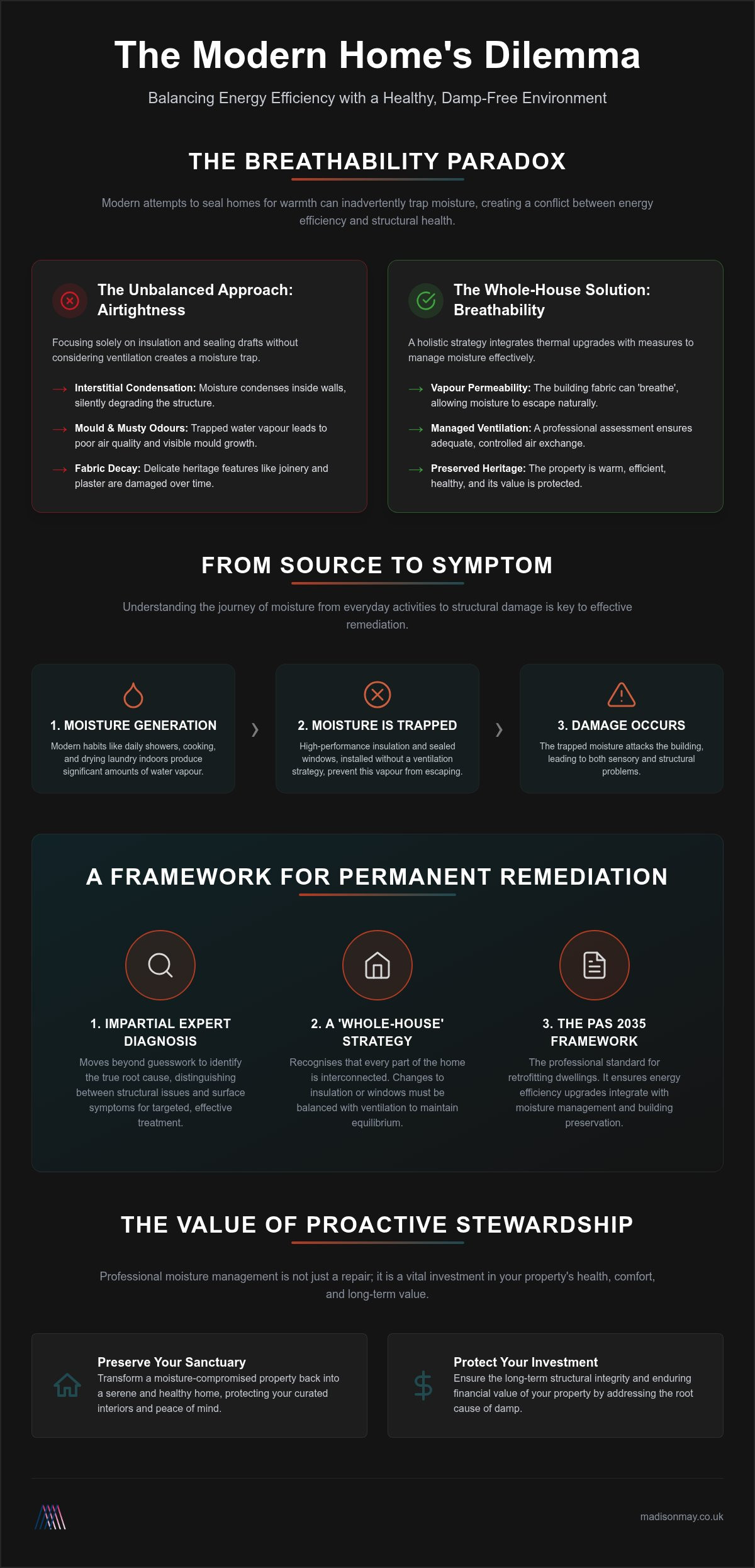
In our quest for a warmer, more sustainable future, we’ve inadvertently created a new architectural challenge. The drive for energy efficiency often leads to homes being sealed against the cold, yet this airtightness can become a catalyst for moisture retention. Effective damp remediation today isn’t a standalone repair; it’s a critical component of the ‘whole-house’ philosophy. This approach recognises that every change to a building’s thermal envelope affects its ability to manage water vapour. When we prioritise warmth without considering breathability, we risk compromising the very sanctuary we’re trying to improve.
When we wrap a property in modern insulation without considering its original design, we risk creating a moisture trap. This leads to interstitial condensation, a hidden threat where water vapour condenses within the wall structure itself. Unlike surface mould, this internal dampness can silently degrade structural timbers and insulation materials for years before becoming visible. We advocate for a balanced strategy that prioritises vapour permeability, ensuring your home remains warm without sacrificing its essential airflow. It’s about creating a home that’s as resilient as it is comfortable.
The Role of Ventilation in a Retrofitted Home
Part F of the Building Regulations has evolved to address these specific risks. It’s no longer sufficient to simply add insulation; every upgrade must be accompanied by a professional ventilation assessment to ensure adequate air exchange. Failing to do so often results in thermal bridging, where cold spots at wall junctions or window reveals invite persistent mould growth. For those managing tenanted properties, resources like the guide on damp and mould in private rented homes highlight the legal and health implications of failing to maintain this delicate balance between heat and air.
Vapour Permeability and Building Fabric
Traditional buildings were often constructed with lime-based materials that naturally managed moisture. Modern moisture-sealed environments, by contrast, require mechanical help to achieve the same result. Identifying the specific needs of your property requires a nuanced understanding of its fabric. Detailed building surveys are the first step in determining whether your home requires breathable coatings or enhanced ventilation systems. Perhaps you’re considering an energy upgrade but worry about its impact on your home’s health. You might find that a professional retrofit assessment is the most elegant way to ensure your property remains a dry, inviting refuge for years to come.
Diagnostic Precision: Identifying the Three Pillars of Damp
Achieving a dry, healthy home begins with diagnostic precision. Without an impartial, expert assessment, any attempt at repair is merely guesswork. Too often, homeowners are led towards expensive, invasive treatments that fail to address the underlying cause. A sophisticated professional framework for damp remediation prioritises understanding the building’s unique moisture profile before a single brick is disturbed. This ensures that your investment is directed towards permanent solutions rather than temporary masks. By identifying whether the issue is structural, environmental, or a combination of both, we can restore the integrity of your sanctuary with confidence.
Rising vs. Penetrating Damp: A Surveyor’s Perspective
Distinguishing between these two requires a nuanced eye. Rising damp involves moisture climbing through porous masonry from the ground, yet it is frequently confused with simple salt contamination or high ground levels. If an external render is bridged or a flower bed is too high, the symptoms may mimic rising damp whilst being entirely different in origin. Tracing penetrating damp involves a meticulous journey through the external envelope, looking for defects in masonry or failing house insulation. We find that chemical injections are rarely the sole answer; they often ignore the structural defects that allowed moisture ingress in the first place. True remediation requires addressing the root defect to ensure the building fabric remains resilient.
The Condensation Challenge
In the UK, condensation remains the most common form of damp, yet it is frequently the most misunderstood. It is a product of modern life, where cooking, bathing, and even breathing create a high-humidity environment within our increasingly sealed homes. When this warm, moist air meets a cold surface, it reaches its dew point and transforms into liquid water. This is why ‘black mould’ appears in corners or behind furniture. It isn’t just a surface blemish. It is a clear signal of systemic ventilation failure. Effective damp remediation must look beyond the mould itself to restore the harmonious balance of air movement throughout the entire property, ensuring every room feels fresh and inviting.
A Professional Framework for Permanent Damp Remediation
Achieving a dry, resilient home requires a departure from the fragmented approach of traditional trades. Instead, we must embrace a professional framework that treats your property as a single, integrated system where every element influences the next. This journey begins with a meticulous PAS 2035 Retrofit Assessment, a technical standard designed to ensure that energy upgrades never compromise a building’s health. By surveying the entire structure, we move beyond surface-level symptoms to conduct a thorough root cause analysis. This identifies the external defects or internal imbalances that allowed moisture to take hold, providing the clarity needed for a permanent resolution. It’s a process of restoring balance, ensuring that the moisture profile of your dwelling remains stable throughout the seasons.
The Power of the Retrofit Assessment
A professional assessment is the only way to ensure a permanent solution because it considers the building as a whole. Our approach relies on data-driven insights to create a tailored EPC improvement plan, acting as a strategic roadmap for your home’s future. Unlike trade-led ‘free surveys’ which often prioritise product sales, independent consultancy offers an impartial perspective focused solely on the building’s needs. This bespoke planning integrates ventilation, insulation, and heating upgrades into a harmonious design that respects the home’s original character whilst meeting modern standards. It provides the technical certainty that every intervention is necessary and effective.
Coordinating the Cure
The success of complex damp remediation rests on professional coordination. A Retrofit Coordinator acts as a visionary guide, overseeing every phase of the project to ensure technical rigour and seamless execution. They manage the delicate intersection of different trades, ensuring that every measure, from draught proofing to masonry repair, is installed to the highest standards. Adopting a phased approach to energy efficient home improvements prevents the common pitfalls where new insulation inadvertently causes ventilation issues. This meticulous oversight preserves the soul of your residence whilst transforming it into a high-performance sanctuary. Every detail is intentional, and every material is chosen with care to ensure the building can breathe.
If you’re ready to move beyond temporary patches and invest in the long-term health of your property, a specialist ventilation assessment provides the essential foundation for a moisture-free future.
Madison May: Curating Healthier, More Resilient Environments
At Madison May, we view damp remediation as far more than a technical necessity. It is a vital step towards a more energy-efficient, sustainable future for your property. Our philosophy is rooted in the belief that a home should be a biologically healthy environment that resonates with the personal story and identity of its inhabitants. We combine technical rigour with a deep appreciation for refined aesthetics, ensuring that the structural health of your residence is restored without compromising its visual soul. This balanced approach allows us to transform moisture-compromised spaces into resilient sanctuaries that stand the test of time. We believe every material choice and every technical detail should be intentional, reflecting a commitment to quality and enduring craftsmanship.
Clarity and confidence are the cornerstones of our service. By offering fixed-fee assessments, we provide homeowners and landlords with an impartial roadmap free from the hidden agendas of trade-led surveys. You receive expert guidance that prioritises the building’s specific needs above all else, fostering a sense of ease throughout what can otherwise be a complex process. Restoring the harmony of a home requires meticulous planning and an attentive ear to the property’s unique history. We position ourselves as trusted curators of your lifestyle, ensuring that your living environment remains a dry, inviting refuge.
A Bespoke Journey to a Dry Home
The path to a moisture-free property is a bespoke journey that requires professional poise and precision. From the initial assessment to the final coordination of energy-saving measures, we guide you through the intricate requirements of Part F and PAS 2035. This ensures that your energy upgrades are seamlessly integrated with effective moisture management strategies. The peace of mind that comes from a truly independent consultancy is invaluable. It ensures that every decision made is in the best interest of your home’s fabric and your family’s well-being, avoiding the pitfalls of generic, one-size-fits-all solutions.
Your Partner in Property Evolution
Our clients trust us to manage the delicate intersection of heritage and performance. We don’t just fix problems; we help you build a roadmap for a home that is both beautiful and biologically healthy. Whether you are preserving the character of a period property or modernising a contemporary residence, we act as your partner in property evolution. We invite you to take the first step towards a more resilient environment. You can enquire about a professional ventilation and damp assessment to begin the transformative journey of restoring your home’s integrity today.
Cultivating a Legacy of Comfort and Resilience
A home should be a sanctuary; it’s a deeply personal refuge that deserves meticulous care. We’ve explored how a whole-house philosophy transforms damp remediation from a surface fix into a fundamental act of property stewardship. By prioritising diagnostic precision and professional coordination, you ensure that modern energy standards and original building fabric exist in effortless union. This journey is about more than just dry walls. It’s about curating a biologically healthy space that reflects your personal identity whilst protecting your long-term investment.
Our independent, fixed-fee assessments provide the technical rigour needed to navigate the complexities of Part F and PAS 2035 with absolute confidence. This professional framework removes the confusion of conflicting advice, replacing it with a clear, data-driven roadmap for your property’s evolution. Expert Retrofit Coordination ensures that every measure is installed to the highest standards, preserving the soul of your residence for the future. Your home is a living entity that requires a harmonious balance of air and warmth. With the right guidance, it will remain a dry, inviting refuge for generations to come.
Secure your property’s future with a professional Retrofit Assessment
Frequently Asked Questions
What is the primary difference between damp proofing and damp remediation?
Damp proofing typically involves installing a physical or chemical barrier to block moisture, whereas damp remediation is a comprehensive, restorative process. It addresses the underlying causes of moisture ingress whilst restoring the property’s breathability and structural integrity. Remediation looks at the whole-house environment, including ventilation and thermal performance, to ensure a permanent solution rather than just masking the symptoms with a single barrier or treatment.
Can adding loft or wall insulation actually cause damp in my home?
Insulation itself doesn’t create moisture, but it can certainly cause damp if it restricts the natural airflow of a traditional building. When you seal a home to retain heat without enhancing ventilation, you risk trapping water vapour within the fabric. This often leads to interstitial condensation or surface mould. A balanced approach ensures that every thermal upgrade is matched by a professional ventilation strategy to maintain a dry, healthy sanctuary.
How do I know if the mould on my walls is caused by a leak or condensation?
Identifying the source requires a meticulous look at the mould’s pattern and location. Condensation typically manifests as black spot mould in cold corners, behind furniture, or around window reveals where air is stagnant. Conversely, a leak often results in localised staining, tide marks, or damp patches that persist regardless of the weather or internal humidity. Professional diagnostic tools can precisely measure the moisture profile of the masonry to confirm the origin.
What are the current Part F Building Regulations regarding ventilation?
The current Part F Building Regulations mandate that any energy efficiency work must not negatively impact the property’s ventilation. In 2026, these standards prioritise the principle of ventilating when you insulate, requiring a professional assessment of air exchange rates whenever windows or insulation are upgraded. Compliance ensures that your efforts to modernise the home don’t inadvertently lead to poor indoor air quality or persistent moisture issues within the living space.
Is a PAS 2035 assessment necessary for solving a damp problem?
A PAS 2035 assessment is essential for anyone seeking a permanent, risk-managed solution to damp remediation in a modernised home. It provides a professional framework that treats the building as a single, integrated system. This rigorous standard ensures that every technical intervention is appropriate for the property’s specific age and construction type. It offers the technical certainty that your improvements will enhance the home’s performance without causing structural or environmental damage.
How much does a professional damp and ventilation survey typically cost?
The investment for a professional survey varies depending on the property’s size and the complexity of the moisture issues. Rather than seeking a free survey from a contractor who may have a vested interest in selling specific products, it’s wise to invest in an independent consultancy. This ensures you receive an impartial, fixed-fee assessment that identifies root causes accurately. You should verify the specific scope of the survey before proceeding with any work.
Why is black mould appearing after I installed new energy-efficient windows?
Modern energy-efficient windows are designed to be exceptionally airtight, which significantly reduces the natural draughts that older frames allowed. Whilst this improves warmth, it also traps the water vapour generated by daily life. Without adequate trickle vents or mechanical ventilation, this moisture reaches its dew point on cold surfaces, resulting in black mould. It’s a clear signal that your home’s breathability has been compromised by the new thermal seal and requires urgent attention.
Does an EPC improvement plan address existing damp issues?
A sophisticated EPC improvement plan goes beyond simple energy ratings to address the fundamental health of the building fabric. It identifies where damp issues are compromising thermal performance and recommends specific remediation measures to restore the home’s integrity. By integrating damp remediation into your energy roadmap, you ensure that future upgrades are built on a dry, stable foundation. This holistic planning protects both the property’s heritage and its long-term value.