

Your Victorian home was never intended to be a sealed box, yet many modern treatments attempt to stifle its natural character by treating historic masonry like a structural failure to be tanked and suffocated. If you’ve struggled to fix damp in victorian house Huddersfield settings, you’ve likely encountered the deep frustration of persistent musty smells and damp patches that reappear despite costly chemical injections. It’s exhausting to feel that your sanctuary is being compromised by conflicting advice, especially when the average UK damp remediation project now costs around £5,000 without ever addressing the underlying loss of breathability.
We believe that a home should be a reflection of the self, a place of calm that breathes in harmony with its inhabitants. This guide promises to show you how to restore the essence and soul of your residence through a sophisticated, whole-house retrofit approach that honors original craftsmanship while embracing modern efficiency. We’ll explore a meticulous roadmap that integrates the 2026 Building Regulations and curated ventilation strategies, ensuring your home remains a dry, warm, and timeless sanctuary for years to come.
Key Takeaways
- Understand why the naturally porous Yorkshire sandstone of your residence requires a vapour-open approach to maintain a healthy, balanced environment.
- Discover the meticulous steps necessary to effectively fix damp in victorian house Huddersfield properties by restoring breathability rather than relying on invasive chemical injections.
- Learn how to navigate the requirements of Approved Document Part F to ensure that modern insulation upgrades don’t inadvertently lead to moisture entrapment.
- Identify the value of sophisticated thermal imaging in uncovering hidden cold bridges, allowing for a diagnosis that moves beyond the superficiality of traditional surveys.
- Explore how a curated retrofit journey can seamlessly integrate high-performance energy efficiency with the timeless soul of your Victorian sanctuary.
The Victorian Huddersfield Context: Why Your Sanctuary Feels Damp
The stone walls of Huddersfield tell a story of industrial ambition and local resilience. From the tightly packed terraces of the Colne Valley to the grand, leafy villas of Edgerton, our town’s architectural heritage is defined by the honeyed hues of Yorkshire sandstone. This material is not a static barrier but a living, breathing fabric. However, when the delicate balance of this masonry is disturbed, the home begins to lose its sense of peace. Understanding what is structural damp is the first step in reclaiming your space, as it allows us to differentiate between natural moisture cycles and genuine building failure.
In the Pennines, our homes face a unique environmental dialogue. The driving rain and lingering humidity of West Yorkshire create a constant pressure on the external masonry. When you seek to fix damp in victorian house Huddersfield settings, you aren’t just fighting water; you’re managing the local climate. The emotional toll of a damp home is significant. What was once a cherished sanctuary can quickly feel like a burden, as musty scents and cold walls replace the warmth and calm you’ve worked so hard to curate.
Huddersfield’s Unique Building Fabric
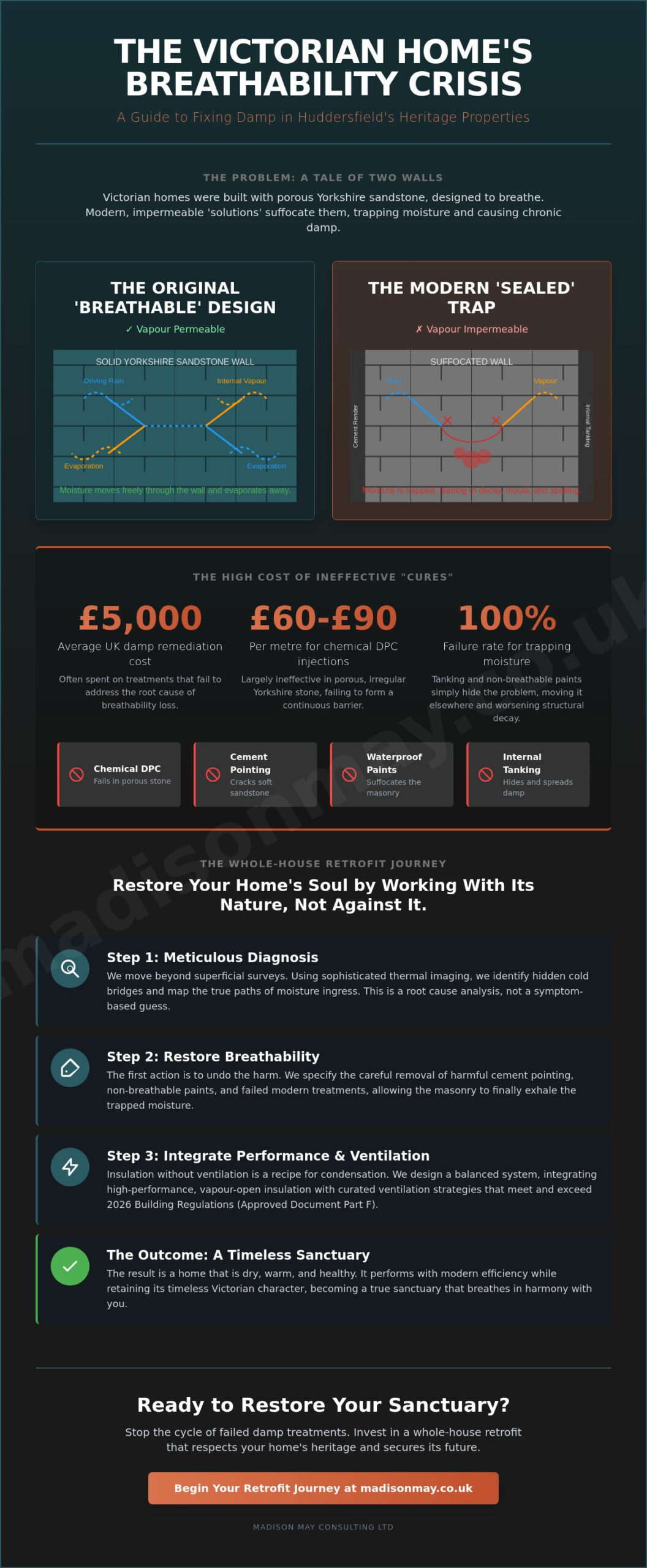
Unlike modern cavity walls that rely on a physical gap to stop water, Victorian properties use solid wall construction. These thick layers of stone were designed to work in tandem with lime mortar, a material that’s naturally vapour-permeable. This breathability is essential. It allows moisture that enters the wall to evaporate harmlessly back into the atmosphere. When this process is interrupted, moisture becomes trapped, leading to internal decay that can compromise the soul of the building. We see this often in Huddersfield, where the porous nature of our local stone is misunderstood by those accustomed to modern, impermeable materials.
The Modern Intervention Trap
The most common cause of damp in our local heritage homes isn’t the age of the building, but the well-meaning yet harmful interventions of the last few decades. Hard cement pointing is a frequent culprit. It creates a rigid, waterproof seal that forces moisture to stay inside the softer sandstone, eventually causing the stone face to crack and spall. Non-breathable masonry paints and modern waterproofing coatings act in much the same way, suffocating the facade. Even small changes, such as blocked air bricks or raised garden beds, can cut off vital sub-floor ventilation. This loss of airflow transforms a historic cellar into a humid trap, inviting mould to flourish in a space that was once dry and stable.
Breathability vs. Tanking: The Meticulous Approach to Damp
The Victorian engineering philosophy was one of quiet harmony rather than forced resistance. While modern construction relies on impermeable barriers, historic homes were designed to manage moisture through a delicate, vapour-open system. Breathability is the movement of moisture through a building’s fabric without causing damage. When we attempt to fix damp in victorian house Huddersfield interiors, we must respect this original intent. Forcing a historic structure to behave like a modern plastic-wrapped box often leads to a cycle of failure that compromises the very soul of the sanctuary you’ve sought to create.
Many homeowners are led toward chemical damp-proof course (DPC) injections, which typically cost between £60 and £90 per metre. In the context of Huddersfield’s rugged gritstone and sandstone, these treatments are frequently ineffective. The irregular, porous nature of our local stone makes it nearly impossible to create a truly continuous chemical barrier. Similarly, the practice of ‘tanking’-applying an internal waterproof membrane-rarely solves the underlying issue. Instead, it traps moisture behind a wall of cement or plastic, increasing the hydrostatic pressure and forcing water into adjacent rooms or up into the floor timbers. This doesn’t cure the damp; it simply hides it while the structural integrity of the masonry slowly erodes in the dark.
The Science of Vapour Movement
Moisture in a Victorian home arrives from two distinct directions. Externally, it’s the Pennine rain; internally, it’s the byproduct of our daily lives, from bathing to breathing. In a healthy home, this vapour moves freely through the walls and is carried away by constant, gentle airflow. When we introduce cold spots, or thermal bridges, through poor insulation choices, moisture condenses in these localized areas. This intersection of heat, air, and moisture is where the battle for a dry home is won or lost. A meticulous ventilation assessment can reveal these hidden imbalances before they manifest as visible mould.
Restoring the Natural Balance
To reclaim the comfort of your residence, we must look toward materials that speak the same language as the original builders. Lime-based renders and plasters are essential tools in this journey. Unlike modern gypsum, lime allows moisture to evaporate, acting as a natural dehumidifier for the building fabric. Reinstating original ventilation pathways, such as clear air bricks and functioning chimneys, further encourages this restorative cycle. A ‘whole house’ view is the only way to achieve lasting remediation. By treating the home as a single, integrated system, we ensure that every intervention enhances the others, resulting in a space that is as resilient as it is beautiful.
The Retrofit Gap: Why Insulation Needs Ventilation
The pursuit of a warmer, more efficient home often leads to an unintended dialogue between modern technology and historic fabric. We call this the ‘Retrofit Gap’. It occurs when well-intentioned improvements, such as high-performance glazing or thick loft insulation, are installed without a corresponding strategy for airflow. In our quest to fix damp in victorian house Huddersfield settings, we frequently encounter residences where the soul of the building has been stifled by these interventions. By sealing the natural draughts that once carried moisture away, homeowners inadvertently create a pressurized environment where humidity has nowhere to escape, leading to the silent growth of mould behind the very features meant to provide comfort.
Adherence to the updated Building Regulations is no longer just a matter of compliance; it’s a necessity for the health of your sanctuary. The 2026 edition of Approved Document F, which takes full effect on March 24, 2027, emphasizes that ventilation must be considered alongside any energy-saving measure. Whether you’re replacing windows or extending a kitchen, the regulations now mandate specific extraction rates, such as 30 l/s for kitchens and 15 l/s for bathrooms. Ignoring these requirements during a renovation doesn’t just risk legal friction; it fundamentally alters the moisture balance of your home. For a deeper understanding of these complexities, our guide to damp remediation in West Yorkshire offers a broader perspective on protecting your property from the unique Pennine climate.
Insulation and the Dew Point
Internal wall insulation (IWI) is a sophisticated tool, yet it requires a meticulous hand. By adding insulation to the inner face of a Huddersfield sandstone wall, you fundamentally change the temperature profile of the stone. The masonry stays colder for longer, shifting the ‘dew point’-the exact location where water vapour turns into liquid-to the interface between the insulation and the stone. Without a bespoke vapour control layer and a curated design, this interstitial condensation can rot floor joists and degrade masonry in secret. Every layer must be chosen with care to ensure the wall remains vapour-open and resilient.
Smart Ventilation Solutions
Restoring air quality doesn’t require the intrusion of noisy, industrial fans that disrupt the calm of your interior. Modern solutions like decentralised Mechanical Extract Ventilation (dMEV) provide a constant, whisper-quiet background trickle of airflow, ensuring your home breathes without the heat loss associated with traditional vents. For many historic Huddersfield villas, Positive Input Ventilation (PIV) offers an even more elegant approach. By gently introducing filtered air into the heart of the home, it creates a slight positive pressure that encourages stale, damp air to exit through the building’s natural pathways. It’s a seamless integration of technology that preserves both the atmosphere and the structural integrity of your retreat.
Diagnosing the Root Cause: The Madison May Assessment
Many contractors offer a “free survey” as a gateway to selling a specific product, often a chemical injection that fails to address why you need to fix damp in victorian house Huddersfield properties in the first place. These cursory visits, which typically last under thirty minutes, rarely look beyond the surface of the plaster. A professional damp survey, which usually costs around £300, is a small but vital investment in the long-term health of your sanctuary. It provides an unbiased, technical analysis that prioritizes the building’s needs over a quick sale, ensuring that every intervention is both necessary and effective. This process is about listening to the building and understanding its unique story before prescribing a cure.
The Madison May Consulting Ltd approach is defined by a commitment to meticulous detail and a deep respect for heritage. We don’t just look for damp; we look for the reason it has been invited into your home. This might involve tracing a persistent damp patch back to a hairline crack in a stone lintel or a blocked valley gutter hidden from street level. By identifying the true origin of moisture, we prevent the cycle of expensive, repetitive repairs that so often plague historic residences in West Yorkshire.
The Professional Survey Process
Our assessment begins with a comprehensive external inspection, where we examine the condition of Huddersfield sandstone pointing, chimney flashings, and cast-iron rainwater goods. These are the primary defenses against the Pennine climate. Internally, we move beyond simple handheld moisture meters to create a comprehensive moisture map of your residence. This involves humidity data logging to understand how your home responds to the rhythms of daily life. Thermal imaging identifies specific heat loss zones and cold bridges that traditional meters miss, allowing us to visualize the invisible movement of energy and moisture through the building fabric. This scientific clarity ensures that our recommendations are grounded in reality rather than guesswork.
The EPC Improvement Roadmap
Once the root causes are identified, we curate a logical sequence of repairs that respects the home’s essence. It’s essential to address ‘wet’ issues, such as leaking gutters or failed lime mortar, before introducing any new insulation layers. This ensures that the building fabric is dry and ready to perform. For Victorian terraces, this might mean a combination of draught proofing and targeted masonry repairs before looking at more significant upgrades. This structured approach is the foundation of the meticulous EPC improvement plan, which guides you toward a more energy-efficient future without sacrificing the home’s historic soul.
A PAS 2035 Retrofit Assessment is the gold standard for this journey, providing a holistic view that balances comfort, compliance, and preservation. If you’re ready to move past temporary fixes and begin a transformative journey for your home, we invite you to book a bespoke building survey to uncover the true narrative of your space and restore its sense of calm.
Crafting Your Sanctuary: The Journey to a Damp-Free Home
The journey to finally fix damp in victorian house Huddersfield residences concludes not with a harsh chemical barrier, but with a home that finally feels at peace with itself. At Madison May, our philosophy centers on the idea that functionality and beauty should never be in conflict. By choosing a sophisticated, whole-house retrofit, you’re not just performing maintenance; you’re engaging in a transformative artistic journey that restores the breathability and essence of your sanctuary. This meticulous approach ensures that every detail, from the choice of breathable plaster to the discreet placement of a ventilation unit, is intentional and serves the narrative of your home.
Retrofit Coordination is the steady, expert hand that guides this process through its inherent complexities. Managing multiple trades and technical requirements can feel overwhelming, yet our role is to act as a trusted curator, ensuring that the transition from a draughty, musty space to a warm, energy-efficient retreat is measured and graceful. Protecting your heritage asset in this way provides a sense of calm and security, knowing that your Victorian sanctuary is preserved for future generations to cherish. It’s an investment in the soul of the building that pays dividends in both comfort and long-term value.
Bespoke Design and Heritage Preservation
Choosing materials that respect the soul of a Victorian building is a delicate task that requires a deep understanding of historic masonry. We prioritize vapour-open solutions that allow the original Huddersfield stone to breathe while providing the thermal comfort of a modern residence. This intersection of energy efficiency and high-end aesthetics is perhaps most evident when choosing bespoke windows and doors, where the rhythmic symmetry of historic glazing bars meets the performance of advanced thermal technology. It’s about creating a space that feels curated and timeless, where every material is chosen with care to resonate on a personal level.
Your Next Steps in Huddersfield
The first step toward this refined future is booking a professional Retrofit Assessment. This PAS 2035 compliant strategy offers the peace of mind that comes from a clear, expert-led roadmap, removing the confusion of conflicting advice from traditional damp-proofers. It’s a commitment to quality and a celebration of your home’s unique character. By addressing the root causes of moisture through a whole-house lens, you ensure that your home remains a dry, healthy environment for decades to come. We invite you to begin your journey to a restored sanctuary today, and rediscover the quiet confidence of a home that truly breathes.
Restoring Balance to Your Victorian Residence
Your Victorian home is a narrative of historic craftsmanship that deserves more than a temporary, chemical fix. By choosing to fix damp in victorian house Huddersfield settings through a lens of breathability and whole-house coordination, you protect the very essence of your residence. We’ve explored how restoring the natural dialogue between stone and air, while integrating sophisticated modern ventilation, creates a space that is both energy-efficient and emotionally resonant. It’s a transition from managing a burden to inhabiting a true sanctuary.
Our approach is rooted in specialist West Yorkshire heritage knowledge, ensuring that every intervention respects the unique behavior of local sandstone. Through PAS 2035 aligned assessments and bespoke energy efficiency roadmaps, we provide the clarity needed to move from a place of frustration to a state of enduring calm. Your home shouldn’t just be a structure; it should be a reflection of your commitment to quality and preservation. We invite you to Book Your Meticulous Retrofit Assessment in Huddersfield and begin the journey of reclaiming your home’s original soul. A dry, warm, and timeless sanctuary is within your reach.
Frequently Asked Questions
Is rising damp common in Huddersfield’s Victorian houses?
True rising damp is far less frequent than many traditional contractors suggest, as most moisture issues in Huddersfield’s Victorian properties actually stem from penetrating rain or internal condensation. While our local sandstone is naturally porous, it’s designed to manage moisture through constant evaporation. Misdiagnosing these environmental factors often leads to invasive, unnecessary treatments that fail to address why a home has lost its natural, breathable balance.
Can I fix damp myself by painting over it with ‘anti-mould’ paint?
Applying anti-mould paint is a temporary aesthetic mask that fails to address the underlying structural cause of the issue. These impermeable coatings often suffocate the masonry, trapping moisture within the wall and potentially accelerating the decay of the stone and mortar behind the surface. To truly fix damp in victorian house Huddersfield interiors, one must identify the source rather than simply hiding the symptoms with a superficial layer.
Why did my damp return after a chemical damp-proof course?
Chemical damp-proof courses frequently fail in historic Huddersfield stone because the irregular, rubble-filled nature of solid walls prevents the formation of a truly continuous barrier. When moisture is blocked at a single point, it simply finds a new path, often manifesting higher up the wall or in adjacent rooms. This cycle demonstrates why a vapour-open approach is essential for the long-term health and structural integrity of your residence.
Will adding loft insulation make my Victorian house more damp?
Adding loft insulation can inadvertently increase dampness if it’s installed without a corresponding strategy for airflow and adequate ventilation. By making the roof space colder and reducing the natural draughts that once carried moisture away, you risk creating an environment where warm, humid air from living areas condenses on cold surfaces. Every insulation upgrade must be balanced with a meticulous ventilation plan to maintain the home’s calm atmosphere.
How much does a professional retrofit assessment cost in West Yorkshire?
While the cost varies based on the scale and complexity of your residence, a professional damp survey in the UK typically averages around £300 as of May 2026. A comprehensive Retrofit Assessment is a more detailed undertaking that considers the entire building’s energy performance, ventilation, and moisture balance. This investment provides a clear, bespoke roadmap, ensuring that any future improvements to your sanctuary are both compliant and effective.
What is the difference between a damp survey and a retrofit assessment?
A damp survey focuses specifically on identifying existing moisture issues and their immediate causes within the building fabric. In contrast, a Retrofit Assessment is a holistic evaluation that looks toward the future, balancing energy efficiency, ventilation, and structural health under the PAS 2035 framework. It’s the difference between solving a single, isolated problem and crafting a complete, high-performing environment that serves as a true reflection of the self.
Can I install double glazing in a Victorian house without causing condensation?
You can certainly enjoy the thermal comfort of double glazing, provided the installation is integrated with a curated ventilation strategy. Modern, airtight windows remove the natural air changes that Victorian houses rely on to stay dry, which can lead to condensation on cold walls. By including subtle trickle vents or mechanical extract systems, you can achieve a warm, quiet retreat without compromising the essential air quality of your home.
Is there a grant for fixing damp in Huddersfield?
Financial assistance is often available through national schemes like ECO4 or the Great British Insulation Scheme, which may cover damp remediation when it’s part of a broader energy efficiency upgrade. Eligibility typically depends on your property’s current EPC rating and specific household circumstances. We recommend a professional assessment to identify which funding pathways might support the transformation of your Huddersfield residence into a dry, energy-efficient, and timeless sanctuary.