

Could the storied stone walls that define the architectural soul of West Yorkshire be the very thing standing between your investment and its future as a modern sanctuary? You likely understand the weight of the 2018 mees legislation, yet the path to achieving an E rating or higher often feels clouded by conflicting advice regarding heritage masonry. It’s a delicate dance to improve thermal performance while honoring the meticulous craftsmanship of a period home, requiring a touch that’s both technical and deeply respectful of history.
Our guide offers a curated roadmap to navigate these complexities, ensuring your property meets the rigorous PAS 2035 standards without sacrificing its timeless character. We’ll explore how to transform your rental into a high-performance retreat for tenants, protecting you from the £5,000 penalties associated with non-compliance. This meticulous checklist moves from the initial assessment to the final, bespoke retrofit; it provides the clarity you need to preserve your property’s value and soul.
Key Takeaways
- Discover how to reconcile the enduring charm of West Yorkshire’s stone-built heritage with modern energy requirements, ensuring your property remains both compliant and characterful.
- Master the meticulous process of auditing your portfolio to identify EPC gaps and create a seamless path toward meeting future mees obligations.
- Navigate the nuances of the £3,500 cost cap and learn the essential steps for registering valid exemptions to protect your investment while maintaining high standards of craftsmanship.
- Learn to craft a bespoke retrofit strategy that utilizes materials sympathetic to our local vernacular, transforming necessary upgrades into an elegant evolution of your property’s narrative.
- Understand the vital role of a Retrofit Coordinator as a visionary guardian for your portfolio, artfully bridging the gap between technical compliance and sophisticated interior design.
Understanding MEES: The Minimum Energy Efficiency Standards in West Yorkshire
The Minimum Energy Efficiency Standards, commonly referred to as mees, represent a vital shift in how we perceive the stewardship of our homes. These regulations ensure that domestic private rented properties meet a baseline of thermal performance, aligning with broader international Minimum Energy Performance Standards designed to reduce carbon footprints. For landlords in West Yorkshire, this isn’t merely a legislative hurdle. Our region’s heritage is etched into its stone-built architecture, from the grand Victorian terraces of Halifax to the rugged gritstone cottages of the Pennines. These materials possess a timeless soul, yet their porous nature and lack of cavity walls present a unique challenge for those seeking modern efficiency. At Madison May, we see these requirements as a catalyst. Compliance is the first brushstroke in a larger narrative of creating a refined, energy-efficient sanctuary where heritage and comfort exist in perfect harmony.
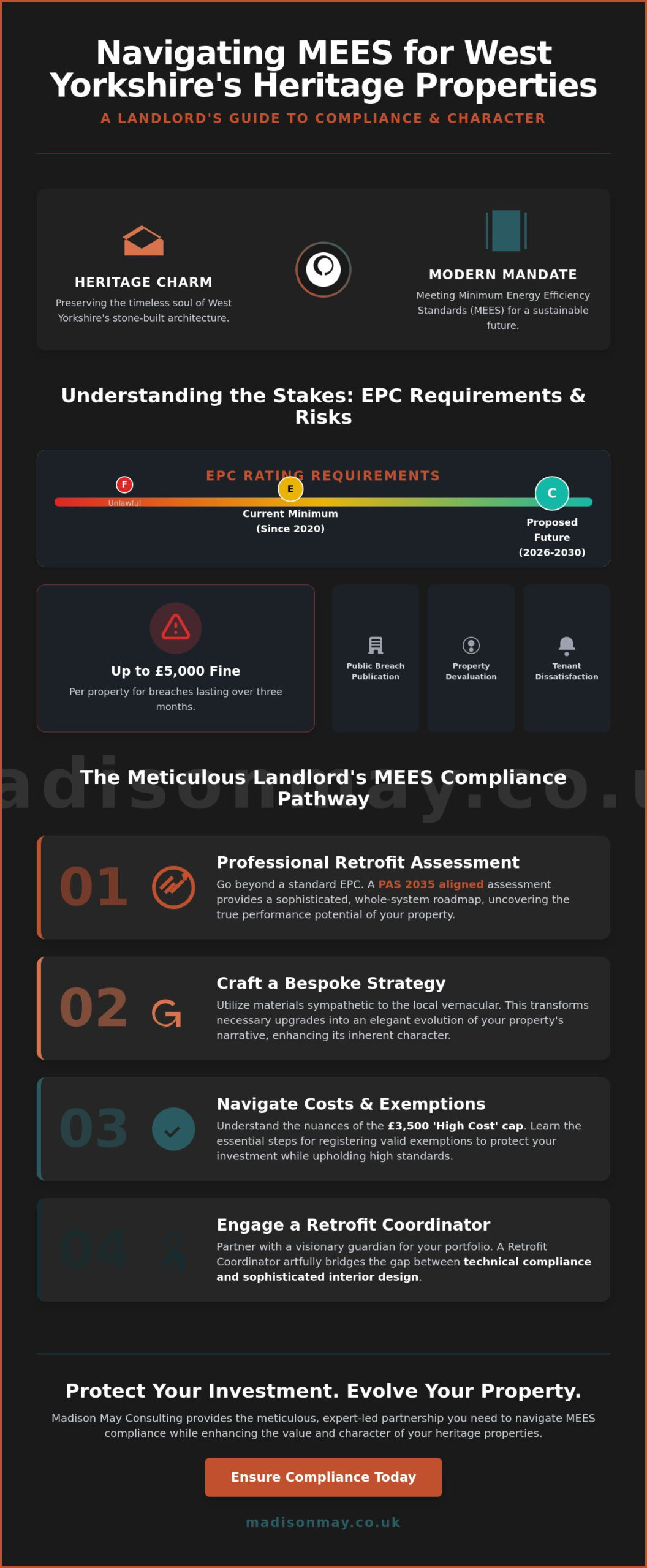
The transition from the current ‘E’ rating toward the proposed ‘C’ rating milestones in 2026 and 2030 reflects a growing commitment to sustainable living. While the path to these higher standards requires meticulous planning, it offers an opportunity to elevate the essence of a property. By investing in the fabric of the building now, you’re not just following a rule; you’re future-proofing a piece of West Yorkshire’s history.
The Current Legal Landscape for Landlords
Since April 1, 2020, it’s been unlawful to let properties with an Energy Performance Certificate (EPC) rating of F or G. This legal benchmark serves as a guardian of tenant well-being. For owners navigating the rental market in the Halifax region, every lease renewal or new tenancy agreement requires a valid certificate that proves the home meets the minimum ‘E’ rating. The EPC provides a curated roadmap for improvements, ensuring that the intersection of functionality and beauty is maintained through thoughtful upgrades.
Financial Penalties and the Risk of Non-Compliance
The consequences of ignoring mees regulations extend beyond simple fines, though those are substantial. Local authorities in West Yorkshire have the power to impose financial penalties of up to £5,000 per property for breaches lasting over three months. Beyond the immediate fiscal impact, there’s a quieter, more pervasive cost. A property that fails to meet these standards often suffers from a diminished market value and heightened tenant dissatisfaction. A cold, drafty house can never truly be a sanctuary. Meticulous attention to these details protects your investment while honoring the people who call your property home.
- Fines of up to £5,000 for non-compliance.
- Publication of the breach on the PRS Exemptions Register.
- Risk of property devaluation in a discerning market.
- Increased maintenance costs due to damp and poor ventilation.
The Meticulous Landlord’s MEES Compliance Checklist
Achieving compliance within the evolving landscape of mees regulations requires more than a cursory glance at an outdated certificate. For the discerning landlord in West Yorkshire, the journey toward an EPC rating of C by 2030 begins with a rigorous audit of the property portfolio, contrasting current performance against the refined standards of the future. It’s essential to consult the official government guidance for landlords to understand the statutory thresholds before commissioning any physical interventions. A current, precise EPC serves as the foundation, ensuring that every subsequent investment is both purposeful and effective.
Step 1: The Professional Retrofit Assessment
A standard EPC often relies on generic data points that fail to capture the nuances of a bespoke property. For the traditional homes that define the Yorkshire landscape, a PAS 2035 aligned assessment offers a sophisticated roadmap that considers the building as a whole system. Madison May’s assessments uncover the soul of a building’s performance, illuminating the hidden potential within its historic walls. This detailed scrutiny ensures that energy-saving measures don’t merely tick a box but enhance the home’s inherent character through a deeply personal narrative of improvement.
Step 2: Evaluating the Building Fabric
The integrity of the building fabric determines whether a space feels like a draughty corridor or a true sanctuary. In West Yorkshire, meticulous attention must be paid to solid stone walls, suspended timber floors, and aging roof structures. Identifying specific points of heat loss is vital; for instance, uninsulated solid walls can account for 45% of heat escape in older terraces. Prioritising fabric-first measures ensures that the home remains efficient for decades, providing a silent, steady comfort that complements high-end interior finishes. You might consider how a curated design strategy can seamlessly blend these technical upgrades with your aesthetic vision.
Step 3: Ventilation and Damp Remediation
Sealing a property to improve its mees rating can inadvertently trap moisture within historic stone, leading to structural decay and a compromised living environment. Compliance with Part F regulations is not just a legal necessity but a fundamental part of maintaining a healthy home. We must balance modern airtightness with intelligent ventilation strategies, whether through passive stacks or discreet mechanical heat recovery systems. This careful calibration prevents dampness, ensuring the air remains as fresh and inviting as the design itself. A well-ventilated home preserves the building’s heritage while securing its future as a premium rental asset.
Exemptions and the ‘High Cost’ Cap: Navigating the Nuances
Compliance with mees regulations often requires a thoughtful balance between financial investment and the preservation of a building’s character. For domestic properties, the government has established a ‘High Cost’ cap of £3,500, including VAT. This figure represents the maximum amount a landlord is required to spend on energy efficiency improvements. If the necessary upgrades exceed this threshold, the property may be eligible for a five-year exemption. According to the Energy Saving Trust guidance, landlords must provide three separate quotes from qualified installers to prove that even the cheapest recommended measures exceed the spending limit.
Madison May views these caps as a functional baseline rather than a final destination. While an ‘All Improvements Made’ exemption protects you from immediate legal penalties, it does little to enhance the lived experience of your tenants or the enduring value of your investment. A property that merely meets the minimum standard often lacks the warmth and atmospheric depth that define a true sanctuary. We advocate for a curated approach that looks beyond the immediate cost, focusing instead on the seamless integration of modern efficiency with timeless design. Investing in the fabric of the building ensures it remains a sought-after asset for decades to come.
The Five-Year Exemption Rule
Exemptions aren’t permanent accolades; they’re temporary pauses in the lifecycle of a property. Most valid exemptions last for exactly five years and must be registered on the PRS Exemptions Register with meticulous evidence. It’s vital to remember that these exemptions are tied to the landlord, not the building. If you acquire a property with an existing exemption, it doesn’t transfer to you. New owners are granted a short six-month grace period from the date of purchase to bring the property into compliance or register a fresh exemption based on their own circumstances. Documentation must be precise, as local authorities can challenge the validity of an exemption at any time.
Heritage and Conservation Area Considerations
West Yorkshire is defined by its rich architectural heritage, from the industrial majesty of Halifax to the bohemian stone terraces of Hebden Bridge. In these conservation areas, the mees framework interacts with strict planning permissions. You might find that double glazing or external wall insulation unacceptably alters the historic essence of a listed building. In such cases, a ‘Consent’ exemption may be appropriate if you can demonstrate that the required measures would breach conservation rules. We recommend early liaison with local planning authorities to explore bespoke retrofit solutions, such as high-performance slimline glazing or internal lime plastering, which honor the building’s soul while improving its thermal performance.
Crafting a West Yorkshire Retrofit Strategy
Approaching the thermal enhancement of a historic property requires a blend of visionary creativity and technical precision. A successful retrofit strategy doesn’t merely satisfy mees requirements; it honors the narrative of the building while elevating the tenant experience. By developing a multi-stage plan, you can distribute the investment over several years, ensuring each intervention is deliberate and high-quality. This rhythmic approach prevents the disjointed feeling of piecemeal upgrades, which frequently fail in traditional West Yorkshire homes by disrupting the natural moisture balance of solid stone walls.
Insulation Upgrades for Traditional Stone Homes
Traditional gritstone properties require materials that speak the same language as the original masonry. While external wall insulation might offer thermal efficiency, it often obscures the timeless appeal of the Yorkshire vernacular architecture. Internal insulation using breathable wood fibre or lime-based solutions allows the structure to manage moisture effectively, preventing the damp issues common with modern synthetics. You can explore a more technical exploration of these materials in our guide to improving your epc rating.
Elegant Windows, Doors, and Draught-Proofing
The transition from a draughty house to a sanctuary begins at the apertures. Replacing thin, rattling panes with bespoke, heritage-style double glazing preserves the aesthetic integrity of a conservation area while drastically reducing heat loss. Meticulous draught-proofing around original joinery offers a subtle yet profound improvement in comfort. These quiet refinements ensure the home remains a place of calm, where the wind stays outside and the warmth is curated within, contributing to a premium living experience for discerning tenants.
Heating and Renewables: The Future of Yorkshire Rentals
Transitioning toward a sustainable future involves moving away from the traditional gas boiler. In the cooler West Yorkshire climate, air-source heat pumps offer a consistent warmth when paired with appropriately sized radiators. Data from the MCS indicates that heat pump installations in the region increased by 22% during 2023, reflecting a growing confidence in this technology. Smart controls allow tenants to manage their environment with ease, reducing energy waste. While solar PV on a narrow terrace may seem challenging, modern battery storage solutions make even small arrays viable for powering communal areas. This integration of technology and heritage ensures your property remains relevant and compliant with mees standards through 2030 and beyond. For landlords seeking to maximise both compliance and capital value, exploring loft conversions Halifax specialists can unlock significant untapped potential within the existing building envelope.
To begin your journey toward a more efficient and beautiful property, view our curated design services.
Madison May: Your Partner in Meticulous Property Evolution
West Yorkshire’s architectural heritage is a rich tapestry of gritstone and history; yet, it presents unique challenges for the modern landlord. We bridge the gap between technical retrofit and elegant design, ensuring your property evolves without losing its inherent character. Meeting the stringent demands of mees regulations is often viewed as a regulatory burden, but we see it as an invitation to craft a high-performance sanctuary. With over 30% of West Yorkshire’s housing stock predating 1919, the path to compliance requires a nuanced understanding of traditional building physics that generic assessments simply cannot provide.
Our Retrofit Coordinators serve as the Project Guardian for your portfolio. They protect the architectural integrity of your investment while managing the complex technicalities of energy efficiency. This role is vital for maintaining the delicate balance between moisture movement in old stone and the airtightness required for modern comfort. We don’t just aim for a better letter on a certificate; we strive for a timeless quality that stands the test of changing legislation and shifting seasons.
Bespoke Consultancy for Discerning Landlords
Every EPC improvement plan we create is tailored to the specific story of your property. We don’t believe in generic solutions for homes that possess such distinct personality. Our fixed-fee assessment services offer transparency and authority, providing a clear roadmap for your investment without hidden costs. By linking technical upgrades to our philosophy of heritage property refurbishment, we ensure that energy efficiency and beauty coexist in perfect harmony. Our local expertise allows us to address the specific needs of West Yorkshire’s building stock, from the damp-prone valleys of Calderdale to the exposed heights of the Pennines.
Your Journey to Compliance Starts Here
We integrate mees regulatory requirements into a broader, more graceful vision for your home. This process is about more than just numbers on a certificate. It’s about the emotional resonance of a space that feels warm, quiet, and deeply considered. We invite you to a measured, graceful consultation to discuss your portfolio strategy and explore how we can elevate your properties into high-performance assets. Our approach is steady and deliberate, reflecting the care we put into every joint and finish. Begin your property’s transformation with a Madison May Retrofit Assessment and discover the peace of mind that comes with meticulous craftsmanship and visionary design.
Elevating Your Portfolio Beyond Compliance
Navigating the transition toward higher energy standards is more than a regulatory hurdle; it’s an opportunity to refine the soul of your property. While current mees requirements mandate an EPC rating of E, the UK Government’s proposed targets aim for a rating of C by 2030. This shift requires a meticulous strategy, especially when managing West Yorkshire’s unique stone-built heritage. These historic structures demand a bespoke approach that balances modern thermal efficiency with breathable, timeless craftsmanship to protect the building’s integrity. For those ready to take the next step, a structured EPC improvement plan tailored to the specific demands of regional stone architecture provides the clearest path from compliance to genuine comfort.
At Madison May, we transcend simple checklists to offer a curated retrofit journey. Our PAS 2035 Aligned Retrofit Assessors specialize in the delicate performance of regional stone architecture, ensuring your investment remains both a sanctuary for tenants and a high-performing asset. Through our meticulous, fixed-fee consultancy services, we provide the clarity and poise needed to transform compliance into a seamless integration of beauty and function. You don’t have to face these complex legislative changes alone. Landlords looking to go further can also discover how elegant loft conversions in Halifax can add significant value and energy-efficient living space to their existing portfolio.
Secure your property’s future with a meticulous MEES assessment from Madison May
Your property’s evolution begins with a single, thoughtful step toward a more sustainable and elegant future.
Frequently Asked Questions
What is the current minimum EPC rating for rental properties in West Yorkshire?
The current minimum EPC rating for all domestic rental properties in West Yorkshire is an ‘E’. Since April 1, 2020, it’s been illegal to let a property that falls below this threshold unless you’ve registered a valid exemption. This standard ensures every home provides a baseline of warmth. It transforms a simple structure into a reliable sanctuary for your residents.
Do MEES regulations apply to listed buildings in Halifax or Huddersfield?
MEES regulations apply to listed buildings in Halifax and Huddersfield if the energy improvements don’t unacceptably alter their architectural character. You’ll need to consult local conservation officers to determine if specific upgrades, like slim-profile double glazing, are permitted under heritage rules. Preserving the soul of a Pennine stone cottage requires a delicate balance between modern efficiency and timeless craftsmanship.
How much am I legally required to spend on energy improvements under MEES?
You’re legally required to spend a maximum of £3,500, including VAT, on energy efficiency improvements to reach the required ‘E’ rating. If the necessary work costs more than this government-mandated cap, you can apply for a “high cost” exemption. This financial ceiling ensures that the journey toward compliance remains manageable while still elevating the property’s overall performance and comfort.
Can a tenant refuse entry for a MEES-related retrofit assessment?
A tenant can legally refuse entry for a MEES assessment or retrofit, which allows you to register a “tenant consent” exemption. This protection lasts for five years or until the current tenancy concludes. It’s essential to document all correspondence and refusal notices carefully. Maintaining a graceful relationship with your residents is as vital as the physical upkeep of the building itself.
How long does a MEES exemption last once registered on the PRS register?
Most exemptions last for exactly five years once they’re successfully registered on the national PRS register. After this 60-month period expires, the exemption is no longer valid; you must either meet the minimum ‘E’ rating or apply for a new exemption. This cycle encourages landlords to periodically reassess their properties. It ensures that every home continues to evolve alongside modern standards of care.
What happens if my West Yorkshire property cannot reach an ‘E’ rating despite improvements?
If your property cannot reach an ‘E’ rating despite completing all possible improvements up to the £3,500 cap, you should register an “all improvements made” exemption. This provides a legal safe harbor for five years. You’ll need to provide evidence from a qualified assessor to prove that the property’s unique structure limits further efficiency gains. It recognizes the architectural heritage of older northern homes.
Is there local funding available for West Yorkshire landlords to meet MEES?
Local funding is often available through the West Yorkshire Combined Authority and the Better Homes Yorkshire scheme. These programs frequently provide grants for insulation and heating upgrades to help landlords meet requirements without bearing the full financial burden. In 2023, similar initiatives helped hundreds of property owners across Leeds and Bradford. Utilizing these resources allows for a meticulous approach to property refinement.
How does PAS 2035 affect my MEES compliance strategy?
PAS 2035 affects your strategy by requiring a professional, whole-house approach to energy retrofits. It ensures that every material and installation works in harmony, preventing issues like condensation that can arise from poorly planned insulation. This framework aligns perfectly with a commitment to quality. It treats the property as a single, breathing entity rather than a collection of disconnected parts.