

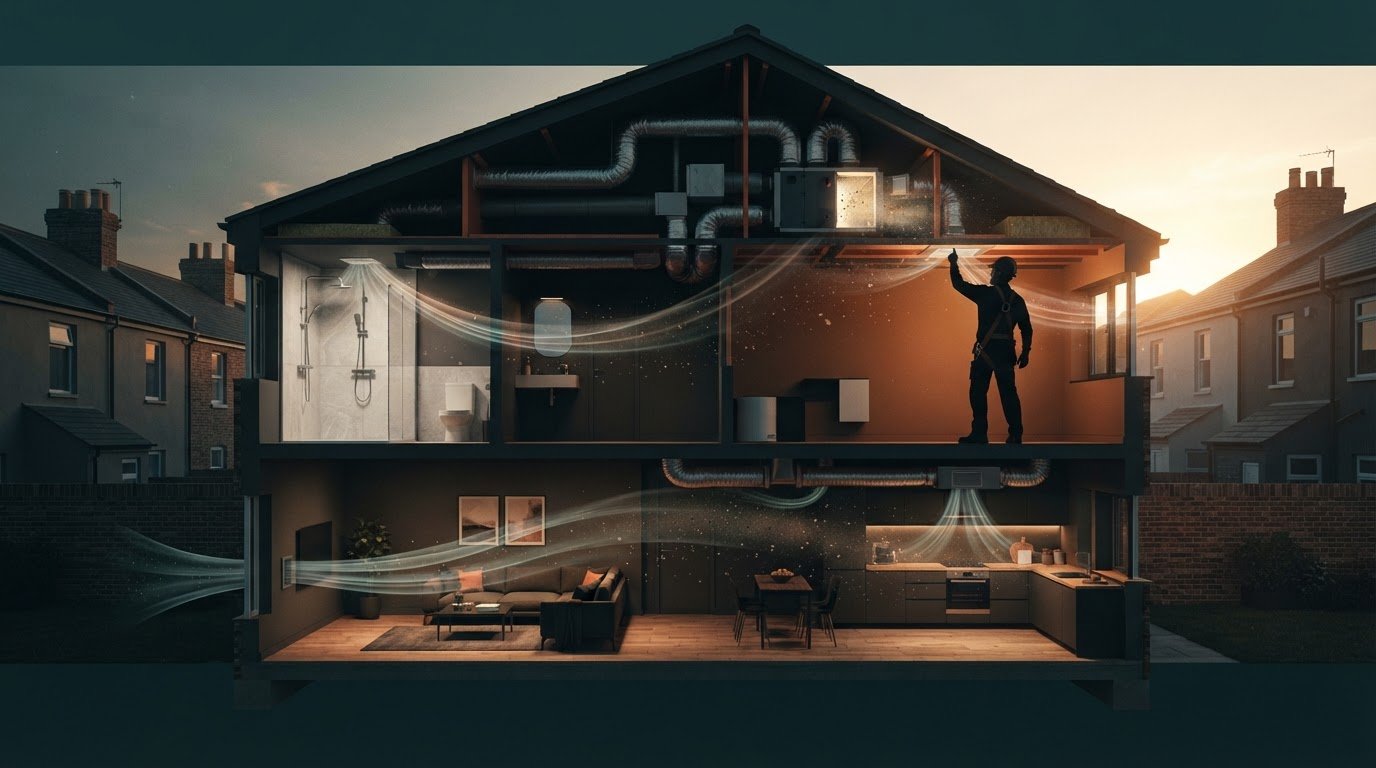
What if the answer to dust that keeps returning isn’t simply another round of cleaning? If allergy concerns persist despite your best efforts, it’s understandable to wonder whether better airflow or an air purifier would make a difference. Reducing dust and allergens with ventilation can help manage some airborne particles, but ventilation isn’t a cure-all. It works alongside sensible cleaning and steps to control the sources bringing particles into your home.
The right approach depends on your home, how airtight it is and where unwanted particles are coming from. Insulation and draught-proofing can make a home more comfortable and efficient, but without suitable ventilation, stale air and moisture may build up. Equally, opening windows may bring more pollen indoors when outdoor levels are high.
This guide explains how ventilation moves airborne particles, where filtration may help and what these measures can’t do on their own. It also covers practical checks for different homes and why ventilation should be considered alongside retrofit improvements. If you’re unsure what to do next, a property-specific ventilation assessment may help you understand your home’s airflow needs.
Key Takeaways
- Understand how fresh-air supply and stale-air extraction affect airborne particles, and why ventilation alone may not capture fine dust.
- Compare natural, extract and balanced mechanical ventilation to see what may suit your home.
- For reducing dust and allergens with ventilation, pair suitable airflow with source control and cleaning rather than relying on one measure alone.
- Use a room-by-room check to spot likely sources and identify where extraction or airflow may need attention.
- Learn when persistent condensation, lingering odours, poor extraction or planned retrofit work could make a property-specific ventilation assessment useful.
How can ventilation help reduce dust and allergens indoors?
If dust quickly returns after cleaning or allergy concerns persist, ventilation may be part of the answer, but it isn’t a complete solution. Ventilation manages the movement of air through a home; it doesn’t remove every allergen or guarantee relief from symptoms. Reducing dust and allergens with ventilation works best as part of a broader approach that also considers what’s producing particles and how they’re cleaned away.
Ventilation is the controlled movement of indoor and outdoor air to refresh a home and remove stale air. It’s different from air cleaning. Ventilation changes the air in a space, whilst an air cleaner or suitable filter captures particles from air passing through it. Indoor air quality can be improved through a combination of ventilation, filtration and source control, as outlined in this overview of primary methods for improving indoor air quality.
Where do indoor dust and allergens come from?
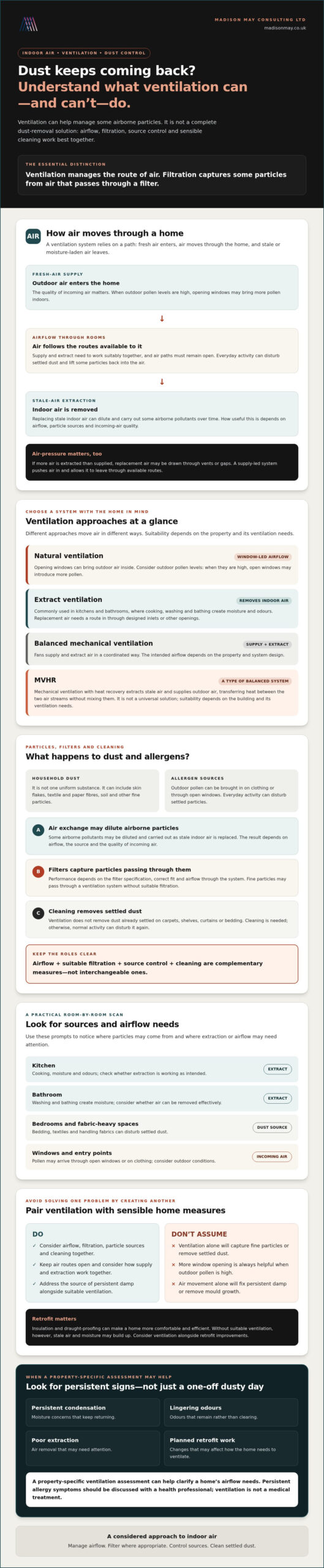
Household dust isn’t one uniform substance. It can include skin flakes, textile and paper fibres, soil and other fine particles. Allergens may come from sources such as outdoor pollen brought in on clothing or through open windows. Everyday activity, including walking across a room, changing bedding or handling fabrics, can disturb settled dust and lift some particles back into the air.
Damp-related mould is a separate concern. Air movement may help manage moisture, but it won’t fix the source of persistent damp or remove mould growth on its own. Addressing the moisture source is important alongside suitable ventilation.
What ventilation can and cannot do
When stale indoor air is replaced with outdoor air, some airborne pollutants may be diluted and carried out over time. How useful this is depends on airflow through the home, the source of the particles and the quality of incoming air. If outdoor pollen levels are high, for example, opening windows may bring more pollen indoors rather than reduce it.
Ventilation also doesn’t remove settled dust from carpets, shelves, curtains or bedding. Suitable cleaning is needed to remove those particles; otherwise, normal household activity can disturb them again. Fine particles may also pass through a ventilation system if it doesn’t have suitable filtration.
Think of ventilation as managing the air’s route, not as a promise of clean air or symptom relief. It can support a more considered indoor environment, but it isn’t a medical treatment. Discuss persistent allergy symptoms with a health professional.
How do ventilation, filtration and airflow work together?
To understand what a ventilation system can do, look at three connected elements: where fresh air enters, where stale or moisture-laden air leaves, and the route air takes between them. A system works as intended only when those air paths remain open and its supply and extract are suitably balanced for the home. Air pressure is part of the picture too. Extracting more air than is supplied can draw replacement air through vents or gaps, whilst a supply-led system pushes air into the home and allows it to leave through available routes.
Ventilation brings air in and moves stale air out; filtration captures some particles from air passing through a filter. Neither function automatically guarantees the other. Ventilation on its own doesn’t necessarily trap fine particles.
What do extract, supply and balanced ventilation mean?
Extract ventilation removes indoor air, commonly from kitchens and bathrooms where cooking, washing and bathing create moisture and odours. Replacement air must then enter elsewhere, through designed inlets or other openings. Supply ventilation works in the opposite direction by introducing outdoor air, which needs a suitable route out. In a balanced mechanical system, fans supply and extract air in a coordinated way, with the intended airflow depending on the property and system design.
Mechanical ventilation with heat recovery (MVHR) is one type of balanced system. It extracts stale air and supplies outdoor air, transferring heat between the two air streams without mixing them. The Centre for Sustainable Energy explains how Mechanical ventilation with heat recovery (MVHR) can be used in well-sealed homes. It isn’t a universal answer: suitability depends on the building and its ventilation needs.
Can air filters capture pollen and fine particles?
They can, but performance depends on more than the filter label. Its specification, correct fit, airflow through the system and regular maintenance all matter. A poorly fitted, clogged or overdue filter may not perform as intended, so follow the system manufacturer’s guidance for checks and replacement. Don’t assume every ventilation unit includes filtration designed to capture the particles you’re concerned about.
A filter within a ventilation system treats air moving through that system. A standalone room air cleaner instead draws in and filters air from the room; it doesn’t necessarily provide fresh outdoor air or extract moisture from a kitchen or bathroom. The two can serve different purposes, and neither removes dust already settled on surfaces.
Air also needs a clear route. Blocked grilles, closed transfer routes or neglected filters can undermine airflow through the home. If insulation or draught-proofing is planned, consider ventilation alongside those changes rather than treating airtightness as a separate decision. A property-specific ventilation assessment may help clarify airflow needs before work is finalised.
Which ventilation and dust-control measures suit different homes?
The right approach to reducing dust and allergens with ventilation depends on the home’s existing system, its condition and the household’s needs. A well-maintained extract fan may be sufficient for managing moisture in a bathroom, whilst a more airtight home may need a carefully designed, continuous supply and extract system. No single option suits every property. Consider ventilation alongside any insulation and draught-proofing work.
Use this comparison as a starting point, then check how air moves through your home.
| Measure | Suitable context | Potential benefit | Limitation | Maintenance consideration |
|---|---|---|---|---|
| Natural ventilation | Homes with openable windows and usable background vents | Simple way to introduce outdoor air | Airflow depends on weather, window use and outdoor conditions | Keep vents clear and consider pollen or outdoor air quality before opening windows |
| Intermittent extract | Kitchens or bathrooms with working extract fans | Removes moisture and odours when switched on | Only operates when used and doesn’t provide whole-home filtration | Keep grilles clean and check that the fan operates properly |
| Continuous extract | Homes designed for ongoing mechanical extraction | Provides steady extraction from selected rooms | Needs suitable replacement-air paths and correct operation | Follow guidance for cleaning and system checks |
| Balanced mechanical ventilation | Some newer or substantially upgraded homes | Coordinates outdoor-air supply and stale-air extract; some systems include filters | Requires appropriate design, installation and ongoing attention | Check filters and follow maintenance guidance |
When might simple ventilation measures be enough?
Start by using existing vents and extract fans as intended, provided they’re in good condition. Blocking vents to keep pollen out can restrict background airflow and may contribute to stale air or excess moisture. Instead, consider outdoor pollen and air-quality conditions when deciding whether and when to open windows, while keeping suitable ventilation routes clear.
When might mechanical ventilation or filtration be considered?
If rooms remain stuffy, extraction seems weak, or you’re planning insulation or draught-proofing, an assessment may help establish whether the current arrangement suits the property. Filtration in a central ventilation system treats air moving through that system. A room air cleaner filters air locally but doesn’t replace ventilation or extract moisture. Compare practical requirements too, including noise, running needs, filter replacement and the work needed to install or adapt a system.
A property-specific assessment can help put those choices in context, rather than selecting equipment based on dust concerns alone.
How can you improve indoor air quality without creating new problems?
A measured approach is more useful than changing several things at once. Start by observing the home, then address likely sources and check that existing ventilation is working before considering alterations. This helps you understand what may be happening without assuming every patch of condensation or build-up of dust has the same cause.
What can you check before changing your ventilation?
- Identify likely sources and observe each room. Note where dust gathers, which rooms feel stuffy, and when odours or allergy concerns occur. Keep a simple record of patterns, such as whether an issue appears after cooking, cleaning or opening windows.
- Look at vents and extract fans. Check for visible obstructions, dust build-up or obvious faults. Don’t block vents to keep out pollen, and avoid dismantling equipment if you’re unsure how it works.
- Record signs of condensation or damp. Note where and when they appear, such as on a window or in a particular room. These observations are useful, but they don’t prove a specific cause. Persistent damp may need further investigation.
- Review planned home improvements. If you’re adding insulation or reducing draughts, consider how ventilation will be maintained as part of the overall work. Making a home more airtight without considering airflow can leave moisture and indoor pollutants with fewer routes out.
How do cleaning and ventilation complement each other?
Cleaning and ventilation address different parts of the problem. Air movement can help remove or dilute some pollutants in the air, whilst suitable cleaning removes settled particles from surfaces and furnishings. Damp dusting can help limit how much dust is stirred up. Regular vacuuming with a machine fitted with a suitable filter can also help manage household dust. These are general housekeeping measures, not allergy treatment.
Take care before disturbing unknown or potentially hazardous materials, particularly during renovation or repair. Don’t sweep, sand or vacuum material you suspect may be hazardous. Seek appropriate specialist advice instead.
If you’re planning home improvements, consider how insulation, draught-proofing and ventilation will work together before deciding on changes. If you’re unsure how air moves through your property, a property-specific ventilation assessment may help inform your next steps. Reducing dust and allergens with ventilation is best approached as part of a considered plan, rather than by sealing gaps or adding equipment without first understanding the home.
When should you arrange a professional ventilation assessment?
Consider further investigation if condensation keeps returning, odours linger, or an extract fan appears ineffective despite being switched on and kept clear. These signs don’t identify a cause on their own, but they can indicate that the home’s ventilation needs closer attention. An assessment may also be useful before retrofit work, particularly if insulation or draught-proofing could change how air moves through the property.
What might a ventilation assessment examine?
The scope should reflect the building and the concerns you’ve noticed. Depending on the assessment, this may include reviewing ventilation provisions, airflow routes and extract systems in the context of the home’s fabric and services. Ask in advance what the assessment covers and whether it includes checks or written findings, as these details can vary.
Madison May Consulting Ltd provides ventilation assessments and damp remediation guidance. Its retrofit assessments include data collection on building fabric, services and ventilation. These services can help inform property-related decisions, but an assessment isn’t an allergy diagnosis, a survey of every indoor pollutant or a promise of health outcomes.
How does ventilation fit into a retrofit plan?
Insulation, airtightness, heating and ventilation affect one another. Improving insulation or reducing draughts can make a home more comfortable, but changes to the building fabric may also alter existing airflow. Considering ventilation as part of the wider plan helps avoid treating energy efficiency and indoor air quality as separate concerns.
A building survey can provide broader context for planned work, while a retrofit assessment can take account of a property’s fabric, services and ventilation. The right next step depends on the home and the improvements being considered. It can help to understand how the different elements of a project fit together before work begins.
If you’re weighing up changes or want to understand your home’s ventilation needs, explore Madison May’s home-improvement consultancy and discuss whether a property-specific assessment may be appropriate. An assessment can help clarify building-related questions about reducing dust and allergens with ventilation, but it isn’t medical advice.
Take a considered next step for your home
Reducing dust and allergens with ventilation is most effective as part of a thoughtful approach. Ventilation can help manage airborne particles, but it works alongside suitable filtration, source control and regular cleaning. The right measures depend on your home’s airflow, existing systems and planned improvements, so don’t assume one ventilation option suits every property.
If condensation persists, extraction seems poor or you’re planning insulation or draught-proofing, a property-specific assessment can help clarify what may need attention. Madison May Consulting Ltd offers ventilation assessments and damp remediation guidance. Its retrofit assessments consider building fabric, services and ventilation, with PAS 2035 aligned reporting and EPC improvement plans also available.
To discuss your home’s ventilation or retrofit needs, contact Madison May Consulting Ltd about a property-specific assessment.
Frequently Asked Questions
Can ventilation reduce dust and allergens in a home?
Yes, ventilation can help dilute and remove some airborne particles as indoor air is replaced, but it won’t remove every allergen or settled dust. Its effect depends on how air moves through the home and what is entering it. For reducing dust and allergens with ventilation, combine suitable airflow with source control and cleaning. Ventilation isn’t a medical treatment and can’t guarantee relief from allergy symptoms.
Does opening windows help reduce pollen indoors?
Not always. Opening windows can refresh indoor air, but it may also let pollen inside, particularly when outdoor pollen levels are high. Consider outdoor conditions and whether pollen is a concern before airing a room. If you keep windows closed, don’t block designed ventilation openings as a substitute. The best approach depends on the home’s existing ventilation and conditions outside at the time.
Do ventilation systems remove dust from the air?
Ventilation moves air through or out of a home, but it doesn’t necessarily capture dust. Some systems include filters, though their ability to trap particles depends on the filter, how it fits, airflow and maintenance. Ventilation can also help carry some airborne particles out as air is exchanged. Dust that has settled on shelves, carpets or furnishings needs to be removed through suitable cleaning.
Can better ventilation help with mould and damp?
Suitable ventilation can help remove moisture produced by activities such as cooking and bathing, which may help manage indoor humidity. It won’t, by itself, fix every cause of damp or remove mould growth. If condensation or damp keeps returning, note where it appears and consider further investigation rather than assuming poor ventilation is the only cause. Addressing the underlying moisture issue is important alongside airflow.
Are air purifiers or ventilation better for allergens?
They do different jobs, so one isn’t automatically better. A room air purifier draws in and filters air locally, subject to its filter and correct use. Ventilation brings outdoor air into the home and removes indoor air; it may not filter particles unless designed to do so. Your choice depends on whether the priority is fresh-air exchange, particle filtration or both, as well as the home’s existing system.
Should I block air vents to keep dust and pollen out?
No, don’t block vents intended to provide ventilation. Restricting airflow may leave rooms stuffy or contribute to moisture build-up, and it doesn’t address dust already inside. If pollen is a concern, consider outdoor conditions when deciding whether to open windows, and use suitable cleaning to remove settled particles. If a vent appears damaged, draughty or poorly placed, seek advice before altering or sealing it.
Does insulating a home mean it needs more ventilation?
Not necessarily more ventilation, but insulation and draught-proofing can change how air moves through a home. If improvements make the building more airtight, existing gaps may no longer provide the same airflow, so ventilation should be considered as part of the plan. The right provision depends on the property, its current system and the work proposed. Avoid sealing a home without considering how stale, moist air will be removed.
When should I get a ventilation assessment?
Consider an assessment if condensation persists, odours linger, extraction seems weak or you’re planning insulation or draught-proofing. A property-specific assessment may examine ventilation provisions, airflow routes and extract systems in the context of the building. Madison May Consulting Ltd offers ventilation assessments and damp remediation guidance; check the assessment scope before proceeding. It can inform building decisions, but it doesn’t diagnose allergies or guarantee health outcomes.