


The very measures intended to warm our homes, such as modern insulation, can often be the hidden architects of a damp problem if the underlying building science is ignored. You might find yourself scrubbing away recurring black mould or wondering why a persistent musty scent lingers in your favourite rooms, despite your best efforts to keep things clean. It’s a common frustration, often exacerbated by conflicting advice from tradespeople who treat the symptoms rather than the cause. If you’re seeking a professional damp survey that truly gets to the root cause, it is essential to look beyond the surface level. True restoration begins with understanding how your home breathes, ensuring that every layer of fabric and every breath of air works in harmony.
Madison May Consulting Ltd understands that your home is more than just a structure; it is a personal sanctuary that should provide comfort and security. This guide will show you how to transform a moisture-prone environment into a dry, energy-efficient refuge by applying the principles of professional building science and retrofit coordination. We’ll explore the critical role of ventilation, the impact of modern regulations like Awaab’s Law, and how a whole-house approach protects your investment whilst lowering your energy bills. By looking at the property as a single, living system, you can achieve a home that is as healthy as it is beautiful.
Key Takeaways
- Learn how to move beyond temporary surface treatments by embracing a holistic building science approach that neutralises the root causes of moisture whilst restoring the enduring health of your property.
- Master the ‘Retrofit Triangle’ to ensure that new insulation and heating upgrades work in perfect harmony with ventilation, preventing the unintended moisture risks that often follow modern energy-efficient improvements.
- Gain clarity on the distinct characteristics of rising, penetrating, and condensation-led damp, highlighting why a professional damp survey West Yorkshire residents trust is the essential foundation for an accurate diagnosis.
- Explore how adhering to Building Regulations Part F and prioritising ventilation can transform your living spaces from damp-prone environments into breathable, healthy, and energy-efficient sanctuaries.
- Discover how the PAS 2035 framework and expert Retrofit Coordination provide a sophisticated roadmap for protecting your home’s fabric and ensuring long-term resilience against the elements.
Defining Damp Remediation: Moving Beyond Surface Treatments
True damp remediation is far more than a mere tactical strike against moisture; it is a thoughtful process of restoration that seeks to return a property to a state of graceful equilibrium. For decades, the industry relied upon aggressive, often invasive chemical treatments to mask symptoms, yet modern building science has ushered in a more sophisticated era. This shift prioritises the identification and neutralisation of moisture sources through a deep understanding of building physics, ensuring that the fabric of your home is preserved rather than merely covered. When you commission a damp survey West Yorkshire property owners can trust, you are engaging in a diagnostic journey that treats your home as a living, breathing system where every element must work in harmony to maintain a healthy environment.
Remediation differs fundamentally from temporary cleaning or superficial repairs. Whilst a quick wipe of a wall might remove the visual evidence of mould, it does nothing to address the underlying thermal imbalances or moisture pathways that allowed it to flourish. A professional approach involves a meticulous analysis of how water enters, moves through, and leaves the building. By respecting the original craftsmanship of a property whilst integrating modern moisture management, we can transition from a cycle of recurring issues to a permanent state of resilience and curated comfort.
The Philosophical Shift in Property Care
In the United Kingdom, our architectural heritage is a tapestry of varying materials and construction techniques, many of which were designed to breathe in ways that modern living standards often disrupt. The introduction of central heating, double glazing, and high-occupancy lifestyles has changed the internal climate of our homes, necessitating a more nuanced approach to moisture. At Madison May Consulting Ltd, our philosophy is rooted in the belief that a home should be a sanctuary; a dry, healthy space that reflects the identity of those who dwell within. This requires moving away from the “one size fits all” mentality of historical Damp proofing methods and instead embracing a bespoke strategy that honours the building’s integrity whilst ensuring it meets contemporary expectations of warmth and efficiency.
Why Traditional ‘Quick Fixes’ Often Fail
Many homeowners find themselves trapped in a frustrating loop of applying anti-mould paints or superficial sprays that promise instant results but deliver only temporary relief. These products often act as a bandage, hiding the decay beneath a fresh coat of white whilst the moisture continues to degrade the structural fabric. Equally, the common industry reflex to recommend “injected damp proof courses” is frequently a misdiagnosis; in many instances, the moisture is not rising from the ground but is instead a result of internal condensation or external penetrating damp. A professional damp survey West Yorkshire is the only way to peel back these layers of confusion. Only through a comprehensive building survey can we uncover hidden thermal bridges and moisture traps, ensuring that the solution we propose is as enduring as the home itself.
The Delicate Balance: Why Modern Retrofits Require Meticulous Damp Planning
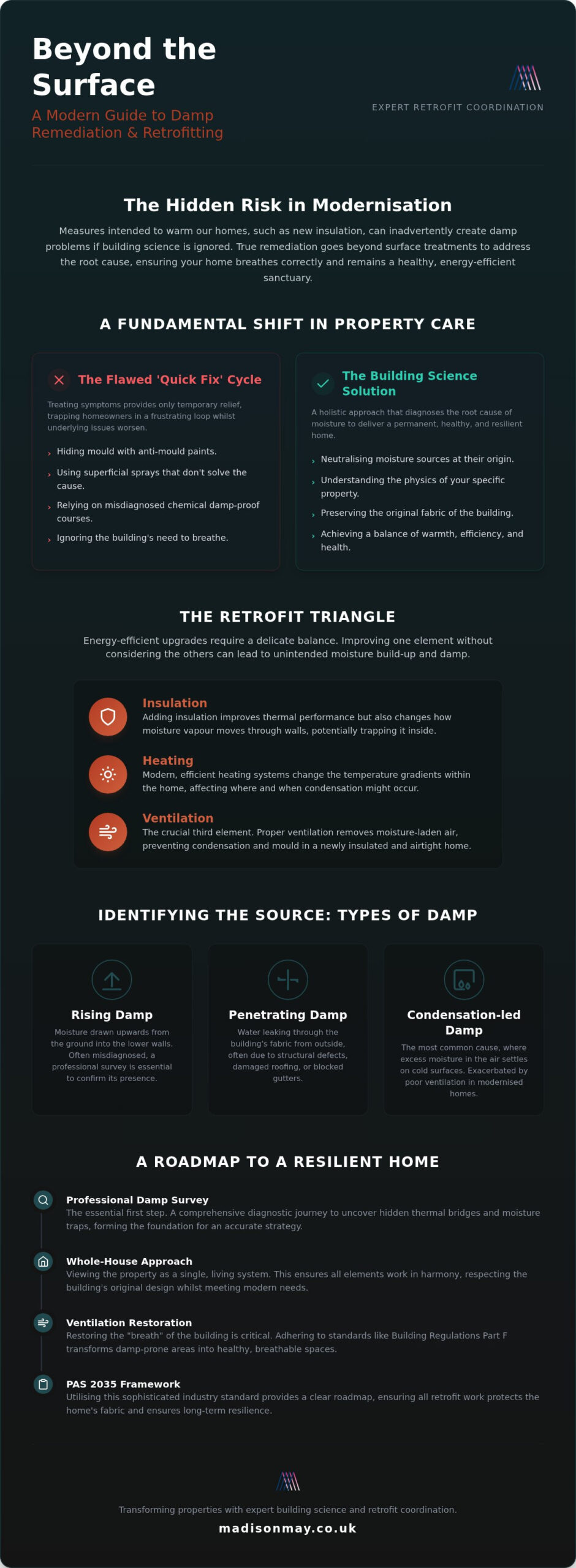
The pursuit of a warmer, more sustainable home is an admirable journey, yet it requires a profound respect for the physics of the structure. We often speak of the ‘Retrofit Triangle’, a conceptual framework that highlights the critical interdependence between Insulation, Heating, and Ventilation. When we introduce energy-efficient measures like external house insulation, we fundamentally change how a building manages heat and moisture. Without the guidance of a damp survey West Yorkshire residents can rely on, these improvements can inadvertently ‘seal in’ moisture, turning a sanctuary into a humid environment where the building fabric is at risk. Achieving high thermal performance shouldn’t come at the cost of your home’s breathability; it requires a coordinated approach that respects the building’s original character whilst embracing modern standards.
The danger of ‘over-sealing’ a property is particularly acute when draught-proofing is carried out in isolation. Whilst blocking cold air is essential for comfort, it can also trap the several litres of water vapour produced daily by cooking, bathing, and even breathing. Without a professional assessment to ensure adequate air exchange, this trapped moisture will seek out the coldest surfaces in your home, leading to structural decay and a decline in air quality. By identifying these risks early, we can design a remediation strategy that balances warmth with health, ensuring your property remains a resilient refuge against the West Yorkshire elements.
Understanding Thermal Bridging and Condensation
Thermal bridging occurs when a specific part of the building fabric allows heat to escape more rapidly than the surrounding areas. These junctions, often found at floor levels, lintels, or window reveals, create localised cold spots where the temperature falls below the dew point. It is at these precise coordinates that airborne moisture transforms into liquid, creating the sensory experience of a ‘cold corner’ that feels perpetually damp to the touch. Over time, this dampness invites the growth of mould, marring the refined aesthetics of your living space. As noted in the guidance for Assessing Damp in Historic Buildings, identifying these invisible thermal pathways is essential for any successful remediation. We utilise advanced thermal imaging to bring these risks into focus, allowing for a strategy that addresses the root cause rather than just the visual symptoms.
The Unintended Consequences of Partial Retrofits
There is a significant risk in treating home improvements as a series of disconnected tasks. For example, replacing original windows or installing rigorous draught-proofing without a professional ventilation assessment can lead to immediate condensation issues. The air becomes stagnant, and the moisture generated by daily life has nowhere to go. Similarly, cavity wall insulation can sometimes lead to ‘sweating’ walls if it disrupts the building’s natural moisture equilibrium. A meticulous EPC improvement plan provides the necessary oversight to prevent these expensive errors, ensuring that every upgrade is part of a coherent, whole-house strategy. Before embarking on your next project, consulting with a specialist in building science will ensure your home remains a dry, energy-efficient refuge for years to come.
Identifying the Source: A Comparison of Damp Types and Professional Damp Survey Findings
Accurate diagnosis is the cornerstone of property restoration; without it, any attempt at remediation is merely guesswork. Misdiagnosis remains the most expensive mistake a homeowner can make, often resulting in invasive and unnecessary works that fail to address the root cause. A truly professional damp survey West Yorkshire homeowners commission should be an exercise in independent consultancy, offering a clear, unbiased perspective that prioritises the health of the building over the sale of a specific product. By categorising moisture into three distinct types, rising, penetrating, and condensation, we can begin to unpick the complex narrative of a property’s moisture profile and design a path toward curated comfort.
Whilst many contractors offer ‘free’ surveys, these are frequently tied to the sale of proprietary chemical treatments or specific remedial products. This creates a conflict of interest that can lead to the installation of unnecessary damp-proof courses when the issue is actually atmospheric. We believe in a more refined approach, where the surveyor acts as a guardian of the building’s integrity. By using precision instruments and a deep knowledge of building science, we ensure that every recommendation is grounded in reality rather than a sales target.
Rising and Penetrating Damp: Structural Challenges
Rising damp occurs when ground moisture is drawn upwards through the masonry via capillary action, often leaving behind tell-tale salt tidemarks and blistering plaster near the floor. It is a specific failure of the original damp-proof course, yet it’s frequently misdiagnosed in properties where the external ground level has simply been raised. Penetrating damp, by contrast, is an external ingress often caused by faulty guttering, porous brickwork, or cracked render. These structural failures allow water to migrate through the walls, creating localised damp patches that expand after heavy rain. Our comprehensive building surveys are designed to map these failures with precision, ensuring that maintenance is targeted exactly where it is needed.
Condensation: The Modern Homeowner’s Primary Adversary
In the modern era, condensation has become the most prevalent moisture issue in UK homes. It is a product of relative humidity; when moisture-laden air meets a cold surface, it reaches its dew point and transforms into liquid. Modern lifestyles, involving high-occupancy and frequent bathing or cooking, increase the moisture load significantly. There is a direct link between energy efficient home improvements and condensation, as sealing a home to save heat can inadvertently trap water vapour. Remediation here isn’t about blocking water with chemicals; it’s about atmospheric control. By managing the internal climate and ensuring proper air exchange, we can eliminate black spot mould and restore a sense of calm and health to your living spaces.
Restoring the Breath of a Building: The Critical Role of Ventilation in Remediation
In the delicate choreography of building science, ventilation is often the forgotten partner, yet it remains the most vital element for maintaining the long-term health of both the structure and its inhabitants. Whilst previous sections explored the physical barriers to moisture, true resilience is found in how a home breathes. A professional damp survey West Yorkshire residents arrange often reveals that even when the structural fabric is sound, the internal atmosphere is stagnant, allowing moisture to accumulate and degrade the curated beauty of the living space. Building Regulations Part F (Approved Document F) now mandates specific ventilation standards for retrofit projects, recognising that energy efficiency and airtightness must never compromise the quality of the air we breathe.
The transition from passive ventilation, such as simply opening a window, to active moisture management is a hallmark of a sophisticated remediation strategy. Passive methods are often unreliable in the damp, cool climate of West Yorkshire, where the desire to retain heat frequently outweighs the need for fresh air. By implementing active systems, we can ensure a constant, controlled exchange of air that preserves the aesthetic and structural integrity of your property, preventing the quiet decay that moisture-laden air inevitably brings to fine finishes and heritage fabrics.
Mechanical Ventilation Strategies
Modern remediation often requires the precision of mechanical systems to achieve the necessary equilibrium. Decentralised Mechanical Extract Ventilation (dMEV) provides a whisper-quiet, constant extraction in wet rooms, ensuring that steam from bathing or cooking is neutralised at the source. For a more transformative, whole-house solution, Positive Input Ventilation (PIV) systems introduce filtered, tempered air into the home, creating a subtle positive pressure that pushes moist air out through natural leakage points. To ensure these systems function effectively, we often recommend the subtle ‘undercutting’ of internal doors, allowing air to circulate freely amongst rooms and maintaining a consistent, healthy climate throughout your sanctuary.
The Ventilation Assessment Process
A professional ventilation assessment is a meticulous exercise in data and observation. We measure air change rates to ensure the building meets safety standards whilst matching the ventilation capacity to the specific occupancy and moisture production of your household. This tailored approach ensures that your home isn’t just ‘ventilated’, but is optimised for your unique lifestyle. This includes ensuring that high-performance windows and doors are specified with appropriate trickle vents to provide essential background airflow without compromising thermal comfort. By integrating these elements, we create a home that is as breathable as it is beautiful. To ensure your property is equipped with the correct moisture management systems, you should book a professional ventilation assessment today.
Crafting a Damp-Free Future: The Madison May Consulting Ltd Approach to Retrofit Excellence
The transition from a property plagued by moisture to a resilient, healthy home requires more than just remedial work; it demands a visionary strategy. At Madison May Consulting Ltd, we move beyond the outdated practices of the previous century, replacing aggressive chemical injections with the precise, data-driven methodology of modern building science. When you engage us for a damp survey West Yorkshire homeowners can trust, you aren’t simply hiring a surveyor; you are appointing a dedicated Retrofit Coordinator. This role serves as the guardian of your project’s technical integrity, ensuring that every measure, from insulation to ventilation, is harmonised to prevent moisture risks and protect the enduring fabric of your sanctuary.
The gold standard for this transformative process is the PAS 2035 Retrofit Assessment. Whilst traditional damp-proofing often ignores the wider context of the building, this framework provides a holistic view of the property’s services, ventilation, and thermal profile. It is the essential first step in any remediation journey, providing the clarity needed to make intentional choices. By choosing a compliant assessment, you gain total peace of mind that your home improvements are future-proofed and aligned with the highest national standards for energy efficiency and health.
The PAS 2035 Assessment Advantage
A PAS 2035 assessment is a requirement for many government-backed schemes, yet its true value lies in the depth of insight it offers the discerning homeowner. It moves beyond the visible symptoms of damp to analyse the root causes within the building fabric and internal environment. This data-driven approach ensures that remediation is targeted and effective, avoiding the expensive trial-and-error of superficial fixes. By understanding the specific moisture load and thermal risks of your property, we create a robust foundation for a home that remains dry, warm, and energy-efficient for generations.
Your Journey to a Refined Sanctuary
We believe that property care should be a personal journey, guided by an attentive listener who prioritises your story and the identity of your home. Madison May Consulting Ltd blends professional authority with a warm, sophisticated touch, navigating the complexities of retrofit coordination on your behalf. There is no sales pressure here, only independent, expert consultancy designed to restore your home to a state of calm and grace. Every detail is considered with care, and every material is chosen for its long-term resilience, ensuring your property is an outward expression of quality and comfort.
Your path from a damp-troubled house to a refined, energy-efficient sanctuary begins with a single, expert evaluation. To safeguard your building’s future and reclaim your peace of mind, we invite you to begin your home’s transformation with a professional assessment today.
Reclaiming the Serenity of Your Home
Transforming a property from a damp-prone environment into a healthy sanctuary requires a departure from superficial repairs and an embrace of true building science. We have explored how the delicate balance of insulation, heating, and ventilation forms the bedrock of a resilient home; ensuring that every upgrade preserves the structural integrity of your space. By prioritising a whole-house approach, you move beyond masking symptoms and begin the journey of meaningful restoration that respects both heritage and modern comfort.
When you choose a damp survey West Yorkshire residents can trust, you are opting for clarity over sales pressure. Our PAS 2035 compliant reports and independent consultancy provide the professional authority needed to navigate the complexities of modern retrofits with ease. We invite you to secure your home’s future with a professional Retrofit Assessment from Madison May Consulting Ltd. By applying our whole-house building science expertise, we can help you craft a living environment that is as enduringly dry as it is beautifully curated. Your home is your most personal refuge; let us help you protect its heritage and your well-being with quiet confidence and visionary care.
Frequently Asked Questions
How much does professional damp remediation cost in the UK?
The cost of addressing moisture issues is determined by the specific diagnostic findings and the complexity of the required interventions. Traditional trade-based fixes, such as chemical injections or external wall insulation, represent a significant range of industry price points depending on the scale of the property. By prioritising a professional building science approach, you ensure that your investment is directed towards the root cause, avoiding the wasted expense associated with superficial or misdiagnosed repairs.
Is damp remediation a permanent fix for my property?
Can I carry out damp remediation myself or do I need a professional?
Whilst minor surface mould can often be managed with domestic cleaning products, identifying the underlying cause of persistent moisture requires the sophisticated diagnostic tools and expertise of a specialist. A damp survey West Yorkshire property owners commission provides an independent, expert analysis that prevents the significant cost and frustration of misdiagnosis. Professional building science ensures that any intervention, such as a ventilation upgrade, doesn’t inadvertently create new moisture risks elsewhere in the structure.
What happens if I ignore damp and mould in my home?
Ignoring damp and mould leads to the progressive degradation of the building fabric and poses significant risks to the health of the inhabitants. Structural elements like timber floor joists can succumb to dry rot, whilst the implementation of Awaab’s Law in October 2025 highlights the legal and moral urgency for social landlords to address these hazards within strict timeframes. Neglecting these issues often transforms a manageable maintenance task into a complex and costly structural restoration project.
Will damp remediation improve my property’s EPC rating?
Effective remediation often inherently improves a property’s EPC rating, particularly when the process involves upgrades to insulation and ventilation systems. By reducing thermal bridging and managing internal humidity, the home becomes easier to heat and far more energy-efficient. A professional Retrofit Assessment ensures these improvements are correctly documented, reflecting the enhanced thermal performance and health of your home whilst potentially increasing its long-term market value; for a formal assessment of this value, Winfields Chartered Surveyors & Valuers can provide independent RICS Red Book valuation reports.
How long does a typical damp remediation project take to complete?
The duration of a remediation project varies based on the scale of the intervention, with ventilation assessments and system installations often completed within a single day. More extensive structural repairs or the installation of external insulation may require several weeks of meticulous craftsmanship to ensure a high-quality finish. Following the neutralisation of a moisture source, masonry can also take several months to dry out completely through natural evaporation before final redecoration can begin.
Does home insurance usually cover the cost of a damp survey or remediation?
Most standard home insurance policies do not cover damp remediation as it is typically classified as a gradual maintenance issue rather than a sudden, accidental event. Coverage is generally only available if the damp is a direct consequence of an “insured peril,” such as a burst pipe or significant storm damage to the roof. It is advisable to consult with a professional surveyor to determine the exact cause of the ingress before discussing a potential claim with your insurer.
What is the difference between a standard damp survey and a retrofit assessment?
A standard damp survey focuses primarily on identifying specific points of moisture ingress, whereas a Retrofit Assessment, aligned with PAS 2035, provides a holistic, whole-house analysis. The assessment considers the complex interplay between a building’s fabric, its heating systems, and its ventilation requirements to ensure that energy-efficiency measures don’t trigger moisture risks. It represents a more sophisticated approach to property care, ensuring that every detail of your home’s transformation is intentional and technically sound.