


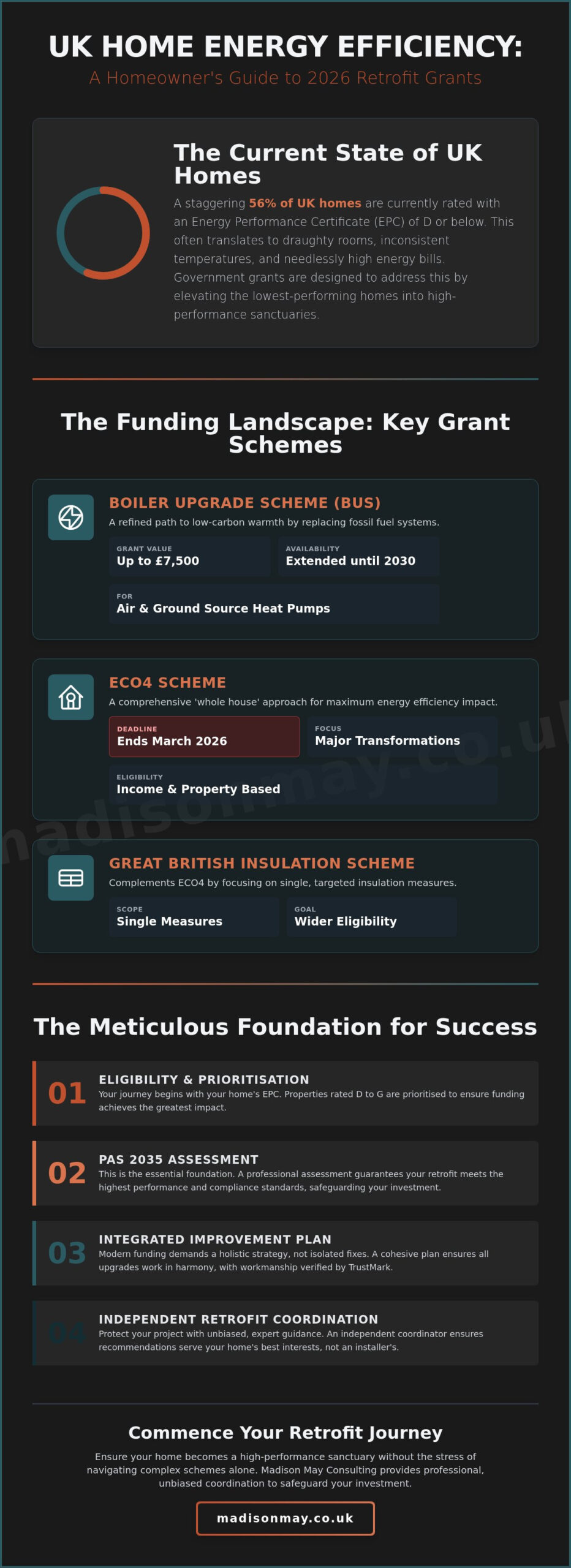
With 56% of UK homes currently rated EPC D or below, the dream of a truly efficient, high-performance sanctuary often feels frustratingly out of reach for many. You likely recognise the quiet discomfort of a draughty room or the weight of rising energy costs, yet the path to transformation is frequently obscured by a dense thicket of eligibility rules and technical jargon. Securing retrofit grants for homeowners should be a journey of refinement rather than a source of stress, especially when you seek to balance modern sustainability with the enduring character of your property.
We understand that you desire more than just a functional upgrade; you seek a home that reflects your values through meticulous craftsmanship and visionary design. This guide promises to clarify the 2026 funding landscape, helping you distinguish between the long-term stability of the Boiler Upgrade Scheme and the approaching deadlines of ECO4. By the end of this article, you’ll discover how to navigate these government incentives whilst adhering to the rigorous PAS 2035 standards, ensuring every improvement contributes to a warmer, more graceful environment that serves as both a personal refuge and a sensible investment.
Key Takeaways
- Understand how national funding streams integrate with local initiatives to create a cohesive and effective strategy for your home’s energy evolution.
- Discover how to access up to £7,500 in funding through the Boiler Upgrade Scheme to transition your heating systems toward a more sustainable, low-carbon future.
- Identify the specific eligibility criteria for retrofit grants for homeowners West Yorkshire, distinguishing between comprehensive ECO4 transformations and targeted insulation measures.
- Learn why a professional PAS 2035 assessment is the essential foundation for ensuring your home improvements meet the highest standards of performance and regulatory compliance.
- Explore how independent retrofit coordination can safeguard your investment, ensuring your home remains a high-performance sanctuary without the bias of installer-led recommendations.
Navigating the Landscape of Retrofit Grants for Homeowners in West Yorkshire
The journey toward a sustainable home in 2026 is no longer defined by isolated repairs; it has become an intentional evolution of a property’s character and performance. Within West Yorkshire, the availability of funding is shaped by a sophisticated interplay between national government directives and local delivery partners who understand the unique architectural heritage of our region. Accessing retrofit grants for homeowners West Yorkshire requires a departure from the fragmented approach of previous decades, moving instead toward a philosophy where every insulation upgrade or heating improvement serves as a chapter in a larger, harmonious narrative of restoration.
The narrative of domestic energy in the United Kingdom has undergone a profound transformation, shifting from basic draught-proofing to a comprehensive understanding of energy efficiency in British housing as a standard for modern living. This shift is particularly visible in Yorkshire and The Humber, a region that currently accounts for 12% of homes upgraded through the Warm Homes: Social Housing Fund. For the private homeowner, this means that funding is no longer a simple transaction but a merit-based reward for those committed to professional, high-standard retrofitting. Acting with deliberation is essential, as several key funding windows, including the current phase of ECO4, are scheduled to conclude by March 2026.
The Core Pillars of Energy Funding in 2026
Current funding structures rely on a delicate balance of income-based eligibility and property-specific metrics. Whilst central government schemes like the Boiler Upgrade Scheme provide a broad national framework, local authority partners often facilitate the delivery of more nuanced programmes tailored to the specific needs of West Yorkshire communities. Your property’s Energy Performance Certificate (EPC) acts as the primary document of record; homes rated between D and G are typically prioritised for the most substantial support. It’s a system designed to elevate the lowest-performing homes into high-performance sanctuaries, ensuring that financial aid is directed where it can achieve the most significant emotional and environmental impact.
The Evolution of Grant Eligibility and Standards
The standards governing 2026 grants are more rigorous than ever before, reflecting a commitment to meticulous craftsmanship and long-term reliability. The role of TrustMark has become central to this process, serving as a seal of quality that protects homeowners from the substandard workmanship that occasionally plagued earlier schemes. Rather than approving single-measure fixes in isolation, modern eligibility often requires an integrated EPC Improvement Plan. This holistic approach ensures that a new heating system isn’t compromised by poor insulation, or that a loft conversion remains breathable and efficient. It’s about creating a seamless experience where functionality and beauty coexist, supported by a framework that values the property’s future as much as its present comfort.
The Boiler Upgrade Scheme: A Refined Path to Low-Carbon Warmth
The transition to a low-carbon home is a deliberate act of stewardship; it’s an investment in the enduring legacy and comfort of your property. Through the Boiler Upgrade Scheme (BUS), the government provides a refined mechanism to replace ageing fossil fuel systems with elegant, renewable alternatives. As of May 2026, the grant value remains a substantial £7,500 for both air source and ground source heat pumps, reflecting a national commitment that has been extended through to 2030. When exploring retrofit grants for homeowners West Yorkshire, the BUS often represents the most accessible entry point for those wishing to modernise their heating whilst significantly reducing their carbon footprint.
Beyond the financial incentive, the move to renewable heating offers profound sensory rewards. Traditional gas boilers operate with a binary intensity, often creating pockets of heat and sudden cooling cycles. In contrast, modern heat pumps provide a rhythmic, consistent warmth that maintains the home as a steady sanctuary. This quiet efficiency doesn’t just improve daily life; it future-proofs the property’s value in a market where over 90% of listings currently lack sustainable features. To secure this funding, all installations must be performed by a contractor with Microgeneration Certification Scheme (MCS) accreditation, ensuring that the technical execution matches the high aspirations of the project.
Optimising Your Investment in Renewable Heating
A heat pump is most effective when it operates within a high-performance building envelope. Before upgrading your heating, it’s vital to address the building fabric through insulation and draught proofing to ensure that energy is retained with grace. Modern units are designed with an understated aesthetic that can be integrated seamlessly into your exterior spaces, marrying functionality with beauty. Understanding how these systems integrate with your existing architecture is a task for a thoughtful expert who prioritises your home’s unique story and technical requirements.
Eligibility and Application Nuances
The Boiler Upgrade Scheme is particularly well-suited to detached and semi-detached homes in West Yorkshire, where space for external units is often more readily available. Your chosen installer will typically manage the grant application on your behalf, but you must ensure they are correctly registered and that your property has no outstanding recommendations for loft or cavity wall insulation on its EPC. When combined with smart home energy management, these systems allow for a level of personalisation that transforms a simple utility into a responsive, intelligent component of your living environment.
Strategic Insulation: Comparing ECO4 and the Great British Insulation Scheme
Choosing the correct insulation strategy is a defining moment in the life of a property, one that determines whether a house remains a drafty structure or evolves into a high-performance sanctuary. Within the current funding landscape, two primary pathways exist for those seeking retrofit grants for homeowners West Yorkshire. The Energy Company Obligation (ECO4) is designed for comprehensive property transformations, often bundling multiple upgrades together to significantly elevate a home’s thermal performance. It’s a deep, holistic commitment to the building’s future. In contrast, the Great British Insulation Scheme offers a more targeted approach, focusing on single, high-impact measures like loft or cavity wall insulation for homes that may not require a full-scale overhaul.
The emotional impact of a home that retains its warmth effortlessly cannot be overstated. There’s a profound sense of calm that comes from knowing your living space is protected by a meticulously designed thermal envelope. Identifying which scheme aligns with your property requires a professional building survey that respects the unique architectural fabric of your residence. These assessments move beyond surface-level observations to pinpoint the exact zones where heat loss occurs, ensuring that grant-funded work is both strategically sound and personally resonant.
The Whole-House Approach to Thermal Performance
External wall insulation is a transformative design choice that requires a delicate balance between modern performance and the preservation of a property’s original character. It’s an intricate process that demands a visionary design to ensure the new exterior harmonises with the streetscape whilst providing exceptional thermal resistance. By linking these grants to broader energy efficient home improvements, you can ensure that every insulation upgrade is part of a seamless journey toward a more refined and sustainable lifestyle. This method prevents the “patchwork” effect of isolated repairs, creating a unified and enduring result.
Ventilation: The Essential Partner of Strategic Insulation
A common pitfall in modern retrofitting is the tendency to “seal in” a property without considering its need to breathe. Adding thick layers of insulation without a professional ventilation assessment can inadvertently trap moisture, leading to internal air quality issues. At Madison May, we ensure that your pursuit of efficiency doesn’t necessitate future damp remediation. Our approach strictly adheres to Part F building regulations, integrating controlled airflow into the design of your thermal upgrades. It’s about creating a healthy, balanced environment where functionality and beauty coexist without the hidden risks of poor moisture management.
The Meticulous Foundation: Why PAS 2035 Assessments Safeguard Your Funding
A truly high-performance home is built upon a foundation of precision and foresight. Whilst many homeowners begin their journey by looking at specific products, the most successful transformations start with a pas 2035 assessment. This framework is the official domestic retrofit standard in the United Kingdom. Specifically, the PAS 2035:2023 version ensures a whole-house approach rather than a series of disconnected, potentially conflicting upgrades. For those applying for retrofit grants for homeowners West Yorkshire, this assessment is often a mandatory requirement. It acts as a safeguard for both the public funding and the long-term health of your property.
One of the most significant advantages of this process is the removal of the “installer-led” bias. An installer might naturally prioritise the technology they sell, but an independent consultancy focuses solely on the building’s specific requirements. This objectivity is vital for identifying the most cost-effective sequence of works. For example, it might reveal that improving the building fabric is a prerequisite for a heat pump installation. By working with a qualified Retrofit Coordinator, you gain a sophisticated guide who ensures the technical integrity of every measure, providing a sense of calm and clarity throughout the process.
Beyond the Basic EPC: The Depth of Professional Assessment
A standard Energy Performance Certificate is merely a snapshot; it lacks the granular detail required to plan a complex renewable upgrade. A professional retrofit assessment involves a deep collection of data, ranging from occupancy patterns to detailed building surveys. This information is used to create a bespoke EPC improvement plan for your sanctuary. This roadmap doesn’t just suggest changes; it models how they will interact, ensuring that your investment results in a home that is as efficient as it is beautiful.
Mitigating Risk in Energy Efficient Home Improvements
The fear of unintended consequences, such as mould or poor air quality, is a valid concern for many. Professional assessments mitigate these risks by incorporating building performance testing and ventilation checks. This ensures that every energy-saving measure is balanced with the physical realities of your home’s construction. The journey toward a more sustainable lifestyle should be as seamless as the design process itself, free from the stress of technical failure. To begin this journey with a partner who values meticulous craftsmanship, you can book a professional retrofit assessment to validate and unlock your funding opportunities.
Commencing Your Retrofit Journey with Madison May Consulting
The path to a refined, energy-efficient home is often perceived as a technical hurdle, yet we view it as a transformative artistic journey. Choosing to modernise your residence is an act of quiet confidence; it’s a statement that you value quality and heritage, even as you embrace the future of renewable energy. Our role at Madison May Consulting Ltd is to act as your sophisticated guide, helping you translate the clinical requirements of retrofit grants for homeowners West Yorkshire into a tangible reality. We move beyond the functional, ensuring that every heating upgrade or insulation measure is part of a larger, harmonious design that respects the unique story of your property.
Our local expertise within the Yorkshire region provides a distinct advantage, as we understand the specific challenges posed by our local architecture and climate. We don’t simply process applications; we curate environments. By conducting professional assessments that validate and unlock funding opportunities, we provide the meticulous foundation required for regulatory and technical success. This transition from initial inspiration to a finished, high-performance sanctuary is managed with the calm deliberation of a high-end consultation, ensuring you feel supported at every stage of the process.
Our Professional Retrofit Services
We provide a suite of services designed to offer absolute clarity and confidence. Our fixed-fee retrofit assessments remove the uncertainty often associated with home improvements, providing a clear roadmap for your property’s evolution. Once the strategy is set, our retrofit coordination service manages the end-to-end complexity of the project, overseeing quality and ensuring that the intersection of functionality and beauty is never compromised. For landlords, our bespoke consultancy is essential for achieving MEES compliance, protecting the longevity of your rental portfolio whilst enhancing its appeal to discerning tenants who value comfort and sustainability.
Take the First Step Toward Your Sanctuary
Beginning your journey is as simple as booking a consultation to evaluate your property’s potential. During a Madison May Consulting Ltd professional building survey, you can expect an attentive listener and a thoughtful expert who prioritises your personal vision. We look beyond the surface, identifying the subtle details that will make your home more efficient without losing its evocative emotional style. The result is a home that functions with rhythmic efficiency and stands as a deeply personal refuge. By investing in professional guidance today, you ensure the long-term value of a home that is both an outward expression of your identity and a high-performance sanctuary for years to come.
Cultivating Your High-Performance Sanctuary
The journey toward a more sustainable and evocative home begins with a single, intentional step. We’ve explored how the current landscape of domestic energy funding offers a rare opportunity to refine your living space whilst reducing its environmental footprint. Whether you’re drawn to the consistent warmth of a modern heat pump or the quiet protection of strategic insulation, the key to a successful transformation lies in the meticulous application of professional standards. Acting now is vital, as funding windows for specific retrofit grants for homeowners West Yorkshire are scheduled to conclude by March 2026.
Navigating these complexities shouldn’t be a source of stress. By choosing a partner with specialist regional expertise in the Yorkshire area, you ensure that every detail of your project is handled with grace and technical precision. Our TrustMark Registered Retrofit Coordinators provide the steady hand needed to manage end-to-end quality, supported by PAS 2035 Aligned Assessments that protect both your property and your investment. You’re invited to begin your meticulous home transformation with Madison May. It’s time to create a sanctuary that resonates with your personal story and remains a high-performance refuge for years to come.
Frequently Asked Questions
How do I check my eligibility for renewable energy grants in West Yorkshire in 2026?
Checking your eligibility begins with a review of your property’s current Energy Performance Certificate (EPC) and your household’s financial circumstances. Most schemes, such as ECO4, require a rating of D, E, F, or G, alongside specific income thresholds or receipt of qualifying benefits. You should also consult the West Yorkshire Combined Authority’s latest guidance to see how national funds are being delivered through local partners in your specific borough.
Does the Boiler Upgrade Scheme cover the full cost of a heat pump installation?
The Boiler Upgrade Scheme provides a substantial contribution of £7,500 toward air source and ground source heat pumps, though it rarely covers the entire installation cost. Homeowners typically fund the remaining balance, which varies based on the complexity of the system and any necessary radiator upgrades. It’s a strategic investment that significantly lowers the initial capital required to transition your home into a low-carbon sanctuary.
What is the difference between ECO4 and the Great British Insulation Scheme?
The primary distinction lies in the scope of the work; ECO4 facilitates a comprehensive, multi-measure transformation whilst the Great British Insulation Scheme focuses on single, high-impact upgrades. ECO4 is designed for households on lower incomes or benefits, aiming for a total property overhaul. The Great British Insulation Scheme is often more accessible to a wider range of Council Tax bands, providing targeted loft or cavity wall insulation to improve thermal performance quickly.
Why do I need a PAS 2035 assessment before applying for a government grant?
A PAS 2035 assessment is a mandatory requirement for government-funded projects to ensure that every improvement is technically sound and part of a holistic plan. This framework protects you from the risks of isolated, poorly planned installations that could compromise your home’s structure. By following this gold standard, you ensure that your retrofit journey is overseen by a qualified professional who prioritises the long-term health and efficiency of your property.
Can landlords access government funding for energy efficiency improvements?
Landlords can indeed access specific retrofit grants for homeowners West Yorkshire, provided their tenants meet the necessary income or benefit criteria. Schemes like ECO4 and the Great British Insulation Scheme are excellent tools for meeting Minimum Energy Efficiency Standards (MEES) and enhancing property longevity. This funding allows landlords to improve their EPC ratings whilst ensuring their tenants enjoy a warmer, more comfortable living environment without significant capital outlay.
Will adding insulation under a grant scheme cause damp in my home?
Modern insulation measures, when implemented under the rigorous PAS 2035 framework, include essential ventilation assessments to prevent moisture issues. Damp typically occurs when a building’s breathability is compromised without adequate airflow management. By adhering to Part F building regulations, professional installers ensure that your home remains draught-free and warm whilst maintaining the healthy, balanced atmosphere necessary to protect the building fabric from condensation or mould.
How much can I save on my energy bills with renewable upgrades in 2026?
Upgrading from an EPC rating of D or below can lead to a meaningful reduction in long-term energy expenditure by retaining heat more effectively. Whilst exact figures depend on your property’s unique architectural fabric and energy usage patterns, integrated measures like heat pumps and high-grade insulation create a more efficient thermal envelope. This rhythmic performance ensures your home stays comfortable throughout the Yorkshire winter without the erratic costs associated with fossil fuel heating.
Are solar panels included in the current government grant offerings?
Solar panels remain a key component of the ECO4 scheme, typically offered as part of a broader package of energy-efficient home improvements. They are generally prioritised for homes where they can make the most significant impact on the property’s overall EPC rating. Whilst they aren’t usually available as a standalone grant for most homeowners, they serve as a visionary addition to a whole-house retrofit plan that aims for true energy independence.