

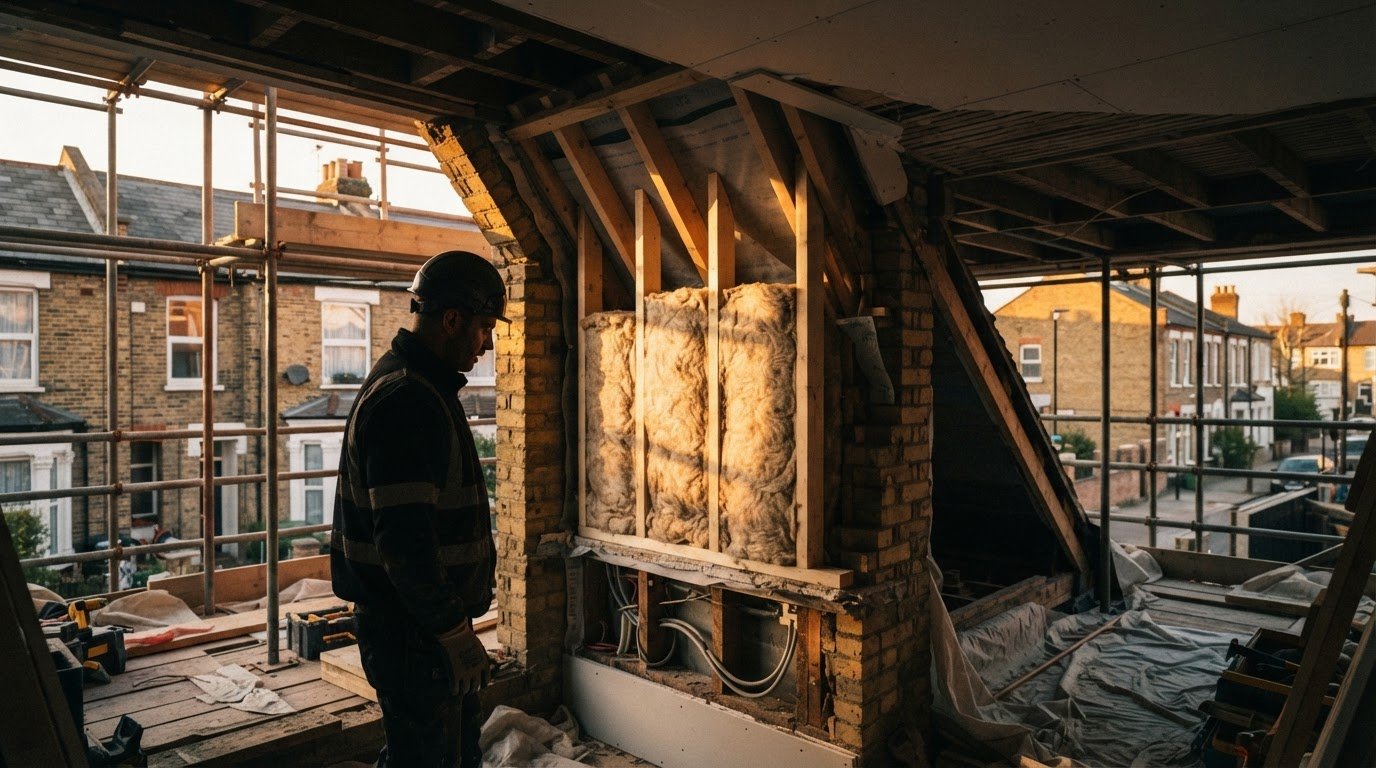
The most natural insulation isn’t automatically the right choice for every home. If you’re weighing sheep’s wool insulation pros and cons, ask whether its properties suit the part of your home you’re improving, the available space and your wider plans for the building. Sheep’s wool is renewable and can help manage moisture, but it usually costs more than conventional options and may need a greater thickness than some rigid products to achieve comparable thermal performance.
It’s understandable to be drawn to a material that feels compatible with an older or traditionally built home. But insulation doesn’t work in isolation: ventilation, existing damp, construction details and heating all affect how an upgrade performs. Choosing by material alone can overlook issues that influence the design and installation.
This guide explains sheep’s wool’s practical advantages and limitations, and sets out how to compare it with other options. You’ll also see how a whole-property assessment can help establish whether wool fits your home and retrofit plans. Madison May’s Retrofit Assessments review insulation alongside building fabric, ventilation, heating and overall energy performance, providing a property-specific starting point for tailored improvements.
Key Takeaways
- Use the sheep’s wool insulation pros and cons to weigh the material against the practical needs of your project.
- Compare the specific products and building elements involved, rather than assuming all wool insulation performs in the same way.
- Check available space, building fabric, ventilation and heating before choosing an insulation approach.
- Consider how the material, fitting requirements and retrofit goals work together across the property.
- A Retrofit Assessment reviews insulation alongside ventilation, fabric, heating and energy performance to inform a tailored, PAS 2035-compliant improvement plan.
Sheep’s wool insulation: what it is and what the pros and cons mean
Sheep’s wool insulation is made from sheep’s fleece and processed into products for use in parts of a building such as roofs, walls or floors. The fibres hold pockets of air, helping to slow heat transfer. Suitability depends on the particular product, the building element and how the insulation is fitted.
That distinction matters: a material’s general characteristics don’t guarantee a particular result in your home. Wool products can differ in construction, thickness and treatment. Roofs, walls and floors also have different space and installation constraints. A balanced look at sheep’s wool insulation pros and cons should account for all of these factors, rather than treating wool as one standard solution.
How sheep’s wool insulation works as a material
Wool fibres are crimped and layered, creating spaces that can hold still air. Since air moves less readily when held within a material, these spaces contribute to insulation. The performance of a finished product depends on its design and installation, not simply on the fact that it contains wool.
Some products come as batts or rolls, which can be fitted between or across building elements. These are common forms, not a specification shared by every product. Wool’s characteristics and uses are outlined in Sheep wool, but assess insulation performance, treatment and suitability using the documentation for the specific product you’re considering.
Don’t assume that every wool insulation product has the same treatment or behaves identically in damp conditions. Those are product-level details. Check the relevant technical information and fitting instructions instead of relying on broad descriptions of wool as a natural material.
What a fair pros-and-cons comparison should measure
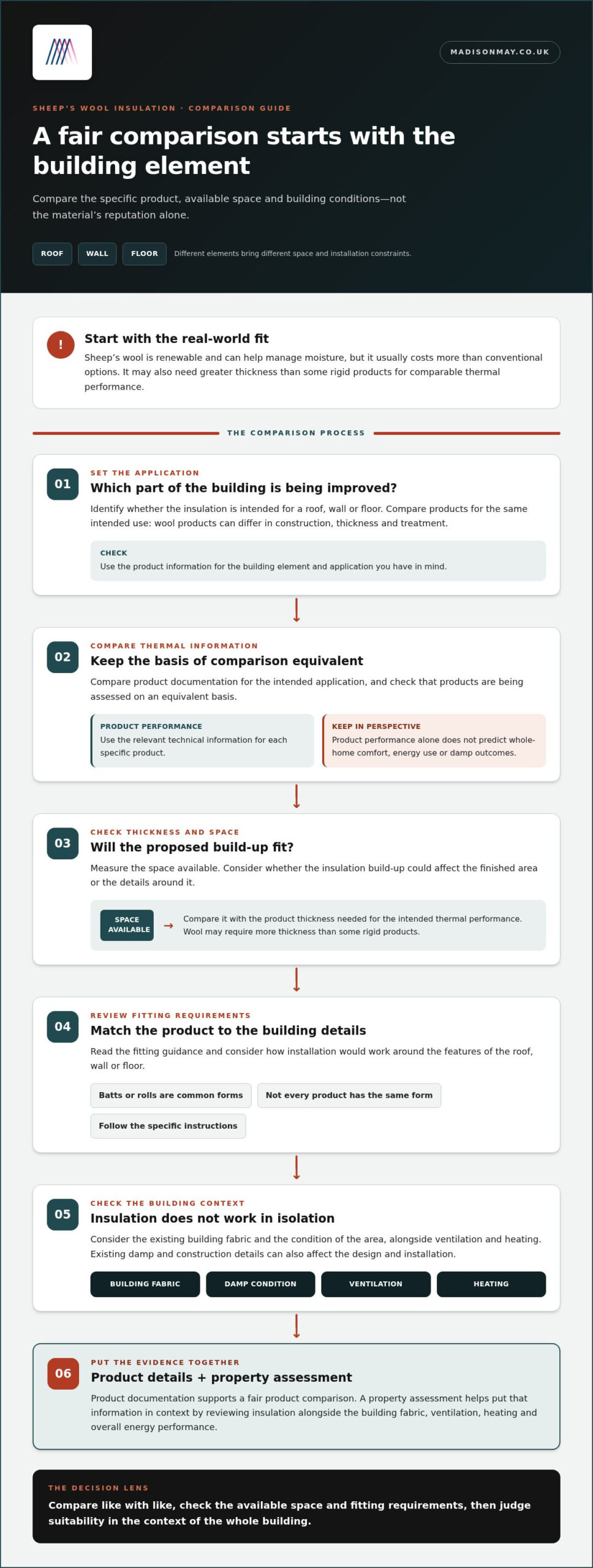
Compare products against the same practical criteria and for the same intended use. This keeps the decision focused on your home, rather than on a material’s reputation alone.
- Thermal performance: Compare product information for the intended application. Check that the products are being assessed on an equivalent basis.
- Thickness and available space: Measure the space available and consider whether the proposed insulation build-up would affect the finished area or details around it.
- Installation: Review the fitting guidance and consider how the product would work around the features of the roof, wall or floor.
- Building compatibility: Take account of the existing fabric and the condition of the area, as well as ventilation and heating.
These criteria connect material choice to the wider property, but they are not interchangeable. A product’s stated thermal performance describes the product in relevant conditions; it doesn’t by itself predict whole-home comfort, energy use or damp outcomes. Those depend on how insulation works with the rest of the building. Product documentation supports a fair comparison, while a property assessment helps put that information in context.
The advantages of sheep’s wool insulation, and what they mean in practice
Sheep’s wool may appeal if you’re looking for an insulation material with a natural origin. That quality alone, however, can’t tell you how it will perform in a particular home. Its practical advantages depend on the product, the building element and how the insulation is designed and installed. Look beyond appealing descriptions to the evidence and the needs of the property.
This is central to understanding sheep’s wool insulation pros and cons: a material attribute can inform your decision, but it isn’t a promise of a particular household outcome.
Natural material, renewability and environmental claims
Wool comes from sheep’s fleece, so some homeowners value it as a natural, renewable material rather than an insulation made entirely from synthetic ingredients. That may matter if you’re considering the materials used throughout an older or carefully refurbished home. Products can differ in composition and processing, though, so “natural” doesn’t mean untreated or made solely from wool.
Environmental comparisons need evidence at product level. Claims about embodied carbon or overall sustainability depend on factors such as how a product is made and what its published assessment covers. Saying wool is renewable doesn’t establish that every wool insulation product has a lower environmental impact than every alternative. Look for relevant product documentation before treating an environmental comparison as decisive.
Practical handling claims also need to be checked against the product. Flexibility and ease of fitting can depend on its form, the available space and the installation method. Follow the technical information and fitting instructions instead of assuming that every product can be handled or installed in the same way.
Moisture, temperature and acoustic claims
Wool insulation is sometimes associated with moisture management, temperature regulation and sound absorption. These characteristics may be relevant, but check the technical information for the specific product and intended use. Look at what has actually been tested and under which conditions, rather than relying on a general claim about wool.
Moisture-related performance isn’t the same as preventing damp. It doesn’t diagnose or resolve the cause of existing moisture, nor does it replace suitable ventilation. Temperature-related claims don’t guarantee a warmer home either: results depend on the insulation’s placement and installation, as well as other parts of the building. Assess acoustic performance against the product information and your particular noise concern, rather than treating insulation as soundproofing.
A material may have useful characteristics, but those characteristics don’t guarantee a specific result in your home.
That’s why it helps to consider the property as a whole. A review of building fabric, ventilation and heating can show how a proposed measure fits with existing conditions, rather than treating the material as an isolated upgrade. Madison May’s Retrofit Assessment considers these elements alongside energy performance to inform a tailored improvement plan. Explore how a whole-property Retrofit Assessment can put the decision in context.
The disadvantages of sheep’s wool insulation compared with other options
A fair comparison doesn’t begin with a universal ranking. Sheep’s wool, mineral wool and rigid insulation boards are different product categories, and their suitability depends on the building element, available space and required performance. A limitation in one project may matter less in another: extra thickness could be an issue in a shallow roof, for example, but less restrictive where there’s more room.
For a useful assessment of sheep’s wool insulation pros and cons, compare products intended for the same application using current technical information. Avoid drawing conclusions from a material label alone. The product’s properties, installation guidance and compatibility with the existing building all shape the decision.
Thermal performance, thickness and available space
Thermal comparisons rely on the specifications of the actual products being considered, assessed for the same building element and relevant conditions. Comparing a wool product intended for a roof with a board designed for a different application won’t give a meaningful result. A general claim about a material can’t replace current product documentation.
Thickness is a design consideration, not automatically a drawback. In a roof with limited depth, the insulation build-up may affect available space or junction details. Walls and floors have different constraints. Establish the project’s required performance, then compare how the documented properties and thickness of each suitable product fit the building.
Treatment, installation and product-specific limitations
Products can vary in composition, treatment, format and fitting instructions, including products made from the same material. Don’t assume that wool insulation is always untreated or always chemically treated, and don’t generalise about pest resistance. Use the details stated for the specific product.
Installation constraints also depend on the building and chosen product. Irregular framing, awkward junctions or limited access may affect how a product can be fitted, while the manufacturer’s guidance sets out its intended use. Include unclear details in the design and assessment process rather than relying on a blanket claim about wool.
Use the same evidence questions for every option:
| Criterion | Question to resolve | Evidence needed |
|---|---|---|
| Application | Is the product intended for this roof, wall or floor? | Product technical information and fitting guidance |
| Thermal performance | Are the products being compared on an equivalent basis? | Current, product-specific performance data for the intended use |
| Thickness and space | Will the proposed build-up fit without compromising the design? | Product dimensions and a property-specific assessment |
| Composition and treatment | What does this product contain, and what treatments are specified? | Manufacturer’s product documentation |
| Installation | Can it be fitted appropriately in the existing building? | Installation instructions considered alongside site conditions |
This approach makes trade-offs visible without relying on blanket rankings. An assessment that considers insulation alongside the building fabric, ventilation and heating can help establish which constraints matter most before you select a material.
How to decide whether sheep’s wool insulation suits your property
Start with the part of the building you’re improving, not with a favourite material. A loft or roof has different space and construction considerations from a solid wall, and neither can be assessed in isolation from the home’s condition, ventilation and heating. Use this sequence to make the sheep’s wool insulation pros and cons relevant to your property.
Start with the building element and property context
Before comparing materials, identify the area to be insulated and what you want the work to achieve. Improving a loft may involve different access, depth and detailing questions from insulating a solid wall. The construction and condition of the existing fabric matter too, particularly if there are signs of damp or previous alterations. Note these details so you can define what a suitable solution needs to address.
- Set the project goal. Decide whether your priority is comfort, energy performance, refurbishing a particular room or coordinating insulation with wider work. Clear aims make it easier to judge which trade-offs matter.
- Identify the building element. Record whether the work concerns a loft or roof, wall or floor. Note access, existing layers and any features that could affect the insulation build-up.
- Review fabric and ventilation. Consider the condition of the area and how air moves through the home. Don’t treat insulation as a substitute for understanding moisture issues or ventilation needs.
- Include the heating system. Consider existing heating and planned upgrades as part of the same picture. Changes to the building fabric may need to be considered alongside how the home is heated.
- Compare suitable products. Use technical documentation for products intended for the same application. Compare stated performance, composition, thickness and installation requirements on an equivalent basis.
Compare material evidence and whole-home priorities
Once the property context is clear, weigh product evidence against your priorities. If space is constrained, the proposed thickness and detailing may carry more weight. If you’re planning several improvements, the sequence of work may matter as much as the insulation material. No single product attribute establishes how comfortable or energy efficient the whole home will be.
A property-specific assessment can consider insulation, building fabric, ventilation, heating and energy performance together. Madison May’s Retrofit Assessment informs a tailored improvement plan that is PAS 2035 compliant. An EPC Improvement Plan can help organise potential measures, without promising a particular EPC result. This wider perspective is useful before committing to one upgrade, especially if you’re considering related energy-efficient home improvements.
To put your insulation decision in the context of the wider property, arrange a Retrofit Assessment.
Make sheep’s wool insulation part of a considered retrofit plan
Choosing insulation is one decision within a larger picture. The sheep’s wool insulation pros and cons matter, as do the condition of your property’s fabric, how it is ventilated and heated, and any improvements you may want to make over time. A whole-property view helps you assess whether a material fits the home and how it might work alongside other measures.
What a retrofit assessment contributes to insulation decisions
Madison May’s Retrofit Assessment reviews insulation, building fabric, ventilation, heating systems and overall energy performance. Rather than treating a roof, wall or floor as an isolated project, the assessment considers how the relevant building element relates to the rest of the property. That context helps identify constraints and priorities before you settle on an insulation approach.
The assessment uses information about the actual home to inform a tailored improvement plan that is PAS 2035 compliant. This can help organise potential measures and show how insulation may relate to ventilation or heating improvements. It doesn’t guarantee a particular EPC result, and it doesn’t make a material suitable simply because it has appealing attributes. Product documentation still matters when you compare specifications and intended applications.
If you’re planning several changes, sequencing can also matter. Considering fabric, ventilation and heating together helps place insulation within a coordinated retrofit, rather than treating it as a standalone choice. Madison May’s Accredited Retrofit Assessors & Coordinators support PAS 2035-compliant retrofit work. Retrofit Coordination supports works in meeting PAS 2035 requirements, helping connect planned measures through the wider project.
A practical next step with Madison May
A home assessment usually takes 1-2 hours, with reports delivered within 3-5 working days. The findings provide a property-specific basis for weighing wool against other appropriate options, taking account of the intended building element, existing conditions and wider energy performance. They can also help distinguish questions product data can answer from those that need to be considered in the context of the building.
If you’re still weighing the benefits and limitations, a Retrofit Assessment can bring those details together before you decide how to proceed. The findings support a tailored plan, not a promised rating or a one-size-fits-all material recommendation.
Choose an insulation plan that fits the home you want to create
The most useful outcome of comparing sheep’s wool insulation pros and cons isn’t a quick verdict on one material. It’s a clearer sense of what your home needs, which compromises you’re comfortable with and how insulation fits into the improvements you may be planning next. Before settling on a specification, note your priorities and any questions about space, existing conditions or the order of work. That gives the decision a practical starting point rooted in the property, rather than in a general promise about a material.
A considered retrofit plan can turn those priorities into a coherent direction for your home. Madison May’s Accredited Retrofit Assessors & Coordinators use property data to inform tailored, PAS 2035-compliant improvement plans, without promising a particular EPC outcome. To explore what an assessment could mean for your project, book your assessment.
With a thoughtful plan in place, you can move forward knowing your insulation choice has been considered as part of the home as a whole.
Frequently Asked Questions
What is a retrofit assessment?
A retrofit assessment is a survey of a property that gathers information about its insulation, building fabric, ventilation, heating systems and energy performance. This helps build a picture of how the home functions and where improvements may be appropriate. For example, it can help place an insulation proposal alongside ventilation needs, rather than considering the material choice on its own. The findings inform a tailored, PAS-compliant improvement plan.
Do I need to upgrade my EPC rating?
Whether to improve your EPC rating depends on your circumstances and plans for the property; an upgrade isn’t automatically the right first step for every home. Landlords and homeowners may consider improvements to support energy performance, manage bills or prepare for future requirements. If you’re weighing sheep’s wool insulation pros and cons as part of that decision, an EPC Improvement Plan can help organise potential measures without guaranteeing a particular rating.
How long does an assessment take?
Most home assessments take 1-2 hours, with a full report delivered within 3-5 working days. The time on site allows the assessor to collect information about the property, while the report provides a considered basis for planning possible improvements. You can use its findings to understand how proposed work relates to the home’s existing features and decide what you’d like to explore next.
Do you help with grant funding applications?
Yes. Madison May supports clients with identifying available funding and meeting the technical requirements needed to apply. Funding routes and eligibility can depend on the household, property and proposed work, so support with identifying options can help you understand what may be relevant to your plans. This is guidance with funding identification and application requirements, not a guarantee that funding will be available or awarded.