

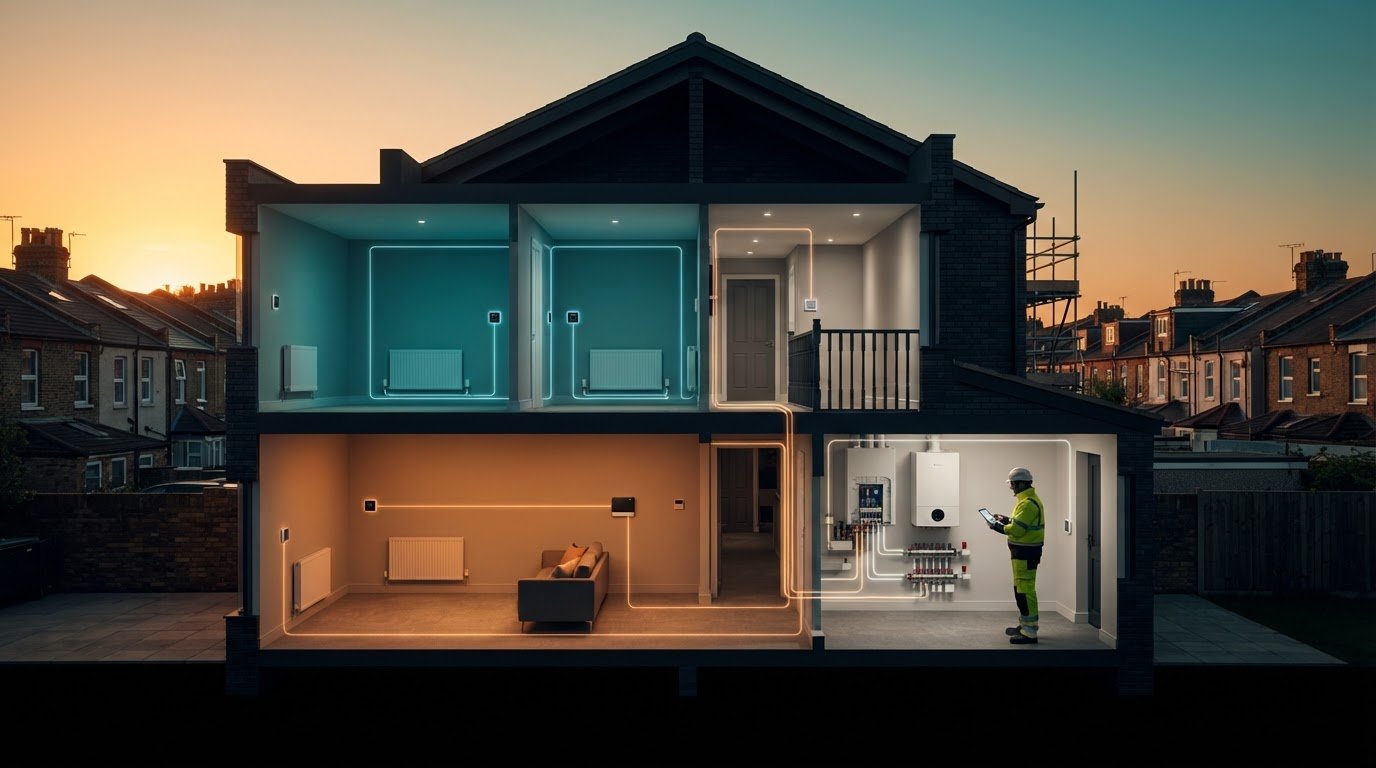
What if more heating controls create complexity without making your home more comfortable? If you’re researching smart thermostats for multi zone heating UK, focus on how separate controls could improve comfort and fit your household’s routines, rather than on how many devices you can add. You may want room-by-room control but be unsure whether a system will work with your boiler, heat pump or existing controls, or whether smart radiator valves are the same as separate heating zones.
This guide explains the main approaches, so you can compare central controls, zone thermostats and radiator valves before choosing a setup. You’ll also learn which compatibility details matter and how to consider controls as part of a wider energy-efficiency plan. The right choice depends on your heating system and how heat moves through your home. An assessment of the building fabric, services and ventilation can help put control decisions in context, alongside measures such as insulation and heating upgrades.
Key Takeaways
- A heating zone is a controllable part of a system, not necessarily a single room. Decide where separate settings would genuinely improve comfort.
- Understand how thermostats, smart radiator valves, receivers and zone valves work together before comparing control options.
- When weighing up smart thermostats for multi-zone heating UK, compare room-level flexibility with compatibility, setup complexity and everyday usability.
- Before choosing equipment, note your heat source, existing zones, emitters, room needs and current heating schedules.
- Consider controls alongside insulation, ventilation and heating upgrades. Managing heat cannot replace reducing heat loss.
What are smart thermostats for multi-zone heating, and when are they useful?
Does every room need its own temperature setting? Usually, no. A heating zone is a controllable part of a heating system. It might include one room or several, depending on the pipework and system design. A smart thermostat can provide app-based control and scheduling, but those features alone don’t create separate zones. The Smart thermostat technology overview explains how connected controls can offer features such as remote access. The number of independently controlled areas depends on the wider heating setup.
In brief: smart thermostats for multi-zone heating let you manage schedules or temperatures in separate parts of a home, provided the heating system and its controls are designed to operate those areas independently.
How is a heating zone different from a room?
A zone is defined by what the heating system can control, not simply by the walls around a room. For example, one circuit might heat several bedrooms together, while another serves the living area. In a wet central-heating system, the existing pipework and zone valves can determine which parts of the home can be controlled separately.
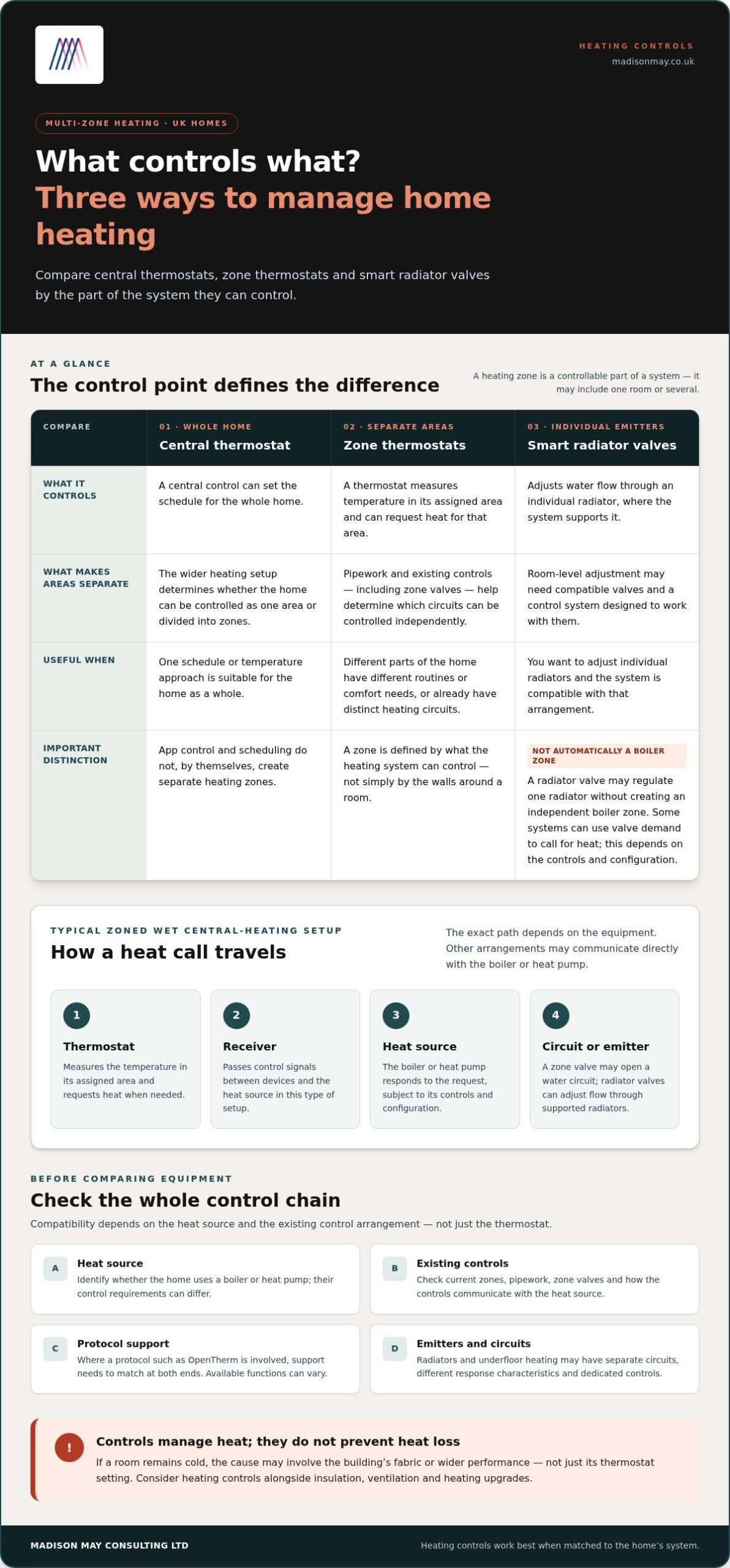
Room-by-room adjustment may need additional compatible equipment, such as smart radiator valves, and a control system that works with them. A thermostat that changes the schedule for the whole home won’t necessarily give each room an independent temperature setting. When considering smart thermostats for multi zone heating UK, check the heating system’s layout and controls before assuming a device can create a new zone.
When might multi-zone smart heating be useful?
Separate controls can be useful when daily routines differ across the home. A living area used mainly in the evening and bedrooms occupied later may benefit from different schedules. Separate settings may also suit households where occupants prefer different temperatures or homes that already have distinct heating circuits.
An unused room doesn’t automatically need its own thermostat. If it shares a zone with other spaces, adding room-level controls may involve extra equipment and coordination. Consider whether separate settings would address a real comfort or scheduling need, rather than adding controls for their own sake.
Smart controls manage when and where heat is delivered; they don’t prevent warmth escaping through poorly insulated walls, roofs or floors, or through draughty openings. If a room remains cold, the cause may involve heat loss or the building’s wider performance, not simply its thermostat setting. A whole-home assessment considers the building fabric, heating services and ventilation together, helping you weigh control choices alongside potential insulation and heating upgrades.
How do multi-zone smart thermostats control a UK home’s heating?
Think of a heating call as a sequence: a control detects that an area needs heat, sends a request, and the system directs warmth to the relevant circuit or emitter. The exact process depends on the equipment. In a typical zoned wet central-heating setup, a thermostat can signal a receiver, which communicates with the heat source and may operate a zone valve so hot water flows through that circuit. In other arrangements, controls may communicate directly with the boiler or heat pump.
Each component has a distinct role. A thermostat measures the temperature in its assigned area and requests heat when needed. A receiver passes control signals between devices and the heat source. Zone valves open or close water circuits, while smart radiator valves adjust flow through individual radiators where the system supports them. A radiator valve may regulate one radiator without creating a separate boiler zone. Some systems can use a valve’s demand to call for heat, but that depends on the controls and configuration.
What do the controls do day to day?
Scheduling sets desired temperatures at chosen times, while app-based control lets you adjust settings remotely. Some systems can also respond to measured temperatures or learn from patterns, but available functions differ. These are ways to operate a system, not proof that it can heat each room independently. The Energy Saving Trust guide provides further context on heating controls and their role in managing home heating.
How does the heating system affect smart-control compatibility?
Compatibility depends on both the heat source and the existing control arrangement. A boiler may use simple switching controls or a communication protocol such as OpenTherm. Support needs to match at both ends, and available functions can vary. Heat pumps have their own control requirements, so a thermostat designed for a boiler may not provide the same operation or suit a particular heat-pump setup.
Mixed emitter systems need particular care. A home with radiators and underfloor heating may have separate circuits, different response characteristics and dedicated controls. The control layout should account for how those emitters work together, rather than treating every device as interchangeable. For smart thermostats for multi zone heating UK, assess compatibility across the heat source, receiver, valves and existing controls before settling on a configuration.
Because controls interact with a home’s heating services, a whole-home retrofit assessment puts heating decisions in the context of the property’s fabric and ventilation.
Multi-zone thermostat options compared: what should you weigh up?
The best arrangement depends on the controls your home already has and the degree of separation you need. A single central thermostat, established heating zones and smart radiator valves can all regulate heat, but they don’t do the same job. When comparing smart thermostats for multi zone heating UK, start by distinguishing between controlling a circuit and adjusting individual radiators.
| Control approach | Room-level flexibility | Compatibility and setup | Day-to-day use |
|---|---|---|---|
| Single thermostat | Usually controls the heating for one area or the home as a whole, rather than setting each room independently. | Often suits a system arranged around one heating circuit and its existing controls. Smart functions depend on the heat source and control connection. | Simple to schedule and adjust, but the measured temperature may not reflect conditions in every room. |
| Existing separate zones | Controls distinct circuits or areas, which may each have their own thermostat. A zone can serve more than one room. | Makes use of existing zone valves or circuits. Smart controls need to match the system and its wiring or communications. | Offers clear area-by-area schedules, though household members may need to manage more than one setting. |
| Smart radiator valves | Can provide radiator-level adjustment where supported, giving finer room-by-room control. | Requires compatible valves, radiators and a control arrangement. Valves don’t necessarily create independent boiler zones by themselves. | Useful for tailoring individual spaces, but more settings and devices may mean more to organise. |
Central thermostat, separate zones or smart radiator valves?
A central thermostat suits straightforward control, while established zones can independently serve areas already divided by the system. Smart radiator valves may add finer adjustment within those areas. The options can complement each other, for example, separate circuits paired with radiator-level control, but they can also overlap. Adding room controls won’t automatically make the boiler or heat pump operate each room as a separate zone.
Which features matter beyond app control?
Look beyond remote access. Check whether you can set schedules for the areas you need, whether the temperature is measured in a useful location, and whether manual adjustments are straightforward for everyone in the household. Then consider how the controls integrate with the heat source and existing equipment. The Energy Saving Trust guide to heating controls provides a useful overview of common control types. Prioritise clear, dependable operation over a long list of features you may not use.
Compatibility is specific to the system and manufacturer, so assess the existing controls, heat source and zone valves before comparing add-ons or replacements. A retrofit assessment considers the home’s fabric, services and ventilation, helping you place heating controls within a wider energy-efficiency plan.
How to choose smart thermostats for multi-zone heating in the UK
Before comparing equipment, build a clear picture of your existing system and the comfort you want from it. This checklist helps narrow the options for smart thermostats for multi zone heating UK without assuming that one device will suit every home.
- Identify the heat source. Record whether you have a boiler, heat pump or another system, along with its make and model if known. Note how the current controls communicate with it, as the interface can affect which smart controls are suitable.
- Map the existing zones. Mark the location of each thermostat and note which rooms or circuits it controls. Include visible zone valves and separate heating circuits, rather than assuming each thermostat corresponds to one room.
- List the emitters. Note which spaces use radiators, underfloor heating or a combination. Record any separate underfloor-heating controls, as mixed systems may need a carefully coordinated control plan.
- Define room needs. Identify where separate temperatures or schedules would improve everyday comfort, based on how each space is used. Avoid creating extra zones without a practical reason.
What should you check in the existing heating setup?
Make a simple plan of the controls, visible wiring, zone valves, radiator circuits and underfloor-heating controls. Don’t remove covers or handle wiring; just record what’s visible and how the system behaves. Note any past alterations, unusual layouts or controls that no longer seem to work as expected. Older or mixed systems can benefit from an informed assessment before you compare replacement and add-on options.
Write down the current schedules and settings too. Note when heating starts, which controls affect each area and where the thermostat sensors are positioned. This gives you a useful baseline for judging whether a proposed setup will simplify operation or add another layer to manage.
How should household routines shape the zone plan?
Group spaces by their real patterns of use. A home office used during the day and bedrooms used mainly at night may call for different schedules, while rooms used together may be simpler to control as one area. Consider open-plan spaces, sensor positions and how heat or airflow moves between connected rooms. A sensor in a warm spot may not reflect comfort elsewhere.
Keep the arrangement practical. More zones can offer finer control, but also create more schedules and settings to maintain. Comfort and energy outcomes depend on the property, its heating system and household behaviour, so don’t treat a particular configuration as a guaranteed way to reduce bills.
Heating-control requirements can differ across the UK’s nations and may change over time. Check current official guidance that applies to your location and project before relying on a regulatory claim. Madison May’s whole-home retrofit assessment puts control choices within a broader plan, considering the home’s fabric, services and ventilation.
Make smart heating controls part of a whole-home energy plan
Smart controls shape when heat is delivered and which areas receive it, but they can’t reduce the rate at which a home loses warmth. A thermostat may help align heating with household routines; it won’t remedy a cold external wall, draughty window or poorly performing roof. The most useful setup for smart thermostats for multi zone heating UK is one that works with the heating system and the home’s wider needs.
Why do insulation and ventilation matter to heating controls?
Comfort depends on more than the temperature shown on a thermostat. A room that loses heat quickly may feel chilly even while its heating is on, and draughts or ventilation can affect how comfortable it feels. If one room remains persistently colder than others, repeatedly changing the thermostat setting may not address the cause. Consider the building fabric, heat distribution and ventilation together.
Insulation and draught proofing can form part of a plan to improve how a home retains warmth. Ventilation also needs consideration alongside fabric improvements to support healthy indoor conditions. Explore energy-efficient home improvements as part of a broader approach, rather than treating controls as a standalone answer to heat loss.
How can an assessment guide the next step?
A retrofit assessment brings the property’s fabric, services and ventilation into the same picture. This context helps show how existing heating controls relate to the home’s overall performance and where heating upgrades may sit alongside insulation or ventilation measures. Madison May provides PAS 2035-aligned retrofit assessments that collect information on these elements, as well as EPC improvement plans that set out practical measures and their potential sequence.
This helps you consider which control arrangement may suit your household and how it fits with other improvements and the order in which they could be considered. Outcomes depend on the property, its heating system and how the household uses it, so adding zones alone won’t guarantee a particular comfort or energy result.
Explore Madison May’s whole-home retrofit guidance to understand your property and plan improvements. Explore Madison May’s retrofit approach.
Choose heating controls that fit the whole home
The right setup for smart thermostats for multi zone heating UK is the one that suits your heating system, existing controls and household routines. Remember that a heating zone isn’t automatically a single room, and smart radiator valves, thermostats and zone controls each have different roles. Map what’s already in place before weighing room-level flexibility against added complexity.
Controls can help manage when and where heat is delivered, but they can’t replace improvements that reduce heat loss. Insulation, ventilation and heating upgrades all form part of the wider picture, so a persistently cold room may need more than a changed schedule. A considered plan starts with understanding the property and how its systems work together.
Madison May’s PAS 2035-aligned retrofit assessments consider building fabric, services and ventilation. EPC improvement plans then set out a tailored sequence of potential home upgrades, helping you understand possible next steps in context. Explore Madison May’s whole-home energy-efficiency guidance and take a clear, considered step towards a more comfortable, efficient home.
Frequently Asked Questions
Do smart thermostats work with multi-zone heating?
Yes, smart thermostats can work with multi-zone heating when the thermostat and associated controls are compatible with the heat source and existing setup. Zones may be formed by separate circuits or zone valves, while room-level control may use compatible radiator valves. Trace how the thermostat, receiver and valves communicate with the boiler or heat pump before choosing equipment. Replacing one thermostat alone won’t necessarily create additional independent zones.
Can smart radiator valves create separate heating zones?
Smart radiator valves can control individual radiators where the system supports them, but they aren’t automatically the same as separate heating circuits. For the intended behaviour, the valves, thermostat and heat source need to coordinate as part of a compatible setup. Consider how rooms share heat and airflow too. Controlling one radiator separately doesn’t necessarily mean the boiler or heat pump treats that room as an independent zone.
How many heating zones should a home have?
There’s no universal number of heating zones that suits every home. The practical arrangement depends on the layout, existing circuits, heating emitters and household routines. A useful zone serves an area with meaningfully different heating needs, rather than being added simply because another control is available. Map when rooms are occupied and how they’re used, then consider whether separate schedules would improve comfort without making the system cumbersome to manage.
Are smart thermostats compatible with heat pumps?
Some smart thermostats can work with heat pumps, but suitability and control behaviour depend on the heat pump, its interface and the thermostat. Don’t assume a control setup designed for a boiler will transfer unchanged. Check the relevant manufacturers’ guidance and consider the system design, especially if radiators and underfloor heating are combined. The aim is a control arrangement that works with the heat source, not simply one that offers the preferred app features.
Can multi-zone heating reduce energy use?
Multi-zone heating may help households match heating to how rooms are used, but it can’t guarantee lower consumption or a specific saving. The effect of smart thermostats for multi zone heating UK homes depends on the property, insulation, heating system, settings, weather and household behaviour. Avoid heating spaces unnecessarily, but investigate persistent cold or discomfort as a possible property issue too. Changing a schedule alone may not address heat loss or uneven heat distribution.
Do UK homes have to use multi-zone heating controls?
Requirements depend on the applicable building regulations, the type of work and the UK nation where the property is located. Rules and guidance can change, so check current official requirements before making a compliance decision. This guide offers general buying information, not a determination that an existing system or proposed installation meets the rules. Compatibility and regulatory compliance are separate considerations: a control may work with a system without establishing that the overall work complies.
Should I upgrade insulation before buying a smart thermostat?
Not necessarily. The right sequence depends on the property and its existing heating system. Understanding heat loss, ventilation and heating services can help show whether new controls are the right next step or part of a wider plan. PAS 2035-aligned retrofit assessments consider these elements, while EPC improvement plans outline a tailored sequence of potential upgrades. This broader view helps you weigh controls alongside insulation and other improvements, rather than treating them in isolation.