


What if the invisible barrier between your family and the biting British winter was less about the heat you generate and more about the quiet efficiency of the materials you choose? It’s a common frustration to feel a persistent draught whilst the heating is on full, or to stare at a technical energy report with more confusion than clarity. You aren’t alone in wanting to protect your sanctuary without the fear of making an expensive, incorrect choice. Understanding how to improve wall insulation UK starts with mastering the U-value, a metric that defines exactly how much warmth your property can retain.
In this article, you’ll discover how these thermal measurements dictate the comfort of your living spaces and learn to interpret them with professional confidence. We’ll provide a clear roadmap for reducing heat loss, from the 2026 building regulation targets to the importance of a PAS 2035 aligned retrofit assessment. By the end, you’ll have the insight needed to plan your home improvements with both visionary creativity and technical certainty, ensuring every upgrade contributes to a lasting sense of serenity.
Key Takeaways
- Learn how U-values serve as a definitive measure of thermal efficiency, helping you transform your property into a more serene and sustainable sanctuary.
- Understand the intricate science of wall build-ups and how the synergy of materials directly influences your home’s ability to retain warmth.
- Discover the latest standards in building regulations and gain practical insights on how to improve wall insulation UK whilst adhering to a fabric-first approach.
- Explore how achieving low U-values enhances your daily wellbeing by eliminating cold spots and protecting your interior from damp and condensation.
- Gain clarity on why a professional PAS 2035 assessment is the essential starting point for any successful and meticulously planned home retrofit.
What is a U-Value? Defining the Thermal Performance of Your Space
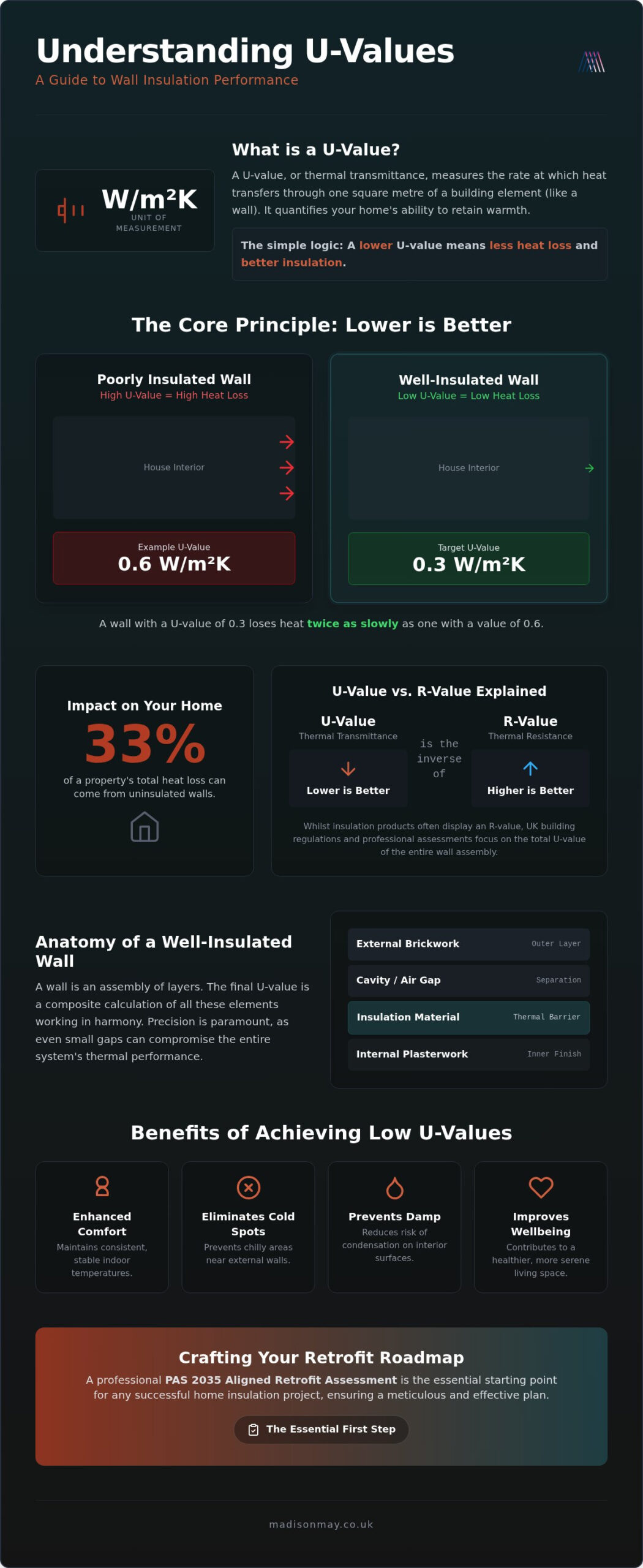
Imagine standing in a room that should be a retreat, yet feeling a subtle, persistent chill radiating from the walls. This sensation is often the first sign that your home’s thermal envelope is underperforming. To address this, we must look at a specific metric: the U-value. What is a U-Value? Technically, it is the measure of thermal transmittance, calculating the rate at which heat transfers through a square metre of a building element, such as a wall or window, for every degree of temperature difference between the inside and outside. It is expressed in Watts per square metre Kelvin (W/m²K).
In the context of understanding how to improve wall insulation UK, the U-value is determined by the synergy of material thickness and thermal conductivity. A thick layer of traditional stone might feel substantial, but if it conducts heat rapidly, its U-value will remain high. Modern insulation materials are engineered for low conductivity, allowing them to provide a superior barrier even in thinner profiles. It is this delicate balance of craftsmanship and science that defines the sanctuary of your home. Whilst a U-value measures a specific component, it differs from an Energy Performance Certificate (EPC), which assesses the property as a whole, including its heating systems and lighting.
The Simple Logic of Lower Numbers
The mathematics of warmth is refreshingly straightforward: the lower the number, the better the performance. If you compare a wall with a U-value of 0.6 W/m²K to one with a value of 0.3 W/m²K, the latter loses heat exactly twice as slowly. Research from the Energy Saving Trust suggests that uninsulated walls can account for approximately 33% of a property’s total heat loss. By lowering these figures through meticulous upgrades, you create a space where temperatures remain consistent, rather than fluctuating with the weather. This stability is the bedrock of a truly comfortable home.
U-Value vs R-Value: Understanding the Inverse Relationship
Whilst exploring insulation products, you might encounter the R-value, which represents thermal resistance. It is the inverse of a U-value; it measures how effectively a material resists the flow of heat. It’s common for individual insulation boards to be marketed by their high R-values, yet UK building regulations and professional assessments focus on U-values to determine the final performance of the entire wall build-up. To convert between them, you simply divide 1 by the R-value. Understanding this relationship is vital for those researching how to improve wall insulation UK, as it allows you to see beyond the packaging and focus on the final, installed performance of your walls. This clarity ensures that every material chosen serves the ultimate goal of preserving your home’s internal serenity.
The Science of Seclusion: How U-Values are Calculated and Measured
To truly understand the thermal performance of your home, one must look beneath the surface. The efficiency of any insulation material is rooted in its thermal conductivity, often referred to as its lambda value. This metric represents how easily heat passes through a specific material; the lower the lambda, the more effective the material is at preserving your internal sanctuary. However, a wall is rarely a single material. It is a carefully curated assembly of layers. In a typical UK property, this build-up includes the external brickwork, a cavity or air gap, the insulation itself, and the internal plasterwork. Each layer contributes its own resistance to heat flow.
The final U-value is a composite calculation of all these elements working in harmony. Precision is paramount. Even microscopic gaps between insulation boards or poorly fitted sections can compromise the entire calculation. This leads to significant heat loss that undermines your efforts in learning how to improve wall insulation UK. When these layers are not perfectly aligned, the theoretical efficiency of the wall drops, leaving you with cold spots that disrupt the calm of your living space.
W/m²K: Decoding the Unit of Measurement
The unit W/m²K may appear daunting on a technical report, but its logic is elegant. It measures Watts (energy) per Square Metre (area) per Kelvin (temperature difference). It quantifies the energy flow through your walls based on the contrast between your cosy interior and the external environment. W/m²K is the rate of energy loss per degree of temperature difference. Understanding this helps you appreciate why adherence to Building Regulations standards for insulation is so vital for long-term comfort.
The Influence of Thermal Bridging
Even the most sophisticated insulation can be betrayed by thermal bridging. These are invisible “cold spots” where structural elements, such as wall ties or timber studs, create a direct path for heat to bypass the insulation. These bridges can significantly increase the effective U-value of a wall, often leading to localized condensation and discomfort. Meticulous design is required to eliminate these paths, ensuring the warmth remains where it belongs. This level of detail is what separates a standard renovation from a transformative architectural project.
For those living in heritage or older properties, calculating these values is rarely a straightforward task. Existing walls often have unknown compositions or hidden issues that require a professional eye. A professional building survey can reveal the current state of your home’s fabric, providing the essential data needed to plan a meaningful transformation. This assessment ensures that your journey toward a more sustainable home is grounded in technical accuracy rather than guesswork, allowing you to invest in your property with quiet confidence.
Navigating Building Regulations: Standards for Improving Wall Insulation in the UK
Compliance with UK building regulations is more than a legal necessity; it is a commitment to the enduring quality of your home’s fabric. Approved Document Part L serves as the guiding philosophy for this journey, championing a ‘fabric first’ approach that prioritises the building’s envelope over its mechanical systems. This methodology suggests that by perfecting the walls, roof, and floors, we can reduce the energy demand of a home at its source. As we move towards the full implementation of the Future Homes Standard in March 2026, the expectations for our living spaces are evolving, reflecting a national shift towards a more sustainable and thermally efficient future.
For existing dwellings, the limiting U-
Beyond the Number: The Impact of Low U-Values on Comfort and Wellbeing
The true value of a low U-score isn’t found on a technical certificate; it’s felt in the quiet, cosy corners of your home. When you understand how to improve wall insulation UK, you’re doing more than just ticking a regulatory box. You’re eliminating that sharp, radiant chill that often haunts rooms with external walls. High-performing insulation ensures that the surface temperature of your internal walls remains close to the ambient air temperature, creating a cocoon of thermal stability. This equilibrium is essential for preventing surface condensation, which occurs when warm, moist air meets a cold, uninsulated surface. By keeping walls warm, you’re inherently protecting your home’s aesthetic and structural integrity from the threat of mould.
There is also a profound acoustic benefit to this level of craftsmanship. The same materials that resist heat flow are often excellent at dampening external noise. Whether it’s the hum of traffic or the whistle of a gale, a well-insulated envelope turns your home into a silent retreat. This layer of seclusion allows the outside world to fade away, leaving only the peaceful atmosphere you’ve carefully curated.
The Interplay of Insulation and Ventilation
A sophisticated home improvement strategy follows the philosophy of “build tight, ventilate right.” As you reduce the U-value of your walls, you naturally decrease the number of unintended air paths. Without a bespoke ventilation strategy, this newfound airtightness can trap moisture, leading to poor air quality. This is why a professional assessment is so vital; it ensures that your journey to a warmer home doesn’t inadvertently lead to damp issues. Air pressure testing can identify hidden draughts, allowing for a targeted approach that maintains fresh air circulation whilst preserving precious heat. To ensure your home remains a healthy environment, you can book a ventilation assessment to balance efficiency with air quality.
The Emotional Resonance of a Warm Home
A home should be a sanctuary, a place where the external world feels distant and the internal world feels secure. Achieving thermal stability through lower U-values provides a sense of domestic refuge that is deeply restorative. There is a specific kind of peace that comes from knowing your home is working with you, not against you. Beyond the physical comfort, the reduction in monthly energy expenditure offers a lasting peace of mind. When your property is efficient, you can focus on the art of living rather than the cost of heating. This transformation from a draughty house to a thermally efficient sanctuary is a vital step in creating a space that truly resonates with your personal identity; to further this journey of alignment, Become Your Creator offers spiritual coaching that helps you cultivate the same balance within yourself as you have within your home.
Crafting Your Retrofit Roadmap: How to Improve Wall Insulation in the UK Effectively
The journey toward a more efficient home is a narrative of careful choices and expert coordination. To truly understand how to improve wall insulation UK, one must look beyond isolated fixes and embrace the rigorous standards set by PAS 2035. This framework ensures that energy efficient home improvements are delivered with technical precision and architectural sensitivity. A professional retrofit assessment from Madison May Consulting Ltd serves as the essential first chapter of this process, identifying the specific U-value improvements that will offer the most meaningful return for your unique property. This data-led approach removes the guesswork, allowing you to invest in your building’s fabric with absolute confidence.
A Retrofit Coordinator acts as the guardian of your project’s integrity, ensuring that each measure works in harmony rather than in conflict. Without this level of oversight, individual upgrades can lead to the unintended moisture issues or thermal bridges we’ve previously explored. By following a structured, professionally managed roadmap, you ensure that every material chosen and every seal applied contributes to the lasting serenity of your living space. This meticulous planning is what transforms a standard renovation into a high-performance sanctuary.
The Whole-House Approach to Energy Efficiency
Adopting a holistic strategy is the most effective way to address the complexities of a traditional British building. When we tackle U-values in isolation, we risk missing the subtle interdependencies between the walls, floor, and roof. Proper sequencing is vital; improving the building’s fabric should always precede the installation of new heating systems. This “fabric-first” priority ensures that a new heat pump or boiler isn’t oversized for a home that is still leaking warmth through its envelope. From the insulation in your loft to the draught-proofing of your cellar, every detail must be considered to create a seamless thermal barrier.
Your Next Steps with Madison May Consulting Ltd
Beginning this transformation requires a partner who values your home’s story as much as its energy rating. The EPC improvement plan provided by Madison May Consulting Ltd offers a meticulous roadmap, guiding you through the nuances of building regulations and the complexities of modern insulation technology. We invite you to move away from the confusion of technical reports and into a process defined by clarity and visionary creativity. By understanding how to improve wall insulation UK through our expert lens, you can begin the journey toward a more sustainable, high-performance sanctuary that reflects your commitment to quality and enduring comfort.
Transforming Your Property into a High-Performance Sanctuary
Mastering the nuances of U-values is more than a technical exercise; it is an act of stewardship for your home’s future. We’ve explored how these metrics define the invisible boundary between external chills and internal calm, and why adhering to the 2026 Future Homes Standard is vital for long-term comfort. When you consider how to improve wall insulation UK, remember that success lies in a meticulous, whole-house strategy that prioritises the building’s fabric. This balanced approach ensures that a single upgrade doesn’t inadvertently cause moisture issues elsewhere, protecting the very serenity you seek to create.
To begin your property’s transformation with quiet confidence, Book a Professional Retrofit Assessment to Uncover Your Home’s Potential. Our PAS 2035 aligned assessments and expert EPC improvement roadmaps provide the clarity needed to navigate complex regulations and create a truly efficient refuge. Your journey toward a more sustainable and evocative living space is a meaningful investment in your personal well-being. Let the science of warmth guide your next chapter in home design, turning your house into a lasting sanctuary of comfort and poise.
Frequently Asked Questions
What is considered a ‘good’ U-value for a house wall in 2026?
A ‘good’ U-value for a house wall in 2026 is 0.15 W/m²K for new dwellings under the Future Homes Standard, whilst 0.30 W/m²K is the limiting value for improved existing walls. Achieving these targets ensures your property remains resilient against rising energy costs and future regulatory shifts. These figures represent a high level of thermal seclusion, transforming your home into a more sustainable sanctuary that retains heat with effortless efficiency.
Can I calculate the U-value of my own home walls?
Whilst you can estimate values using online calculators, accurately determining the U-value of existing walls requires a professional assessment. Older properties often have hidden air gaps, moisture, or unknown material compositions that complicate manual calculations. A qualified surveyor uses precision tools to measure the thermal transmittance of your specific wall build-up, providing the technical certainty needed to plan your improvements with confidence and architectural sensitivity.
Is there a difference between U-values for new builds and existing homes?
Yes, building regulations differentiate between new builds and existing dwellings to reflect the practicalities of retrofitting older structures. New homes must meet a stringent notional target of 0.15 W/m²K, whereas improved existing walls typically aim for 0.30 W/m²K for internal or external insulation. Understanding these variations is a vital step in learning how to improve wall insulation UK, as it helps you set realistic yet aspirational goals for your property’s performance.
Why is my house still cold if I have a low U-value for my windows?
A cold home despite high-performance windows often points to heat loss through uninsulated walls or unintended air paths. Windows only represent a fraction of your home’s envelope; uninsulated walls can account for a third of total heat loss. If the surrounding fabric has a high U-value, the contrast creates cold spots and draughts. A holistic, whole-house approach ensures that every element, from walls to openings, works in harmony to preserve your internal serenity.
How do U-values affect my Energy Performance Certificate (EPC) rating?
Lower U-values directly improve your Energy Performance Certificate (EPC) rating by reducing the energy required to maintain a comfortable temperature. Because the EPC assessment heavily weights the thermal efficiency of the building’s fabric, upgrading your insulation is one of the most effective ways to move a property into a higher band. This transformation not only enhances your daily comfort but also increases the long-term value and regulatory compliance of your home sanctuary.
Does adding thick insulation always result in a better U-value?
Whilst thickness generally improves thermal resistance, the performance of the material itself is equally important. High-performance materials with low thermal conductivity can achieve superior U-values in thinner profiles than traditional mineral wool. The goal is to find the perfect balance between material efficiency and the practical constraints of your space. A bespoke design ensures that your chosen insulation provides maximum seclusion without compromising the aesthetic proportions or internal volume of your rooms.
What is the relationship between U-values and thermal bridging?
Thermal bridging occurs where structural elements create a direct path for heat to bypass your insulation, effectively increasing the overall U-value of the wall. These cold paths can undermine even the most expensive upgrades, leading to localized chills and potential moisture issues. Meticulous design and professional installation are required to eliminate these bridges, ensuring that your home’s thermal barrier remains continuous and your internal environment remains consistently warm and inviting.
Will lowering my U-values cause damp or mould in my property?
Lowering U-values won’t cause damp if it’s balanced with a professional ventilation strategy. As walls become more airtight, it’s essential to manage internal moisture through planned air changes. Following the “build tight, ventilate right” philosophy prevents the stagnant air that leads to mould. By integrating a ventilation assessment into your plans for how to improve wall insulation UK, you protect your property’s health whilst enjoying the profound benefits of a warmer, more efficient home.