

A comfortable room isn’t defined by its thermostat alone. Thermal comfort is how satisfied you feel with the surrounding conditions. To have thermal comfort explained clearly, it helps to look at how your body exchanges heat with the room, not just at the air temperature.
It’s easy to assume that turning up the heating will settle a chilly room, but cool surfaces, draughts, humidity, clothing and activity all shape how warm or cold you feel. In workplaces, the Health and Safety Executive does not mandate a specific temperature, and air temperature alone is not a reliable measure of thermal comfort.
This article explains how your body regulates and releases heat, what makes a home feel comfortable, and why warmth is about more than a thermostat reading. It also covers how comfort relates to building energy performance and how considered home improvements can reduce heat loss while supporting a more balanced indoor environment.
Key Takeaways
- Look beyond the thermostat: surrounding surface temperatures can shape how warm a room feels.
- Understand how your body releases heat to see why the same room can feel different to different people.
- Consider air movement, humidity, clothing and activity when assessing comfort at home.
- Explore how building requirements relate to comfort, and how energy-efficient improvements can help address heat loss.
What is mean radiant temperature?
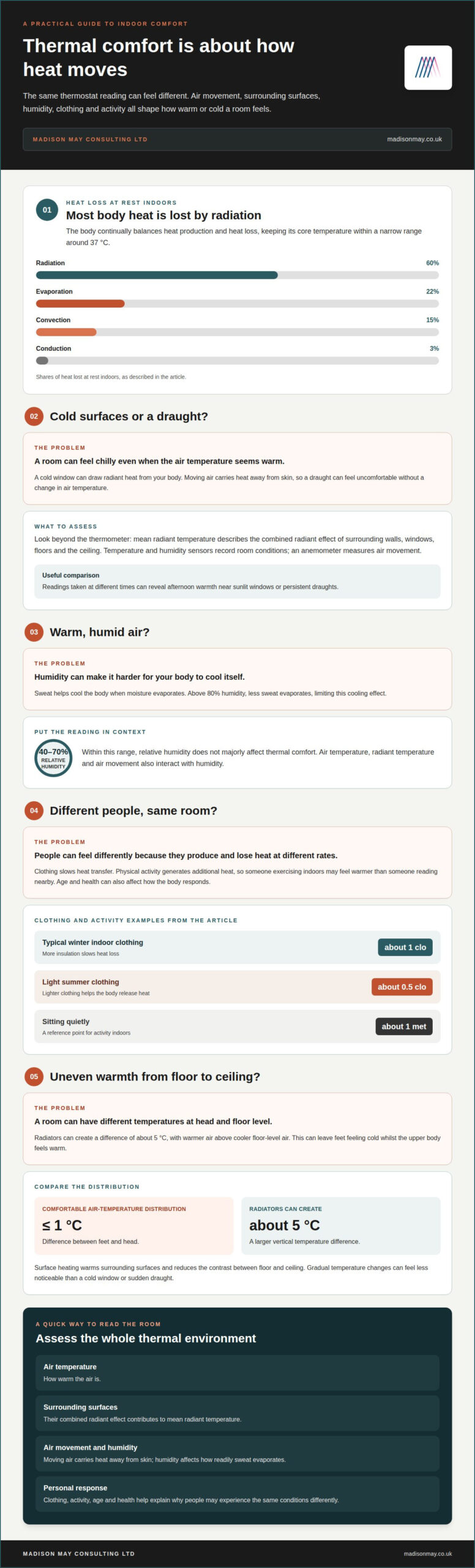
Air temperature measures the warmth of the air, but it doesn’t describe the whole thermal environment. A room thermometer can show the same reading beside a cold window and near a warm ceiling. Yet the feeling may differ because your body exchanges radiant heat with surrounding surfaces. Air speed also matters: moving air carries heat away from skin, while humidity affects how readily sweat evaporates.
Mean radiant temperature describes the combined radiant effect of the surfaces around you, including walls, windows, floors and the ceiling. A cold windowpane can draw heat from your body even when the air feels warm. Operative temperature combines air temperature and mean radiant temperature to indicate how warm a space feels overall. For example, a room with warmer surfaces may feel comfortable at a lower air temperature than one with cold walls.
Standards help assess these interacting conditions rather than relying on a single thermostat reading. According to the International Organization for Standardization, ISO 7730 specifies analytical determination and interpretation of thermal comfort using PMV and PPD indices and local thermal comfort criteria. PMV estimates the average thermal sensation, with 0 representing neutrality. PPD estimates the share of people likely to feel dissatisfied; even at PMV 0, PPD is usually around 5%.
Temperature distribution matters too. For comfortable air-temperature distribution, the difference between feet and head should be no more than 1 °C. Radiators can create a difference of about 5 °C, leaving warmer air above cooler floor-level air. This vertical variation can make feet feel cold while the upper body feels warm. Surface heating creates a different pattern, warming surrounding surfaces and reducing the contrast between floor and ceiling. Gradual temperature changes can feel less noticeable, while a cold window or sudden draught provides a sharper thermal stimulus.
Human heat exchange and thermoregulation
Your body continually balances heat production with heat loss, keeping its core temperature within a narrow range around 37 °C. At rest indoors, radiation accounts for about 60% of heat lost, evaporation 22%, convection 15% and conduction 3%. Clothing slows heat transfer; physical activity generates additional heat. Sitting quietly is about 1 met, so someone exercising indoors may feel warmer than someone reading nearby.
Thermoregulation adjusts blood flow to the skin and sweat production as conditions change. Skin temperature is around 31 to 34 °C, and sweating helps cool the body when moisture evaporates. Humidity matters: above 80%, less sweat evaporates, limiting this cooling effect. In winter, warm clothing can reduce heat loss; in summer, lighter clothing helps the body release heat. Age and health can also affect how the body responds.
Heat stress develops when heat gain outpaces the body’s ability to cool itself. In extreme conditions, excessive workplace heat can increase the risk of heat stroke or collapse. The predicted heat strain model, set out in ISO 7933, estimates sweat rate and the internal core temperature a working person may develop. Physical effort, clothing insulation and environmental conditions all shape the estimate.
Recognising heat stress involves considering symptoms alongside the conditions and work being undertaken. The wet bulb globe temperature index is one measurement method referenced to BS EN 27243; BS 8966 helps estimate metabolic rate, while BS ISO 9920 addresses clothing insulation. During heat waves, indoor temperatures in nine low-income homes in London and Manchester exceeded 37 °C. For homes where heating performance needs attention, heating upgrades can form part of a considered approach to indoor comfort.
What factors influence comfort?
Comfort depends on room conditions and personal responses, not a single temperature reading. Clothing and activity affect insulation and the heat your body produces, so people may feel differently in the same indoor environment.
Environmental and personal influences
Environmental and personal influences are the conditions around you and the characteristics you bring to a room. Air temperature, radiant temperature, air movement and humidity interact with expectations, age and health, shaping whether an indoor space feels comfortable. Relative humidity between 40% and 70% does not majorly affect thermal comfort. Sensors can record temperature and humidity, while anemometers measure air movement. Comparing readings at different times can reveal afternoon warmth near sunlit windows or persistent draughts.
Discomfort in cold and warm environments
Thermal discomfort occurs when your body feels too cold or too warm. In a cold room, moving air increases heat loss through convection, so a draught can feel unpleasant even if the air temperature stays the same. In a warm, humid space, sweat evaporates less readily, making it harder for your body to lose heat. Sensor readings can help distinguish general room warmth from a local source of discomfort, such as direct sun or a draught.
Clothing and activity levels
Clothing changes how quickly heat leaves the body, while activity changes its metabolic rate and heat production. Typical winter indoor clothing is about 1 clo; light summer clothing is about 0.5 clo. A person working actively may feel warmer than someone sitting quietly in the same room, because physical effort generates additional heat. In naturally ventilated homes, changing layers or opening windows can help occupants adapt as conditions shift. Uniforms or protective clothing may limit those adjustments.
Thermal comfort and building energy regulations
Building energy performance and thermal comfort are connected, but they answer different questions. Energy performance concerns how a building uses energy; comfort concerns how people experience the indoor environment. A home can use heating efficiently yet still feel uncomfortable if cold surfaces, air movement or humidity are not well managed. Consider the building fabric, heating and indoor conditions together rather than treating the thermostat setting as the whole answer.
In the UK, the Health and Safety Executive suggests a minimum workplace temperature of 16°C, or 13°C for rigorous physical work. This is workplace guidance, not a recommended temperature for every home or person. Building standards take a broader view: EN 16798-1 addresses indoor environmental input parameters for building energy performance, including indoor air quality, thermal environment, lighting and acoustics. EN 15251 is also cited for design and assessment inputs across these areas. Neither standard turns personal comfort into one universal room-temperature target.
That distinction matters when planning improvements. Insulation can reduce heat loss, but it should be considered alongside ventilation and the heating system. Relative humidity, activity and the temperatures of internal surfaces also affect how occupants experience a room. Assessing the building fabric and services together can help inform improvements to comfort and energy performance. The right measures depend on how the building is constructed and used, not simply on increasing the heating.
For homeowners considering changes, a retrofit assessment can examine the building fabric, services and ventilation together, then identify practical improvement options. This gives energy efficiency and indoor comfort a shared starting point instead of treating each upgrade in isolation. Explore retrofit assessment options if you’re considering how coordinated improvements could support your home.
Madison May Consulting Ltd
Madison May helps homeowners and landlords connect everyday comfort concerns with practical property improvements. If some rooms feel cold, heat escapes around windows or a conservatory is difficult to use comfortably, a retrofit assessment can review the building fabric, services and ventilation together.
PAS 2035-aligned retrofit assessments and EPC improvement plans identify options for reducing heat loss, while energy-efficient home improvements can address the needs of the whole home. Depending on the property, relevant measures may include improvements to windows and doors, conservatory upgrades or ventilation assessments and damp remediation. Considering these elements together helps link the way a home feels with its energy performance.
If you’re considering home improvements to support comfort, contact Madison May to discuss a retrofit assessment for your property.
Shape a more comfortable home
Use your experience of each room to guide your next steps. Notice when discomfort occurs, where it is most noticeable and whether it changes with the weather or how you use the space. These patterns can turn thermal comfort explained in practical terms into a clearer starting point for decisions about your home.
Rather than treating warmth as a setting to turn up, consider how your home works as a whole and which changes suit its condition and your priorities. A considered plan can bring comfort and energy performance into the same conversation while respecting the character and everyday use of your home.
If you’re ready to explore possible improvements, contact Madison May Consulting Ltd to discuss the next step for your property. A more comfortable home can begin with a thoughtful conversation and a clear sense of what matters to you.
Frequently Asked Questions
What is thermal comfort?
Thermal comfort is the feeling that the conditions around you are acceptable. Put simply, thermal comfort explained through everyday experience means feeling at ease in a room without persistently feeling too hot or cold. It describes a person’s response, not a fixed temperature that suits everyone. Two people may feel differently in the same room because their activity or clothing differs.
What does comfort mean?
Comfort means feeling at ease in your surroundings, without persistently feeling too hot or too cold. At home, that might mean being able to sit, sleep or work without repeatedly adjusting your clothing or moving to another room. Comfort is personal: expectations, daily routines and sensitivity to temperature all influence how a space feels. Thinking about thermal comfort in the context of your routines can clarify what matters most.
How can a room become comfortable?
A room feels more comfortable when its conditions suit the people and activities there. For instance, a bedroom used for sleep may need a different feel from a kitchen where someone is cooking. Consider how the room is used, whether sunlight or draughts affect particular areas, and whether ventilation suits the space. These observations can help identify which environmental changes are relevant.
So what is the ideal room temperature?
There isn’t one ideal temperature for every person, room or season. For UK homes in winter, CIBSE Guide A suggests living-room temperatures of around 22 to 23 °C and bedroom temperatures of around 17 to 19 °C. The World Health Organization recommends at least 18 °C indoors in cold weather to protect health. These are useful reference points, not a complete measure of comfort.
What is ASHRAE 55?
ASHRAE 55 is a standard for assessing acceptable indoor environmental conditions for building occupants. It includes a method based on predicted mean vote, or PMV, and an adaptive approach for naturally ventilated buildings. The adaptive method applies only where mechanical cooling isn’t installed. In practice, the standard helps explain why comfort assessments consider more than a thermostat reading.
What is operative temperature?
Operative temperature combines air temperature and mean radiant temperature to indicate how warm a room feels. Imagine two rooms with the same air temperature: the one with warmer surrounding surfaces may feel more comfortable. This helps explain why a thermometer reading alone may not match your experience, particularly near windows or external walls.