


What if the secret to a warmer, more resilient home isn’t simply adding more insulation, but rather understanding the intricate ways your property breathes and performs? For many, the prospect of energy upgrades feels fraught with uncertainty, especially with the fear that poorly planned installations might invite damp or mould into a cherished living space. It’s natural to feel hesitant amongst conflicting advice, yet understanding what to expect from a PAS 2035 survey can transform this confusion into a sense of calm clarity. This professional diagnostic is far more than a checklist; it is a sophisticated narrative of your home’s structural health, ensuring that every improvement respects the unique heritage and character of your sanctuary.
In this meticulous guide, we explore the journey of a PAS 2035:2023 assessment and how this whole-house philosophy secures the enduring comfort of your environment. You’ll discover how a qualified Retrofit Coordinator ensures every measure works in harmony, providing a clear roadmap through the mandatory Medium-Term Improvement Plan. We will preview how to navigate the £15 billion Warm Homes Plan with confidence, helping you curate a healthier, more beautiful home that stands the test of time.
Key Takeaways
- Understand why the whole-house approach is essential for preventing structural issues like damp, ensuring every energy measure complements your home’s unique character.
- Gain a clear understanding of what to expect from a PAS 2035 survey as a professional diagnostic journey, from the duration of the inspection to the meticulous care taken by the assessor.
- Discover why a standard EPC lacks the depth required for sophisticated retrofitting and how the PAS 2035 standard provides ten times the data points for a bespoke blueprint.
- Learn how to elegantly organise your property and gather essential documentation to ensure a seamless and successful assessment process.
- Explore how expert Retrofit Coordination translates complex survey data into a visionary design that protects your investment and elevates your sanctuary.
Understanding the PAS 2035 Standard: A Whole-House Philosophy
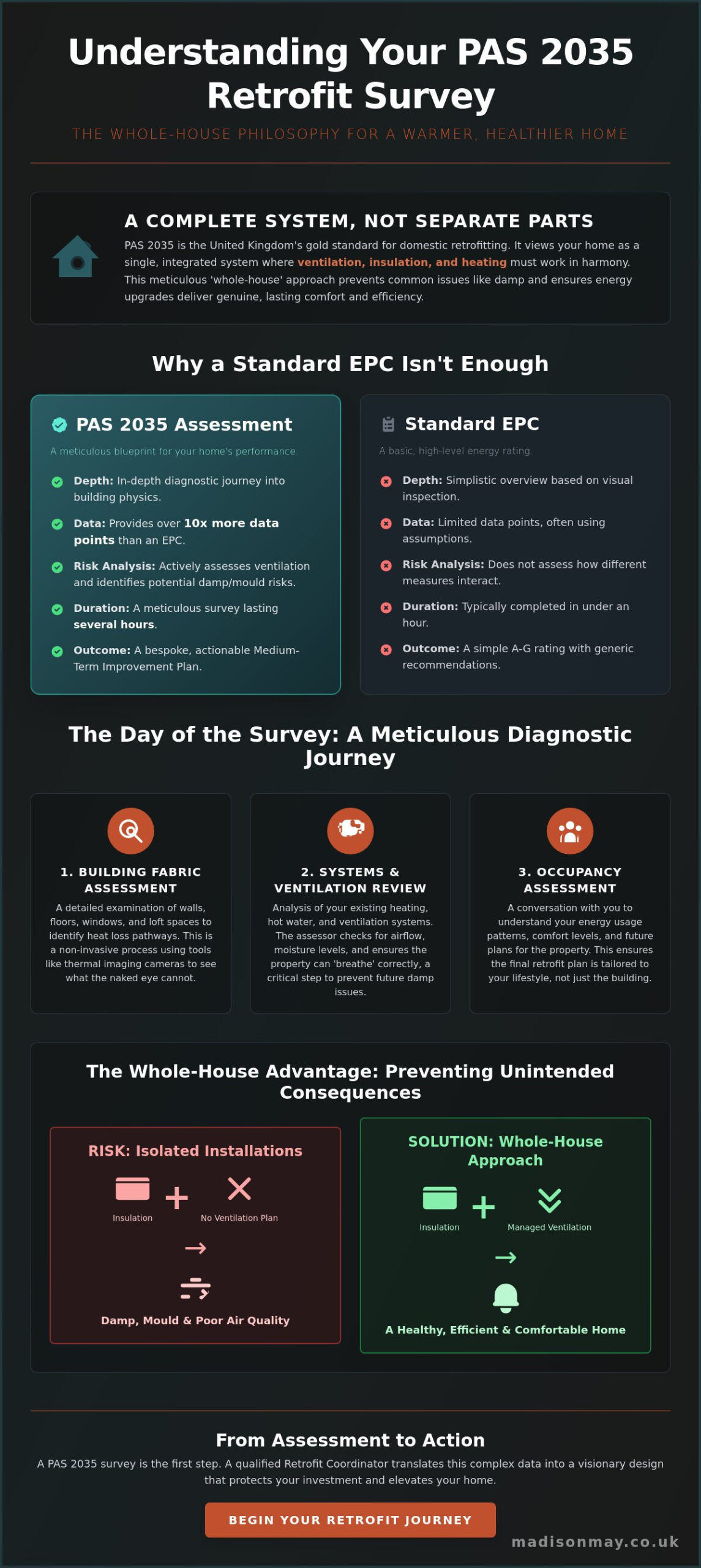
PAS 2035 represents more than a mere regulatory requirement; it’s a commitment to the structural integrity and emotional resonance of your home. As the gold standard for domestic retrofit in the United Kingdom, this framework ensures that energy improvements are never viewed in isolation. Instead, it adopts a whole-house philosophy that treats your property as a single, integrated system. By considering how ventilation, insulation, and heating interact, this meticulous approach eliminates the performance gap, that frustrating discrepancy where a home’s actual energy efficiency fails to meet its theoretical design. When you begin to explore what to expect from a PAS 2035 survey, you’re choosing a path that prioritises the long-term health of your sanctuary over quick, disconnected fixes.
The landscape of home energy is currently in a period of sophisticated transition. The latest standard, PAS 2035:2023, was published in September 2023 to refine the retrofit process even further. Whilst the previous version, PAS 2035:2019, remains relevant for a short period, it will be fully withdrawn on 30 March 2025. This evolution reflects a growing understanding that every home has a unique story, particularly those with heritage features that require a gentle, expert touch. To understand the technical foundations of this framework, the PAS 2035: 2019 – Designing Buildings Wiki offers a comprehensive overview of how these standards first emerged to protect homeowners from substandard work.
The Evolution of Home Energy Standards
This rigorous framework didn’t appear by accident. It was born from the “Each Home Counts” review, a pivotal study that identified why so many previous energy efficiency schemes failed to deliver. We’ve moved far beyond the simplistic Energy Performance Certificate (EPC). A modern assessment is a deep, rhythmic analysis of building physics. It’s designed to protect the character of your property whilst ensuring it meets modern demands for warmth and efficiency. This shift ensures that your personal journey toward a sustainable home is guided by data rather than guesswork.
Why Quality Matters in Retrofit
The dangers of isolated installations are well-documented. Adding thick insulation without assessing ventilation can lead to unintended consequences, such as trapped moisture and mould, which compromise both your health and the building’s fabric. A professional diagnostic is the only way to ensure your investment delivers genuine, lasting comfort. Recognising PAS 2035: The Meticulous Gold Standard for Home Retrofit is the first step in securing a healthier living environment. This level of detail is a core part of what to expect from a PAS 2035 survey, as it provides the confidence that every measure installed will actually work as intended, creating a harmonious balance between functionality and beauty.
The Day of the Survey: A Meticulous Diagnostic Journey
When a Retrofit Assessor arrives at your door, the experience differs significantly from a standard property inspection. You aren’t merely receiving a visitor; you are welcoming a specialist dedicated to understanding the intricate performance of your home. A primary part of what to expect from a PAS 2035 survey is the gift of time. Unlike a hurried EPC, this diagnostic journey often spans several hours, reflecting the meticulous care required to map every nuance of the building’s fabric. This is a non-invasive process that respects your sanctuary, using sophisticated tools to ‘see’ through the walls without disturbing the peace of your living spaces.
This thoroughness is a cornerstone of the industry’s guide to PAS 2035, which emphasises the need for high-quality data to inform future design decisions. The assessor employs sensory tools like thermal imaging cameras to detect invisible heat loss and moisture meters to identify potential risks before they become visible problems. Every measurement is taken with a sense of grace and poise, ensuring that the final data set is as accurate as it is comprehensive.
Step 1: Assessing the Building Fabric
The journey begins with the building’s envelope. The assessor examines wall construction, loft insulation depth, and floor types to calculate precisely where heat escapes. They look for thermal bridges, those subtle points where structural elements conduct heat away from the interior. Recording the condition of windows and doors allows for the calculation of specific U-values, ensuring that any proposed upgrades are perfectly calibrated to your home’s needs.
Step 2: Evaluating Ventilation and Services
Ventilation is the pulse of a healthy home. The assessor meticulously checks every extract fan and trickle vent to ensure your property can breathe. They review heating systems and hot water cylinders, analysing the delicate relationship between insulation and airflow. This step is vital for preventing the unintended consequences of retrofit, such as trapped moisture. For those concerned about existing issues, our Damp Remediation: A Comprehensive Guide provides deeper insight into how we protect your home’s structural health.
Step 3: Understanding Your Lifestyle
Finally, the assessment turns to the most important element: you. An occupancy assessment explores how your habits and lifestyle influence energy consumption. By discussing your Project Intended Outcomes (PIO), the assessor ensures the final plan is entirely bespoke. This personal dialogue is a defining feature of what to expect from a PAS 2035 survey, moving the process from a technical exercise to a transformative artistic journey. If you are ready to begin this transition, you can book a professional Retrofit Assessment to secure your home’s future.
PAS 2035 vs EPC: Why a Standard Certificate Isn’t Enough
Whilst most homeowners are familiar with the colourful bars of an Energy Performance Certificate (EPC), this document is merely a high-level estimate rather than a detailed blueprint for transformation. An EPC provides a snapshot, but it lacks the forensic depth required to safeguard your property’s future. When considering what to expect from a PAS 2035 survey, the most striking difference lies in the volume of information gathered; a professional assessment requires approximately ten times more data points than a standard EPC. This isn’t data for data’s sake. It represents a profound understanding of how your home functions as a living, breathing entity.
The PAS 2035:2023 standard mandates this level of rigour to ensure that any improvements are both safe and effective. Where an EPC might suggest generic measures based on property age, a PAS 2035 report offers a sequenced, property-specific roadmap. This professional narrative is verified by a Retrofit Coordinator, providing an extra layer of oversight that a standard certificate simply cannot match. It transforms a simple piece of paper into a twenty-year improvement plan, allowing you to curate your home’s evolution with confidence and poise.
Comparison of Data Points
An EPC typically focuses on basic dimensions and visible heating systems, often relying on assumptions when structural details are hidden. In contrast, a PAS 2035 assessment dives deep into full ventilation strategies and structural health, ensuring that new measures don’t disrupt the delicate balance of your home’s fabric. This level of detail is essential for creating The Meticulous EPC Improvement Plan, where generic recommendations are replaced by precise, actionable intelligence tailored to your property’s unique heritage.
Addressing the Cost Objection
It’s tempting to view a survey as a purely administrative expense, yet a ‘cheap’ assessment often leads to expensive mistakes later, such as mismatched insulation or inadequate airflow. Choosing a professional path provides the security of professional indemnity and TrustMark protection, ensuring your project is handled with the highest level of integrity. The investment in a comprehensive survey serves as a vital tool for risk mitigation, protecting both your financial outlay and the physical health of your sanctuary. By understanding what to expect from a PAS 2035 survey, you’re investing in a legacy of comfort and quality that far exceeds the utility of a standard certificate. This measured approach ensures that your journey toward a more efficient home is as serene as the finished result.
How to Organise Your Home for a Successful Assessment
Preparing your property for a professional diagnostic is an act of stewardship that ensures the resulting roadmap is as accurate as possible. Whilst the process is non-invasive, a successful outcome relies on the assessor’s ability to witness the hidden narratives of your home’s construction. Understanding what to expect from a PAS 2035 survey involves more than just opening your door; it’s about facilitating a seamless flow through your living spaces. By clearing access to service metres, lofts, and storage cupboards, you allow the specialist to focus entirely on the building’s performance without the distraction of physical obstacles.
Beyond the physical space, gathering historical documentation provides the assessor with a rich context that data alone cannot capture. Previous building works, warranties for existing windows and doors, and recent energy bills all tell a story of how the home has evolved. This preparation transforms the assessment into a collaborative dialogue, where your personal experience of draughts or cold spots informs the technical data. It’s a moment to pause and reflect on the sanctuary you wish to create, ensuring every detail is considered with visionary creativity.
A Checklist for Homeowners
- Provide clear access to the loft hatch and any crawl spaces, as these are vital for assessing insulation and structural health.
- Ensure the boiler, hot water cylinder, and heating controls are easily accessible for a thorough review of your home’s services.
- Locate any historical survey reports or existing EPCs to help the assessor build a complete picture of the property’s journey.
- Identify any areas where you feel particularly uncomfortable, such as specific rooms that are difficult to heat or prone to draughts.
Managing Expectations
It’s helpful to remember that this survey is a rigorous diagnostic exercise, not a sales pitch for specific products. The assessor’s role is to provide an objective analysis of what your home requires to reach its full potential. Some recommendations may be significant, whilst others might be phased over several years to suit your personal journey. Throughout the visit, the assessor maintains a professional, understated presence, respecting the calm of your environment whilst performing their duties with meticulous care. To begin your journey with a team that values quality and heritage, you can arrange your professional building survey today.
By taking these small steps to organise your environment, you ensure the assessor can work with the calm deliberation your project deserves. This clarity of vision from the outset is a fundamental part of what to expect from a PAS 2035 survey, allowing the subsequent design phase to unfold with grace and precision. Your home is a deeply personal refuge, and a well-prepared assessment is the first step in honouring its unique story whilst securing its future efficiency.
From Assessment to Action: The Madison May Consulting Ltd Approach
Once the assessor has departed and the technical data is gathered, the true transformation begins. At Madison May Consulting Ltd, we view the conclusion of the diagnostic phase not as an end, but as the birth of a bespoke design. Whilst the initial steps of understanding what to expect from a PAS 2035 survey focus on data collection, the subsequent stage is where that information is woven into a narrative of comfort and style. Your Retrofit Coordinator steps in as the guardian of your project, ensuring that every technical recommendation aligns with your personal vision and the structural heritage of your property. This transition is handled with the same calm deliberation as a high-end design consultation. It moves you seamlessly from theory to reality.
Aesthetic harmony is never a compromise in our process; it is a fundamental requirement. We understand that a home must be more than just efficient; it must remain a sanctuary of refined aesthetics. By integrating Retrofit Coordination into the heart of our service, Madison May Consulting Ltd ensures that energy improvements like high-performance windows and doors or sophisticated heating upgrades are installed with meticulous craftsmanship. This approach guarantees that the functionality of a modern retrofit never detracts from the soul of your living space, creating a natural and effortless union between performance and beauty.
Crafting Your Personal Energy Roadmap
We believe that technical data should be accessible and inspiring. Our team translates the complex findings of your assessment into a clear, elegant Energy Efficient Home Improvements: A Guide, prioritising measures that offer the most profound impact on your daily comfort. This roadmap isn’t a rigid set of rules but a flexible plan that respects your timeline. By focusing on the intersection of building physics and personal lifestyle, we ensure your EPC improvement plan feels like a curated journey rather than a construction project.
A Sanctuary Restored
The final outcome of this meticulous process is a home that feels fundamentally different. There is a deep emotional reward in inhabiting a space that is consistently warm, quiet, and healthy, free from the worries of damp or inefficient energy use. Our commitment to visionary design means your property remains a deeply personal refuge, now fortified for the future. If you are ready to move beyond the initial question of what to expect from a PAS 2035 survey and begin the actual work of curation, we invite you to take the next step. Begin your home’s transformation today by booking a professional consultation with our expert team.
Securing the Future of Your Sanctuary
Embracing a whole-house philosophy is the first step in transforming your property from a simple dwelling into a resilient, high-performance refuge. By understanding what to expect from a PAS 2035 survey, you’ve moved beyond the limitations of generic estimates and towards a future defined by data-driven comfort. This diagnostic journey ensures that every measure, from insulation to ventilation, works in perfect harmony with your home’s unique structural story. It’s a commitment to quality that protects your heritage whilst eliminating the risks of poor-quality installations.
As a Specialist Retrofit Consultancy and TrustMark Registered Firm, Madison May Consulting Ltd provides the professional authority needed to guide you through this transition. Our Expert Retrofit Coordinators act as the dedicated guardians of your project, ensuring that every detail is executed with visionary creativity and meticulous craftsmanship. The result is a healthier, more beautiful living environment that resonates on a personal level. Your home deserves a roadmap as individual as your own story. Book your meticulous PAS 2035 Retrofit Assessment today and begin the graceful journey toward a more efficient, enduring sanctuary. Your future comfort starts with a single, well-considered decision.
Frequently Asked Questions
How long does a PAS 2035 survey typically take?
A thorough survey typically takes between two and four hours to complete, depending on the complexity and size of your property. This extended duration allows the specialist to map every structural nuance and ventilation path with the meticulous care your home deserves. It is a significant departure from the rapid pace of a standard inspection, reflecting the whole-house philosophy inherent in the current standards. By taking this time, the assessor ensures that no detail of the building’s fabric is overlooked.
Do I need to move furniture or clear rooms for the assessor?
You don’t need to clear entire rooms or move heavy furniture, but ensuring easy access to key areas like loft hatches, service metres, and heating controls is essential. Providing a clear path to these points allows the assessor to maintain a professional, understated presence whilst conducting their diagnostic. This preparation helps to protect the calm of your sanctuary whilst ensuring the specialist can gather the forensic data required for a successful retrofit design.
What is the difference between a Retrofit Assessor and a Retrofit Coordinator?
The Retrofit Assessor is the specialist who visits your home to gather forensic data, whereas the Retrofit Coordinator acts as the project’s guardian and lead designer. Whilst the assessor focuses on the physical diagnostic, the coordinator translates that information into a cohesive, long-term improvement plan. Both roles are vital to the process, working in harmony to ensure every energy measure is safe, effective, and beautifully integrated into your living space.
Will a PAS 2035 survey help me access government grants?
A PAS 2035 survey is a mandatory requirement for accessing many government-backed incentives, including the Energy Company Obligation (ECO) scheme and the Warm Homes Plan. Compliance with this standard ensures that any funded work meets rigorous quality benchmarks, protecting homeowners from substandard installations. Understanding what to expect from a PAS 2035 survey is the first step for anyone seeking public investment to enhance their home’s efficiency and comfort.
Can I still have a survey if my home is a listed building or in a conservation area?
You can certainly have a survey if you live in a listed building or a conservation area, though the assessment will require a particularly sensitive touch to respect the property’s heritage. The framework is specifically designed to protect the structural integrity and aesthetic character of traditional homes. Your assessor will pay close attention to historical materials and breathability, ensuring that any proposed energy improvements honour the unique story of your property whilst improving its performance.
Is the PAS 2035 survey valid for a certain number of years?
The data gathered during the assessment is typically considered valid for ten years, mirroring the lifespan of a standard Energy Performance Certificate. However, if you make significant structural changes or install new energy measures, it’s often wise to update your survey to ensure your property’s performance narrative remains accurate. This ensures your Medium-Term Improvement Plan stays relevant as a visionary roadmap for your home’s evolution and enduring comfort.
What happens if the survey identifies damp or mould issues?
If the survey identifies damp or mould, the assessor will investigate the root cause, such as inadequate ventilation or thermal bridging, rather than merely noting the symptoms. This diagnostic approach ensures that any subsequent retrofit design includes specific remediation measures to restore the health of your environment. Addressing these issues is a core part of what to expect from a PAS 2035 survey, as it prevents new insulation from exacerbating existing moisture problems in your sanctuary.
How much does a PAS 2035 assessment usually cost for a standard home?
The investment for a PAS 2035 assessment varies depending on the size of your property and the specific complexity of its construction. Whilst industry averages exist, a specialist consultancy will typically provide a bespoke quote that reflects the meticulous depth of their diagnostic process. It is best to check directly with your chosen provider to understand the full scope of the service, ensuring you receive a comprehensive report that secures the future comfort and efficiency of your home.