

Could the most profound transformation of your home in 2026 be the quiet, invisible one that unfolds behind its walls and beneath its floorboards? As the UK moves towards a more sustainable future, crafting a sophisticated budget for home energy upgrades 2026 becomes less about simple utility and more about curating a legacy of comfort and enduring value. It’s natural to feel a sense of hesitation when faced with the intricate requirements of the Warm Homes Plan or the technical nuances of heat pump integration. You want to ensure that every investment not only enhances your sanctuary but also protects its architectural integrity from concerns such as damp or inefficient installation.
We understand that your property is a deeply personal refuge; we’re here to help you master this financial landscape with quiet confidence. This guide provides a clear roadmap for the year ahead, illustrating how to elegantly blend private capital with government initiatives like the £7,500 Boiler Upgrade Scheme. We’ll examine the vital role of a professional Retrofit Assessment in sequencing your property investments, ensuring every upgrade enhances both your home’s character and its thermal performance whilst securing your long-term peace of mind.
Key Takeaways
- Understand why 2026 is the definitive year to align your property with the Future Homes Standard and the government’s £15 billion Warm Homes Plan.
- Discover how to structure a realistic budget for home energy upgrades 2026 by elegantly combining private capital with grants like the £7,500 Boiler Upgrade Scheme.
- Learn why the “Fabric First” principle is essential, ensuring insulation and high-performance windows are prioritised before investing in complex heating systems.
- Identify how a professional Retrofit Assessment serves as the most critical step in avoiding wasted expenditure whilst protecting your home’s architectural integrity.
- Explore how a bespoke EPC Improvement Plan creates a clear financial roadmap to enhance both the thermal efficiency and the enduring value of your sanctuary.
The 2026 Energy Landscape: Why Strategic Budgeting is Essential
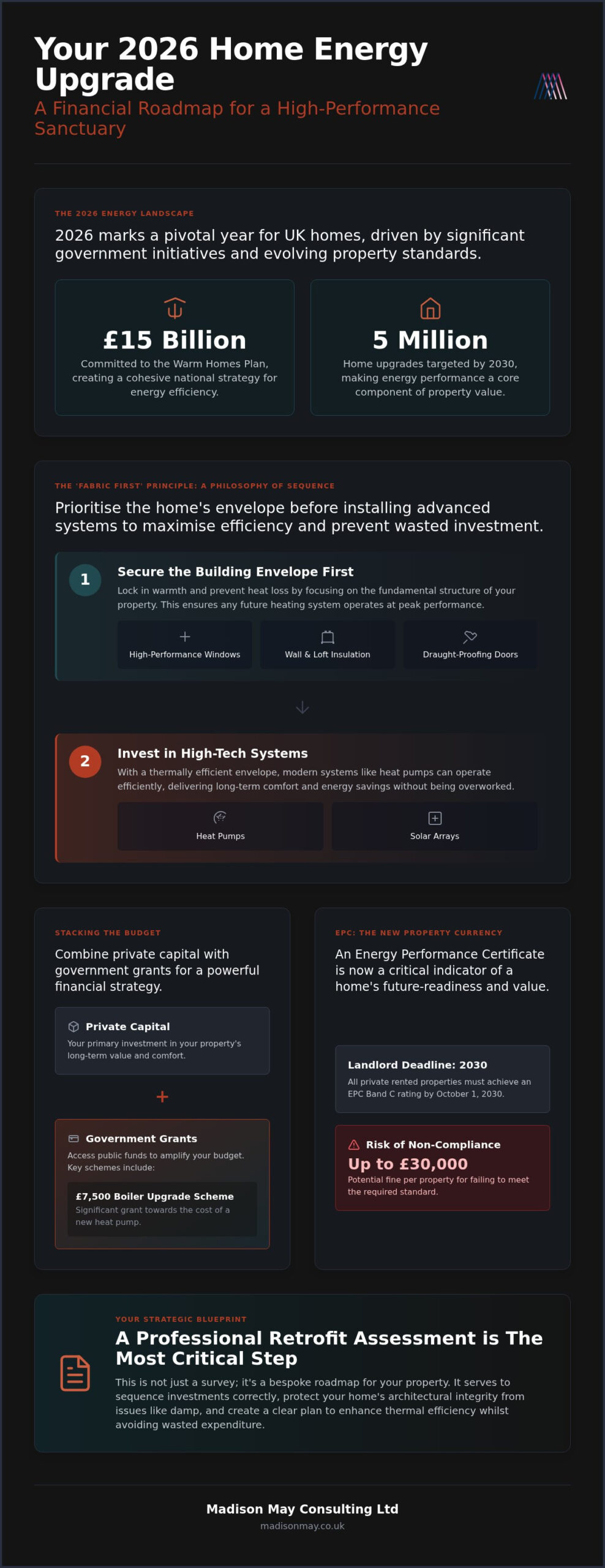
The year 2026 marks a profound shift in how we perceive our homes. No longer are energy efficiency measures seen as mere reactive responses to fluctuating utility bills. Instead, they’ve become an essential part of an architectural legacy. This evolution is driven by the nearly £15 billion government commitment to the Warm Homes Plan, positioning energy performance as a core component of property value. When you begin to develop your budget for home energy upgrades 2026, you’re not just managing costs. You’re orchestrating a long-term investment in a sanctuary that remains comfortable, compliant, and profoundly desirable. It’s a move away from the temporary “cost-of-living” mindset toward a philosophy that treats the home as a high-performing, long-term asset.
The Warm Homes Plan and the 2026 Budget
The UK government’s pledge to facilitate five million home upgrades by 2030 has reached a critical juncture. Unlike previous schemes like ECO4, which often felt fragmented, the 2026 funding cycle represents a more cohesive strategy. The Warm Homes: Local Grant is a central pillar here, with local authorities taking a leading role in distributing funds to ensure that improvements are tailored to specific regional needs. This direct grant approach simplifies the path for eligible households, offering a more stable foundation for your financial planning. It moves us closer to the UK home energy efficiency standards required for the future. Understanding how these local funds interact with your personal capital is the first step in crafting an effective roadmap for the year.
EPC Ratings: The New Currency of the UK Property Market
In the current market, an Energy Performance Certificate is far more than a bureaucratic requirement; it’s a reflection of a property’s health and future-readiness. For landlords, the pressure is particularly acute as we move toward the October 1, 2030 deadline for all private rented properties to reach an EPC Band C rating. Non-compliance carries significant weight, with potential fines reaching up to £30,000 per property. This is why a meticulous EPC improvement plan should be the first entry in your budget for home energy upgrades 2026. Beyond regulation, lenders are increasingly rewarding efficiency with preferential mortgage rates. A home that breathes well and retains its warmth isn’t just a place to live. It’s a refined asset that commands respect in any valuation, ensuring your investment pays dividends in both comfort and capital growth.
Understanding the Costs: Fabric First vs. High-Tech Systems
True property stewardship begins with a quiet respect for the building’s fabric. Whilst the allure of high-tech solar arrays or sophisticated heat pumps is undeniable, the PAS 2035 “Fabric First” principle suggests that we must first secure the home’s envelope. It’s a philosophy of sequence. There’s little wisdom in installing a powerful new heating system if the warmth it generates immediately escapes through porous walls or dated glazing. For homeowners seeking reliable glazing upgrades, check out uPVC WindowCare Ltd. to explore modern window and door installations. When you refine your budget for home energy upgrades 2026, prioritising insulation and draught-proofing ensures that subsequent investments operate at peak efficiency. This methodical approach prevents the “piecemeal” trap where disconnected upgrades lead to unforeseen issues like damp or poor air quality.
The High-Performance Envelope: Windows, Doors, and Insulation
Investing in bespoke windows and doors is often the most evocative way to enhance both the thermal performance and the aesthetic character of a sanctuary. Unlike standard double glazing, these high-performance elements are crafted to endure. They offer a superior return on investment through reduced heat loss and heightened security. For those seeking the most immediate impact within a modest outlay, professional draught-proofing remains an incredibly effective measure. However, for a truly transformative result, external wall insulation provides the highest level of thermal comfort. It requires a more significant portion of your capital, but the impact on your lifestyle and the building’s longevity is profound.
The Ventilation Gap: Protecting Your Investment
As we make our homes more airtight, we must be careful not to silence the building’s natural ability to breathe. The “Ventilation Gap” is the critical imbalance between airtightness and air changes. Without a professional ventilation assessment, adding thick layers of insulation can inadvertently trap moisture, leading to interstitial condensation and mould. Integrating mechanical ventilation or passive stack systems into your budget for home energy upgrades 2026 isn’t merely a technical requirement; it’s a way to safeguard your health and the structure of your property. Seeking Energy Saving Trust home improvement advice can help clarify these technical needs, ensuring your home remains a fresh and vibrant refuge. A professional building survey serves as a vital safeguard, identifying these risks before they become costly remediations.
Stacking the Budget: Navigating Grants and Private Capital
Financing a home transformation in 2026 requires a sophisticated eye for detail and a strategic approach to layering capital. It’s no longer about chasing a single grant; it’s about orchestrating a symphony of financial instruments to support your budget for home energy upgrades 2026. One of the most compelling advantages for this year is the 0% VAT rate on qualifying energy-saving materials, which is scheduled to remain in effect until March 31, 2027. This tax relief, when combined with the broader £15 billion Warm Homes Plan, allows you to stretch your private capital further, ensuring that every pound invested contributes to the enduring quality and thermal integrity of your sanctuary.
The Boiler Upgrade Scheme (BUS) and Beyond
The £7,500 Boiler Upgrade Scheme (BUS) grant remains a stable cornerstone for those transitioning to air source or ground source heat pumps. For homeowners in off-gas-grid properties, a temporary enhanced grant of £9,000 is available from July 21, 2026, until March 31, 2027, specifically targeting the replacement of oil or LPG systems. As the government shifts toward the Warm Homes Plan, the landscape is becoming more nuanced, with a greater emphasis on targeted support. A professional Retrofit Assessment is becoming a standard prerequisite for these high-level funding streams, as it provides the technical assurance that your chosen upgrades are perfectly suited to your property’s specific requirements. It’s also worth noting that the ECO4 scheme, which can provide significant funding for major retrofits, is set to close on December 31, 2026, creating a natural window of opportunity for eligible households to act.
Innovative Financing for 2026
Beyond direct government support, the financial sector has introduced elegant ways to fund property enhancements. Many lenders now offer “green” additional borrowing or preferential mortgage rates for homes that demonstrate high energy performance. This is especially relevant for major structural retrofits, such as loft conversions or conservatory upgrades. By transforming a conservatory with high-performance thermal elements, you’re doing more than adding floor space; you’re creating a year-round retreat that functions as a seamless extension of your home’s thermal envelope. This “whole-house” funding model ensures that your private investment works in harmony with available grants, creating a financial roadmap that is as robust as it is visionary. By combining low-interest borrowing with direct subsidies, you can achieve a level of comfort and efficiency that might have previously seemed out of reach.
Creating Your 2026 Energy Upgrade Roadmap
A vision for a more efficient home requires more than just capital; it demands a meticulously planned journey. When you develop a budget for home energy upgrades 2026, you’re creating a narrative for your property’s future. This roadmap ensures that every intervention is intentional, protecting the home’s character whilst elevating its performance. By following a structured sequence, you can avoid the common pitfalls of disjointed renovations and ensure that your investment yields the highest possible return in both comfort and value.
- Step 1: The Professional Retrofit Assessment. This is the cornerstone of your project, providing a deep understanding of your building’s current state to ensure no pound is spent in vain.
- Step 2: The EPC Improvement Plan. We design this around your specific lifestyle and property goals, turning generic recommendations into a bespoke investment strategy.
- Step 3: Appointing a Retrofit Coordinator. This professional acts as the technical steward of your project, overseeing contractor quality and managing complex risks.
- Step 4: Phasing the Work. By understanding which measures must happen simultaneously, you avoid the structural conflicts that often plague unplanned renovations.
The Role of the Retrofit Coordinator
Think of the Retrofit Coordinator as the guardian of your architectural sanctuary. Their presence ensures that all installations meet the rigorous PAS 2035 standards, which is often a non-negotiable requirement for securing high-level grants and maintaining insurance validity. By integrating comprehensive building surveys early in the process, they uncover hidden heat loss and structural nuances before a single contractor arrives on site. This proactive oversight prevents the expensive remedial works that so often derail poorly managed projects, keeping your budget for home energy upgrades 2026 firmly on track.
Phasing Your Investment for Cashflow
A full deep-retrofit can represent a significant commitment, sometimes exceeding £30,000 for a heritage property. However, there is great wisdom in spreading this investment over two or three years. We encourage prioritising “low-regret” measures first, such as draught-proofing and loft insulation, which offer immediate reductions in energy bills and enhance daily comfort. A phased roadmap allows for financial flexibility without compromising the final energy performance. This approach ensures you maintain eligibility for evolving grant schemes whilst managing your cashflow with grace and composure. If you’re ready to begin your journey, we invite you to book a professional Retrofit Assessment to clarify your path forward.
The Madison May Approach: Turning Budgets into Bespoke Sanctuaries
Every property possesses a unique architectural narrative, a story told through its materials, its light, and its history. At Madison May, we don’t view a drafty corridor or an inefficient heating system as a mere technical problem to be solved with a generic fix. Instead, we see an opportunity to refine your sanctuary, treating each home as a singular project that requires a thoughtful, curated touch. Our commitment to a “Whole House Approach” ensures that your property remains a healthy, breathable environment, avoiding the common pitfalls of modern retrofitting that can lead to damp or poor air quality. When you establish your budget for home energy upgrades 2026, our fixed-fee assessments provide the absolute clarity required for sophisticated financial planning. We remove the ambiguity often found in the industry, replacing it with a rhythmic, predictable process that respects both your vision and your investment.
Bespoke Consultancy for the Discerning Homeowner
We move beyond off-the-shelf solutions, crafting personalised energy roadmaps that honour the heritage and identity of your property. For the discerning homeowner, the intersection of functionality and beauty is where true luxury resides. We believe that energy upgrades should be either entirely invisible or aesthetically pleasing, blending seamlessly into the existing design rather than detracting from it. Whether it’s the subtle integration of insulation or the selection of high-performance windows, every material is chosen with care and intentionality. Our expertise, rooted in a tradition of meticulous craftsmanship, serves a national audience with a personal touch that ensures your home remains a deeply personal refuge. It’s about creating a space where efficiency and elegance coexist in a natural, effortless union, reflecting your values without compromising on style.
Your Next Steps Toward a Future-Proofed Home
The most opportune time to finalise your budget for home energy upgrades 2026 is now. As we approach key government deadlines and the expiration of the 0% VAT relief in March 2027, material costs and contractor demand are expected to rise significantly. Early preparation is not just a practical necessity; it’s a mark of visionary stewardship for your property. Booking a PAS 2035 Retrofit Assessment is the definitive first step toward a future-proofed home, providing the technical foundation needed to access grants and ensure long-term compliance. This professional oversight offers the profound peace of mind that comes from a professionally managed, rhythmic design process. We invite you to book a consultation and begin this transformative journey with us, turning technical requirements into a meaningful expression of your home’s enduring character.
Securing Your Home’s Future with Confidence and Clarity
The landscape of British housing is undergoing a quiet revolution, where the thermal integrity of your property becomes as significant as its aesthetic charm. By embracing the “Fabric First” principle and navigating the £15 billion Warm Homes Plan with precision, you can transform your home into a high-performing sanctuary. Establishing a robust budget for home energy upgrades 2026 is the essential first step in this journey, allowing you to layer private capital with strategic grants whilst the 0% VAT relief remains in place.
Success lies in the details of the design. A professional roadmap ensures that every insulation measure or heating upgrade is part of a coherent whole, protecting your property from technical risks like damp or poor ventilation. We invite you to begin your journey toward a more efficient sanctuary with a Madison May Retrofit Assessment. Our approach combines PAS 2035 Aligned Assessments with expert EPC Improvement Plans and specialist Retrofit Coordination to ensure your investment is both beautiful and enduring. Your home is more than a building; it’s a legacy of comfort and quality that deserves the highest standard of care.
Frequently Asked Questions
What is the average budget for a whole-house energy upgrade in 2026?
The financial requirement for a comprehensive retrofit varies significantly based on property age and construction type. Whilst a basic upgrade might start with low-regret measures like loft insulation, a deep retrofit for a heritage property often requires a budget for home energy upgrades 2026 exceeding £30,000. These investments are typically phased over several years, utilising a combination of private capital and government grants like the £7,500 Boiler Upgrade Scheme to manage cashflow effectively.
Can I still get a grant for a new gas boiler in 2026?
Direct grants for fossil fuel systems have largely been phased out in favour of low-carbon alternatives. The focus of the Warm Homes Plan is to incentivise the transition to heat pumps and high-performance insulation. Whilst some limited support may exist under the final months of the ECO4 scheme for eligible low-income households before it closes in December 2026, most homeowners should pivot their financial planning toward renewable heating technologies and fabric improvements.
What is the difference between a standard EPC and a PAS 2035 Retrofit Assessment?
A standard EPC provides a high-level snapshot of energy performance, whereas a PAS 2035 Retrofit Assessment is a sophisticated, whole-house evaluation. This professional assessment examines the building fabric, existing services, and ventilation in meticulous detail. It serves as a technical foundation for any budget for home energy upgrades 2026, ensuring that all measures are compatible and installed to the rigorous standards required for government-backed funding and long-term property health.
Are there specific grants for landlords to improve rental properties in 2026?
Landlords can access several funding streams to meet the upcoming EPC Band C requirement by 2030. The Boiler Upgrade Scheme provides a £7,500 grant for heat pump installations in eligible rental properties. Additionally, the Warm Homes: Local Grant supports upgrades for properties with low-income tenants. Integrating these subsidies into a long-term EPC Improvement Plan is essential for maintaining regulatory compliance and protecting the capital value of a rental portfolio across the country.
How long does it take for home energy upgrades to pay for themselves?
The return on investment for energy upgrades is measured through both immediate utility savings and long-term capital appreciation. Whilst modest measures like draught-proofing offer rapid payback, major retrofits are best viewed as investments in a property’s future-proofed value. With mortgage lenders increasingly offering preferential rates for high-performing homes and the 0% VAT relief available until March 2027, the financial benefits extend far beyond simple monthly bill reductions to include enhanced comfort and marketability.
Do I need planning permission for external wall insulation or solar panels in 2026?
Most energy-saving installations fall under Permitted Development rights, though specific rules apply to listed buildings and properties within conservation areas. External wall insulation can sometimes require permission if it significantly alters the building’s appearance. It’s always prudent to consult with a Retrofit Coordinator or your local planning authority before commencing work. This ensures your project respects the architectural heritage of your sanctuary whilst remaining compliant with all national and local regulations.
What happens if I install insulation but don’t upgrade my ventilation?
Neglecting ventilation when adding insulation creates a critical imbalance known as the “Ventilation Gap.” As a home becomes more airtight, moisture from daily activities can become trapped within the building fabric, leading to interstitial condensation and mould growth. A professional ventilation assessment is a vital component of any responsible retrofit. It ensures that your property remains a healthy, breathable environment, protecting both the structural integrity of the home and the well-being of its occupants.
Is the Boiler Upgrade Scheme grant taxable for homeowners?
The Boiler Upgrade Scheme grant is not considered taxable income for individual homeowners in the UK. Because the funding is paid directly to the MCS-certified installer and deducted from the total cost of the heat pump installation, there’s no direct tax liability for the resident. This arrangement simplifies the financial process, allowing you to focus on the technical transition to low-carbon heating without the complexity of additional self-assessment or income tax considerations.