


The very materials you choose to shield your sanctuary from the winter chill could, if misapplied, become the silent architects of a damp problem. When weighing up diy draught proofing vs professional retrofit services, the decision often rests on more than just immediate warmth. You’ve likely spent evenings noticing persistent cold spots even when the radiators are hot, or perhaps you’ve hesitated to seal unsightly gaps for fear of trapping moisture and inviting mould. It’s a valid concern that touches on the heart of home maintenance and the preservation of your property’s quiet elegance.
This guide will help you discover the most effective way to eliminate biting draughts and lower your energy bills whilst ensuring your building’s structural health remains intact. We’ll examine the immediate, cost-effective nature of self-installed fixes alongside the sophisticated, whole-house approach of a professional assessment. By the end, you’ll have the clarity needed to transform your property into a serene, well-ventilated refuge where functionality and beauty exist in perfect harmony, providing you with absolute peace of mind that your home is breathing correctly.
Key Takeaways
- Distinguish between the nuisance of uncontrolled draughts and the necessity of intentional ventilation to keep your living space healthy and vibrant.
- Compare the accessible, temporary nature of diy draught proofing vs professional craftsmanship to choose the most sustainable path for your property’s efficiency.
- Understand the “Ventilation Paradox” and why a professional retrofit approach is essential to prevent moisture buildup and protect your sanctuary’s structural health.
- Recognise how high-grade, integrated seals offer a superior aesthetic finish whilst providing a significant, long-term boost to your home’s EPC performance.
- Gain the confidence to invest in meticulous improvements that balance immediate thermal comfort with the enduring value of a well-designed, breathable home.
The Architecture of Warmth: Understanding Heat Loss and Draughts
A home is far more than a mere collection of rooms; it is a personal refuge, a sanctuary where the rhythm of daily life should unfold in absolute comfort. Yet, this sense of calm is often disrupted by the subtle, persistent intrusion of cold air. Draught proofing is the intentional sealing of these uncontrolled air infiltration points, a meticulous process that distinguishes between a house that breathes and one that simply leaks. While a traditional Draught excluder might offer a charming, temporary reprieve at the base of a door, true thermal efficiency requires a deeper understanding of how air moves through your unique space.
There is a vital distinction to be made between controlled ventilation and uncontrolled draughts. Ventilation is a deliberate design choice, essential for maintaining air quality and preventing the buildup of moisture that leads to damp. Draughts, conversely, are wasteful and accidental. They are the invisible thieves of warmth, slipping through often overlooked apertures such as loft hatches, gaps between heritage floorboards, and the entry points where service pipes pierce the building fabric. The choice between diy draught proofing vs professional intervention often begins with identifying these hidden paths that turn a curated interior into a source of physical discomfort.
The Science of Air Infiltration
Why Draughts Compromise Your Comfort
The impact of a draught is felt long before it is seen. Even when your heating system is working hard, a moving current of air causes radiant heat loss from the skin, making you feel cold despite a high thermostat reading. By eliminating these erratic air movements, you create a consistent thermal envelope that allows modern heating systems to operate at lower, more efficient flow temperatures. This harmony between airtightness and heating not only preserves the soul of the building but ensures that every corner of your sanctuary remains inviting. When weighing up diy draught proofing vs professional solutions, consider how a seamless seal contributes to the quiet, steady warmth that defines a truly well-crafted home.
The Practicalities of DIY Draught Proofing: A Temporary Reprieve
The allure of a quick, self-administered remedy is entirely understandable. For many, the journey towards a warmer home begins with a visit to the local hardware store, where rows of self-adhesive foam tapes and plastic brush strips promise an afternoon of productive labour. Whilst DIY draught-proofing offers a sense of immediate agency, it often serves as a temporary reprieve rather than a lasting solution. When debating diy draught proofing vs professional alternatives, one must consider the delicate balance between function and the refined aesthetics of a curated home.
The satisfaction of a self-installed fix is often short-lived. These off-the-shelf products, designed for universal application, frequently lack the durability required to withstand the daily rhythm of a busy household. Over time, the adhesive fails, the materials degrade, and the very draughts you sought to banish begin to whisper through the gaps once more. For those who view their home as a sanctuary, the utilitarian appearance of peeling foam or mismatched plastic strips can feel like a jarring intrusion into a sophisticated interior design.
Common DIY Materials and Their Limitations
Foam tapes are perhaps the most common choice, yet they are notorious for losing their elasticity after just one or two seasons. They flatten, become brittle, and eventually fail to bridge the gaps they were intended to seal. Fitting these perimeter seals to warped or period timber frames presents a significant challenge; a straight strip of tape rarely marries perfectly with the unique character of an aged door. There is also the “over-sealing” trap. In an earnest attempt to eliminate every chill, DIYers may accidentally block essential vents or combustion air paths, inadvertently compromising the building’s safety and air quality.
When DIY is (and Isn’t) Appropriate
Small, modern properties with standard, uniform window sizes are the most suitable candidates for a DIY approach. In these environments, the risks are lower and the windows are often designed to accept basic seals without interfering with their operation. However, complex architectural features and heritage properties require a more sophisticated touch. Bespoke timber doors and sash windows can easily be jammed or damaged by incorrectly applied materials. A thoughtful building survey can help you identify whether your property requires a more meticulous, professional approach to preserve both its performance and its soul.
The Professional Advantage: Precision, Aesthetics, and Performance
While a DIY approach offers a sense of immediate action, the transition to professional craftsmanship represents a profound shift from patchwork repairs to an orchestrated pursuit of airtightness. A specialist doesn’t merely stick a strip of foam to a frame; they execute a calibrated intervention that respects the building’s soul. When considering diy draught proofing vs professional solutions, the most significant difference lies in the materials and the methodology. Professionals utilise high-grade silicone compression seals and routed-in brushes that are machined directly into the timber, ensuring a seal that is as enduring as the architecture itself.
The Meticulous Assessment Process
A sophisticated assessment is the essential prelude to any meaningful energy upgrade. Unlike a casual inspection, professional surveys often employ thermal imaging to map heat loss with surgical precision, revealing the exact paths where warmth escapes. This data-driven approach allows for the measurement of gap tolerances to the millimetre before a sealing method is selected. Such detailed insights are the foundation of comprehensive building surveys, ensuring that every measure taken is perfectly tailored to the unique requirements of your home’s structure.
Craftsmanship and Longevity
The longevity of a professional installation is rooted in the use of permanent, mechanical fixings rather than temporary adhesives. This meticulous attention to detail ensures that draught proofing does not compromise the “easy-glide” of traditional sash windows or the heavy, satisfying swing of a character door. It’s about achieving a natural and effortless union between functionality and beauty. Furthermore, such expert installation supports the integrity of bespoke windows and doors, protecting your investment whilst enhancing the serene atmosphere of your refuge. In the ongoing comparison of diy draught proofing vs professional results, it’s this commitment to enduring quality that defines the professional path.
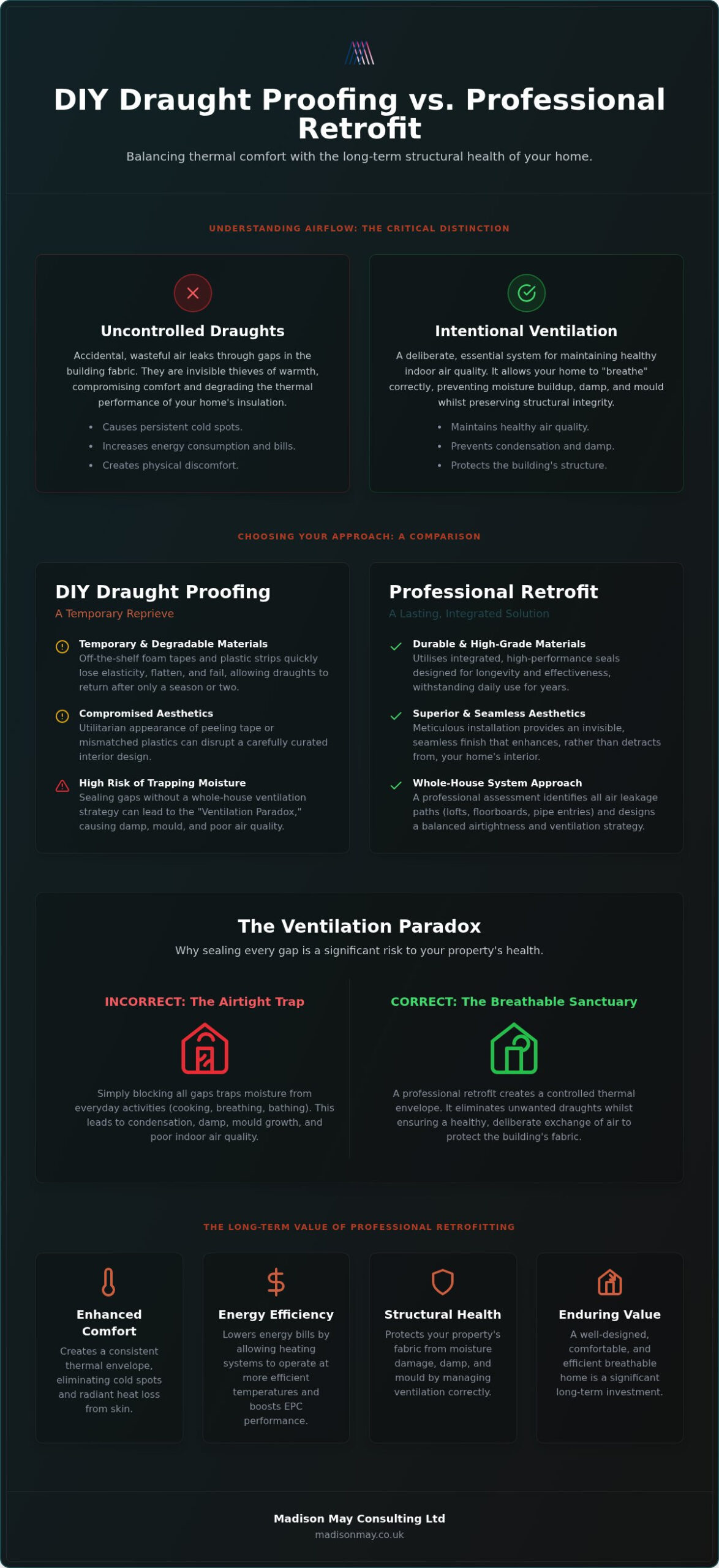
The Ventilation Paradox: Why Sealing Every Gap is a Risk
A home functions as a living, breathing entity, requiring a delicate equilibrium between warmth and breathability to remain a healthy refuge. The guiding principle of modern building physics is to “build tight, ventilate right.” Whilst the impulse to seal every crevice is understandable, excessive airtightness without a corresponding strategy for airflow can transform a sanctuary into a damp, humid environment. In the debate of diy draught proofing vs professional application, the latter offers a critical safety net against the “ventilation gap.” Professionals operate under the guidance of Approved Document F of the Building Regulations, ensuring that whilst we banish the cold, we don’t inadvertently trap the moisture generated by daily life.
An EPC Improvement Plan crafted by a specialist recognises that draught proofing should never be done in isolation from a ventilation assessment. Without this holistic view, a well-meaning homeowner might block the very air paths intended to protect the building’s structural health. The goal is to eliminate the erratic, wasteful movement of air whilst preserving the intentional, controlled exchange that keeps the interior atmosphere fresh and serene.
Damp Remediation and Airflow
True comfort is found in the intersection of thermal efficiency and air quality. When a specialist approaches a property, they conduct a rigorous assessment of existing extractor fans and trickle vents. There is a precise science to this process; as you increase airtightness, you alter the relationship between surface temperatures and the dew point. Without expert calibration, a sealed window can become a cold bridge where condensation gathers, eventually leading to mould. A professional ensures your sanctuary remains healthy, maintaining the structural integrity of the building whilst achieving peak efficiency through meticulous damp remediation and airflow management.
The Role of the Retrofit Coordinator
The complexity of a whole-house transformation requires a visionary guide. A Retrofit Coordinator plays this essential role, managing the intricate balance between insulation, airtightness, and ventilation. Their oversight is the primary defence against the unintended consequences that often plague ill-conceived energy upgrades. By following a PAS 2035 aligned strategy, they ensure that every measure, from draught proofing to heating upgrades, works in perfect harmony. This holistic view is where the choice of diy draught proofing vs professional service becomes most clear; one is a solitary fix, while the other is a curated journey toward a sustainable future. To begin your home’s transformation with expert guidance, you can book a ventilation assessment to ensure your refuge remains both warm and breathable.
Investing in Your Sanctuary: The Long-Term ROI of Professional Retrofitting
The true value of a home improvement isn’t always found on a balance sheet. While fuel savings are a welcome outcome, the real return on investment lies in the restoration of your sanctuary’s quiet poise. When evaluating diy draught proofing vs professional retrofitting, the conversation must shift from simple payback years to the enduring value of comfort gained and the preservation of architectural heritage. A professionally managed energy efficient home improvement provides a level of atmospheric serenity that a temporary DIY fix cannot match. It serves as the essential foundation for a meticulous EPC improvement plan, transforming your property from a drafty structure into a high-performance refuge where every detail is intentional.
There is a profound peace of mind that comes from knowing your home is performing at its peak. Eliminating those erratic cold spots allows you to enjoy your living spaces fully, regardless of the season. This professional approach ensures that the building’s “breathing” is correctly calibrated, protecting the structural health of your investment for the long term. It’s a transformative journey that elevates the house from a mere dwelling to a curated environment of calm and efficiency.
Enhancing Property Value and Compliance
Professional intervention offers a layer of security that extends to the property’s legal and financial standing. As energy performance standards tighten, having robust documentation for energy upgrades becomes a significant asset during future property sales or lettings. Meeting Minimum Energy Efficiency Standards (MEES) requires a sequence of high-quality measures that stand up to the rigorous scrutiny of surveyors and discerning buyers. A professional draught-proofing job, when integrated into a broader EPC strategy, demonstrates a commitment to quality that adds tangible worth to the building’s narrative. It reassures future owners that the home has been curated with care, balancing modern efficiency with timeless craftsmanship.
Your Journey to an Efficient Home
The choice between diy draught proofing vs professional craftsmanship ultimately reflects your vision for your home as a personal story. DIY methods offer a quick, temporary reprieve for standard spaces, yet they often fail to address the underlying physics of a complex or period building. A professional approach, anchored by a fixed-fee Retrofit Assessment, identifies every path to efficiency whilst safeguarding the structure’s health and breathability. This ensures your home remains a warm refuge for years to come, free from the unintended consequences of ill-conceived fixes. By prioritising a whole-house approach, you invest in a legacy of craftsmanship that preserves both the beauty and the function of your personal sanctuary.
Crafting Your Enduring Sanctuary
The choice between diy draught proofing vs professional craftsmanship is ultimately a decision about the legacy you wish to create within your home. While self-installed strips offer a fleeting reprieve from the winter chill, a professional intervention ensures that your property remains a healthy, breathable sanctuary for years to come. By respecting the delicate balance between airtightness and essential ventilation, you protect the structural soul of your refuge whilst enhancing its daily comfort.
A truly efficient home is the result of meticulous planning and expert coordination. It’s a transformative process. Whether you’re seeking to improve your property’s EPC rating or simply wish to enjoy a space free from persistent cold spots, the path forward is one of clarity and precision. Begin your journey to a warmer, more efficient home with a professional Retrofit Assessment. Our PAS 2035 aligned assessments and expert Retrofit Coordination are delivered with fixed-fee transparency, providing you with a reliable roadmap for your property’s future. You deserve a home that reflects your values of quality and calm, ensuring every room remains an inviting refuge for those you love.
Frequently Asked Questions
Is professional draught proofing worth the extra cost compared to DIY?
Professional work is an investment in longevity and precision that simple DIY strips cannot match. While self-adhesive foam offers a temporary fix, professional solutions use high-grade, permanent materials that are machined into the building fabric. This approach preserves the structural health of your sanctuary and ensures the seals don’t fail after a single winter. It’s a choice between a recurring patchwork task and a definitive, high-performance upgrade.
Can draught proofing my home cause damp and mould problems?
Yes, if done without a proper understanding of airflow and ventilation. Sealing a house too tightly without assessing existing vents can trap moisture from cooking and bathing, leading to condensation and mould. A professional assessment ensures that your home remains a healthy refuge by balancing airtightness with controlled, intentional ventilation. This technical calibration is a key advantage in the diy draught proofing vs professional debate.
How long do professional draught seals typically last?
Professional seals are designed to endure for many years, often outlasting the window or door itself. Unlike DIY foam tapes that lose elasticity within a few seasons, professional-grade silicone compression seals and routed-in brushes are mechanically fixed. These materials are chosen for their resilience against temperature fluctuations and repeated use. This durability ensures your home remains a quiet, efficient sanctuary without the need for constant maintenance or replacement.
What is the “Build Tight, Ventilate Right” principle in retrofitting?
This principle dictates that as we make a building more airtight to save energy, we must simultaneously ensure there is adequate, controlled ventilation. The goal is to eliminate erratic, wasteful draughts whilst maintaining a flow of fresh air to preserve indoor air quality. It’s a delicate balance that protects the building fabric from moisture damage. Professional retrofitters use this framework to ensure that efficiency never comes at the cost of a healthy living environment.
Do I need a professional assessment before I start draught proofing?
A professional building survey is highly recommended to identify hidden paths of heat loss that are invisible to the naked eye. An assessment using thermal imaging can pinpoint exactly where cold air is infiltrating your sanctuary. This data-driven approach allows for a bespoke plan that addresses the root causes of discomfort. It prevents the common mistake of applying generic fixes to complex architectural features that require a more meticulous, tailored touch.
Will professional draught proofing affect the look of my period windows?
Professional draught proofing is designed to be virtually invisible, preserving the refined aesthetics of your heritage joinery. Specialist techniques involve machining seals into the timber frames, ensuring they are concealed when the windows are closed. This meticulous craftsmanship respects the character of your property whilst providing modern thermal performance. In the comparison of diy draught proofing vs professional results, the ability to maintain a home’s visual soul is a defining factor.
How does draught proofing impact my property’s EPC rating?
Draught proofing is a recognised energy efficiency measure that can contribute to a higher Energy Performance Certificate (EPC) rating. By reducing the amount of energy required to heat your home, it demonstrates a commitment to sustainable living. When part of a broader EPC Improvement Plan, professional draught proofing provides the verified documentation needed for future sales or lettings. It’s a strategic step in transforming your refuge into a more compliant and valuable asset.
What is the difference between draught proofing and insulation?
Insulation acts as a thermal blanket, slowing the transfer of heat through solids like walls and roofs. Draught proofing, however, addresses the physical movement of air through gaps and crevices. Both are essential components of a whole-house approach to efficiency. Whilst insulation keeps the heat in, draught proofing stops the cold from slipping through the cracks. Together, they create a seamless thermal envelope that ensures your sanctuary remains consistently warm and inviting.