


Could the very upgrades intended to make your home a warm, energy-efficient sanctuary actually be compromising its ability to breathe? It’s a quiet irony that many homeowners face; after the meticulous installation of new insulation or high-performance windows, they find themselves greeted by the persistent mist of condensation and the creeping fear of mould. You aren’t alone in feeling that the path to a more sustainable home is often obscured by complex building regulations and the worry that a warmer house might become a damp one.
This guide illuminates how a professional ventilation assessment acts as the vital bridge between thermal performance and a healthy living environment. By understanding the unique rhythm of your property, you can ensure that your energy efficiency improvements perform beautifully whilst remaining fully compliant with the latest 2026 Approved Document F standards. We shall explore how a bespoke approach to airflow protects your heritage, reduces your energy costs, and transforms your house into a truly breathable refuge where every detail serves your well-being.
Key Takeaways
- Learn why a professional ventilation assessment is the essential partner to insulation upgrades, ensuring your home remains a breathable sanctuary rather than a sealed box.
- Discover how to identify the early sensory signs of inadequate airflow, from lingering aromas to a heavy atmosphere, before they evolve into costly damp issues.
- Understand the meticulous data collection process used in a whole-house survey to align your property with the latest PAS 2035 and Part F standards.
- Explore how advanced tools like thermal imaging and hygrometers provide the clarity needed to balance thermal performance with pristine air quality.
- Gain the confidence to pursue energy efficiency upgrades whilst protecting your home’s heritage and your family’s health through a strategic retrofit approach.
Understanding the Ventilation Assessment: A Pillar of Property Health
A ventilation assessment is far more than a simple inspection of window latches or a cursory glance at an extractor fan. It represents a sophisticated, data-driven evaluation of how a home interacts with its environment, ensuring that the air you breathe remains as fresh as the design of your living space. Whilst many homeowners believe that a quick “airing out” by opening a casement window suffices, a professional survey delves into the invisible currents that define your home’s health. It creates a bridge between the structural integrity of the building and the physical well-being of those within, identifying where the delicate balance between warmth and breathability might be failing.
When we modernise our homes with thick insulation and draught-proofing, we often inadvertently disrupt the natural architectural ventilation principles that older properties relied upon. This transition from a “leaky” building to a sealed one requires a precise ventilation assessment to prevent the accumulation of moisture within the fabric of the walls. Without this expert insight, the very upgrades meant to protect your sanctuary can become the catalysts for hidden decay and structural compromise.
The Core Objectives of a Ventilation Survey
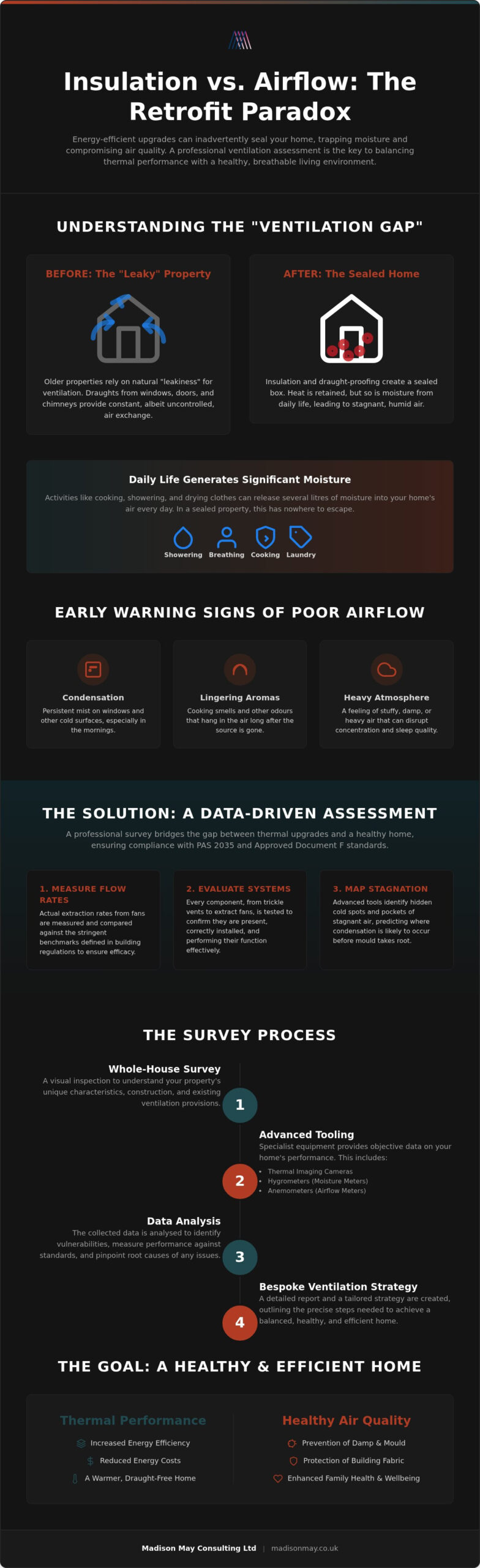
A meticulous survey aims to quantify the invisible. It isn’t enough to know that air is moving; we must know if it’s moving fast enough to maintain a healthy environment. The process focuses on several key areas:
- Measuring Flow Rates: We compare actual extraction rates against the stringent benchmarks defined in Approved Document F to ensure compliance and efficacy.
- System Evaluation: Every trickle vent and extract fan is tested to ensure they aren’t merely present, but performing their silent duty effectively.
- Mapping Stagnation: By identifying pockets of stagnant air, we can predict where condensation is likely to strike before mould ever takes root.
Why Modern Living Demands Better Airflow
Our contemporary lifestyles are surprisingly humid. Activities like cooking, showering, and even drying laundry indoors can release several litres of airborne moisture into the home daily. In a sealed property, this water has nowhere to go. It settles on cold surfaces, leading to that heavy, damp atmosphere that disrupts sleep and clouds concentration. A professional assessment helps transition your property from accidental ventilation, which relies on unreliable draughts, to a system of intentional, controlled airflow. This ensures your home remains a restorative retreat, where the air is as clear and refined as the interior itself.
Insulation vs. Airflow: Bridging the Ventilation Gap
The pursuit of a more energy-efficient home is a sophisticated endeavour, yet it often creates an unintended consequence known as the “Ventilation Gap”. By sealing every crevice and layering high-performance insulation, we essentially transform a property into a sealed box. This shift fundamentally alters the internal thermodynamics of the building. Whilst the heat remains trapped inside, so too does the moisture generated by daily life. This trapped air quickly becomes stagnant, losing the crisp quality that defines a healthy home. It can lead to a heavy atmosphere that affects everything from your sleep quality to the longevity of your interior décor.
This is where the science of the dew point becomes critical; water vapour in the air will always seek out the coldest, least insulated corners of a room to condense. Without a professional ventilation assessment, these hidden cold spots become breeding grounds for damp, as the humid air has no escape route. A meticulous survey identifies these vulnerabilities before they manifest as visible mould, ensuring your thermal upgrades don’t come at the cost of your home’s breathability.
The Retrofit Paradox
Older UK properties possess a unique architectural character, often relying on a natural “leakiness” for their historical airflow. When we introduce modern draught-proofing, we silence the house’s natural breathing rhythm. It’s a delicate balance that modern new builds, designed with integrated systems from the outset, don’t face in the same way. A whole-house approach ensures that as you increase the thermal resistance of your walls, you also manage the movement of air according to the standards in Approved Document F. It’s about evolving the property’s performance without sacrificing its structural health or the personal comfort of its inhabitants.
Protecting Your Investment
Investing in energy efficient home improvements is a significant commitment to your property’s legacy. However, failing to account for airflow can lead to structural rot and degraded timber, issues that are far more expensive to rectify than a proactive ventilation assessment. By treating ventilation as the essential partner to insulation, you protect the very fabric of your sanctuary from the quiet erosion of moisture. It’s about ensuring your home’s evolution is as sustainable as it is comfortable. If you are beginning your retrofit journey, a bespoke consultation can offer the clarity needed to proceed with confidence.
What to Expect During a Professional Ventilation Survey
A professional ventilation assessment is a journey of discovery into the hidden dynamics of your home. Rather than a cursory inspection, it’s a deliberate and measured survey that treats your property with the reverence it deserves. We begin by examining the subtle interfaces where air enters and exits your sanctuary, ensuring that every component, from the discreet trickle vents to the robust extract fans, is performing its silent duty. This process isn’t merely about ticking boxes; it’s about understanding the unique breath of your building and identifying where that rhythm has been disrupted by modern interventions.
To achieve this level of precision, we employ a suite of sophisticated instruments that bring the invisible into focus. Anemometers measure the exact velocity of air moving through extractors, whilst hygrometers map the relative humidity across different rooms to identify moisture imbalances. Thermal imaging cameras allow us to see through the veil of the building fabric, pinpointing the cold bridges where condensation is most likely to settle. This data-driven approach ensures that our findings are grounded in reality, providing a clear, sensory picture of your home’s unique atmospheric signature.
Key Performance Indicators (KPIs) for Airflow
Our analysis focuses on several critical metrics that define a healthy living environment. We measure airflow in litres per second (L/s) within high-moisture zones like kitchens and bathrooms to ensure they meet the rigorous standards outlined in the UK government’s ventilation guide. Beyond the mechanical, we evaluate background ventilation through air bricks and the “undercut” of internal doors. These small gaps are essential for cross-room air movement, preventing stagnant pockets from forming in bedrooms or hallways when doors are closed for privacy. It’s this level of detail that ensures every corner of your home remains fresh and inviting.
The Final Report and Recommendations
The culmination of this meticulous ventilation assessment is a comprehensive report that translates complex technical data into a graceful, actionable roadmap. We prioritise improvements based on their impact on your property’s health, ranging from simple maintenance of existing vents to the installation of advanced mechanical systems. This bespoke document doesn’t just address immediate concerns; it serves as a vital component of your broader EPC improvement plan. By aligning your ventilation strategy with your energy efficiency goals, we ensure your home remains a sustainable, breathable refuge for years to come.
Recognising the Symptoms of Inadequate Home Ventilation
Your home often speaks in a quiet language of sensory cues, offering subtle warnings before structural issues become irreversible. The experience of poor ventilation isn’t always as dramatic as a flooded basement; instead, it manifests as a persistent, heavy atmosphere that clings to the skin. You might notice that aromas from the morning’s cooking linger well into the evening, or that the air feels oddly stagnant in rooms that should be restorative retreats. These are the first whispers of a moisture imbalance, suggesting that the natural rhythm of your property has been stifled, often by the very measures intended to keep it warm.
Condensation on windows is perhaps the most common symptom homeowners encounter, yet it’s frequently misunderstood as a simple issue with the glazing itself. In reality, those morning droplets are a sign of a systemic failure in the building’s ability to breathe. When warm, moisture-laden air cannot escape, it seeks out the coldest surfaces to deposit its burden. This is the “canary in the coal mine” for your property’s health. A professional ventilation assessment allows us to look beyond the glass, diagnosing the underlying lack of airflow that causes this moisture to settle in the first place.
The Telltale Signs of Moisture Imbalance
Whilst condensation is visible, other indicators of poor airflow are more discreet, requiring a keen eye to identify before they escalate into significant damp remediation projects. We often look for these specific markers during our meticulous building surveys:
- Black Spot Mould: This typically appears in the stillest corners of a room, behind large furniture, or along north-facing walls where the air remains cold and unmoving.
- Bubbling Paint and Peeling Wallpaper: Moisture trapped behind decorative finishes causes them to lose their bond with the substrate, often starting near the ceiling line where humid air rises.
- A Persistent Musty Odour: A damp, earthy scent that survives even after deep cleaning is a clear indicator of stagnant air and hidden fungal growth.
Health and Wellbeing Indicators
The impact of inadequate ventilation extends far beyond the building fabric, touching the very health of those who reside within. Stale air acts as a reservoir for allergens, dust mites, and volatile organic compounds, which can lead to an increased frequency of respiratory irritation or asthma flare-ups. There is also a profound psychological weight to living in a space that feels damp or unkept; a home should be a sanctuary of clarity and calm, not a source of physical discomfort. If you’ve noticed these symptoms in your own living space, the most graceful first step is to arrange a professional ventilation assessment to restore the harmony of your environment.
A Whole-House Strategy: Integrating Ventilation into Your Retrofit
A home is far more than a collection of isolated components; it’s a unified sanctuary where every structural element must work in concert to support your well-being. When we approach home improvement with a piecemeal mindset, we risk creating subtle imbalances that compromise the building’s long-term integrity. Madison May embraces a whole-house strategy, ensuring that a professional ventilation assessment isn’t merely an afterthought, but a foundational step in your retrofit journey. This philosophy aligns with the rigorous PAS 2035 standard, a framework specifically designed to elevate the quality of energy efficiency upgrades in existing UK properties whilst protecting them from the unintended consequences of over-sealing.
The role of the Retrofit Coordinator is essential in this process, acting as a trusted curator who oversees the delicate intersection of thermal performance and air quality. They ensure that as your insulation levels rise, your home’s breathing rhythm remains steady and controlled. This integrated approach future-proofs your sanctuary against a changing climate and rising energy costs, transforming a simple renovation into a visionary investment in your property’s legacy. By looking at the house as a complete system, we move away from reactive fixes and toward a state of enduring, effortless harmony.
PAS 2035 Compliance and Your Property
Adhering to the PAS 2035 framework isn’t just about regulatory box-ticking; it’s about the peace of mind that comes from a certified, meticulous process. These professional assessments are mandatory for most government-backed energy schemes, providing a layer of protection for homeowners venturing into deep retrofits. Whether you’re considering a conservatory upgrade to create a year-round refuge or a comprehensive insulation plan, the ventilation survey ensures your new spaces remain fresh and vibrant. It’s a commitment to quality that guarantees your upgrades perform as beautifully in practice as they do on paper.
Taking the Next Step Toward a Healthier Home
Transitioning from a drafty house to a refined, breathable environment begins with clarity rather than complexity. We offer a fixed-fee consultation as a stress-free entry point, allowing you to explore the possibilities for your property without the weight of uncertainty. This initial ventilation assessment provides the data needed to move from diagnosis to implementation with quiet confidence. We invite you to begin this transformative journey with us, letting our expertise guide you through the intricacies of building science to curate a home that is as healthy as it is elegant. Your path to a more sustainable, restorative living space is just a thoughtful conversation away.
Cultivating a Breathable Legacy for Your Home
Embracing a whole-house strategy ensures that your pursuit of energy efficiency remains a source of enduring comfort rather than a catalyst for moisture issues. We have explored how the delicate balance between thermal performance and airflow is the foundation of a truly healthy sanctuary. By identifying the sensory warnings of stagnant air and aligning your property with the rigorous PAS 2035 standards, you protect both your building’s fabric and your family’s well-being. It’s a commitment to quality that transcends simple renovation.
A professional ventilation assessment offers the clarity needed to navigate these technical complexities with grace. At Madison May, we combine meticulous building survey expertise with a fixed-fee consultancy model to provide total transparency for your retrofit journey. This data-driven approach ensures that every upgrade performs beautifully whilst maintaining pristine air quality. Begin your journey toward a healthier home by booking a professional assessment with Madison May. Let us help you curate a living environment that breathes as effortlessly as it inspires, ensuring your home remains a restorative refuge for years to come.
Frequently Asked Questions
What is the difference between an EPC and a ventilation assessment?
An Energy Performance Certificate (EPC) primarily evaluates a property’s thermal retention and energy efficiency, whereas a ventilation survey focuses on the health and movement of air. While an EPC suggests ways to save heat, a ventilation survey ensures those measures don’t compromise your indoor air quality. It’s a deeper, more technical evaluation that identifies how moisture interacts with your building’s fabric, ensuring a harmonious balance between warmth and breathability.
Is a ventilation assessment mandatory for all home improvements?
While not mandatory for every minor refurbishment, a ventilation assessment is a legal requirement for all energy efficiency projects aligned with the PAS 2035 standard. This includes most government-backed schemes and grants. Even for private projects, modern building regulations necessitate adequate airflow when making significant thermal improvements. It’s a vital safeguard that ensures your home remains a healthy sanctuary after it has been sealed against the elements.
Can I fail a ventilation assessment, and what happens next?
An assessment isn’t a traditional pass or fail test; rather, it’s a diagnostic roadmap for your property’s health. If the survey identifies that your current airflow rates fall below the benchmarks set by Approved Document F, the final report will simply outline the necessary remediations. This might include upgrading extract fans or adding trickle vents. The goal is to provide a clear path toward compliance and a more restorative living environment.
How long does a professional ventilation survey typically take?
A professional survey typically takes between one and two hours, depending on the complexity and size of your property. During this time, our experts meticulously evaluate every room, measuring extraction rates and mapping moisture levels with sophisticated instruments. This measured pace allows for a thorough investigation of the building’s unique dynamics without feeling rushed. You’ll receive a detailed analysis that translates these observations into a clear strategy for your home’s future.
Will improving my ventilation make my house feel colder or more draughty?
Improving your ventilation shouldn’t make your home feel colder; in fact, it often enhances comfort by removing the heavy feeling of humid air. Modern systems are designed for intentional, controlled airflow rather than the random, chilling draughts found in older properties. Technologies like Mechanical Ventilation with Heat Recovery (MVHR) can even recover over 90% of the heat from extracted air, ensuring your sanctuary remains warm whilst the atmosphere stays crisp and fresh.
Do I need a ventilation assessment if I am only installing new windows?
Yes, installing new windows significantly alters the way air enters and leaves your home. Modern glazing is far more airtight than older units, which can inadvertently trap moisture if a proper ventilation strategy isn’t in place. A professional survey ensures that your new windows are specified with the correct trickle vents or that supplementary systems are adequate. It’s about ensuring your aesthetic and thermal upgrades don’t lead to unintended condensation issues.
How much does a domestic ventilation assessment cost in the UK?
In 2026, industry reports suggest that a standard domestic damp and ventilation survey in the UK typically ranges between £150 and £600. The specific investment depends on your property’s size and the complexity of the investigation, such as whether thermal imaging is required. Whilst prices vary, a professional assessment provides invaluable peace of mind. It acts as a preventative measure against the far more costly structural damage caused by unchecked moisture.
Can a ventilation assessment help with existing mould problems?
A ventilation assessment is an essential first step in resolving persistent mould problems by identifying the root cause of moisture accumulation. Rather than simply treating the surface symptoms, the survey pinpoints where the building’s breathing rhythm has failed. By measuring actual airflow and identifying cold bridges, we can recommend precise interventions that stop mould from returning. This transforms your home back into a clean, healthy refuge where you can breathe easily once more.