


Could your home’s legacy be defined not just by its storied history, but by its future resilience? Many homeowners feel a deep sense of stewardship towards their property, yet the path to a sustainable transformation often feels obscured by layers of financial complexity. For homeowners across the UK, the search for home energy efficiency grants often unveils a confusing maze of eligibility criteria and shifting deadlines that can turn a visionary project into a source of hesitation. The reality is that over 18 million homes in the UK currently sit at an EPC rating of D or below, making the transition to a more efficient, refined sanctuary a collective priority.
It’s natural to feel concerned about the significant upfront costs of a deep retrofit or to worry that technical upgrades might compromise the curated aesthetic of your living space. You deserve a clear, sophisticated roadmap that aligns your environmental aspirations with a sound financial strategy. Madison May Consulting Ltd is here to help you navigate this landscape. This article explores the most effective ways to fund your home’s evolution, from the £7,500 Boiler Upgrade Scheme to bespoke green finance options that preserve both your capital and your property’s enduring value.
Key Takeaways
- Discover how an EPC Improvement Plan serves as a meticulously crafted financial roadmap, allowing you to phase your investment over several years without compromising the integrity of your home.
- Navigate the complex landscape of home energy efficiency grants Yorkshire and beyond, identifying which government-backed incentives align with your property’s unique requirements.
- Explore the rise of green mortgages and private lending options that reward sustainable stewardship with preferential rates, transforming your retrofit into a savvy investment in your property’s future value.
- Learn why professional retrofit coordination is the essential guardian of your budget, ensuring that every technical measure is harmonised to prevent costly structural damage.
- Understand the current 0% VAT incentives on energy-saving materials, which offer a time-sensitive opportunity to enhance your home’s comfort whilst reducing long-term operational costs.
Understanding the Financial Landscape of Home Retrofitting
Approaching the enhancement of your home is an act of stewardship that transcends simple maintenance. It’s a transition from viewing property as a series of disparate systems to seeing it as a singular, refined sanctuary. When you begin this journey, it’s vital to perceive the capital involved not as a sunk cost, but as a strategic investment in your home’s enduring legacy. A well-executed plan ensures that your living space remains resilient against the elements whilst reflecting your commitment to quality and craftsmanship.
Whilst investigating the various home energy efficiency grants Yorkshire and other regions offer, you’ll encounter a choice between shallow, isolated measures and a more comprehensive approach. A deep energy retrofit addresses the entire building envelope simultaneously, ensuring that every upgrade works in harmony. This holistic method prevents the common pitfall of installing expensive technology into a building that cannot yet retain heat, which only serves to lock in inefficient energy patterns for years to come.
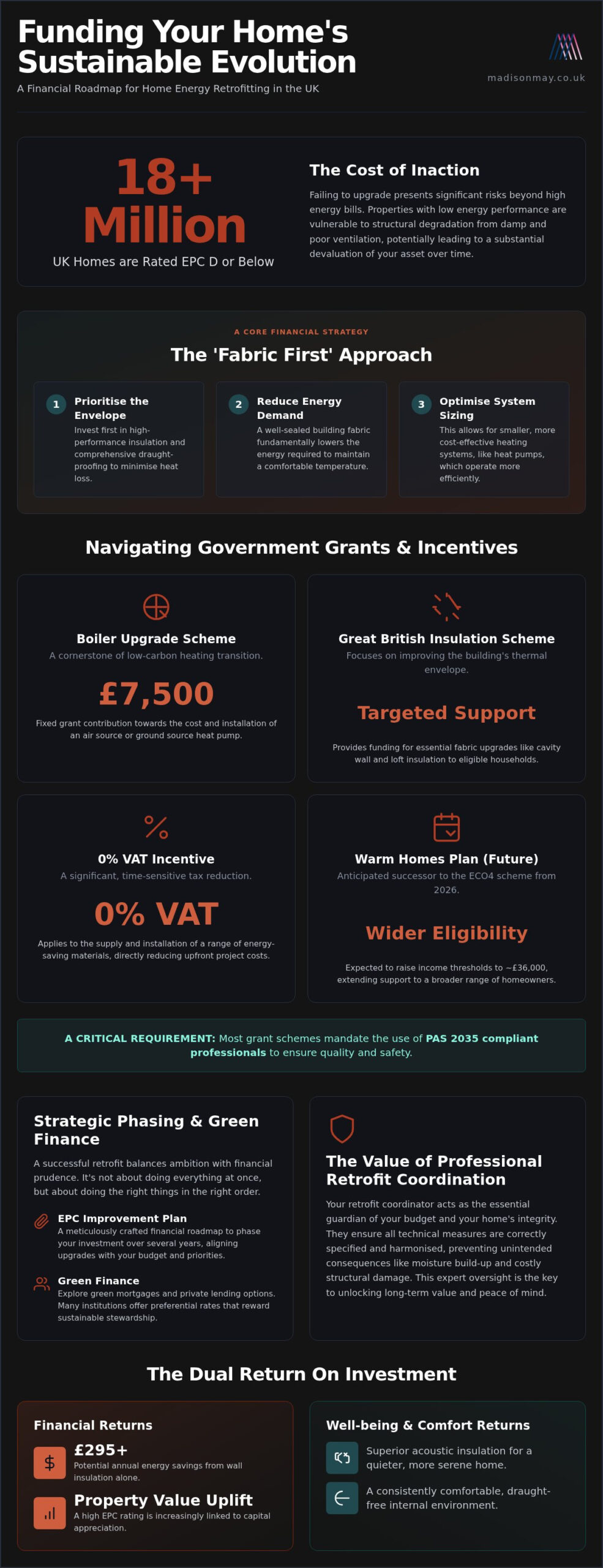
The financial cost of inaction is often higher than the investment itself. With over 18 million homes in the UK currently rated EPC D or below, the risk of property degradation from damp and poor ventilation is a reality for many. Rising energy prices and the gradual erosion of a building’s structural integrity can devalue your asset significantly. By contrast, simple measures like wall insulation can provide annual savings of over £295, protecting your capital whilst enhancing your daily comfort.
The Fabric First Financial Philosophy
A sophisticated financial strategy always begins with the building’s fabric. By prioritising insulation and draught-proofing, you essentially wrap your home in a protective layer that minimises heat loss. This “fabric first” approach is a meticulous way to organise your budget; it allows you to downsize the requirements for future heating systems, such as air source heat pumps, which are more cost-effective to install and run when the building’s demand for energy is low. It’s the foundation of a sustainable refuge that doesn’t rely on constant, aggressive heating to feel warm.
Calculating the Real Value of a Sustainable Refuge
The true value of a retrofit extends far beyond the numbers on a utility bill. There’s a profound emotional dividend in inhabiting an acoustically insulated, draught-free space that feels consistently serene. From a purely financial perspective, a high EPC rating is increasingly linked to property value uplift, as discerning buyers seek homes that are already prepared for a low-carbon future. We believe that a successful retrofit ROI is the effortless union of long-term capital appreciation and the immediate, sensory improvement of your home’s atmosphere.
Navigating Government Grants and Financial Incentives
The 2026 landscape of public funding is a tapestry of evolving opportunities, designed to support homeowners in their transition toward a more resilient living environment. While the Energy Company Obligation (ECO4) is scheduled to conclude in March 2026, the anticipated launch of the Warm Homes Plan signifies a broader commitment to property transformation. This successor scheme is expected to raise income thresholds to approximately £36,000, inviting a wider circle of discerning homeowners to participate in the journey toward a more efficient refuge. These schemes don’t just provide funding; they offer a structured way to enhance your home’s character whilst reducing its environmental footprint.
For those focusing on specific technical upgrades, the Boiler Upgrade Scheme remains a cornerstone of low-carbon heating, providing a fixed £7,500 grant towards air source heat pumps. Simultaneously, the Great British Insulation Scheme targets the building’s fabric, offering essential support for those looking to secure their home’s envelope. However, accessing these public funds requires a commitment to quality. Most schemes mandate the use of PAS 2035 compliant professionals, a regulatory standard that ensures every measure is installed with the meticulous care your home deserves. Before committing to any construction, it’s wise to establish a technical foundation with a professional retrofit assessment to ensure your project meets the stringent standards required for funding.
Local Authority Delivery and Regional Top-ups
Local Authority Delivery schemes often act as regional top-ups, providing additional funding for specific postcodes that may have unique architectural or environmental challenges. Whilst searching for home energy efficiency grants Yorkshire residents will find that their current Energy Performance Certificate (EPC) is the primary key to unlocking these resources. Properties rated D, E, F, or G are typically prioritised, as these buildings offer the greatest potential for a transformative uplift in both comfort and value. Checking with your local council remains a vital step in discovering these hyper-local incentives that can bridge the gap in a project’s budget.
VAT Reductions on Energy-Saving Materials
Beyond direct grants, the 0% VAT rate on energy-saving materials offers a significant, albeit time-sensitive, financial advantage. In effect until April 2027, this tax incentive provides what is essentially a 20% discount on professional installations of heat pumps, solar panels, and insulation. It represents a rare alignment of government policy and private investment, rewarding those who choose to enhance their property’s legacy now. A recent UKERC policy review highlights how such blended financial mechanisms are essential for accelerating the pace of home improvements, ensuring that high-quality retrofits become a standard for the modern British home.
Green Finance: Mortgages and Private Lending Options
While government incentives provide a welcome foundation, they often represent just one facet of a comprehensive funding strategy for a deep retrofit. For the discerning homeowner, green finance has emerged as a sophisticated route to bridge the gap between public support and the full realisation of a sustainable sanctuary. These bespoke financial products reward environmental stewardship by offering preferential interest rates to those committed to enhancing their property’s performance. It’s a shift in the lending landscape that recognises a high-quality, efficient home as a lower-risk, more resilient asset.
Green mortgages are no longer reserved solely for new builds. Many major UK lenders now offer these products to existing homeowners who achieve an EPC rating of A or B, or those who undertake a verified journey of improvement. If you aren’t looking to switch lenders, a further advance on your existing mortgage can be a seamless way to access capital. This allows you to borrow additional funds at competitive rates, specifically earmarked for energy-efficient home improvements that align with your property’s long-term legacy.
Leveraging Equity for Energy Performance
Protecting your home’s equity is as much about future-proofing as it is about refined design. As the property market evolves, inefficient homes are increasingly susceptible to “brown discounts,” where a poor energy rating negatively impacts the sale price. By contrast, a high-performing home preserves its value and appeals to a growing demographic of environmentally conscious buyers. While searching for home energy efficiency grants Yorkshire residents often find that private capital, when used strategically, can amplify the impact of any grant funding received. A high EPC rating can also improve mortgage affordability stress tests, as reduced utility costs signify a more stable financial profile. We recommend consulting with a financial advisor to ensure your retrofit strategy harmonises with your broader investment goals.
Unsecured Personal Green Loans
For more targeted enhancements, such as upgrading windows and doors or installing high-quality insulation, unsecured green loans offer a flexible alternative. These specialised lending products typically feature lower interest rates than standard personal loans, provided the capital is used for verified energy-saving measures. They provide swift access to funds, which is particularly beneficial when addressing urgent requirements identified in a ventilation assessment or building survey. Unlike a mortgage advance, these loans don’t require you to leverage your home’s equity, making them an excellent choice for focused, high-impact projects that can be completed with minimal delay.
Strategic Phasing: How to Organise Your Budget for Long-Term Success
Transforming a property into a high-performance sanctuary doesn’t require a single, overwhelming capital outlay. By viewing your retrofit as a gradual journey of refinement, you can manage your budget with the same deliberation you apply to your home’s interior design. This phased approach allows you to absorb costs over several years whilst making meaningful progress toward a more resilient and comfortable refuge. When searching for home energy efficiency grants Yorkshire homeowners often find that funding is most effective when integrated into a broader, multi-year strategy.
Efficiency measures are most cost-effective when they coincide with existing plans. If you’re already considering a loft conversion or a significant refurbishment, that’s the natural moment to introduce insulation or draught-proofing. Aligning these upgrades with planned construction work allows you to share labour costs and scaffolding expenses, making the overall investment far more palatable. It’s a way of working with the rhythm of your home’s life rather than against it.
The Meticulous Roadmap: Step-by-Step Investment
A successful transformation relies on a logical sequence of works. A professional EPC improvement plan serves as your technical and financial compass, ensuring each step builds upon the last. The process typically begins with a detailed assessment to remove any ambiguity from the project. Following this, the focus shifts to the building’s fabric; addressing the “leaky bucket” through high-quality insulation and bespoke windows and doors. Only after the home’s energy demand has been significantly lowered should you consider investing in sophisticated heating systems like air source heat pumps.
Budgeting for the Hidden Essentials
Sophisticated retrofitting requires an understanding of how a building breathes. When you improve airtightness to retain heat, you must also allocate funds for professional ventilation assessments to prevent the risk of damp or mould. These hidden technical essentials are just as vital as the visible upgrades. Engaging a Retrofit Coordinator acts as a safeguard for your capital, ensuring that different trades work in harmony and that every measure is technically compatible. Professional oversight prevents the “buy cheap, pay twice” trap, ensuring your investment delivers enduring quality. Whilst exploring home energy efficiency grants Yorkshire residents should remember that technical excellence is the best way to protect their home’s future value. To establish a firm foundation for your project, you might consider starting with a professional retrofit assessment to create your bespoke investment roadmap.
Ensuring Meticulous Value: The Role of Professional Retrofit Coordination
Investing in your home’s future requires more than just capital; it demands a conductor to harmonise the complex technical requirements of a modern retrofit. Professional coordination acts as a vital insurance policy for your investment, ensuring that every pound spent contributes to a cohesive and high-performing result. Without this oversight, homeowners risk the pitfalls of uncoordinated works, where isolated measures can lead to unintended consequences like interstitial condensation or structural damage. Whilst searching for home energy efficiency grants Yorkshire residents must recognise that the technical success of a project is just as important as the funding that supports it.
Adhering to the rigorous PAS 2035 standards is not merely a regulatory requirement for accessing public funds; it’s a hallmark of quality and longevity. These standards ensure that every upgrade is designed specifically for your property’s unique character and context. Madison May Consulting Ltd curates this journey with a steady, expert hand, moving from the initial spark of an assessment to the final, finished detail of project completion. By positioning a Retrofit Coordinator at the centre of the process, you ensure that technical standards are never compromised by the pressures of construction.
The Retrofit Coordinator as Your Project Guardian
A coordinator serves as the guardian of both your budget and your home’s integrity. They manage the delicate intersection of different trades, ensuring that an insulation specialist’s work doesn’t inadvertently interfere with the ventilation strategy. This holistic oversight verifies that every measure contributes meaningfully to your overall energy efficient home improvements strategy. It provides the peace of mind that your home remains a safe, dry, and healthy sanctuary, where the atmospheric quality is as refined as the aesthetic design.
Next Steps: Securing Your Property’s Future
The journey toward a more resilient home begins with clarity. A comprehensive building survey is the essential first step to assess your property’s current performance and identify its latent potential. This data allows us to craft a bespoke roadmap that aligns your financial goals with the physical needs of the building. We invite you to request a personal consultation to explore how we can help you navigate the complexities of home energy efficiency grants Yorkshire and green finance. Together, we can transform your property into a meticulously crafted sanctuary that stands as a testament to both heritage and innovation.
Crafting Your Property’s Sustainable Legacy
Securing the future of your home is a journey defined by thoughtful stewardship and visionary planning. We’ve explored how a strategic blend of public incentives and private green finance can transform your property into a high-performing sanctuary without the need for a single, overwhelming capital outlay. By phasing your investment and prioritising the building’s fabric, you ensure that every upgrade enhances both your daily comfort and your home’s enduring value. Whilst the landscape of home energy efficiency grants Yorkshire and beyond continues to evolve, the technical foundation of your project remains the most critical factor in its long-term success.
Madison May provides expert PAS 2035 aligned consultancy and bespoke EPC improvement plans, maintaining a national reputation for meticulous energy efficiency standards. Our role is to act as the sophisticated guide through the complexities of the design and funding process, ensuring your vision is realised with poise and precision. Book your professional Retrofit Assessment with Madison May to begin your property’s transformation with quiet confidence. Your home is a deeply personal refuge that deserves a future as refined as its past.
Frequently Asked Questions
Is it worth paying for a retrofit assessment if I only want to do one measure?
Yes, a professional assessment is vital because every modification influences the delicate balance of your home’s ecosystem. Even a single measure, like new insulation, can shift how moisture and heat move through the building fabric. Investing in an assessment provides the technical assurance that your chosen upgrade won’t lead to unintended consequences like damp. It transforms a simple home improvement into a considered step toward a more resilient sanctuary.
Can I get a grant for retrofit if I am a landlord?
Landlords are eligible for several government-backed incentives to improve the performance of their rental portfolios. The Boiler Upgrade Scheme, for instance, provides a £7,500 grant for air source heat pumps and is available to private landlords in England and Wales. Whilst searching for home energy efficiency grants Yorkshire property owners should check specific local criteria, as many schemes require tenants to meet certain income thresholds or the property to have a low EPC rating.
How much does a typical whole-house retrofit cost in the UK?
The investment required for a comprehensive retrofit varies significantly based on the age, size, and architectural heritage of your property. Whilst some projects focus on high-impact fabric improvements, others involve a deep energy retrofit encompassing heating, windows, and solar technology. Rather than viewing the total cost as a single hurdle, many homeowners utilise a phased approach to distribute the capital over several years, ensuring each stage meets meticulous quality standards.
What happens if I install insulation without a ventilation assessment?
Installing insulation without a ventilation assessment creates a “ventilation gap” that often leads to damp and mould. When you seal a building to retain heat, you also trap moisture generated by daily living. Without a calculated path for air exchange, this moisture condenses on cold surfaces, potentially damaging the building’s structural integrity. A professional assessment ensures your home remains a healthy refuge by harmonising airtightness with controlled, effective ventilation.
Are green mortgages only available for new-build homes?
Green mortgages are increasingly available for existing properties, not just new-build homes. Many lenders offer preferential interest rates or cashback rewards for homeowners who reach an EPC rating of A or B through retrofitting. You can also access “green further advances” on your current mortgage to fund specific energy-saving measures. This financial path rewards your commitment to property stewardship, acknowledging that a high-performing home is a more secure, valuable asset.
How do I know if a retrofit professional is PAS 2035 compliant?
You can verify a professional’s credentials by checking the TrustMark register, which is the government-endorsed quality scheme for home improvements. PAS 2035 is the overarching framework for UK domestic retrofits, and any coordinator or assessor must be appropriately accredited to oversee funded works. Choosing a compliant professional ensures that your project adheres to rigorous technical standards, protecting your capital and ensuring the long-term performance of your refined living space.
What is the difference between an EPC and a Retrofit Assessment?
An EPC is a high-level snapshot of current energy performance, whereas a Retrofit Assessment is an exhaustive building survey. The latter involves a detailed analysis of the building’s fabric, existing services, and even the occupants’ behaviour. This depth of data allows for the creation of a meticulous EPC Improvement Plan. This plan acts as a sophisticated financial and technical roadmap, moving beyond generic recommendations to provide a bespoke strategy for your home.
Can I pay for my retrofit in stages over several years?
Paying for your retrofit in stages is a highly effective way to manage your budget whilst making steady progress toward a sustainable sanctuary. By utilising home energy efficiency grants Yorkshire residents can often fund initial fabric improvements before moving on to more complex systems in later years. This strategic phasing, guided by a professional roadmap, ensures that each measure is technically compatible and that your investment is always protected against the “buy cheap, pay twice” trap.